 Download Free Sample



Get a Quote
Receive a tailored pricing based on your needs.
- Choose license type
- Multiple user options
- Custom scope & coverage
- Fast turnaround
"Smart Strategies, Giving Speed to your Growth Trajectory"
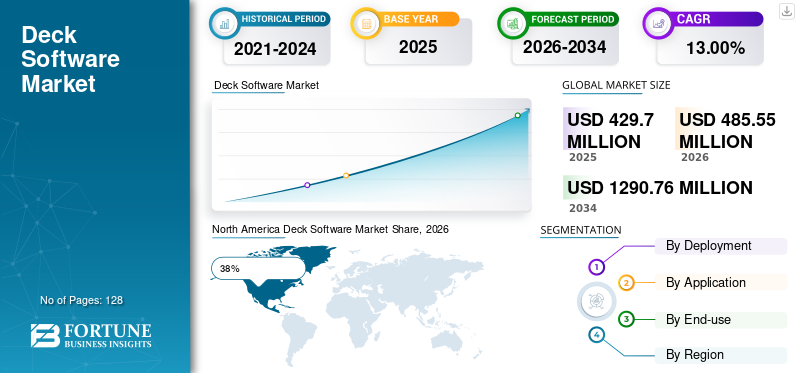
The global deck software market size was valued at USD 429.7 million in 2025. The market is projected to grow from USD 485.55 million in 2026 to USD 1290.76 million by 2034, exhibiting a CAGR of 13.00% during the forecast period.

The deck software market is gaining significant traction across the construction and home improvement sectors as digital design tools become increasingly essential for planning outdoor living spaces. Deck software enables architects, contractors, builders, and homeowners to create detailed deck layouts, generate material estimates, visualize projects in three dimensions, and improve project accuracy. The market is benefiting from rising demand for customized outdoor structures, increasing adoption of digital construction workflows, and growing emphasis on project visualization. Cloud-based design platforms, integrated estimation capabilities, and user-friendly interfaces continue driving software adoption. The deck software market report highlights ongoing innovation, expanding professional usage, and increasing digital transformation across construction activities.
The United States accounts for approximately 44% market share in the global deck software market. Strong demand for residential renovation projects, outdoor living space enhancements, and professional construction planning tools supports market expansion. Builders, contractors, and landscape designers increasingly rely on deck software to streamline project development and improve customer engagement through realistic visualizations. The growing popularity of home improvement projects and increasing investment in outdoor entertainment areas continue driving software adoption. Cloud-based deployment models and integration with construction management systems further strengthen market growth. The USA deck software market Outlook remains favorable due to ongoing digitalization within the construction sector.
Download Free sample to learn more about this report.
 Global Market Size & Forecast
 Market Share
 Key Regional Highlights
North America
North America held the largest regional share at 38% in 2025.
Europe
Europe accounted for 27% of the global market.
Asia-Pacific
Asia-Pacific represented 25% of the global market, supported by increasing adoption of digital construction solutions.
U.S
The U.S. is a major market due to strong construction activity and growing adoption of digital design software.
Japan
Japan accounted for 22% of the Asia-Pacific market, supported by technology adoption and increasing demand for efficient construction planning.
Read More

The deck software market trends indicate a growing shift toward cloud-based design platforms that enable remote collaboration and real-time project management. Construction professionals increasingly prefer software solutions that provide seamless access to project data across multiple devices and locations. This trend supports improved coordination among architects, builders, remodelers, and clients. Another major trend within the deck software market analysis landscape is the integration of advanced visualization technologies. Three-dimensional modeling, virtual walkthroughs, and augmented design features are becoming standard capabilities within modern deck software platforms. These technologies help improve customer decision-making and reduce project revisions.
Download Free sample to learn more about this report.
Artificial intelligence and automation are also influencing software development. Automated material calculations, design recommendations, and compliance checking functions are improving workflow efficiency. Software vendors continue expanding integration capabilities with broader construction management ecosystems. Increasing demand for sustainable construction planning and customized outdoor living spaces further contributes to market development. These innovations continue shaping the deck software market research report environment and driving adoption among construction professionals and homeowners.
Rising Demand for Digital Construction Planning and Visualization Tools
The primary driver of the deck software market growth is the increasing adoption of digital design and project planning technologies throughout the construction industry. Builders and contractors are seeking software solutions that improve design accuracy, reduce material waste, and enhance communication with clients. Deck software enables users to create realistic project visualizations and generate precise material requirements before construction begins. The growing popularity of customized outdoor living environments has increased the need for advanced design capabilities. Construction firms continue investing in digital workflows that improve efficiency and project outcomes. These factors collectively support expansion within the Deck Software industry analysis landscape.
Limited Software Adoption among Smaller Contractors
A key restraint affecting the deck software market is the relatively slow adoption of advanced software solutions among smaller contractors and independent builders. Budget limitations, training requirements, and resistance to technology adoption can create barriers to implementation. Some users continue relying on traditional design methods due to familiarity and lower upfront costs. Additionally, software licensing expenses and integration challenges may discourage smaller organizations from upgrading digital capabilities. These factors can moderate adoption rates despite the significant benefits offered by modern deck software platforms.
Expansion of Cloud-Based Construction Technology Solutions
A major opportunity within the deck software industry analysisav landscape is the continued expansion of cloud-based software platforms. Cloud deployment enables users to access project information from any location while supporting collaboration among multiple stakeholders. Construction companies increasingly prioritize scalable and flexible digital solutions that improve operational efficiency. Growing demand for remote project management capabilities and integrated design environments further supports market growth. Emerging markets undergoing construction modernization also present significant opportunities for software vendors seeking expansion.
Maintaining Compatibility with Evolving Construction Standards
One of the primary challenges facing the deck software market is ensuring compatibility with changing building regulations, design standards, and construction practices. Software providers must continuously update platforms to reflect evolving compliance requirements and industry expectations. Maintaining interoperability with third-party applications and construction management systems also requires ongoing development efforts. Competitive pressure encourages continuous innovation, increasing development costs and resource requirements. These factors influence operational strategies and product development within the deck software market forecast environment.
Cloud-based solutions account for approximately 68% market share in the deck software market and represent the leading deployment model. These platforms provide users with remote accessibility, real-time collaboration capabilities, and simplified software maintenance. Construction professionals increasingly prefer cloud-based solutions because they enable project sharing among stakeholders regardless of location. The ability to access project information from multiple devices enhances workflow flexibility and operational efficiency. Software vendors continue expanding cloud functionality through integration with project management systems and advanced visualization tools. Growing demand for scalable digital construction solutions supports the segment’s leadership position within the deck software market Outlook.
On-premise solutions hold approximately 32% market share within the deck software market. These systems remain important for organizations requiring enhanced control over data security, system customization, and internal infrastructure management. Larger construction firms and specialized design organizations often prefer on-premise deployments due to regulatory, operational, or organizational requirements. The segment benefits from stable demand among enterprises with established information technology resources. Manufacturers continue supporting on-premise customers through software enhancements and performance improvements. Although cloud adoption continues increasing, on-premise solutions remain a valuable component of the overall market.
To know how our report can help streamline your business, Speak to Analyst
Residential applications account for approximately 71% market share in the deck software market and represent the largest application segment. Homeowners and residential construction professionals increasingly utilize deck software to design customized outdoor living spaces that align with specific aesthetic and functional requirements. Growing demand for home improvement projects, outdoor entertainment areas, and personalized property enhancements supports segment expansion. Deck software enables accurate planning, visualization, and material estimation, improving project outcomes and customer satisfaction. Continued growth in residential renovation activities strengthens the segment’s leadership position within the market.
Commercial applications represent approximately 29% market share within the deck software market. Commercial users include hospitality facilities, recreational properties, public spaces, and commercial construction projects requiring outdoor structure planning. Businesses increasingly invest in visually appealing outdoor environments that enhance customer experiences and property value. Deck software supports efficient project design, resource planning, and stakeholder communication. Growing investment in commercial property development and outdoor amenities contributes to sustained demand within this segment.
Architects and builders account for approximately 62% market share in the deck software market. These professionals rely heavily on advanced design tools to develop accurate project plans, generate material estimates, and create visual presentations for clients. The increasing complexity of construction projects and growing demand for customized outdoor structures support software adoption. Integration with broader architectural and construction workflows further enhances segment demand. Continuous innovation in design technologies contributes to ongoing growth among professional users.
Remodelers hold approximately 38% market share within the deck software market. This segment benefits from increasing residential renovation activity and growing consumer interest in upgrading outdoor living spaces. Remodelers use deck software to improve project planning, enhance customer communication, and streamline material estimation processes. The ability to create realistic project visualizations helps improve client engagement and project approval rates. Rising investment in property improvement projects continues supporting growth within the remodeler segment.
North America Deck Software Market Share, 2026 (%)
To get more information on the regional analysis of this market, Download Free sample
North America accounts for approximately 38% market share in the global deck software market and remains the leading regional market due to its highly developed construction industry and strong adoption of digital design technologies. Residential remodeling projects, outdoor living space enhancements, and customized deck construction activities continue driving software demand across the region. Builders, architects, contractors, and landscape designers increasingly rely on deck software solutions to improve project visualization, material estimation, and client communication. The United States dominates regional demand due to substantial spending on home improvement and outdoor renovation projects. Cloud-based software platforms are widely adopted because they support remote collaboration and real-time project management. Canada is also witnessing increased software utilization as construction firms modernize operations. Continuous innovation in three-dimensional modeling, automation tools, and workflow integration further supports market growth. These factors continue strengthening North America's leadership position within the deck software market.
Europe holds approximately 27% market share in the global deck software market and continues to benefit from increasing digital transformation across the construction sector. Construction companies throughout the region are adopting advanced design software to improve planning accuracy, project efficiency, and customer engagement. Demand for sustainable construction solutions and energy-efficient building practices is encouraging greater use of digital planning tools. Architects and builders are increasingly integrating deck software into broader design and construction workflows. Residential renovation projects remain a significant source of software demand, particularly in Western European countries. Cloud-based deployment models are gaining popularity due to their flexibility and scalability. Software vendors continue introducing localized features tailored to regional construction standards. Growing awareness regarding digital construction technologies further supports market adoption. These factors contribute to the expansion of the Europe deck software market Outlook.
Germany accounts for approximately 29% market share within the European deck software market and remains one of the most technologically advanced markets in the region. Strong engineering expertise and widespread adoption of digital construction tools support continued software demand. Architects, builders, and contractors increasingly utilize deck software to improve project planning, design precision, and visualization capabilities. Growing residential renovation activity and demand for customized outdoor living spaces contribute to market growth. The country places significant emphasis on sustainable construction and efficient project management, encouraging adoption of advanced design platforms. Investments in workflow automation and digital building technologies further strengthen market expansion. Construction firms are increasingly integrating software into everyday operations to improve productivity. These factors support the continued growth of the Germany deck software market.
The United Kingdom represents approximately 18% market share within the European deck software market and continues experiencing growing adoption of digital construction planning tools. Residential remodeling and outdoor property improvement projects remain key drivers of software demand. Builders and designers increasingly utilize deck software to create accurate visualizations and improve customer presentations. Cloud-based solutions are gaining strong acceptance because they support collaborative project management and remote access capabilities. Growing awareness regarding the benefits of digital construction technologies is encouraging wider software implementation. Construction professionals are focusing on improving design efficiency and reducing project errors through advanced planning tools. Increasing investment in digital transformation initiatives further supports market development. These factors contribute positively to the United Kingdom deck software market growth environment.
Asia-Pacific accounts for approximately 25% market share in the global deck software market and represents one of the fastest-growing regions. Rapid urbanization, infrastructure development, and increasing construction activity continue supporting market expansion. Construction companies across the region are adopting digital technologies to improve project planning, resource management, and visualization capabilities. Rising demand for residential developments and outdoor recreational structures contributes to software utilization among builders and designers. Cloud-based solutions are particularly attractive due to their accessibility and cost efficiency. Governments are promoting digital construction practices as part of broader modernization initiatives. Software providers are strengthening their regional presence through localized products and expanded support services. Increasing awareness regarding technology-driven construction management further supports growth. These factors position Asia-Pacific as a major contributor to the deck software market forecast.
Japan accounts for approximately 22% market share within the Asia-Pacific deck software market and benefits from strong technology adoption and advanced construction practices. Architects and builders increasingly utilize deck software to improve project accuracy, streamline workflows, and enhance customer communication. The country's focus on precision engineering and efficient construction methods supports demand for advanced design platforms. Growing interest in customized residential projects and outdoor living space enhancements further contributes to software adoption. Integration with digital design ecosystems and project management tools continues improving operational efficiency. Software vendors are introducing enhanced visualization capabilities to meet evolving customer expectations. Continuous investment in construction technology innovation supports market development. These factors strengthen Japan's position within the deck software market Outlook.
China represents approximately 41% market share within the Asia-Pacific deck software market, making it the largest regional contributor. Rapid expansion of the construction industry and increasing digital transformation initiatives continue driving market growth. Builders, contractors, and developers are adopting advanced software solutions to improve project visualization, planning accuracy, and operational efficiency. Government support for construction modernization and smart infrastructure development contributes positively to software demand. Expanding residential construction projects and growing interest in outdoor living space design further strengthen industry analysisav. Cloud-based technologies are becoming increasingly popular due to their scalability and accessibility. Software providers continue expanding distribution networks and localized offerings throughout the country. These factors position China as a key growth engine within the deck software market analysis landscape.
Rest of World accounts for approximately 10% market share in the global deck software market and includes Latin America, the Middle East, and Africa. These regions are experiencing gradual adoption of digital construction technologies as infrastructure development and residential construction activities expand. Builders and contractors are increasingly recognizing the value of project visualization and digital planning tools for improving efficiency and reducing design errors. Investments in modern construction methods and technology-enabled project management continue supporting market growth. Software vendors are expanding their regional presence through partnerships, training initiatives, and localized support services. Growing awareness regarding cloud-based design platforms is encouraging adoption among construction professionals. Although market penetration remains lower than in developed regions, substantial long-term opportunities exist. These factors continue supporting expansion within the Rest of World deck software market.
The deck software market continues attracting investment due to the increasing digitalization of construction planning and outdoor living space design. Investors are focusing on software providers that offer cloud-based platforms, advanced visualization capabilities, and integrated project management functions. As residential renovation and outdoor improvement projects become more sophisticated, demand for specialized design software continues to rise. Construction firms are investing in digital tools that improve project accuracy, reduce planning errors, and enhance customer communication.
Cloud deployment remains a major investment area because it enables remote collaboration, subscription-based business models, and scalable software distribution. Software vendors are also investing in artificial intelligence, automated material estimation, and three-dimensional visualization technologies to strengthen competitive positioning. Emerging construction markets offer significant opportunities as digital adoption increases among contractors, architects, and remodelers.
Innovation within the deck software market is focused on improving design precision, workflow efficiency, and customer engagement. Software developers are introducing advanced visualization tools that allow users to create highly realistic deck designs and virtual project walkthroughs. These capabilities help homeowners and construction professionals evaluate project concepts before construction begins. Artificial intelligence is increasingly being incorporated into deck software platforms. AI-powered features can recommend design modifications, estimate material requirements, and identify potential structural issues.
These capabilities reduce planning time and improve project accuracy. Vendors are also enhancing integration with broader construction management systems, enabling seamless data sharing between design and execution phases. Cloud-native platforms continue receiving significant development attention. Real-time collaboration features allow architects, builders, and clients to participate in project planning regardless of location. Mobile compatibility and multi-device access are also becoming standard features.
The deck software market report provides comprehensive analysis of market structure, competitive dynamics, technology trends, and regional growth patterns. The report evaluates key drivers influencing software adoption, including increasing demand for digital construction planning tools, growing residential renovation activity, and rising emphasis on project visualization. Market restraints, opportunities, and industry challenges are also examined to provide a balanced assessment of market conditions.
Request for Customization to gain extensive market insights.
The study covers segmentation by deployment type, application, and end-use. Cloud and on-premise software solutions are evaluated based on adoption trends and operational benefits. Application analysis includes residential and commercial project planning environments, while end-use assessment focuses on architects, builders, and remodelers. These segments collectively illustrate how software solutions support modern construction workflows.
Fortune Business Insights says that the global market value stood at USD 429.7 billion in 2025 and is projected to reach USD 1,290.76 billion by 2034.
The market is expected to exhibit a CAGR of 13.00% during the forecast period of 2026-2034.
Residential applications led the market with approximately 71% share, driven by rising demand for customized outdoor living spaces and home improvement projects.
Key players include Autodesk Inc., Cedreo, Chief Architect, Inc., Dassault Systemes, Deckorators, Inc., and Trimble Inc.
Major trends include the shift toward cloud-based design platforms and increasing integration of 3D modeling, virtual walkthroughs, and AI-driven automation. North America leads regionally with approximately 38% market share.


(Offer valid till 31st Oct 2026)
Get 30-60 hrs Free Customization
Expand Regional and Country Coverage, Segments Analysis, Company Profiles, Competitive Benchmarking, and End-user Insights.




















Get In Touch With Us
US +1 833 909 2966 ( Toll Free )
Receive a tailored pricing based on your needs.
Discuss your questions with our industry experts.
Have questions? Get quick answers before you purchase.

