 Download Free Sample



Get a Quote
Receive a tailored pricing based on your needs.
- Choose license type
- Multiple user options
- Custom scope & coverage
- Fast turnaround
"Designing Growth Strategies is in our DNA"
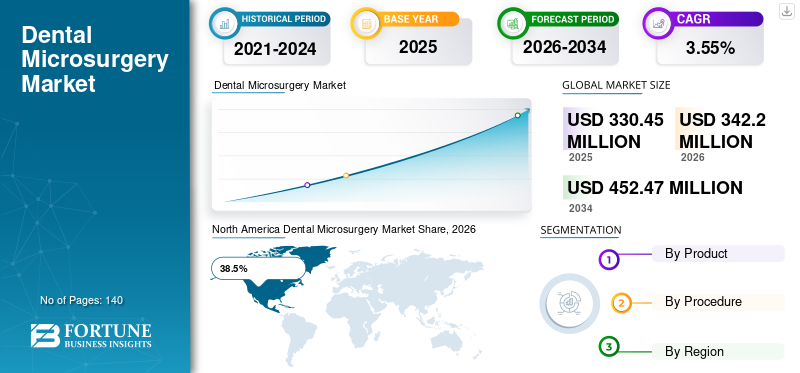
The dental microsurgery market size was valued at USD 330.45 Million in 2025. The market is projected to grow from USD 342.2 Million in 2026 to USD 452.47 Million by 2034, exhibiting a CAGR of 3.55% during the forecast period.

The dental microsurgery market is an advanced segment of the dental healthcare industry that focuses on precision-based surgical procedures performed with the assistance of operating microscopes, magnification systems, microsurgical instruments, and specialized illumination technologies. Dental microsurgery has become increasingly important in endodontics, periodontics, implantology, and oral reconstructive procedures due to its ability to improve visualization, reduce tissue trauma, and enhance procedural accuracy. The market is witnessing growing adoption among specialty dental clinics, hospitals, academic institutions, and private dental practices. Continuous advancements in optical technologies, ergonomic microscope designs, and minimally invasive treatment approaches are strengthening demand across developed and emerging healthcare systems. Increasing awareness regarding treatment precision and patient outcomes continues to support dental microsurgery market growth and dental microsurgery market opportunities.
The United States represents the most established dental microsurgery market within North America. The country benefits from widespread adoption of advanced dental technologies, a large network of specialty endodontic clinics, and strong acceptance of microscope-assisted procedures. Dental professionals increasingly utilize operating microscopes for root canal retreatments, apicoectomy procedures, periodontal microsurgery, and implant-related interventions. High awareness regarding minimally invasive dentistry and clinical precision supports market penetration. Academic institutions and dental training centers have expanded microscope-based education programs, further strengthening demand. The U.S. dental microsurgery market analysis indicates consistent adoption of advanced visualization systems as practitioners focus on treatment predictability, documentation capabilities, and enhanced patient satisfaction.
Download Free sample to learn more about this report.
 Global Market Size & Forecast
 Market Share
 Key Regional Highlights
North America
North America led the market with a 38.5% share, supported by advanced dental care infrastructure and growing adoption of microscope-assisted procedures.
Europe
Europe accounted for 29% of the market, driven by established dental healthcare systems and increasing demand for precision-based treatments
Asia-Pacific
Asia-Pacific held a 24% share, supported by expanding dental infrastructure and rising adoption of advanced microsurgical technologies.
U.S
The U.S. remains a key market, supported by advanced dental practices and strong adoption of specialized microsurgical equipment.
Japan
Japan accounted for approximately 18% of the Asia-Pacific market, supported by advanced dental care capabilities and growing demand for precision dentistry.
Read More

The dental microsurgery market trends are increasingly shaped by technological innovation and the growing demand for minimally invasive treatment methods. One of the most significant developments is the integration of high-definition optical systems with digital imaging platforms. Modern dental microscopes now feature LED illumination, digital recording systems, enhanced magnification controls, and ergonomic positioning mechanisms that improve clinical efficiency and treatment precision. These advancements are encouraging greater adoption among endodontists and oral surgeons.
Download Free sample to learn more about this report.
Another notable trend within the dental microsurgery industry analysis is the growing use of microscope-assisted implantology and periodontal procedures. Traditionally associated with endodontics, microsurgical techniques are now expanding into gum reconstruction, soft-tissue management, and implant placement. Digital workflow integration, including intraoral scanning and microscope-assisted documentation, is further supporting procedural accuracy. Educational institutions and professional associations are also increasing training initiatives focused on microscopic dentistry. As patient expectations continue to evolve toward minimally invasive and highly precise treatments, advanced microsurgical solutions are becoming an essential component of modern dental practice, reinforcing positive dental microsurgery market outlook and long-term industry expansion.
Rising Demand for Minimally Invasive and Precision-Based Dental Procedures
The primary driver supporting dental microsurgery market growth is the increasing demand for minimally invasive dental treatments. Patients increasingly prefer procedures that minimize discomfort, reduce surgical trauma, shorten recovery times, and preserve natural oral structures. Microsurgical techniques enable clinicians to achieve superior visibility and precision through magnification and enhanced illumination, making them particularly valuable for complex endodontic and periodontal procedures.
The growing prevalence of dental disorders including periodontal disease, root infections, periapical lesions, and treatment failures requiring retreatment has further expanded the use of dental microscopes and microsurgical instruments. Dentists are recognizing the clinical advantages associated with improved visualization, accurate tissue handling, and enhanced treatment predictability. Furthermore, advancements in microscope optics, digital documentation capabilities, and ergonomic designs have increased practitioner acceptance. Educational institutions are integrating microscope-assisted dentistry into training programs, contributing to wider professional adoption. These factors collectively strengthen the dental microsurgery market Size and support long-term industry development.
High Equipment Acquisition and Training Costs
One of the most significant restraints affecting the dental microsurgery market is the substantial investment required for advanced microscopy systems and specialized instrumentation. High-quality dental operating microscopes involve considerable capital expenditure, particularly for small clinics and independent practitioners operating within budget constraints.
In addition to equipment costs, practitioners must undergo specialized training to effectively utilize microscope-assisted techniques. The learning curve associated with operating microscopes can be extensive, requiring dedicated education and practical experience. Many clinics also face additional expenses related to staff training, maintenance contracts, software integration, and facility modifications. In developing healthcare markets, budget limitations and reimbursement challenges further restrict adoption. These factors may delay purchasing decisions and limit market penetration among smaller dental practices, particularly in cost-sensitive regions. Consequently, affordability remains a critical challenge influencing overall dental microsurgery market Share expansion.
Expansion of Advanced Dental Care In Emerging Economies
A major opportunity within the dental microsurgery market forecast involves the expansion of advanced dental care infrastructure across emerging economies. Countries throughout Asia-Pacific, Latin America, and the Middle East are investing heavily in healthcare modernization and specialized dental services. Increasing disposable income, urbanization, and awareness regarding oral health are encouraging patients to seek higher-quality treatment options.
Dental tourism also creates favorable conditions for market expansion. Many international patients travel to countries offering advanced dental procedures at competitive costs. This trend encourages clinics to invest in sophisticated microsurgical technologies to remain competitive. Manufacturers are introducing more compact, affordable, and technologically advanced microscope systems tailored to growing markets. The rising number of specialty dental centers, educational programs, and professional training workshops further supports technology adoption. These developments create substantial dental microsurgery market opportunities for equipment manufacturers, distributors, and service providers operating across emerging healthcare ecosystems.
Limited Specialist Availability and Procedural Standardization
One of the primary challenges affecting the Dental Microsurgery Industry Report is the limited availability of highly trained microsurgical specialists. Successful implementation of microscope-assisted dentistry requires advanced technical skills, specialized education, and substantial clinical experience. Many healthcare systems continue to face shortages of practitioners proficient in microsurgical techniques.
Variations in training standards, procedural protocols, and technology adoption rates can create inconsistencies in treatment outcomes. Some dental institutions offer comprehensive microscope-based training, while others provide limited exposure. Additionally, integration of new technologies often requires workflow adjustments and organizational support. Resistance to practice transformation among established practitioners may further slow adoption. Maintaining procedural consistency, ensuring adequate training resources, and improving accessibility to advanced education remain essential for sustainable market expansion. Addressing these challenges will significantly influence future dental microsurgery market Insights and industry competitiveness.
Optical/viewing instruments represent the largest segment within the dental microsurgery market, accounting for approximately 73% of the global market share. These products include dental operating microscopes, magnification systems, advanced visualization platforms, illumination units, and integrated imaging technologies. The segment's dominance is largely attributed to the critical role visualization plays in microsurgical procedures. Enhanced magnification enables clinicians to identify complex anatomical structures, detect microfractures, and perform delicate procedures with exceptional precision.
Demand for optical/viewing instruments continues to increase as dental professionals prioritize minimally invasive treatment approaches. Modern systems feature digital integration, image capture capabilities, ergonomic controls, and superior illumination performance. Endodontists remain the largest user group due to widespread microscope adoption during root canal treatments and retreatments. Periodontists and implant specialists are also increasingly utilizing microscope-assisted workflows. The dental microsurgery market Research Report indicates sustained demand for premium optical technologies as practitioners seek improved procedural outcomes, enhanced patient communication, and better clinical documentation.
Microsurgical instrumentation accounts for approximately 27% of the dental microsurgery market share. This segment includes microsurgical blades, forceps, needle holders, retractors, micro-scissors, suturing devices, and specialized surgical kits designed for high-precision dental procedures. The increasing complexity of oral surgeries and the growing preference for tissue-preserving techniques support segment growth.
Manufacturers continue to develop lightweight, ergonomically designed instruments that improve handling precision and reduce operator fatigue. Microsurgical instrumentation plays a crucial role in procedures involving periodontal reconstruction, implant surgery, apicoectomy, and soft-tissue management. As clinicians increasingly adopt microscope-assisted techniques, demand for compatible precision instruments rises accordingly. The dental microsurgery market analysis highlights growing investment in instrument innovation focused on durability, sterilization efficiency, and enhanced surgical control. Expansion of specialty dental services and increasing procedural sophistication continue to support demand for advanced microsurgical instrumentation globally.
To know how our report can help streamline your business, Speak to Analyst
Apicoectomy represents an important and rapidly expanding procedure segment within the dental microsurgery market, accounting for approximately 22% of procedure-based market activity. An apicoectomy involves surgical removal of the root tip and surrounding infected tissue when conventional root canal therapy fails to eliminate infection. Modern apicoectomy procedures rely heavily on operating microscopes, microsurgical instruments, and advanced root-end filling materials to maximize treatment success.
The increasing prevalence of complex endodontic cases and retreatment requirements is driving demand for apicoectomy procedures worldwide. Microsurgical techniques have significantly improved treatment outcomes through enhanced visualization and precision. Dental specialists increasingly prefer microscope-assisted apicoectomy because it allows accurate identification of anatomical structures while minimizing surgical trauma. Growing awareness regarding tooth preservation and avoidance of extraction further supports procedure demand. The dental microsurgery market trends indicate that technological improvements in magnification systems, ultrasonic instrumentation, and biocompatible materials will continue enhancing adoption of apicoectomy procedures across specialty dental practices and advanced treatment centers.
North America Dental Microsurgery Market Share, 2026 (%)
To get more information on the regional analysis of this market, Download Free sample
North America holds approximately 38.5% of the global dental microsurgery market share. The region benefits from advanced healthcare infrastructure, widespread adoption of dental technology, and strong presence of leading manufacturers. High prevalence of periodontal disease, dental caries, and endodontic conditions supports sustained demand for microscope-assisted procedures. Professional training programs and continuing education initiatives further accelerate technology adoption among practitioners. The region remains a major center for innovation, research, and product commercialization within the Dental Microsurgery Industry.
Europe accounts for approximately 29% of the global dental microsurgery market share. The region demonstrates strong adoption of advanced dental technologies supported by well-developed healthcare systems and high oral health awareness. Increasing incidence of periodontal disease, aging populations, and growing preference for minimally invasive procedures contribute to market expansion. Academic institutions and specialty dental associations actively promote microscope-assisted dentistry, supporting long-term market development.
Germany represents approximately 28% of the European dental microsurgery market. The country is recognized for technological innovation, advanced dental education, and strong adoption of precision healthcare technologies. German dental clinics and specialty centers increasingly invest in operating microscopes and microsurgical instruments to improve treatment quality and patient outcomes.
The market benefits from a highly developed dental care system and a strong presence of medical technology manufacturers. Demand is particularly strong in endodontics, implantology, and periodontal surgery. Professional training programs and research activities continue to support microscope-assisted dentistry across the country. Germany remains one of the most influential markets within the European Dental Microsurgery Industry due to its commitment to clinical excellence and technological advancement.
The United Kingdom accounts for approximately 22% of the European dental microsurgery market. Growing awareness of minimally invasive dental procedures and increasing investment in specialty dental care continue to support market development. Dental professionals increasingly utilize microscope-assisted techniques to improve precision and treatment predictability.
The country benefits from expanding private dental care services and increasing adoption of advanced treatment technologies. Educational institutions and professional organizations promote ongoing training in microsurgical dentistry, encouraging broader practitioner participation. Demand for enhanced visualization systems and specialized instruments continues to rise as clinics focus on improving procedural outcomes and patient satisfaction.
Asia-Pacific represents approximately 24% of the global dental microsurgery market share. The region is characterized by rapid healthcare modernization, expanding dental infrastructure, and increasing awareness regarding advanced oral healthcare. Rising disposable incomes, medical tourism activity, and growing demand for cosmetic and restorative dentistry contribute significantly to market expansion. Government healthcare initiatives and professional training programs further support technology adoption throughout the region.
Japan accounts for approximately 18% of the Asia-Pacific dental microsurgery market. The country maintains a highly sophisticated healthcare system and strong demand for precision medical technologies. Dental professionals widely embrace microscope-assisted procedures, particularly in endodontics and periodontal microsurgery.
The aging population contributes significantly to demand for advanced dental treatments aimed at preserving natural dentition and improving quality of life. Japanese dental institutions actively participate in research and professional education related to microsurgical dentistry. Continuous technological innovation and strong clinical standards support ongoing market development.
China represents approximately 35% of the Asia-Pacific dental microsurgery market. The country's large patient population, increasing oral health awareness, and expanding healthcare infrastructure support substantial demand for advanced dental procedures. High prevalence of dental caries and periodontal disease further contributes to market growth.
Dental clinics and hospitals increasingly invest in microscope-assisted technologies to improve treatment quality and compete within a rapidly evolving healthcare environment. Government initiatives focused on healthcare modernization and increasing availability of specialized dental services continue to strengthen market prospects. China remains a key growth center within the global dental microsurgery market outlook.
The Rest of World region accounts for approximately 8.5% of the global dental microsurgery market share. This category includes Latin America, the Middle East, and Africa. Market development is supported by expanding healthcare infrastructure, increasing oral health awareness, and rising demand for specialized dental treatments.
Private healthcare investments and growth in dental tourism are contributing to adoption of advanced microsurgical technologies. Although penetration remains lower compared to developed markets, ongoing modernization efforts and increasing availability of specialist dental services create favorable conditions for future expansion. Manufacturers are increasingly targeting these markets through distribution partnerships, educational initiatives, and affordable technology solutions.
Investment activity within the dental microsurgery market continues to focus on advanced visualization technologies, digital workflow integration, and precision instrumentation. Manufacturers are allocating significant resources toward research and development of next-generation dental microscopes featuring high-definition optics, digital recording capabilities, artificial intelligence-assisted visualization, and improved ergonomic functionality.
Investment opportunities are particularly attractive in emerging economies where healthcare infrastructure modernization is accelerating. Specialty dental clinics, educational institutions, and hospital networks are increasingly investing in microscope-assisted treatment systems to enhance service quality and competitiveness. Strategic partnerships between technology providers and dental training organizations are also expanding. The dental microsurgery market opportunities landscape includes product innovation, distribution network expansion, digital dentistry integration, and specialist education initiatives. Growing demand for minimally invasive procedures and advanced treatment outcomes continues to create favorable investment conditions across multiple geographic regions and market segments.
Product innovation remains a defining characteristic of the dental microsurgery market. Manufacturers are introducing advanced operating microscopes with enhanced optical clarity, integrated digital imaging, cloud-based documentation, and real-time visualization capabilities. Modern systems increasingly incorporate LED illumination, motorized controls, touchscreen interfaces, and wireless connectivity features.
Development efforts are also focused on microsurgical instrumentation. New instrument designs emphasize precision, lightweight construction, ergonomic handling, and improved sterilization compatibility. Integration of digital technologies with microscopic dentistry is creating opportunities for enhanced treatment planning and procedural documentation. Artificial intelligence-assisted visualization, augmented reality overlays, and advanced image processing technologies are emerging innovation areas. These developments are expected to strengthen procedural accuracy, improve clinical efficiency, and expand the range of applications for microscope-assisted dentistry throughout the dental microsurgery industry.
The dental microsurgery market Report provides comprehensive analysis of industry structure, market trends, competitive landscape, technological developments, and regional performance. The report evaluates key product categories including optical/viewing instruments and microsurgical instrumentation while examining procedure-based applications such as apicoectomy and other microsurgical interventions.
Request for Customization to gain extensive market insights.
Coverage includes assessment of market drivers, restraints, opportunities, and challenges influencing industry development. The study further analyzes regional markets across North America, Europe, Asia-Pacific, and Rest of World, highlighting country-level opportunities and competitive dynamics. Detailed company profiling, innovation trends, investment activity, and product development initiatives are also included. The dental microsurgery market Research Report serves as a strategic resource for manufacturers, distributors, healthcare providers, investors, and policymakers seeking actionable insights into evolving industry conditions, emerging technologies, and future market opportunities. The report emphasizes precision dentistry, minimally invasive treatment adoption, and technological innovation as key themes shaping the dental microsurgery market forecast.
Fortune Business Insights says that the global market value stood at USD 330.45 million in 2025 and is projected to reach USD 452.47 million by 2034.
The market is expected to exhibit a CAGR of 3.55% during the forecast period of 2026-2034.
Optical/viewing instruments led the product segment with approximately 73% of the market, driven by their critical role in providing enhanced magnification and visualization during precision dental procedures.
Key players include Carl Zeiss Meditec AG, Global Surgical Corporation, Albert Waeschle, SYNOVIS MICRO COMPANIES ALLIANCE, INC., and Hu-Friedy Mfg. Co., LLC.
Major trends include high-definition optical systems with digital imaging and the expanding use of microscope-assisted implantology and periodontal procedures. North America led with a 38.5% market share.


(Offer valid till 15th Nov 2026)
Get 30-60 hrs Free Customization
Expand Regional and Country Coverage, Segments Analysis, Company Profiles, Competitive Benchmarking, and End-user Insights.













.webp)






Get In Touch With Us
US +1 833 909 2966 ( Toll Free )
Receive a tailored pricing based on your needs.
Discuss your questions with our industry experts.
Have questions? Get quick answers before you purchase.

