 Download Free Sample



Get a Quote
Receive a tailored pricing based on your needs.
- Choose license type
- Multiple user options
- Custom scope & coverage
- Fast turnaround
"Designing Growth Strategies is in our DNA"
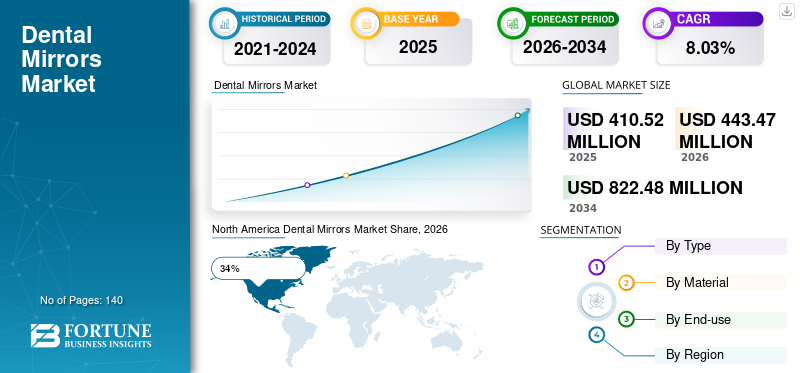
The global dental mirrors market size was valued at USD 410.52 billion in 2025. The market is projected to grow from USD 443.47 billion in 2026 to USD 822.48 billion by 2034, exhibiting a CAGR of 8.03% during the forecast period. The market in Germany dominated with a revenue share of 34% in 2025.

The dental mirrors market is an essential segment of the global dental instruments industry, supporting routine examinations, diagnostic procedures, restorative treatments, and preventive oral healthcare services. Dental mirrors provide enhanced visibility of hard-to-reach areas within the oral cavity, enabling accurate diagnosis and treatment planning. The market is benefiting from increasing awareness of oral health, rising demand for dental procedures, and expanding access to professional dental care services worldwide. Manufacturers continue introducing ergonomic designs, anti-fog technologies, and improved reflective surfaces to enhance clinical efficiency. The dental mirrors market Report highlights growing demand from dental clinics, hospitals, and educational institutions across developed and emerging healthcare markets.
The United States accounts for approximately 35% market share in the global dental mirrors market and remains one of the largest consumers of dental instruments worldwide. Strong awareness regarding oral health, high dental visit frequency, and advanced healthcare infrastructure continue supporting market growth. Dental professionals increasingly utilize high-quality diagnostic instruments to improve examination accuracy and treatment outcomes. The country benefits from a large network of dental clinics, hospitals, and academic institutions that drive continuous demand for dental mirrors. Ongoing investments in dental technology and preventive healthcare initiatives further support expansion. The USA dental mirrors market Outlook remains favorable due to rising dental care utilization.
Download Free sample to learn more about this report.
 Global Market Size & Forecast
 Market Share
 Key Regional Highlights
North America
North America held the largest regional share at 34% in 2025.
Europe
Europe accounted for 29% of the global market.
Asia-Pacific
Asia-Pacific represented 27% of the global market, supported by increasing demand for dental care services.
U.S
The U.S. is a major market due to advanced dental infrastructure and growing demand for preventive and cosmetic dentistry.
Japan
Japan accounted for 21% of the Asia-Pacific market, supported by established dental care infrastructure and increasing adoption of advanced dental instruments.
Read More

The dental mirrors market Trends indicate increasing demand for ergonomic and lightweight dental instruments designed to improve practitioner comfort during extended clinical procedures. Manufacturers are introducing advanced handle designs and anti-slip materials that enhance usability while reducing hand fatigue. These innovations are gaining popularity among dental professionals seeking improved clinical efficiency. Another important trend within the dental mirrors market Analysis landscape is the growing adoption of smart mirrors and enhanced optical technologies. Advanced mirror systems featuring improved illumination, anti-fog coatings, and high-definition reflective surfaces are helping practitioners achieve greater diagnostic accuracy.
Download Free sample to learn more about this report.
These technologies support better visualization of difficult-to-access oral structures. Sustainability is also influencing product development. Manufacturers are increasingly utilizing recyclable materials and environmentally responsible production methods to meet evolving healthcare procurement requirements. Digital dentistry expansion and growing demand for minimally invasive procedures continue supporting innovation. Increasing investments in dental education and clinical training programs further contribute to market growth. These developments continue shaping the dental mirrors market Research Report environment and strengthening demand for advanced diagnostic instruments.
Rising Demand for Preventive and Diagnostic Dental Care
The primary driver of the dental mirrors market Growth is the increasing emphasis on preventive oral healthcare and early diagnosis of dental conditions. Patients are becoming more aware of the importance of regular dental examinations, contributing to higher clinic visitation rates worldwide. Dental mirrors remain essential instruments for routine assessments, cavity detection, periodontal evaluations, and restorative treatment planning. Expanding access to dental services and increasing investments in oral healthcare infrastructure further support market demand. Healthcare providers continue prioritizing accurate diagnostic tools that improve treatment outcomes. These factors collectively contribute to sustained expansion within the Dental Mirrors Industry Analysis landscape.
Availability of Alternative Digital Diagnostic Technologies
A key restraint affecting the dental mirrors market is the increasing adoption of advanced digital imaging and intraoral scanning technologies. These systems provide highly detailed visual information and may reduce dependence on traditional diagnostic instruments in certain clinical applications. While dental mirrors remain indispensable for many procedures, technological advancements are influencing purchasing priorities among some healthcare providers. Budget constraints and equipment modernization initiatives can also impact procurement decisions. These factors create competitive pressures within the market despite the continued importance of dental mirrors in everyday practice.
Expansion of Dental Healthcare Infrastructure in Emerging Markets
A major opportunity within the dental mirrors market Opportunities landscape is the ongoing expansion of dental healthcare infrastructure across emerging economies. Governments and private healthcare organizations are investing in new dental clinics, educational institutions, and specialized treatment centers. Increasing awareness regarding oral health and growing middle-class populations are contributing to higher demand for professional dental services. Manufacturers have opportunities to expand market presence through cost-effective product offerings and regional distribution partnerships. These developments support favorable long-term growth prospects throughout the global market.
Maintaining Product Differentiation in A Competitive Market
One of the major challenges facing the dental mirrors market is maintaining product differentiation within a highly competitive environment. Many manufacturers offer similar products, making innovation and quality important competitive factors. Healthcare providers increasingly evaluate instruments based on durability, ergonomics, optical performance, and infection control characteristics. Regulatory compliance requirements and evolving customer expectations add further complexity to product development. Companies must continuously invest in research, manufacturing improvements, and marketing strategies to maintain market share. These factors influence competitive dynamics within the dental mirrors market Forecast environment.
One-sided dental mirrors account for approximately 78% market share in the dental mirrors market and remain the dominant product category. These mirrors are widely utilized in routine dental examinations because of their simplicity, reliability, and cost-effectiveness. Dental professionals rely on one-sided mirrors to obtain indirect views of oral structures, improve illumination, and retract soft tissues during procedures. The segment benefits from extensive usage across general dentistry, orthodontics, and preventive care settings. Manufacturers continue improving reflective quality, durability, and ergonomic characteristics to enhance performance.
Smart mirrors hold approximately 22% market share within the dental mirrors market and represent an emerging technology-driven segment. These advanced instruments incorporate enhanced optical features, illumination systems, and digital integration capabilities designed to improve diagnostic precision. Dental professionals increasingly adopt smart mirrors to support advanced examination techniques and improve visualization of complex oral conditions. Growing investment in digital dentistry and technology-enabled treatment workflows continues driving segment growth. Manufacturers are focusing on innovation that enhances image clarity, usability, and clinical efficiency. Educational institutions and specialized dental practices are among the leading adopters of these products.
To know how our report can help streamline your business, Speak to Analyst
Plastic dental mirrors account for approximately 41% market share in the dental mirrors market and are widely used due to their lightweight construction and cost-effectiveness. These mirrors are commonly utilized in disposable or single-use applications where infection control and convenience are important considerations. Healthcare providers value plastic mirrors for their affordability and ease of handling during routine examinations. Manufacturers continue improving material quality to enhance durability and optical performance while maintaining competitive pricing. Increasing focus on infection prevention and procedural efficiency supports demand within this segment.
Metal dental mirrors hold approximately 59% market share within the dental mirrors market and remain the preferred choice for many professional dental practitioners. These mirrors offer superior durability, long-term performance, and compatibility with sterilization procedures. Dental professionals often select metal instruments because of their reliability and resistance to wear during repeated clinical use. Manufacturers continue introducing ergonomic designs and improved reflective surfaces that enhance examination accuracy. The segment benefits from strong demand among hospitals, specialty clinics, and advanced dental practices. Increasing emphasis on instrument longevity and clinical quality continues supporting market expansion. These factors reinforce the leadership position of metal dental mirrors within the market.
Hospitals account for approximately 36% market share in the dental mirrors market and represent an important end-use segment. These facilities perform a wide range of diagnostic, surgical, and restorative dental procedures requiring reliable examination instruments. Hospitals often maintain large inventories of dental tools to support multiple departments and patient populations. Increasing investment in oral healthcare services and hospital-based dental programs contributes to market demand. Advanced infection control protocols and equipment modernization initiatives further support product procurement. Growing patient volumes and expanding healthcare infrastructure continue driving utilization of dental mirrors within hospital environments.
Dental clinics hold approximately 64% market share in the dental mirrors market and remain the dominant end-use segment. These facilities perform routine examinations, preventive treatments, orthodontic procedures, and restorative interventions on a daily basis. Dental mirrors are essential instruments used throughout virtually every patient consultation and treatment session. Rising awareness regarding oral health and increasing demand for cosmetic dentistry continue supporting clinic activity levels. Independent practices, group clinics, and specialty dental centers contribute significantly to segment demand. Manufacturers increasingly target clinics through ergonomic product innovations and enhanced optical technologies.
North America Dental Mirrors Market Share, 2026 (%)
To get more information on the regional analysis of this market, Download Free sample
North America accounts for approximately 34% market share in the global dental mirrors market and remains the leading regional market. The region benefits from advanced healthcare infrastructure, strong awareness regarding oral health, and a large network of dental clinics and hospitals. Dental professionals increasingly prioritize high-quality diagnostic instruments that support accurate examinations and treatment planning. The United States represents the largest contributor to regional demand due to high dental visitation rates and substantial investment in oral healthcare services. Growing demand for cosmetic dentistry, orthodontic treatments, and preventive dental care continues supporting utilization of dental mirrors across clinical settings. Healthcare providers are increasingly adopting ergonomic instruments and enhanced optical technologies to improve procedural efficiency. Educational institutions also contribute significantly to demand through dental training programs and research activities. Manufacturers continue introducing innovative products featuring anti-fog coatings, improved reflectivity, and ergonomic designs tailored to practitioner needs.
Europe holds approximately 29% market share in the global dental mirrors market and remains a major contributor due to strong healthcare systems and established dental care infrastructure. The region benefits from widespread awareness regarding preventive oral healthcare and routine dental examinations. Dental professionals continue utilizing advanced diagnostic tools to improve clinical outcomes and patient satisfaction. Countries throughout Europe are investing in healthcare modernization initiatives that support the adoption of high-quality dental instruments. Growing demand for cosmetic dentistry and restorative procedures contributes to increasing utilization of dental mirrors. Manufacturers continue expanding product portfolios featuring enhanced optical performance and durable construction materials. Dental education institutions and professional training programs also support market growth by promoting modern clinical practices. Sustainability initiatives and infection control requirements are influencing procurement decisions across healthcare facilities.
Germany accounts for approximately 26% market share within the European dental mirrors market and remains one of the region’s largest markets for dental instruments. The country benefits from advanced healthcare infrastructure, strong dental education programs, and widespread access to professional oral healthcare services. Dental practitioners increasingly adopt high-quality diagnostic instruments that improve examination precision and patient care. Growing demand for preventive dentistry and restorative treatments continues supporting market expansion. Investments in clinical modernization and dental technology innovation further contribute to product adoption. The presence of established dental equipment manufacturers also strengthens market development. These factors support continued growth within the Germany dental mirrors market Outlook.
The United Kingdom represents approximately 18% market share within the European dental mirrors market and continues experiencing stable demand for dental diagnostic instruments. Increasing awareness regarding oral health and preventive care supports utilization across hospitals and private dental practices. Dental professionals are focusing on improving treatment quality through the adoption of advanced clinical tools. Growing interest in cosmetic dentistry and orthodontic procedures further contributes to market expansion. Healthcare modernization programs and investments in dental education support product demand. Digital dentistry adoption is also encouraging complementary instrument upgrades. These factors contribute positively to the United Kingdom dental mirrors market Growth landscape.
Asia-Pacific accounts for approximately 27% market share in the global dental mirrors market and remains one of the fastest-growing regional segments. Rapid urbanization, increasing healthcare expenditure, and growing awareness regarding oral health continue driving market expansion. Governments throughout the region are investing in healthcare infrastructure and preventive care programs that improve access to dental services. Countries including China, Japan, India, South Korea, and Australia are witnessing increasing demand for dental treatments and diagnostic instruments. Rising disposable incomes and expanding middle-class populations contribute to higher utilization of professional dental care services. Dental clinics are increasingly adopting advanced instruments that improve examination accuracy and clinical efficiency.
Japan accounts for approximately 21% market share within the Asia-Pacific dental mirrors market and benefits from one of the most advanced healthcare systems in the world. Dental professionals prioritize precision, quality, and patient comfort, supporting demand for premium diagnostic instruments. The country’s aging population contributes to increasing utilization of dental services and routine examinations. Investments in dental technology and clinical innovation continue strengthening market development. Healthcare providers increasingly adopt advanced mirror designs that improve visibility and procedural efficiency. Strong professional training standards further encourage product utilization. These factors support continued growth within the Japan dental mirrors market Insights landscape.
China represents approximately 35% market share within the Asia-Pacific dental mirrors market, making it the largest contributor in the region. Rapid expansion of healthcare infrastructure and increasing awareness regarding oral hygiene continue supporting market growth. Growing numbers of dental clinics and hospitals are driving demand for diagnostic instruments and clinical equipment. Government initiatives promoting healthcare modernization contribute positively to market development. Rising disposable incomes and increasing access to professional dental services further strengthen product demand. Manufacturers continue expanding production capabilities and distribution networks throughout the country. These factors position China as a major growth engine within the dental mirrors market Outlook.
Rest of World accounts for approximately 10% market share in the global dental mirrors market and includes Latin America, the Middle East, and Africa. These regions are experiencing increasing demand for dental care services due to improving healthcare infrastructure and growing awareness regarding oral health. Governments and private healthcare organizations continue investing in dental clinics, hospitals, and educational programs. Adoption of advanced diagnostic instruments is gradually increasing as healthcare systems modernize. International manufacturers are expanding regional presence through partnerships and distribution agreements. Rising urbanization and improving access to healthcare services contribute positively to market development. Although market penetration remains lower than in developed regions, substantial long-term opportunities exist. These factors continue supporting expansion within the Rest of World dental mirrors market.
The dental mirrors market continues attracting investment due to increasing demand for preventive dental care, expanding oral healthcare infrastructure, and rising adoption of advanced diagnostic instruments. Investors are focusing on manufacturers that offer high-quality, durable, and ergonomically designed products capable of improving clinical efficiency and diagnostic accuracy. Growing awareness regarding oral hygiene and increasing frequency of dental visits are creating favorable conditions for long-term market expansion.
A major area of investment involves product innovation. Companies are allocating resources toward enhanced optical technologies, anti-fog coatings, lightweight materials, and ergonomic handle designs that improve practitioner comfort and examination precision. Smart mirror technologies and digital dentistry integration are also emerging as important development areas. These advancements help manufacturers differentiate products in a competitive market.
Innovation within the dental mirrors market is increasingly focused on enhancing diagnostic visibility, practitioner comfort, and infection control. Manufacturers are introducing mirrors with superior reflective surfaces that provide clearer visualization of hard-to-access areas within the oral cavity. Enhanced anti-fog technologies are helping improve performance during extended procedures and reducing workflow interruptions.
Ergonomic product development remains a major priority. New handle designs featuring lightweight materials, improved grip surfaces, and balanced weight distribution are helping reduce hand fatigue among dental professionals. These improvements contribute to greater procedural efficiency and practitioner satisfaction. Manufacturers are also exploring advanced sterilization-compatible materials that extend product lifespan while maintaining infection control standards.
The dental mirrors market Report provides comprehensive analysis of industry structure, competitive dynamics, technology developments, and regional demand patterns. The report evaluates key growth drivers including increasing awareness regarding oral health, rising dental procedure volumes, and growing adoption of advanced diagnostic instruments.
Request for Customization to gain extensive market insights.
Market restraints, opportunities, and challenges influencing industry performance are also examined in detail. The report covers segmentation by type, material, and end-use. One-sided and smart mirror categories are evaluated based on adoption trends, technological innovation, and clinical applications. Material analysis includes plastic and metal dental mirrors, while end-use assessment focuses on hospitals and dental clinics. These segments collectively provide insight into product utilization patterns across the healthcare industry.
Fortune Business Insights says that the global market value stood at USD 410.52 billion in 2025 and is projected to reach USD 822.48 billion by 2034.
The market is expected to exhibit a CAGR of 8.03% during the forecast period of 2026-2034.
One-sided dental mirrors led the type segment with approximately 78% market share, supported by their simplicity, reliability, and cost-effectiveness in routine examinations.
Key players include Hu Friedy Group, KaVo Kerr, Acteon Group, MEDESY srl, Integra LifeSciences, and Zirc Dental Products.
Major trends include rising demand for ergonomic, lightweight instruments and growing adoption of smart mirrors and enhanced optical technologies; North America leads regionally with approximately 34% market share.


(Offer valid till 31st Oct 2026)
Get 30-60 hrs Free Customization
Expand Regional and Country Coverage, Segments Analysis, Company Profiles, Competitive Benchmarking, and End-user Insights.













.webp)






Get In Touch With Us
US +1 833 909 2966 ( Toll Free )
Receive a tailored pricing based on your needs.
Discuss your questions with our industry experts.
Have questions? Get quick answers before you purchase.

