Desiccated Coconut Market Size, Share & Industry Analysis, By Nature (Organic and Conventional), By Form (Powder, Flakes, and Chips), By Application (Bakery, Confectionery, Dairy Products, Frozen Desserts, and Others), and Regional Forecast, 2026-2034
 Download Free Sample
(Offer valid till 30th Sep 2026)

KEY MARKET INSIGHTS
 Listen to Audio Version
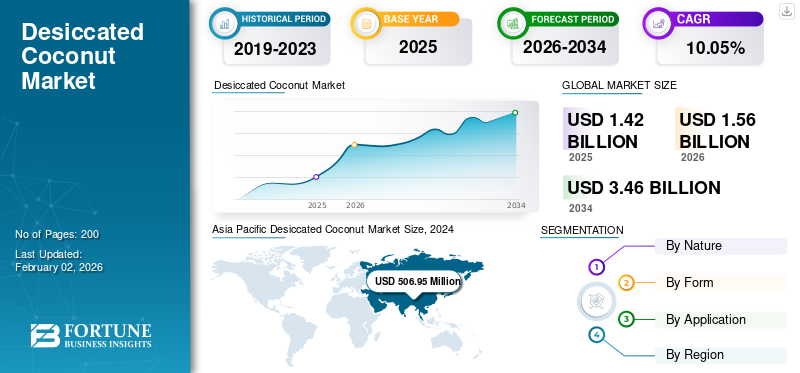
The global desiccated coconut market size was valued at USD 1420 million in 2025. The market is projected to grow from USD 1560 million in 2026 to USD 3460 million by 2034, growing at a CAGR of 10.47% during the forecast period. Asia Pacific dominated the desiccated coconut market with a market share of 38.23% in 2025.
Desiccated coconut is dehydrated and disintegrated coconut kernel or pulp, consisting mainly of the white portion of the kernel after removing the brown testa or parings. The increasing use of the product in confectionery, baked goods, snacks, and drinks is also propelling product adoption globally. Its high nutritional content, low water content, and long shelf life make it a top choice for both industrial and household food processing industries, further boosting market growth.
Goldman International Pvt. Ltd, Super Coco Company, Holland & Barrett, Primex Coco Products Inc., and Pacific Eastern Coconut Utama are some of the prominent players operating in the global market.
Download Free sample to learn more about this report.
Desiccated Coconut Market Key Takeaways
 Global Market Size & Forecast
- 2025 Market Size: USD 1.42 billion
- 2026 Market Size: USD 1.56 billion
- 2034 Forecast Market Size: USD 3.46 billion
- CAGR: 10.47% from 2026–2034
 Market Share
- Asia Pacific dominated the desiccated coconut market with a 38.23% share in 2025.
- Conventional segment held the leading position due to lower production costs and wider application across industries.
- Powder segment accounted for a major share owing to its smooth texture and extensive use in bakery and confectionery products.
 Key Regional Highlights
North America
North America reached USD 0.25 billion in 2025, representing 17.26% of global demand, with growth supported by rising consumption of bakery, confectionery, and healthy snack products.
Europe
Europe captured a 37.69% market share in 2025, generating USD 0.54 billion in revenue, supported by increasing demand for plant-based and clean-label food ingredients.
Asia Pacific
Asia Pacific led the global desiccated coconut market, reaching USD 0.54 billion in 2025 and accounting for a 38.23% share, driven by strong coconut production and rising food processing demand.
U.S.
The U.S. market is witnessing steady growth due to increasing demand for natural, gluten-free, and plant-based ingredients across bakery, confectionery, and packaged food applications.
Japan
Japan is experiencing rising adoption of desiccated coconut products, supported by growing interest in premium bakery products, healthy snacks, and innovative food formulations.
Read More

MARKET DYNAMICS
MARKET DRIVERS:
Growing Popularity of Ethnic Cuisinesto Drive Market Growth
The global desiccated market is currently experiencing substantial growth, driven by the product’s versatility and extended shelf life. Desiccated coconut has become a preferred ingredient in various industries, including the food and beverage industry, cosmetics, and pharmaceuticals, and is known for its natural sweetness. The market is witnessing a shift in health-conscious consumers' preference toward nutritious and natural, plant-based ingredients, along with advancements in processing technologies. Moreover, the growing popularity of ethnic cuisines and the globalization of culinary preferences are likely to fuel demand for the product globally. As consumers seek exotic and authentic flavors, the market is expected to experience increased demand from various regions, further driving global desiccated coconut market growth.
MARKET RESTRAINTS:
High Production Costs and Market Volatility to Impede Market Momentum
The production of desiccated coconut entails several steps, such as harvesting, shelling, cleaning, drying, and packaging. These methods can increase production and labor costs, which may impact profit margins and market prices. The quality and availability of fresh coconuts may change based on seasonality, climate, and problems in coconut cultivation (e.g., pests and diseases). This volatility can further deter the supply chain and affect production capacity. According to the International Coconut Community, in May 2024, the price per metric ton of desiccated coconut reached an average of USD 1,911 in the Philippines, representing a year-on-year increase of 4.5%.
MARKET OPPORTUNITIES:
Growing Export Potential of Emerging Economies to Offer Various Market Opportunities
Emerging economies across the Asia Pacific region have been instrumental in determining global product demand. Countries such as the Philippines, Indonesia, and India are among the world's leading producers of coconuts. Favorable export conditions and surplus production have positioned these markets as pivot hubs in the desiccated coconut trade. The growing willingness of these regions to participate in international trade also harnesses the potential for a more decentralized and competitive global market.
DESICCATED COCONUT MARKET TRENDS:
Increasing Consumer Preference for Vegan/Vegetarian Diets to Fuel Industry Growth
Veganism has rapidly spread globally, resulting in a high demand for vegan products. The increasing popularity of veganism and plant-based diets has become prominent in most developed regions, such as North America and Europe. Veganism encourages developing and utilizing animal-free options for the welfare of animals, humans, and the environment. Consequently, as individuals embrace vegetarian diets, desiccated coconut proves to be a viable ingredient, responding to these dietary needs and health benefits. The natural constitution of the product appeals to a wider clientele looking for plant-based and allergen-free, and functional foods, which, in turn, drives market growth.
Download Free sample to learn more about this report.
Segmentation Analysis
By Nature
Lower Cost Boosted Conventional Segment Expansion
Based on nature, the market is bifurcated into organic and conventional.
The conventional segment dominated the global market in 2024. The conventional desiccated coconut is usually cheaper than its organic alternative, making it more attractive to diverse consumers and businesses, especially in price-sensitive markets. Conventional farming practices involve lower production costs, which play an important role in extensive use of the product across diverse applications. Conventional desiccated coconut finds usage in a wide category of applications, from large-scale baked and confectionery items to processed foods and ready-to-eat snack foods, further fueling its growth.
The organic segment is expected to grow significantly during the forecast period. Nowadays, there is an increasing global trend toward organic food, fueled by increased consumer consciousness of environmental and health concerns. Consumers now increasingly choose organic products as a component of healthy living, demanding foods that are pesticide-free, free from synthetic fertilizers, and genetically modified organisms (GMOs). This change in consumer behavior is fueling demand for organic desiccated coconut.
By Form
Powder Segment Leads due to its Smooth Texture
Based on form, the market is trifurcated into powder, flakes, and chips.
The powder segment dominates the market on a global scale, due to its smooth texture and ease of blending. Desiccated coconut powder is one of the major ingredients in a wide range of products, such as bakery, confectionery, frozen desserts, and others. The increased demand for plant-based and healthy options increases the popularity of such products.
The flakes segment is anticipated to increase substantially during the forecast period. Desiccated coconut flakes are marginally thicker and larger, offering enhanced mouthfeel. They are used frequently in granola, trail mixes, and as a garnish for sweet and savory foods, making them a popular choice for both manufacturers and consumers.
By Application
Bakery Segment Leads due to Growing Usage of the Product to Improve Texture and Flavor of Products
Based on application, the market is divided into bakery, confectionery, dairy products, frozen desserts, and others.
The bakery segment dominates the global market. Desiccated coconut plays a vital role in the bakery industry by improving the texture, flavor, and natural appeal of products such as cakes, muffins, pastries, cookies, and other bread-based desserts. The product’s versatility extends to different baking applications, including fillings, toppings, and crusts. Dried coconut finds enormous demand among consumers who prefer clean-label, plant-based, and allergen-free products as it is naturally free from gluten, preservatives, or dairy products, further fueling its application in the bakery segment.
The confectionery segment will grow significantly in the coming years. Desiccated coconut provides a nutty, sweet taste and a chewy texture, making it suitable for soft cakes, crunchy cookies, or creamy candies. Additionally, desiccated coconut with low moisture levels extends product shelf life, making it well-suited for exporting globally.
Desiccated Coconut Market Regional Outlook
By geography, the market is categorized into North America, Europe, Asia Pacific, South America, and the Middle East & Africa.
Asia Pacific:
Asia Pacific Desiccated Coconut Market Size, 2025 (USD Million)
To get more information on the regional analysis of this market, Download Free sample
Asia Pacific maintained a strong presence in the global market, reaching USD 0.54 billion in 2025, accounting for 38.23% share, and is expected to reach USD 0.58 billion in 2026. Asia Pacific is the leading region in terms of global production, with nations such as the Philippines, Indonesia, and India controlling much of the world’s supply. This dominance is driven by several factors, such as the region's long-standing coconut production and processing facilities, high domestic consumption, and rising exports of coconut-based products. According to the International Coconut Community, in 2024, the Philippines exported 41,854 metric tons of desiccated coconut, marking a 20.8% increase compared to the same period in 2023. The region’s large and expanding population, rising disposable incomes, and shifting consumer preferences toward healthy and natural foods, including coconut products, are further fueling market dominance.
Europe:
The Europe region captured 37.69% of the global market in 2025, generating USD 0.54 billion in revenue, and is projected to reach USD 0.6 billion in 2026. The market in Europe is expected to grow significantly during the forecast period, with the region known as the world’s largest importer of the product. According to the Centre for the Promotion of Imports from Developing Countries, Europe imported 121,000 tons of desiccated coconut in 2022. Desiccated coconut is a popular ingredient in Europe, used especially in bakery and confectionery. The demand for the product in the region is mainly driven by a rising consumer interest in gluten-free, plant-based, and keto diets, the growing popularity of Asian cuisine, and the wide use of coconut in various food products. The Netherlands, the U.K., Germany, and France are among the leading importers of the product in the region.
North America:
In 2025, the North America market stood at USD 0.25 billion, representing 17.26% of global demand, and is projected to grow to USD 0.27 billion in 2026. The demand for coconut products in North America has expanded across various industries. The increasing demand for plant-based food and beverages drives growth in packaged goods such as coconut milk powder and coconut flour. The U.S. remains a key consumer of coconut products, including desiccated coconut, coconut water, coconut oil, and others. According to the Good Food Institute, in the U.S., plant-based food sales increased from USD 8 billion in 2022 to USD 8.1 billion in 2023. Moreover, the rise in consumer shift toward sustainability and clean-label products continues to fuel demand.
South America:
Emerging regions such as South America have become key players in the growing industry. With rising demand for environment-friendly, natural, and plant-based products, coconut-based products, including desiccated coconut, coconut water, oil, and others, are highly sought after in the region. Additionally, the region, especially in Brazil and Argentina, is experiencing growing demand for coconut products due to urbanization, economic development, and changing consumer preferences toward natural ingredients such as desiccated coconut.
Middle East & Africa:
The Middle East & Africa market accounted for USD 0.1 billion in 2025, representing 6.82% of the global industry, and is expected to reach USD 0.1 billion in 2026. The Middle East and Africa have been experiencing an increasing demand for the product, particularly in nations such as the UAE and Saudi Arabia, due to its increasing application in food products, mainly in the confectionery and bakery industries. The UAE has a notably high demand for coconut products such as coconut water, coconut milk, desiccated coconut, and others, due to the country's multi-ethnic expatriate communities and health-conscious individuals. Moreover, the adoption of coconut products in the region has spurred product innovation, with businesses and local entrepreneurs introducing unique items such as coconut-based chocolates, spreads, and other specialty products to cater to evolving consumer preferences.
COMPETITIVE LANDSCAPE
Key Industry Players
Growing Focus on Investment Strategies to Boost Production
The industry is moderately diversified, with both established key players and small regional players competing for the global desiccated coconut market share. Major players in the market have been emphasizing investment and base expansion strategies to consolidate their market position and distribution networks. For instance, in October 2024, Century Pacific Food Inc., one of the largest branded food companies in the Philippines, invested USD 40 million to acquire and improve a coconut processing facility in Mindanao. The new facility would produce higher-value coconut-based products such as desiccated coconut, virgin coconut oil, and others. Goldman International Pvt. Ltd, Super Coco Company, Holland & Barrett, Primex Coco Products Inc., and Pacific Eastern Coconut Utama are a few established players in the market, driving global supply. These players have been catering to diverse applications in bakery, food processing, confectionery, and other industries in order to capitalize on the growing demand.
LIST OF KEYDESICCATED COCONUT COMPANIES PROFILED:
- Goldman International Pvt. Ltd (India)
- Super Coco Company (India)
- Holland & Barrett (U.K.)
- Primex Coco Products Inc. (Philippines)
- CBL Natural Foods (Sri Lanka)
- S & P Industries SDN. BHD (Malaysia)
- Pacific Eastern Coconut Utama (Indonesia)
- VIET DELTA Corporation (Vietnam)
- Silvermill Group (Sri Lanka)
- Ken Taste Products Limited (Kenya)
KEY INDUSTRY DEVELOPMENTS:
- June 2025: PT Resources Holdings Bhd, a processor and trader of frozen seafood products, established a coconut processing facility with an investment of USD 2.36 million in the China-Indonesia Food Industrial Park located in Fuqing, China. The new facility would produce value-added products such as desiccated coconut, frozen coconut water, frozen coconut milk, and others.
- January 2025: EDFI Management Company (EDFI MC) supported Kentaste, one of the leading players in the coconut market, through a new technical assistance initiative, which offers Kentaste support in improving its long-term foresight and sourcing strategies.
- September 2024: NOMO, one of the UK’s no. 1 Vegan & free-from chocolate brands, launched its newest product, the Nomi Coconut Chocolate Bar. The new product is made of Rainforest Alliance Certified cocoa, desiccated coconut, and other premium ingredients.
- June 2024: Huanlejia Food Group, a Chinese producer of canned foods and fruit beverages, built a coconut‐processing factory in Indonesia for USD 21 million. It expanded its overseas footprint and reinforced its ties with local suppliers.
- December 2019: The Asian Development Bank (ADB) signed a USD 5 million financing facility with PT SASL and Sons Indonesia (PTSASL), a subsidiary of the Silvermill Group (Silvermill), in order to expand the group’s coconut-based operations in Indonesia. The new facility is expected to produce over 9,400 metric tons per year of desiccated coconut.
REPORT COVERAGE
The global market report provides market size and forecast by all segments. It includes details on the market dynamics and global market trends expected to drive the market in the forecast period. It offers information about the key regions, key industry developments, new product launches, and details on partnerships, mergers, and acquisitions. The global market analysis also covers a detailed competitive landscape with information on the market share and profiles of key players.
Request for Customization to gain extensive market insights.
Report Scope & Segmentation
|
ATTRIBUTE |
DETAILS |
|
Study Period |
2021-2034 |
|
Base Year |
2025 |
|
Forecast Period |
2026-2034 |
|
Historical Period |
2021-2024 |
|
Growth Rate |
CAGR of 10.47% from 2026-2034 |
|
Unit |
Value (USD Million) |
|
Segmentation |
By Nature, Form, Application, and Region |
|
By Nature |
|
|
By Form |
|
|
By Application |
|
|
By Region |
|
Frequently Asked Questions
Fortune Business Insights says that the global market value stood at USD 1420 million in 2025 and is projected to reach USD 3460 million by 2034.
The market is expected to exhibit a CAGR of 10.47% during the forecast period (2026-2034).
By application, the bakery segment leads the market.
Growing demand for plant-based alternatives is a key factor driving market growth.
Goldman International Pvt. Ltd, Super Coco Company, Holland & Barrett, Primex Coco Products Inc., and Pacific Eastern Coconut Utama are the top players in the market.
Asia Pacific dominates the market.
Increasing consumer preference for vegan/vegetarian diets is a key factor expected to provide growth opportunities.



- 2021-2034
- 2025
- 2021-2024
- 200
-
(Offer valid till 30th Sep 2026)
Get 30-60 hrs Free Customization
Expand Regional and Country Coverage, Segments Analysis, Company Profiles, Competitive Benchmarking, and End-user Insights.




















Related Reports
-
US +1 833 909 2966 ( Toll Free )
-
Get In Touch With Us