DevOps Market Size, Share & Industry Analysis, By Offering (Software, Services), By Deployment (Public Cloud, Private Cloud, and Hybrid), By Organization Size (Large Enterprises, Small and Medium Enterprises), By Industry (BFSI, Retail, Government, Manufacturing, IT & Telecommunication, Healthcare, and Others), and Regional Forecast Report, 2026-2034
 Download Free Sample
DevOps Market Size and Industry Overview
 Listen to Audio Version
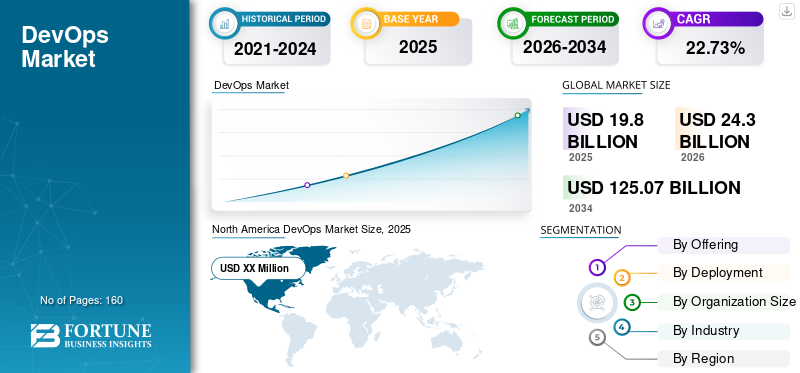
The global devops market size was valued at USD 19.80 billion in 2025. The market is projected to grow from USD 24.30 billion in 2026 to USD 125.07 billion by 2034, exhibiting a CAGR of 22.73% during the forecast period. North America dominated the global market with a share of 49.32% in 2025.
An increasingly complex IT infrastructure, which is a blend of physical, virtual, and cloud environment has made the IT processes more complicated. In this scenario, DevOps comes into the picture by moving considerable management processes out of human hands with the help of automation. This is one of the factors due to which the organizations are aiming to deploy a high level of DevOps automation and sophisticated container orchestration while choosing cloud hosting for their workloads. Development and operations help in increasing an organization’s speed to deliver applications and provide improved services to the customers. Software Deployment Operations (SDO) performance is a key enabler and differentiator for teams and organizations for many industries. This is because SDO enables organizations to leverage software applications to provide improved outcomes. Implementing DevOps practices and capabilities during technology transformation pays off in terms of organizational performance along with quality outcomes.
According to a White Paper published by Capgemini in 2016, DevOps has the potential to increase software deployment frequency by factor 30 and lead times by factor 8,000. DevOps tools offer numerous benefits, such as driving agility and quality innovation, while reducing interruptions in production. Some of the major types of DevOps tools include configuration management tools, API tools, application and infrastructure monitoring tools, collaboration and organizational tools, and build automation tools. DevOps is being envisioned to be the future of application lifecycle automation. Automation in a repetitive task helps to speed up and parallelize tasks, enabling teams and organizations to improve quality of work, task iteration, and consistency. Furthermore, it saves time spent on low-value tasks. As the level of automation increases, high performers in the industry provide free time to their technical staff to do innovative work for providing value addition to the organizations.
Elements, such as deployment automation, continuous integration, version control, and infrastructure automation are referred to as the most common starting points of the DevOps journey. When development and operation teams begin to comprehend the importance of collaboration and sharing, they function to implement technologies and processes rapidly. This facilitates the sharing of knowledge, ideas, metrics, processes, and enabling technologies. However, DevOps faces certain implementation challenges including lack of standard definition, lack of standard approach regarding development and operations adoption, and need for customization for each implementation.
Download Free sample to learn more about this report.
DevOps MARKET KEY TAKEAWAYS
 Market Size & Forecast
- 2025 Market Size: USD 19.80 billion
- 2026 Market Size: USD 24.30 billion
- 2034 Forecast Market Size: USD 125.07 billion
- CAGR: 22.73% from 2026–2034
 Market Share
- North America dominated the DevOps market with a 49.32% share in 2025.
- The software segment held the largest share due to scalability and faster deployment benefits.
- The public cloud segment led the market driven by strong cloud adoption and agile frameworks.
 Key Regional Highlights
North American
North America leads the market, driven by high DevOps adoption across IT, BFSI, and retail industries.
Europe
Europe shows steady growth supported by enterprise automation and banking sector deployment of DevOps tools.
Asia Pacific
Asia Pacific is expected to grow fastest due to rising SME digitalization and cloud adoption.
U.S.
Strong enterprise adoption of DevOps to improve deployment speed and operational efficiency.
Japan
Increasing SME adoption supported by digital transformation and cloud-based infrastructure expansion.
Read More

MARKET DRIVERS
“Growing Popularity of DevOps Tools to Augment Market Demand”
DevOps tools are increasingly getting popular since they are facilitating the development process within a combined team while reducing instances of error. Such tools help to improve the security and stability of the software deployment process. Platform-as-a-service and containerization are among the key development and operations s software market trends. The virtualization of such services is becoming a major trend, simplifying the adoption and implementation of DevOps. The market is witnessing a rising demand for high operational flexibility, client satisfaction, and the penetration of Internet of Things (IoT).
Moreover, DevOps functions as a distinctive method of enterprise software development. Software deployment cannot function without proper cooperation, automation, and communication between software developers and IT operation teams. It resulted from a combination of two popular methods, i.e., Agile Operations and Agile System Administration. DevOps tools facilitate the development process tremendously, thereby increasing its quality, reducing code errors, and improving security and operation procedure maintenance. In 2018, Docker, Slack and GitHub emerged as some of the most popular DevOps tools.
“Ongoing Shift to Hybrid Cloud and Improvement in Operational Efficiency to Favor Growth”
DevOps in hybrid cloud allows quick and flexible provisioning of services which balances the total cost of ownership of managing the development and in-house runtime infrastructure. Hybrid cloud has led to bridging the gap between the IT sector and businesses by improving efficiency and agility, while rapidly delivering IT resources at a low-cost. Moreover, the switching cost between private & public cloud models is high and it has therefore, motivated the adoption of the hybrid cloud model. It would further accelerate the DevOps market growth in the coming years.
Additionally, operations managed by the automated devices are more reliable as compared to the manual procedures. Thus, to reduce the expenses of operational failure, companies have moved towards automated software deployment. DevOps also offer reduced cost of maintenance in IT operations. Due to these factors, the DevOps market is expected to exhibit high growth opportunities during the forecast period.
Download Free sample to learn more about this report.
DevOps MARKET SEGMENTATION Analysis
By Offering Analysis
“DevOps Software Segment to Generate the Highest Revenue During the Forecast Period”
Based on offering, the market is classified into software and services. By using DevOps software and services, enterprises are developing innovative and cost-effective ways of enhancing operational benefits. The software segment held maximum DevOps market share in 2018, owing to faster deployment rate, scalability, and agility features. Additionally, the need for lower Capital Expenditure (CAPEX), Operational Expenditure (OPEX), and regulatory compliance requirements are likely to be responsible for the dominance of the DevOps software segment. The enterprises adopting DevOps solutions are more inclined towards deploying DevOps solutions to run their key business functions.
By Deployment Analysis
“Hybrid Deployment Segment to Exhibit a Healthy CAGR due to Switching Cost and Improved Efficiency”
Based on deployment, the market is fragmented into public cloud, private cloud, and hybrid segments. The public cloud segment accounted for the largest market size in 2018. Also, there has been an increasing adoption of cloud technologies and agile frameworks, along with the digitization of enterprises. This is done to automate business processes and thus, has an enormous potential to offer a substantial operational opportunity. Emerging technology trends of artificial intelligence (AI) and machine learning (ML) are offering a positive push to the market. AI and ML algorithms process vast amounts of information and help in performing unskilled tasks, hence, allowing professionals to focus more on the targeted work, learn patterns, observe problems, and propose solutions.
The public cloud segment held the largest market share in 2018 mainly due to the growing demand for cloud segment in the system architectures and web servers by several industries. Public cloud offers accessibility, remote location access, faster deployment, and various other enterprise benefits, such as scalability and flexibility, which is contributing to the higher adoption of public cloud.
By Organization Size Analysis
“SMEs Segment to Showcase a Healthy CAGR Owing to Higher Profitability”
Based on organization size, the market is segregated into large enterprises and small & medium enterprises (SMEs) segments. Till now, the majority of DevOps have been deployed in large enterprises. The enterprises implementing DevOps are more inclined towards deploying DevOps solutions to run their crucial business functions. Large enterprises have been the early adopters of DevOps to enhance quality and productivity, streamline workflows, reduce time to market, and minimize the costs associated with IT operations (software development, delivery, and maintenance). In the SMEs, challenging factors, namely, lack of skilled workforce, preference towards legacy methods, and the need for standardized DevOps tool are hindering the adoption of DevOps.
By Industry Analysis
“IT & Telecommunication Segment to Lead Backed by High Demand for Rapid Delivery Services”
By industry, the DevOps market segments consist of BFSI, retail, government, manufacturing, IT & telecommunication, healthcare, and others. Various industries ranging from healthcare and manufacturing to banking, insurance, and finance are shifting toward automated software deployment, in order to gain more accuracy, practicality, and lower the maintenance costs.
To know how our report can help streamline your business, Speak to Analyst
IT & telecommunication accounted for the major share of the market in 2018 and is estimated to lead in the next five years due to the increasing demand for rapid delivery services. Currently, industries such as IT & telecom, BFSI, and retail are some of the largest end-users for DevOps tools. Increasing online and mobile transactions, along with the rising demand for enhanced customer experience are expected to drive the market growth in these segments.
DevOps MARKET REGIONAL Analysis
The DevOps market has been studied across five major regions, namely, North America, Asia Pacific, Europe, the Middle East & Africa, and Latin America. The regions are further categorized into several countries for the study. North America generated the highest DevOps market revenue in 2016 as a result of the high adoption rate of development to operation solutions across industries including IT & telecommunication, retail, and BFSI. In Europe, many banks have deployed DevOps in their software process, resulting in 25% efficiency enhancement in offering updates for their applications such as internet banking. It has reduced the workload for the IT operations team so that they can focus on providing value additions to the business operation of the company. Latin America (LATAM) and Middle East & Africa (MEA) market are projected to exhibit healthy growth.
North America DevOps Market Size, 2025 (USD Billion)
To get more information on the regional analysis of this market, Download Free sample
The Asia-Pacific DevOps market is projected to grow at the highest CAGR during the forecast period, with the rising demand for automated software in SMEs in countries such as Singapore, Japan, and China. There has been a growing number of SMEs in the region that are required to deploy DevOps tools to streamline and agile their business operations. Furthermore, the development of advanced infrastructure and increasing penetration of smart devices, smartphones, and digital services in the developing countries of APAC are likely to boost the market growth.
COMPETITVE LANDSCAPE
“Key Market Players are Focused on Developing Custom DevOps Tools”
The top five companies operating in the DevOps market account for nearly half of the DevOps market share. The key players have been actively updating their current DevOps offerings to make their solutions more accessible based on custom client requirements. Companies aim to achieve high capabilities as high expectations are being placed on the IT department. In terms of technological innovations, the IT industry has taken huge leaps; however, the quality of application development projects has been lagging. Many new players are entering the DevOps market since there is a widespread realization of the potential of DevOps to address IT project inefficiencies and delays. DevOps tools are being designed in such a way that they connect to the development, quality management, and technical operations personnel in a way that the entire process functions as a factory. In such a model, each segment has clear roles and responsibilities along with well-defined inputs and outputs to give organizations a comprehensive visibility into their entire DevOps environments.
List Of Key Companies Profiled:
- Amazon Web Services, Inc.
- Atlassian Corporation Plc.
- CA Technologies
- Cigniti Technologies
- GitLab
- Google LLC
- IBM Corporation
- Microsoft Corporation
- Oracle Corporation
- Puppet
- RapidValue
- Red Hat, Inc.
REPORT COVERAGE
Request for Customization to gain extensive market insights.
The DevOps market research report provides various key insights such as market trend analysis, recent industry developments including mergers & acquisitions, macro, and microeconomic factors, ecosystem analysis, consolidated SWOT analysis, competitive landscape, competition matrix, and company profiles.
Report Scope & Segmentation
|
ATTRIBUTE |
DETAILS |
|
Study Period |
2021-2034 |
|
Base Year |
2025 |
|
Forecast Period |
2026-2034 |
|
Historical Period |
2021-2024 |
|
Unit |
Value (USD million) |
|
Segmentation |
By Offering
|
|
By Deployment
|
|
|
By Organization Size
|
|
|
By Industry
|
|
|
By Geography
|
INDUSTRY DEVELOPMENT:
- July 2019: IBM Corporation and DBmaestro announced their global partnership on cloud solutions and DevOps. DBmaestro, a global DevOps leader in database automation, partnered with IBM to implement the latter’s database release automation capabilities and optimize its DevOps environments for enterprises. Further, IBM will be offering DBmaestro’s platform to its worldwide enterprise customer base.
- January 2017: Cisco Systems, Inc. acquired AppDynamics for USD 3.7 billion. AppDynamics is moving more into DevOps and dev-tools. Cisco has decided to distribute AppDynamics’ agent software from the public cloud to individual devices connected to the Internet of Things (IoT).
Frequently Asked Questions
Fortune Business Insights says that the market stood at USD 19.8 Billion in 2025 and is projected to reach USD 125.07 Billion by 2034
In 2025, the market was valued at USD 3,709.1 million
The market is expected to grow at a CAGR of 22.73% in the forecast period (2025-2034)
The public cloud segment under the deployment criterion is expected to lead in the DevOps market
DevOps software solutions help in increasing an organization’s speed to deliver applications and provide improved services to the customers which are likely to drive the growth of the market
IBM Corporation, Microsoft Corporation, Amazon, and Oracle are the top players in the DevOps market
North America is expected to hold the maximum share of the market
The IT & telecommunication segment is expected to drive the adoption of the DevOps solutions owing to the increasing demand for rapid delivery services
Adoption of platform-as-a-service and containerization is likely to emerge as a prominent market trends



- 2021-2034
- 2025
- 2021-2024
- 160
Get 30-60 hrs Free Customization
Expand Regional and Country Coverage, Segments Analysis, Company Profiles, Competitive Benchmarking, and End-user Insights.




















Related Reports
-
US +1 833 909 2966 ( Toll Free )
-
Get In Touch With Us