 Download Free Sample



Get a Quote
Receive a tailored pricing based on your needs.
- Choose license type
- Multiple user options
- Custom scope & coverage
- Fast turnaround
"Smart Strategies, Giving Speed to your Growth Trajectory"
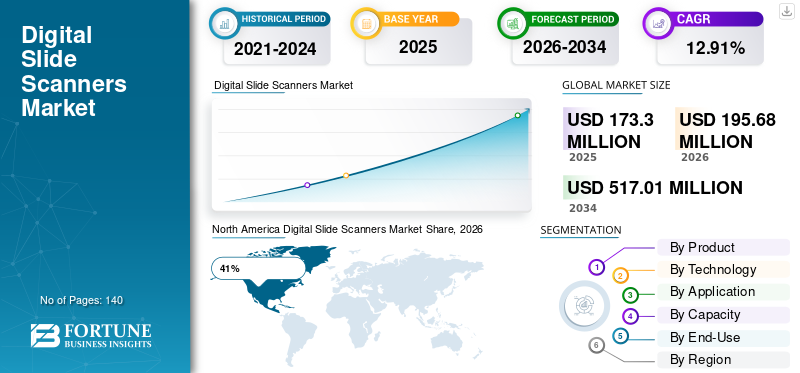
The global digital slide scanners market size was valued at USD 173.3 Million in 2025. The market is projected to grow from USD 195.68 Million in 2026 to USD 517.01 Million by 2034, exhibiting a CAGR of 12.91% during the forecast period.

The digital slide scanners market is experiencing significant expansion due to increasing adoption of digital pathology solutions across hospitals, diagnostic laboratories, research institutions, and academic centers. Digital slide scanners enable high-resolution conversion of glass pathology slides into digital images, improving workflow efficiency, image sharing, diagnostic accuracy, and remote collaboration. Growing demand for automated pathology systems, integration of artificial intelligence in diagnostics, and increasing emphasis on precision medicine are supporting market growth. The digital slide scanners market report highlights rising investments in pathology digitization, growing laboratory automation initiatives, and increasing utilization of whole-slide imaging technologies as major factors contributing to industry development across healthcare and life science sectors.
The United States digital slide scanners market remains one of the most advanced globally due to widespread adoption of digital pathology platforms and strong investment in healthcare technology innovation. Hospitals, cancer centers, and research organizations increasingly utilize digital slide scanners to improve pathology workflows and support telepathology applications. Growing demand for remote diagnostics, increasing cancer screening activities, and rising implementation of artificial intelligence-assisted pathology tools are accelerating market adoption. Academic institutions and biotechnology companies are also investing heavily in digital imaging infrastructure to support research and drug discovery programs. Continuous technological innovation and strong regulatory support for digital pathology adoption further strengthen the market outlook in the United States.
Download Free sample to learn more about this report.
 Global Market Size & Forecast
 Market Share
 Key Regional Highlights
North America
North America led the market with a 41% share, supported by advanced digital pathology infrastructure and growing adoption of automated laboratory workflows.
Europe
Europe accounted for 29% of the market, driven by increasing digitalization of pathology and demand for advanced diagnostic imaging.
Asia-Pacific
Asia-Pacific held a 22% share, supported by expanding healthcare infrastructure and rising adoption of digital pathology technologies.
U.S
The U.S. remains a key market, supported by advanced pathology infrastructure and strong adoption of digital diagnostic technologies.
Japan
Japan accounted for approximately 8% of the Asia-Pacific market, supported by advanced healthcare capabilities and growing adoption of digital pathology solutions.
Read More

The digital slide scanners market trends indicate a growing shift toward fully automated scanning systems capable of processing large slide volumes with minimal human intervention. Healthcare institutions are increasingly adopting digital pathology workflows to improve efficiency, reduce diagnostic turnaround times, and facilitate remote consultations. High-capacity scanners with advanced image quality and rapid scanning capabilities are becoming increasingly important in pathology laboratories managing growing sample volumes. Integration of cloud-based storage systems and digital pathology platforms is also supporting collaborative diagnostics and data management across healthcare networks.
Download Free sample to learn more about this report.
Another major trend influencing the digital slide scanners market outlook is the growing incorporation of artificial intelligence and machine learning technologies into pathology workflows. Digital slide scanners are increasingly being paired with image analysis software capable of supporting disease detection, tissue classification, and biomarker analysis. Manufacturers are also focusing on improving scanning accuracy, image resolution, and interoperability with laboratory information management systems. Growing adoption of telepathology services, rising demand for precision medicine, and increasing investments in personalized healthcare are further contributing to market expansion. These developments continue to transform pathology practices and strengthen the role of digital slide scanning technologies in modern healthcare environments.
Growing Adoption of Digital Pathology and Precision Diagnostics
The primary driver supporting digital slide scanners market Growth is the increasing adoption of digital pathology solutions across healthcare systems worldwide. Pathology laboratories are transitioning from traditional microscope-based workflows to digital imaging platforms that improve diagnostic efficiency and facilitate remote consultations. Digital slide scanners enable rapid conversion of pathology specimens into high-resolution digital images, supporting collaboration among pathologists and improving access to specialized expertise. Growing demand for precision medicine and personalized treatment approaches is further increasing the need for advanced pathology technologies capable of delivering accurate and reproducible results. Healthcare providers are investing in laboratory automation solutions to manage rising diagnostic workloads and improve operational efficiency. In addition, increasing cancer incidence rates and expanding research activities in oncology and life sciences are creating substantial demand for digital pathology infrastructure. Integration of artificial intelligence and image analysis tools with digital slide scanners is also enhancing diagnostic capabilities, supporting widespread adoption across hospitals, academic institutions, and research laboratories.
High Implementation and Infrastructure Costs
One of the major restraints affecting the digital slide scanners market is the substantial investment required for implementation and infrastructure development. Digital pathology systems involve significant expenditures related to scanner acquisition, image storage infrastructure, software integration, and laboratory workflow transformation. Smaller healthcare facilities and diagnostic laboratories may face challenges in allocating sufficient budgets for large-scale digitization projects. In addition, the management of high-resolution pathology images requires extensive data storage and advanced information technology infrastructure, increasing operational complexity. Regulatory requirements, validation procedures, and staff training needs can further delay implementation timelines. Integration challenges with existing laboratory information systems may also create barriers for healthcare providers seeking digital transformation. While the long-term benefits of digital pathology are widely recognized, financial constraints remain an important factor influencing adoption rates, particularly in resource-limited healthcare environments and developing economies.
Expansion of Artificial Intelligence-Enabled Pathology Solutions
A major opportunity within the digital slide scanners market Opportunities landscape is the growing integration of artificial intelligence into pathology workflows. AI-powered image analysis platforms are transforming disease detection, biomarker identification, and diagnostic decision support, creating strong demand for high-quality digital pathology images generated by advanced slide scanners. Healthcare organizations are increasingly investing in AI-enabled diagnostic ecosystems that rely on digital pathology infrastructure for image acquisition and analysis. Research institutions and pharmaceutical companies are also utilizing digital slide scanners for drug development, clinical trials, and biomarker research activities. Growing telepathology adoption and increasing demand for remote pathology consultations further strengthen market opportunities. Emerging markets are investing in healthcare modernization programs and pathology digitization initiatives, creating new growth avenues for manufacturers. Strategic partnerships between scanner manufacturers, software developers, and healthcare institutions are expected to accelerate innovation and support long-term market expansion.
Data Management and Interoperability Complexities
The Digital Slide Scanners Industry Report identifies data management and interoperability as major challenges facing market participants. Digital pathology systems generate extremely large image files that require significant storage capacity, robust network infrastructure, and secure data management solutions. Healthcare providers must ensure efficient image access, retrieval, and sharing while maintaining compliance with privacy and security regulations. Interoperability challenges between scanners, image management software, and laboratory information systems can complicate workflow integration and reduce operational efficiency. Standardization issues across different digital pathology platforms may also hinder seamless collaboration among healthcare institutions. In addition, laboratories must invest in cybersecurity measures to protect sensitive patient data and prevent unauthorized access. Addressing these technical and operational challenges requires ongoing investment in infrastructure, software development, and industry-wide standardization efforts to ensure successful implementation of digital pathology solutions.
Automated digital slide scanners accounted for approximately 72% of the global digital slide scanners market share due to increasing demand for high-throughput pathology workflows and laboratory automation systems. These scanners are widely used across hospitals, diagnostic laboratories, pharmaceutical companies, and research institutions because they significantly reduce manual intervention while improving scanning accuracy and workflow efficiency. Automated systems are capable of processing large volumes of pathology slides with consistent image quality, making them highly suitable for cancer diagnostics, biomarker research, and telepathology applications. Healthcare organizations increasingly prefer automated scanners because they support continuous operation, rapid image acquisition, and seamless integration with laboratory information systems and artificial intelligence-based pathology platforms.
Manual digital slide scanners represented nearly 28% of the digital slide scanners market and remain important in smaller laboratories, academic institutions, and low-volume pathology settings. These systems are preferred by facilities seeking cost-effective digital imaging solutions without requiring large-scale automation infrastructure. Manual scanners provide flexibility for customized scanning procedures and are commonly utilized in educational institutions and specialized pathology research applications where slide throughput requirements are relatively lower. Healthcare providers often choose manual systems due to their lower acquisition costs and simplified operational requirements compared with fully automated platforms. Manufacturers are improving manual scanner capabilities by introducing user-friendly interfaces, compact designs, and enhanced imaging technologies that support high-resolution pathology visualization.
To know how our report can help streamline your business, Speak to Analyst
The technology segment accounted for approximately 34% of the digital slide scanners market due to increasing adoption of advanced imaging technologies such as brightfield scanning, fluorescence imaging, and multispectral imaging systems. Healthcare providers and research institutions are increasingly investing in advanced scanning technologies capable of delivering highly accurate and high-resolution digital pathology images for disease diagnosis and biomedical research applications. Brightfield imaging remains widely utilized in routine pathology workflows, while fluorescence and multispectral technologies are gaining popularity in oncology research and biomarker analysis. Continuous technological advancements in image processing, scanning speed, and artificial intelligence integration are significantly improving diagnostic capabilities and laboratory productivity. Manufacturers are focusing on developing high-performance scanning systems compatible with digital pathology software, cloud-based data management platforms, and laboratory automation systems. Growing emphasis on precision medicine and personalized healthcare is also contributing to rising demand for advanced pathology imaging technologies.
The application segment represented nearly 29% of the digital slide scanners market and includes diagnostic pathology, telepathology, drug discovery, academic research, and disease screening applications. Diagnostic pathology remains the largest application area due to increasing utilization of digital imaging systems for cancer detection, tissue analysis, and pathology consultations. Telepathology adoption is also expanding rapidly as healthcare providers seek remote diagnostic solutions capable of connecting pathologists across different geographic locations. Pharmaceutical and biotechnology companies are increasingly utilizing digital slide scanners in drug development and clinical research programs to improve workflow efficiency and image-based analysis.
Academic and research institutions continue to invest in digital pathology technologies to support pathology education, image sharing, and collaborative biomedical research initiatives. Growing incidence of chronic diseases and increasing need for accurate diagnostic solutions are further strengthening market demand. Manufacturers are developing application-specific scanners with advanced software integration capabilities to improve operational flexibility and support specialized pathology requirements. Rising healthcare digitization initiatives and growing laboratory automation trends continue to contribute significantly to application segment expansion within the Digital Slide Scanners Industry.
The capacity segment accounted for approximately 21% of the digital slide scanners market due to increasing demand for both low-capacity and high-capacity scanning systems tailored to different laboratory environments. High-capacity digital slide scanners are increasingly preferred by large hospitals, reference laboratories, and cancer centers because they can process hundreds of slides continuously with minimal manual intervention. These systems improve operational efficiency and reduce diagnostic turnaround times in facilities handling large pathology workloads. Low-capacity scanners remain important for smaller pathology laboratories, educational institutions, and research facilities requiring cost-effective digital imaging solutions.
Manufacturers are introducing scalable scanner platforms capable of supporting varying throughput requirements across healthcare environments. Increasing pathology sample volumes, expanding cancer screening programs, and rising telepathology adoption are supporting demand for high-capacity systems globally. In addition, healthcare providers are seeking flexible solutions capable of adapting to future workflow expansion and artificial intelligence integration. The capacity segment continues to evolve as laboratories increasingly prioritize productivity, automation, and digital transformation within pathology operations.
The end-use segment represented nearly 16% of the digital slide scanners market and includes hospitals, diagnostic laboratories, academic institutions, pharmaceutical companies, and contract research organizations. Hospitals and diagnostic laboratories remain the largest end users due to increasing adoption of digital pathology systems for routine clinical diagnostics and remote consultation services. Academic institutions utilize digital slide scanners extensively for pathology education, research collaboration, and training programs. Pharmaceutical and biotechnology companies increasingly rely on digital pathology infrastructure for drug development, biomarker analysis, and clinical trial support activities. Contract research organizations are also adopting digital slide scanners to improve research efficiency and support image-based pathology studies for pharmaceutical clients.
North America Digital Slide Scanners Market Share, 2026 (%)
To get more information on the regional analysis of this market, Download Free sample
North America accounted for approximately 41% of the global digital slide scanners market share due to strong adoption of digital pathology solutions, advanced healthcare infrastructure, and increasing investment in laboratory automation technologies. The region benefits from widespread implementation of precision medicine programs and strong demand for telepathology services across hospitals, diagnostic laboratories, and research institutions. Healthcare providers in the United States and Canada are increasingly adopting automated digital slide scanners to improve diagnostic efficiency, reduce turnaround times, and support remote pathology consultations. Growing incidence of cancer and rising pathology workloads are also driving demand for high-capacity digital imaging systems. Pharmaceutical companies and academic institutions are heavily investing in digital pathology platforms to support drug discovery, biomarker analysis, and clinical research applications. Manufacturers are continuously introducing advanced scanners with improved image resolution, artificial intelligence integration, and cloud-based data management capabilities to strengthen competitiveness within the region.
Europe held nearly 29% of the digital slide scanners market share and remains one of the leading regional markets due to increasing pathology digitization initiatives and strong adoption of healthcare automation technologies. Countries including Germany, the United Kingdom, France, and Italy are actively investing in digital pathology infrastructure to improve diagnostic workflows and support precision medicine programs. Healthcare institutions are increasingly implementing automated slide scanning systems to enhance image sharing, pathology collaboration, and laboratory productivity. Rising prevalence of cancer and growing demand for efficient pathology services are also contributing significantly to regional market growth. Academic institutions and research organizations across Europe are utilizing digital slide scanners extensively for pathology education, biomedical research, and pharmaceutical development activities. Manufacturers are introducing technologically advanced products featuring artificial intelligence integration, high-throughput scanning capabilities, and cloud-based pathology platforms to strengthen market penetration. In addition, favorable healthcare policies and increasing investments in telemedicine infrastructure are supporting widespread adoption of digital pathology solutions throughout the region.
Germany represented approximately 26% of the European digital slide scanners market due to strong healthcare infrastructure, increasing laboratory automation initiatives, and rising adoption of digital pathology technologies. Hospitals, cancer centers, and research institutions across the country are increasingly investing in automated digital slide scanners to improve workflow efficiency and diagnostic accuracy. Growing demand for precision medicine and personalized cancer treatment approaches is significantly supporting adoption of advanced pathology imaging systems. German healthcare providers increasingly prefer digital pathology solutions because they facilitate rapid image sharing, remote consultations, and artificial intelligence-assisted diagnostics. Academic institutions and biotechnology companies are also investing heavily in pathology digitization projects to support biomedical research and drug development activities. Manufacturers operating in Germany are focusing on introducing high-resolution scanners with advanced image management capabilities and laboratory information system integration features.
The United Kingdom accounted for nearly 4% of the European digital slide scanners market due to increasing adoption of telepathology solutions and growing investment in healthcare digitization programs. Hospitals and pathology laboratories across the country are implementing digital slide scanning systems to improve diagnostic collaboration, pathology reporting efficiency, and laboratory productivity. Rising cancer incidence rates and increasing pressure on pathology services are encouraging healthcare institutions to adopt advanced digital pathology infrastructure. Academic and research organizations are also utilizing digital slide scanners extensively for pathology education, disease research, and pharmaceutical development activities. Manufacturers are introducing high-capacity scanners with cloud connectivity and artificial intelligence integration capabilities to support evolving laboratory requirements. The market is also benefiting from strong government support for digital healthcare transformation and expansion of remote diagnostic services. Healthcare providers increasingly recognize the advantages of digital pathology in reducing turnaround times and improving access to specialist expertise.
Asia-Pacific captured approximately 22% of the global digital slide scanners market share and is emerging as one of the fastest-growing regions due to rapid healthcare infrastructure development and increasing adoption of digital pathology solutions. Countries including China, Japan, India, South Korea, and Australia are witnessing rising investment in laboratory automation, cancer diagnostics, and telemedicine technologies. Healthcare providers across the region are increasingly implementing digital slide scanners to improve pathology efficiency and address growing diagnostic workloads. Rising prevalence of chronic diseases and increasing demand for precision medicine are also contributing significantly to market expansion. Governments and private healthcare organizations are investing heavily in pathology digitization projects and healthcare modernization initiatives. Manufacturers are expanding regional operations and introducing cost-effective scanning systems tailored to local market requirements. Academic institutions and pharmaceutical companies are increasingly utilizing digital pathology platforms for biomedical research, clinical trials, and pathology training applications. Increasing adoption of artificial intelligence-assisted pathology workflows and cloud-based image management systems continues to strengthen long-term market opportunities throughout the Asia-Pacific digital slide scanners market .
Japan represented approximately 8% of the Asia-Pacific digital slide scanners market due to strong technological advancement and increasing adoption of digital healthcare systems. Healthcare providers across the country are investing heavily in automated pathology solutions to improve diagnostic efficiency and support precision medicine programs. Hospitals and research institutions increasingly utilize digital slide scanners for cancer diagnostics, pathology consultations, and biomedical research activities. Japanese consumers and healthcare organizations place strong emphasis on technological quality and operational accuracy, encouraging manufacturers to introduce advanced high-resolution scanning systems with artificial intelligence integration features. Academic institutions are also expanding digital pathology training programs and collaborative research initiatives utilizing whole-slide imaging technologies. Manufacturers are focusing on product innovation, cloud integration, and compact scanner designs to meet evolving laboratory requirements. Increasing demand for remote pathology consultations and rising investment in telemedicine infrastructure continue to support market growth.
China accounted for approximately 36% of the Asia-Pacific digital slide scanners market and remained the leading regional contributor due to rapid healthcare modernization and increasing demand for pathology automation technologies. Hospitals and diagnostic laboratories across the country are adopting digital pathology systems to improve efficiency, reduce diagnostic workloads, and support expanding cancer screening programs. Government investment in healthcare digitization and precision medicine initiatives is significantly supporting market growth. Healthcare providers increasingly utilize digital slide scanners to facilitate image sharing, telepathology services, and artificial intelligence-assisted diagnostics. Pharmaceutical and biotechnology companies are also investing heavily in digital pathology infrastructure to support drug development and biomedical research activities. Manufacturers are strengthening local production capabilities and expanding distribution networks to improve market penetration throughout China. Rising awareness regarding the benefits of digital pathology and increasing adoption of cloud-based healthcare technologies continue to create favorable market conditions.
The Rest of World region represented approximately 8% of the global digital slide scanners market share and includes Latin America, the Middle East, and Africa. Although adoption rates remain lower compared with North America and Europe, increasing investment in healthcare modernization and pathology automation technologies is creating favorable growth opportunities. Hospitals and diagnostic laboratories across emerging economies are gradually implementing digital pathology systems to improve diagnostic workflows and support remote consultation services. Rising incidence of cancer and growing demand for accurate pathology diagnostics are encouraging healthcare providers to invest in advanced imaging technologies. Governments and healthcare organizations are increasingly focusing on telemedicine infrastructure development and laboratory digitization initiatives. Manufacturers are introducing cost-effective digital slide scanning systems designed for resource-limited healthcare settings. Academic institutions and research laboratories are also expanding utilization of digital pathology technologies for training and collaborative research purposes. Growing awareness regarding precision medicine and increasing adoption of healthcare information technologies are expected to support future growth within the Rest of World Digital Slide Scanners Industry.
The digital slide scanners market Opportunities landscape is attracting substantial investment from healthcare technology companies, pathology solution providers, venture capital firms, and life science organizations seeking to capitalize on the growing adoption of digital pathology. Investments are increasingly focused on developing advanced whole-slide imaging systems, cloud-based pathology platforms, and artificial intelligence-powered diagnostic solutions. Healthcare providers are allocating significant resources toward pathology digitization projects to improve diagnostic accuracy, enhance operational efficiency, and support remote consultation services. Pharmaceutical and biotechnology companies are also investing heavily in digital pathology infrastructure to accelerate drug discovery, biomarker analysis, and clinical research programs. These developments are creating strong demand for high-capacity and automated digital slide scanning systems capable of handling large pathology workloads.
A major opportunity within the digital slide scanners market involves expanding adoption of artificial intelligence-assisted pathology solutions. Digital slide scanners serve as critical components of AI-enabled diagnostic ecosystems by providing high-quality image acquisition capabilities. Emerging markets are increasingly investing in healthcare modernization initiatives, creating new opportunities for manufacturers to expand market presence. Strategic partnerships among scanner manufacturers, software developers, healthcare institutions, and research organizations are accelerating technological innovation.
Innovation remains a major growth driver within the digital slide scanners market as manufacturers continuously develop advanced scanning systems designed to improve image quality, speed, automation, and diagnostic workflow efficiency. Companies are increasingly introducing high-throughput digital slide scanners capable of processing large volumes of pathology specimens with minimal manual intervention. Enhanced image resolution, improved autofocus technologies, and advanced color accuracy capabilities are becoming standard features in next-generation products. Manufacturers are also integrating cloud connectivity and digital pathology software platforms to support collaborative diagnostics and remote pathology consultations.
Artificial intelligence integration has emerged as one of the most important areas of new product development within the Digital Slide Scanners Industry. Manufacturers are designing scanners optimized for machine learning applications and automated image analysis workflows. Compact scanner designs, improved slide handling mechanisms, and scalable storage solutions are also being introduced to address the evolving requirements of hospitals, diagnostic laboratories, and research institutions. Additionally, product developers are focusing on interoperability with laboratory information management systems and pathology workflow software to improve operational efficiency.
The digital slide scanners market report provides comprehensive analysis of industry dynamics, technology trends, competitive landscape, market segmentation, and regional growth opportunities within the global digital pathology sector. The report evaluates major product categories including automated digital slide scanners and manual digital slide scanners while examining their applications across pathology diagnostics, telepathology, pharmaceutical research, and academic institutions. It assesses key market drivers, restraints, opportunities, and challenges influencing adoption patterns among hospitals, laboratories, and life science organizations. Particular emphasis is placed on advancements in whole-slide imaging, laboratory automation, artificial intelligence integration, and cloud-based pathology platforms.
Request for Customization to gain extensive market insights.
The digital slide scanners market Research Report also provides detailed insights into technology adoption trends, end-user demand patterns, investment activities, and competitive positioning strategies employed by major industry participants. Regional analysis covers North America, Europe, Asia-Pacific, and Rest of World markets along with country-level evaluations for Germany, the United Kingdom, Japan, and China. The report examines the impact of healthcare digitization, telepathology expansion, precision medicine initiatives, and pathology workflow modernization on industry development. Strategic assessment of product innovation, research collaborations, and emerging growth opportunities offers valuable information for healthcare providers, investors, manufacturers, and business decision-makers operating within the Digital Slide Scanners Industry.
Fortune Business Insights says that the global market value stood at USD 173.3 million in 2025 and is projected to reach USD 517.01 million by 2034.
The market is expected to exhibit a CAGR of 12.91% during the forecast period of 2026-2034.
The automated digital slide scanners segment led the market, accounting for approximately 72% of the market share due to rising demand for high-throughput pathology workflows and laboratory automation.
Key players include Hamamatsu Photonics, 3DHISTECH, Leica Biosystems (Danaher Corporation), Olympus Corporation, Roche Digital Pathology (Ventana Medical Systems), and Indica Labs.
Major trends include fully automated high-capacity scanning systems and cloud-based digital pathology platforms, along with growing AI/ML integration and telepathology adoption. North America led with approximately 41% of the global market share.


(Offer valid till 31st Oct 2026)
Get 30-60 hrs Free Customization
Expand Regional and Country Coverage, Segments Analysis, Company Profiles, Competitive Benchmarking, and End-user Insights.




















Get In Touch With Us
US +1 833 909 2966 ( Toll Free )
Receive a tailored pricing based on your needs.
Discuss your questions with our industry experts.
Have questions? Get quick answers before you purchase.

