Digitally Printed Wallpaper Market Size, Share & Industry Analysis, By Printing Technology (Inject and Electrophotography), By Substrate (Nonwoven, Vinyl, Paper, and Others), By End-Use (Residential, Retail & Boutique, Automotive & Transportation, Corporate Offices & Co-Working Spaces, and Others), By Distribution Channel (B2B/Contract Channels, Specialty Stores, Online Retail, and Others), and Regional Forecast, 2026-2034
 Download Free Sample
(Offer valid till 15th Oct 2026)

Digitally Printed Wallpaper Market Size and Future Outlook
 Listen to Audio Version
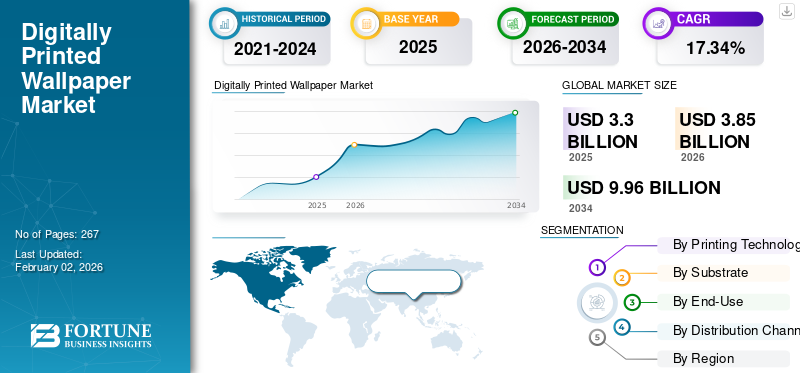
The global digitally printed wallpaper market size was valued at USD 3.30 billion in 2025 and is projected to grow from USD 3.85 billion in 2026 to USD 9.96 billion by 2034, exhibiting a CAGR of 17.34% during the forecast period. Asia Pacific dominated the global market with a share of 38.54% in 2025.
Digitally printed wallpaper is a wallcovering produced by large-format digital printers that apply ink directly to paper, non-woven, vinyl, or textile substrates to create bespoke patterns, photo-real murals, or repeat designs without the need for traditional screens or plates. It’s used across residential feature walls, hospitality (hotels, restaurants), retail and corporate fit-outs, healthcare, education, and events, essentially wherever high-impact, made-to-measure graphics are required. Such printed wallpaper designs support a wide range of substrates and technical finishes, such as fire ratings, washable/contract grades, acoustic or waterproof options. The key product features are true customization, fast turnaround, and low minimums, broad substrate choice, including paper, vinyl, textile, peel-and-stick, and increasingly measurable sustainability credentials when wallpaper manufacturers use solvent-free inks or recycled/eco substrates.
Market growth is being driven by growing demand for personalization and brand storytelling, the rise of online marketplaces, rapid content growth on POD platforms, continuous improvements in digital print technology and inks, and stronger specification activity from architects/interior designers.
- According to the Craft Industry Alliance organization, reported by Spoonflower, the print-on-demand fabric company, witnesses 4,000 new designs uploaded per day, showing very high new-design velocity and supply for bespoke wallpapers.
Key players, including Vescom, Muraspec, Spoonflower, Wall&deco, and Graham & Brown, are responding very rapidly to ever-changing consumer demands.
- For instance, Vescom pushes contract-grade, sustainability-led solutions for architects and large projects, whereas Muraspec emphasizes bespoke digital capability with contract certifications and EPDs. Spoonflower scales long-tail demand via a designer marketplace and is a true print-on-demand company.
Download Free sample to learn more about this report.
Digitally Printed Wallpaper Market Key Takeaways
 Market Size & Forecast
- 2025 Market Size: USD 3.30 billion
- 2026 Market Size: USD 3.85 billion
- 2034 Forecast Market Size: USD 9.96 billion
- CAGR: 17.34% from 2026–2034
 Market Share
- Asia Pacific dominated the digitally printed wallpaper market with a 38.54% share in 2025.
- Inkjet printing technology is projected to account for 81.32% of the market share in 2026.
- Vinyl substrate is expected to hold a 39.90% market share in 2026.
 Key Regional Highlights
Asia Pacific
Asia Pacific was valued at USD 1.27 Billion in 2025 and is projected to reach USD 1.51 Billion in 2026.
North America
North America was valued at USD 1.04 Billion in 2025 and is projected to reach USD 1.20 Billion in 2026.
Europe
Europe reached USD 0.80 billion in 2025 and is projected to grow to USD 0.91 billion by 2026
U.S.
The U.S. market was valued at USD 1.04 Billion in 2025 and is projected to reach USD 1.20 Billion in 2026.
Japan
Japan is expected to support regional market expansion through rising adoption of modern interior aesthetics and growing demand for customized residential décor products.
Read More

MARKET DYNAMICS
MARKET DRIVERS:
Growing Print-On-Demand & Designer Marketplaces to Boost Market Growth
Rise of print-on-demand platforms and designer marketplaces that unlock personalization at scale. They combine large-format digital printing, e-commerce fulfillment, and global distribution so anyone, including homeowners, designers, retailers, or specifiers, can order one-off or small-batch murals with fast turnaround and no minimums. That removes the historic barriers of high setup cost and inventory, fuels a massive long-tail of designs, raises average order value for bespoke projects, and expands the addressable market from big commercial jobs to everyday consumers, all while enabling more sustainable, made-to-order production, leading to digitally printed wallpaper market growth.
- Etsy, Inc. is an American e-commerce company, generated USD 12.6 billion Gross Merchandise Sales (GMS) in 2024, with Home & Living being a top category. This highlights strong demand and spending power in personalized home décor channels that overlap with POD wallpaper buyers.
MARKET RESTRAINTS:
Installation Complexity & Labor Cost to Restrict Market Expansion
Installation of computerized printed wallpaper is often a more demanding and complex process. Successful hanging depends on careful wall preparation steps, including smoothing, priming, or skim-coating textured walls. Precise pattern matching and seam alignment, accurate cutting around outlets and trim, and choosing the correct adhesive/backing for the substrate, all of which require skill and experience to avoid visible seams, bubbling, or premature failure. Practical how-to guides and installer advice stress that the substrate, paste choice, and preparation are the three most common causes of visible defects. That complexity translates directly into time and labor cost.
- U.S. industry aggregators report an average labor cost of around USD 567 per room. Therefore, many consumers avoid bespoke digital murals or opt for cheaper peel-and-stick alternatives and turnkey packages that include professional hanging, thus hampering market growth.
MARKET OPPORTUNITIES:
Offering One-Stop Customer Solution to Create Lucrative Growth Opportunities
A strong growth opportunity in the market is to offer a one-stop customer journey. Allowing consumers to design or pick a custom digitally printed wallpaper via a marketplace or D2C site, preview it on their wall with AR/visualization tools at checkout, and then buy an optional vetted professional installation service creates a comprehensive solution. This removes the two biggest purchase frictions, i.e., uncertainty about how the design will look in place, and the fear/cost of a poor installation. This can increase the conversion, justify higher average order values, and create recurring revenue from installation, maintenance, and future room refreshes.
Download Free sample to learn more about this report.
DIGITALLY PRINTED WALLPAPER MARKET TRENDS:
Rise of Customization and Mass Personalization in Wallcoverings to be a New Market Trend
The market for digitally printed wallpaper is benefiting from a larger shift in consumer behavior toward personalization and customization in all kinds of products. Customers increasingly expect products tailored to their taste, space, and usage, not one-size-fits-all décor. Print-on-demand platforms make it feasible to offer highly customized wallpaper (size, color, pattern) with no minimums, enabling a long tail of designs.
- Shopify retailers that integrated AR experiences reported a 40% increase in order conversion and a 5% reduction in return rate.
- American Chase, a retailer’s AR product trials, were claimed to show 40% higher conversion rates.
Segmentation Analysis
By Printing Technology
Inject Leads with Versatility, Scale, and Cost-Efficient Customization Contributing to Segmental Growth
On the basis of printing technology, the market is classified into inject and electrophotography.
To know how our report can help streamline your business, Speak to Analyst
Inkjet technology will dominate the market, as it will offer significantly greater versatility, scalability, and cost efficiency compared to electrophotography, accounting for an 81.32% market share in 2026. Inkjet systems can print directly on a wide range of substrates from vinyl and paper to non-woven and textiles, and handle both short-run custom murals and higher-volume rolls with equal flexibility. This makes inkjet especially attractive for residential customization, contract projects (hotels, retail, offices), and online print-on-demand platforms where small minimums and design variety are critical.
The electrophotography (laser-based) is projected to expand at a CAGR of 19.16% over the projected years.
By Substrate
Durability, Versatility, and Strong Commercial Adoption Contributed to Vinyl Dominance
In terms of substrate, the market is categorized into non-woven, vinyl, paper, and others.
The vinyl segment will account for 39.90% in 2026. In 2025, the segment is anticipated to dominate with a 42.75% share. Vinyl digital wallpapers are highly resistant to moisture, abrasion, and stains. That makes them the most suitable in hospitality, healthcare, and high-traffic commercial spaces, which are high-value end-users of digital wallcoverings. Also, vinyl substrates accept a variety of ink types, including UV, solvent, and latex, very well, producing vibrant colors and high durability, which is important for custom murals and large-scale designs. The wide cost spectrum from budget peel-and-stick to premium contract-grade vinyl, the range covers multiple consumer and commercial segments, which supports the growth of the product.
The non-woven segment is expected to grow at a CAGR of 18.68% over the forecast period.
By End-Use
Homeowners Drive High-Volume Demand for Personalized Décor which Led Growth of Residential End-Use
Based on end-use, the market is segmented into residential, retail & boutique, automotive & transportation, corporate offices & co-working spaces, and others.
The residential segment held the dominating position in 2026 since homeowners and interior decorators drive the largest volume of demand for digitally printed feature walls, custom murals, and personalized décor. By end-use, the residential segment held a share of 49.96% in 2026. Digital printing makes it possible to order low-minimum, made-to-measure designs online, which aligns perfectly with the surge in DIY renovation and home personalization trends. The application of wallpaper in apartments compliments the artistic appeal of the interiors, and with the growing urbanization and migration of masses from rural areas to metropolitan supplements product demand.
- Online marketplaces and D2C brands, such as Spoonflower, Photowall, Graham & Brown, have further expanded accessibility, making residential the highest-volume end-use.
Retail & boutique, automotive & transportation, corporate offices & co-working spaces, among others are the commercial application of digitally printed wallpaper.
By Distribution Channel
High-Value Bulk Orders and Specification-Driven Demand Supplements B2B/Contract Channel Growth
Based on distribution channel, the market is segmented into B2B/contract channels, specialty stores, online retail, and others.
In 2026, the global market was dominated by B2B/contract channels due to large-scale projects in hospitality, retail, healthcare, and corporate offices as they demand high-value, custom wallcoverings that meet strict specifications (fire safety, durability, sustainability certifications). Interior designers, architects, and contractors typically source directly from manufacturers or authorized distributors to ensure compliance and tailored solutions. These bulk, project-based purchases generate higher revenue per order compared to specialty stores or online retail. Furthermore, the segment is expected to account for 53.07% of the market in 2026.
In addition, online retail is the fastest-growing channel and is projected to grow at a CAGR of 19.91% during the study period.
Regional Outlook
By geography, the market is categorized into Europe, North America, Asia Pacific, South America, and Middle East & Africa.
ASIA PACIFIC
Asia Pacific Digitally Printed Wallpaper Market Size, (USD Billion)
To get more information on the regional analysis of this market, Download Free sample
Asia Pacific contributed approximately USD 1.27 billion to the global market in 2025, accounting for 38.54% share, and is expected to reach USD 1.51 billion in 2026. The region is projected to be the fastest growing market and maintain its dominance over the forecast years. The factors fostering the dominance of the region are rapid urbanization, rising disposable incomes, and a strong wave of residential and commercial construction. Countries like China and India are witnessing an expanding middle class with increasing desire for modern, stylish, and customizable home décor solutions. At the same time, booming hospitality, retail, and office sectors across Southeast Asia are investing in vibrant interiors to attract customers and enhance brand identity, creating demand for high-quality, customizable wallcoverings. The region also benefits from its role as a global manufacturing hub with many wallpaper producers and large-format printing technology suppliers based in or operating heavily within Asia. In 2025, the China market is estimated to reach USD 0.74 billion.
Other regions, such as Europe and North America digitally printed wallpaper, are anticipated to witness significant growth in the coming years.
NORTH AMERICA
In 2025, North America held 31.43% of the global market share, reaching a valuation of USD 1.04 billion, and is projected to grow to USD 1.2 billion in 2026. Strong home improvement culture, high disposable incomes, and consumers’ willingness to spend on premium and personalized décor drives regional market growth. Moreover, the region has a well-developed e-commerce ecosystem, allowing print-on-demand platforms and direct-to-consumer brands to scale quickly. While home renovation remains a consistent expenditure in the U.S. alone, homeowners spend hundreds of billions annually on remodeling and interior upgrades which highlights strong growth prospects in the region.
EUROPE
The market in Europe reached USD 0.8 billion in 2025, representing 24.12% of total market revenue, and is projected to reach USD 0.91 billion in 2026. In the region, Germany and the U.K. both are estimated to reach USD 0.2 and 0.17 billion each in 2026. A major emphasis on design, quality, and sustainability drives the European market growth. The region has a large contract market, including hotels, boutique retail, and office projects, that favors bespoke, digitally printed solutions with fire safety and environmental certifications.
Over the forecast period, South America and Middle East & Africa regions are likely to witness moderate growth in this market.
SOUTH AMERICA
In 2025, South America represented USD 0.12 billion, accounting for 3.78% of the worldwide market, and is projected to grow to USD 0.15 billion in 2026. Rising urbanization, expanding middle-class spending on home décor, and increased adoption of affordable digitally printed wallpapers through online and specialty retail channels drive product demand in these regions.
MIDDLE EAST & AFRICA
The Middle East & Africa region captured 2.13% of the global market in 2025, generating USD 0.07 billion in revenue, and is projected to reach USD 0.08 billion in 2026.
COMPETITIVE LANDSCAPE
Key Industry Players:
A Wide Range of Product Offerings, Coupled with a Strong Distribution Network, to Strengthen Positions of Key Players in Market
Several prominent players shape the competitive landscape of the market, each with distinct strategies to stay competitive. Spoonflower and Vescom are some of the prominent players in the market. Spoonflower, operates a print-on-demand marketplace that empowers independent artists to upload designs, giving consumers access to more than a million patterns without inventory limitations, a strategy that leverages community creativity and scalability. Vescom, by contrast, emphasizes contract-grade wallcoverings by offering digitally printed designs on high-performance substrates that meet fire safety and durability standards, while also launching sustainable product lines to appeal to architects and specifiers seeking eco-friendly solutions.
Apart from this, other prominent players in the market include Muraspec, Omexco, Wall&decò, and Graham & Brown. Collectively, these brands highlight how technical compliance, premium design, and digital innovation are central to competitiveness in the evolving wallpaper market.
LIST OF KEY DIGITALLY PRINTED WALLPAPER COMPANIES PROFILED:
- Spoonflower (U.S.)
- Vescom (Netherlands)
- Muraspec (U.K.)
- Omexco (Belgium)
- Graham & Brown (U.K.)
- Wall&decò (Italy)
- A.S. Création Tapeten AG (U.S.)
- York Wallcoverings (U.S.)
- Cole & Son (U.K.)
- Inkiostro Bianco (Italy)
KEY INDUSTRY DEVELOPMENTS:
- December 2024: Swedish private equity firm Priveq made a strategic investment in Gimmersta Wallpaper, acquiring a minority stake while allowing founders Irene and Christofer Gimmersta to remain majority owners. This partnership aims to accelerate international expansion, deepen product capability, and ultimately target a potential IPO when market conditions align for Priveq.
- June 2025: DuPont is expanding its role in the wallcoverings market with its Tedlar® film technology. The company has partnered with Wallquest to launch a new line of wallcoverings that use DuPont Tedlar. These wallcoverings combine attractive design with strong durability, chemical resistance, and easy cleaning. They are especially useful in high-performance interiors such as hotels, healthcare facilities, and other demanding spaces.
- June 2024: Thibaut, a 138-year-old U.S. manufacturer of fabrics, wallpaper, and furniture acquired the textile brand Rosemary Hallgarten. This acquisition is aimed at strengthening Thibaut’s design and product breadth.
- May 2024: Charger Investment Partners announced it had acquired Wolf-Gordon Inc., a designer, marketer, and supplier of premium interior surface products, including commercial and PVC-free wallcoverings.
REPORT COVERAGE
The global digitally printed wallpaper market analysis provides an in-depth study of market size & forecast by all the market segments included in the report. It includes details on the market dynamics and market trends expected to drive the market during the forecast period. It offers information on the technological advancements, new product launches, key industry developments, and details on partnerships, mergers & acquisitions. The market research report also encompasses a detailed competitive landscape with information on the market share and profiles of key operating players.
Request for Customization to gain extensive market insights.
Report Scope & Segmentation
| ATTRIBUTES | DETAILS |
| Study Period | 2021-2034 |
| Base Year | 2025 |
| Estimated Year | 2026 |
| Forecast Period | 2026-2034 |
| Historical Period | 2021-2024 |
| Growth Rate | CAGR of 17.34% from 2026-2034 |
| Unit | Value (USD Billion) |
| Segmentation |
By Printing Technology
By Substrate
By End-Use
By Distribution Channel
By Region
|
Frequently Asked Questions
Fortune Business Insights says that the global market value stood at USD 3.30 billion in 2025 and is projected to reach USD 9.96 billion by 2034.
In 2025, the market value stood at USD 1.27 billion.
The market is expected to exhibit a CAGR of 17.34% during the forecast period of 2026-2034.
The inject segment led the market by printing technology.
The key factors driving the market are growing demand for personalization and brand storytelling, the rise of online marketplaces, rapid content growth on POD platforms, and continuous improvements in digital print technology and inks.
Vescom, Muraspec, Spoonflower, Wall&deco, and Graham & Brown are some of the prominent players in the market.
Asia Pacific dominated the global market with a share of 38.54% in 2025.
One-stop solution from selecting custom digitally printed wallpaper via a marketplace or D2C site, preview it on their wall with AR/visualization tools at checkout, and then buy an optional vetted professional installation service alternatives are expected to favor the product adoption.



- 2021-2034
- 2025
- 2021-2024
- 267
-
(Offer valid till 15th Oct 2026)
Get 30-60 hrs Free Customization
Expand Regional and Country Coverage, Segments Analysis, Company Profiles, Competitive Benchmarking, and End-user Insights.



















-
US +1 833 909 2966 ( Toll Free )
-
Get In Touch With Us