 Download Free Sample



Get a Quote
Receive a tailored pricing based on your needs.
- Choose license type
- Multiple user options
- Custom scope & coverage
- Fast turnaround
"Designing Growth Strategies is in our DNA"
 Listen to Audio Version
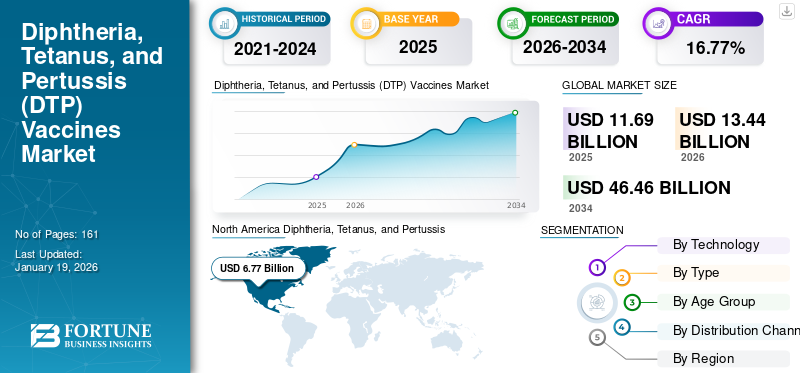
The global diphtheria, tetanus, and pertussis (DTP) vaccines market size was valued at USD 11.69 billion in 2025. The market is projected to grow from USD 13.44 billion in 2026 to USD 46.46 billion by 2034 at a CAGR of 16.77% during the forecast period. North America dominated the diphtheria, tetanus, and pertussis (DTP) vaccines market with a market share of 40.92% in 2025.
Diphtheria, tetanus, and pertussis (DTP) vaccines refer to a combination vaccine that protects infants and children against three serious bacterial infections: diphtheria, tetanus, and pertussis (whooping cough). Different types of DTP vaccines exist for adults and infants, such as DTaP, Tdap, and others.
The complications associated with pertussis include pneumonia, vomiting, seizures, shortness of breath, and apnea. Tetanus affects nerves all over the body, causing severe muscle spasms, and diphtheria leads to a throat infection, which can block the airway and cause severe breathing problems. Thus, avoiding these serious side effects associated with the disease is expected to increase the adoption of diphtheria, tetanus, and pertussis (DTP) vaccines, available as a preventive measure.
Furthermore, the global diphtheria, tetanus, and pertussis (DTP) vaccines market is witnessing significant growth due to the rising prevalence of bacterial diseases globally. Growing government awareness programs to increase vaccine coverage and technological advancements in vaccine development are propelling the demand & adoption of diphtheria, tetanus, and pertussis (DTP) vaccines.
Moreover, the presence of key players such as GSK plc, Sanofi, and Merck & Co. Inc., with vital regulatory-approved products for diphtheria, tetanus, and pertussis (DTP) vaccines, boosts market growth.
Download Free sample to learn more about this report.
 Global Market Size & Forecast
 Market Share
 Key Regional Highlights
North America
North America generated USD 6.77 billion and accounted for 40.92% of the global market in 2025.
Asia Pacific
Asia Pacific reached USD 1.79 billion, representing 36.29% of the global market in 2025.
Europe
Europe recorded USD 1.97 billion in market size in 2025 and is projected to reach USD 2.24 billion in 2026.
U.S.
The U.S. dominated the North American market, supported by rising pertussis cases and strong vaccine availability.
Japan
Japan is expected to witness steady market growth, supported by established immunization programs and increasing vaccination awareness.
Read More

Rising Prevalence of Bacterial Diseases Boosts Demand for DTP Vaccines
The increasing prevalence of vaccine-preventable respiratory infections globally is one of the major factors driving the market growth. The rising number of cases associated with whooping cough, which is majorly caused due to Bordetella pertussis globally, has shifted the focus toward vaccination. These diseases pose more risk for infants under one year old as their immune systems are still developing. Thus, to prevent these infections, vaccines act as preventive measures and are thus expected to boost the market growth.
Lack of Awareness Regarding Vaccination Schedule to Restrict Market Growth
Lack of awareness and hesitancy regarding vaccination in lower economic countries is a prominent factor restraining the market growth. The concerns regarding vaccine safety, false religious beliefs, and lack of information about benefits associated with immunization are a few factors leading to missed vaccine dosage and incomplete immunization schedules.
As per the WHO, the most commonly missed vaccines include those against measles, rubella, diphtheria, pertussis, and polio. Additionally, inadequate healthcare infrastructure and low public awareness in low-income regions hinder the vaccine delivery and uptake.
As a result, these scenarios pose a serious risk of disease outbreaks in underserved regions, highlighting gaps in prevention efforts.
Government Initiatives for DTP Vaccination to Offer Lucrative Growth Opportunities
Despite the availability of diphtheria, tetanus, and pertussis (DTP) vaccines, a significant shift in these infectious conditions is observed globally. Therefore, different government organizations are launching awareness programs to increase vaccination coverage among infants, children, and adults. These programs aim at preventing the outbreak of vaccine-preventable diseases and reducing the financial burden on healthcare authorities.
Such initiatives taken by government organizations boost the adoption of diphtheria, tetanus, and pertussis (DTP) vaccines and propel the market growth.
Limited Cold Chain Infrastructure Leading to Wastage, Challenges Market Growth
The DTP vaccine is temperature-sensitive and must be stored between 2°C to 8°C throughout the supply chain to maintain its potency and safety. This generated a major cold chain logistics challenge, especially in low-resource settings where electricity, refrigeration infrastructure, and transportation are unreliable. Additionally, lack of these settings leads to vaccine wastage, reduced efficacy, and potential health risks.
Rising Advancements in Vaccine Development to Demonstrate Future Growth
Most diphtheria, tetanus, and pertussis (DTP) vaccines used for vaccination in pregnancy have been chemically inactivated. The use of chemical inactivation in the production of tetanus and pertussis vaccines has various disadvantages that have prompted a shift toward recombinant technologies.
Chemical inactivation can denature the protein structure of toxins, thus reducing their immunogenicity and leading to a weaker or shorter-lived immune response. This increases the need for multiple booster doses to maintain protection. These challenges have led to a shift of the company's focus toward recombinant vaccine technologies, as detoxification by genetic engineering maintains the conformational and immunological properties of native Pertussis Toxin (PT).
These techniques enable the development of genetically engineered, non-toxic, yet highly immunogenic antigens, offering improved safety, efficacy, and production consistency.
These vaccine technology advancements are expected to bolster the market’s growth during 2025-2032.
Download Free sample to learn more about this report.
Wide Availability of Inactivated Vaccines Boosted Segment Growth
Based on technology, the global market is segmented into inactivated and others.
The inactivated segment held the highest global diphtheria, tetanus, and pertussis (DTP) vaccines market share in 2024. The presence of a wide range of DTP vaccines in inactivated form is a crucial factor driving the growth of the segment in the market. Additionally, increasing the prevalence of diphtheria, tetanus, and pertussis bacteria cases and growing vaccination coverage boost the segment’s growth.
On the other hand, the others segment is expected to grow with a significant CAGR during the forecast period. The rising advancements in vaccine development technologies and decreasing immunogenicity of chemically inactivated vaccines lead to a shift toward recombinant vaccines. These factors are expected to propel the segment’s growth during 2025-2032.
Widespread Utilization of DTaP Vaccines Bolstered Segment’s Dominance
Based on type, the market is divided into DTaP vaccine, Tdap vaccine, DT/ Td vaccine, and others.
The DTaP vaccine segment dominated the market in 2024. The segment's growth is driven by its effectiveness in protecting children under age 7 collectively against diphtheria, tetanus, and pertussis. The DTaP vaccine contains full-strength doses of all three vaccines. Additionally, increasing approval for the DTaP type vaccine by the regulatory bodies also propels the segment’s growth in the market.
The Tdap vaccine segment held a substantial portion of the market and is expected to grow moderately during the forecast period. The Tdap vaccine is given to children over 7 years and adults to maintain immunity. This vaccine provides a full-strength tetanus vaccine and smaller doses of diphtheria and whooping cough. Tdap is given as a booster dose every 10 years, thus growing slowly during the forecast period. However, with increasing approval of Tdap vaccines the segment’s growth is boosted.
DT/ Td vaccines are expected to hold a comparatively lower share of the market owing to the discontinuation of DT vaccines mainly in the U.S.
Active Immunization Recommendations for Pediatrics to Boost Segment Growth
Based on age group, the segment is bifurcated into pediatric and adults.
The pediatric segment is expected to dominate the global market and grow with a significant CAGR during the forecast period. The rising incidence of DTP in children and the increased risk of fatalities associated with it has shifted the focus toward the completion of immunization schedules among pediatrics, thus boosting the segment’s growth.
The adult segment held the market's considerable share. The vaccination is indicated every 10 years as booster or during pregnancy in adults. The availability of booster vaccines by the key players for adults augments the segment’s growth.
Increasing Availability of Affordable Vaccine Through Government Suppliers to Boost Segment’s Growth
Based on distribution channel, the global market is segmented into hospital & retail pharmacies, government suppliers, and others.
The government suppliers held the largest share of the market. This is primarily due to the increasing availability of these vaccines under national immunization programs. The government suppliers help procure and distribute vaccines to the underserved areas, thus propelling the segment’s growth in the market.
The hospital and retail pharmacies segment is expected to experience significant growth during the forecast period. This can be attributed to convenient access to vaccinations and scheduled pediatric doses available at these locations, enhancing vaccine distribution through such channels. Furthermore, several countries are reviewing their immunization strategies by allowing pharmacies to offer childhood vaccines to increase the distribution of vaccines via these channels.
The global market can be segmented based on region: North America, Europe, Asia Pacific, Latin America, the Middle East & Africa.
North America Diphtheria, Tetanus, and Pertussis (DTP) Vaccines Market Size, 2025 (USD Billion)
To get more information on the regional analysis of this market, Download Free sample
In 2025, North America generated USD 6.77 billion, contributing 40.92% to global market revenue, and is projected to grow to USD 7.86 billion in 2026. The rising incidence of infectious disease cases associated with diphtheria, tetanus, and pertussis and strong healthcare infrastructure are boosting the region’s market growth. Furthermore, the presence of key players in the region with robust products for DTP immunization propels the market growth.
The U.S. dominated the North America region, owing to the rising incidence of diseases. The availability of vaccines to propel market growth in the U.S.
These rising cases increase the demand for immunization to decrease healthcare expenditure and boost the market growth in the country.
Asia Pacific recorded a market size of USD 1.79 billion in 2025, capturing 36.29% of the global market share, and is projected to reach USD 2.05 billion in 2026. The rising number of cases and the presence of key regional players with affordable product offerings augment the region’s growth and increase awareness programs for market growth.
The Europe market accounted for USD 1.97 billion in 2025, representing 38.33% of the global industry, and is expected to reach USD 2.24 billion in 2026. The presence of advanced healthcare facilities with adequate vaccination programs is the key aspect driving the demand for the product in the European market.
Latin America and the Middle East & Africa held comparatively lower shares but are expected to grow during the forecast period. Latin America accounted for USD 0.76 billion in 2025, representing 38.33% of the global market share, and is projected to reach USD 0.84 billion in 2026. The growth of the market is augmented by the increasing prevalence of vaccine-preventable infectious diseases and rising initiatives to eliminate the disease through immunization drives propel the market’s growth in the region.
The Middle East & Africa market generated USD 0.4 billion in 2025, representing 37.36% of the global market landscape, and is expected to reach USD 0.45 billion in 2026.
Strategic Initiatives of GSK plc, Merck & Co., Inc., and Sanofi to Enable Them to Maintain Their Market Positions
This market holds a consolidated structure with players such as GSK plc, Sanofi, Merck & Co., Inc., accounting for a substantial share in 2024. Top companies of diphtheria, tetanus, and pertussis (DTP) vaccines hold their position by providing robust product offerings, strategic initiatives such as collaboration, and consistent research and development strategies to offer exclusive products.
Other key players with an important presence in the global and regional market are Serum Institute of India Pvt. Ltd., Wuhan Institute of Biological Products Co., Ltd., Boryung Biopharma Co., Ltd., and BioNet-Asia, with key products and strategic initiatives to offer cost-effective products, are expected to maintain their position in the market.
The global diphtheria, tetanus, and pertussis (DTP) vaccines market report provides detailed industry analysis. It focuses on key market aspects, such as the epidemiology of key diseases overview of diphtheria, tetanus, and pertussis (DTP) vaccines types. Additionally, it includes an overview of reimbursement scenarios by different countries, pipeline analysis, and vaccination coverage by key countries. Furthermore, insights on new product launches and key industry developments, such as mergers, partnerships, & acquisitions, are mentioned in the report. Besides these, it offers insights into the market trends in diphtheria, tetanus, and pertussis (DTP) vaccine development.
Request for Customization to gain extensive market insights.
|
ATTRIBUTE |
DETAILS |
|
Study Period |
2021-2034 |
|
Base Year |
2025 |
|
Estimated Year |
2026 |
|
Forecast Period |
2026-2034 |
|
Historical Period |
2021-2024 |
|
Growth Rate |
CAGR of 16.77% from 2026-2034 |
|
Unit |
Value (USD billion) |
|
Segmentation |
By Technology
|
|
By Type
|
|
|
By Age Group
|
|
|
By Distribution Channel
|
|
|
By Region
|
Fortune Business Insights says that the global market size was USD 13.44 billion in 2026 and is projected to reach USD 46.46 billion by 2034.
In 2025, the market value in North America stood at USD 6.77 billion.
Registering a CAGR of 16.77%, the market will exhibit steady growth over the forecast period (2026-2034).
Based on technology, the inactivated segment led the market.
The rising prevalence of key infectious diseases and government initiatives are the major factors driving the markets growth.
GSK plc, Sanofi, and Merck & Co. Inc. are some of the major players in the global market.
North America dominated the diphtheria, tetanus, and pertussis (DTP) vaccines market with a market share of 40.92% in 2025.
Increasing regulatory approval for additional indications and the presence of combination booster dosage is expected to drive the growth and adoption of the products.

Get 30-60 hrs Free Customization
Expand Regional and Country Coverage, Segments Analysis, Company Profiles, Competitive Benchmarking, and End-user Insights.













.webp)






Related Reports
Get In Touch With Us
US +1 833 909 2966 ( Toll Free )
Receive a tailored pricing based on your needs.
Discuss your questions with our industry experts.
Have questions? Get quick answers before you purchase.

