Docker Monitoring Market Size, Share & Industry Analysis, By Component (Solution, Service), By Deployment (Cloud, On-premise), By Enterprise Size, By End-use (BFSI, Healthcare, Retail & E-commerce), and Regional Forecast, 2026-2034
 Download Free Sample
Docker Monitoring Market Overview
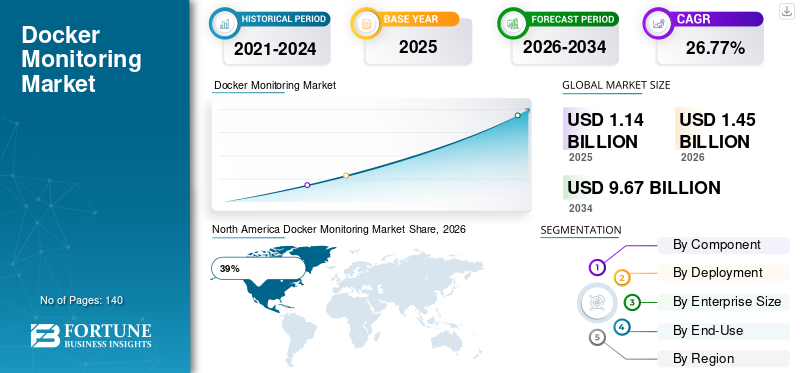
The global docker monitoring market size was valued at USD 1.14 billion in 2025. The market is projected to grow from USD 1.45 billion in 2026 to USD 9.67 billion by 2034, exhibiting a CAGR of 26.77% during the forecast period.

The docker monitoring market is experiencing strong adoption due to the rapid expansion of containerized applications, cloud-native development frameworks, Kubernetes deployments, and microservices architectures. Enterprises are increasingly prioritizing real-time visibility into container performance, resource utilization, workload behavior, and application health. docker monitoring platforms help organizations track CPU usage, memory consumption, network traffic, storage allocation, and container lifecycle activities across distributed environments. The market benefits from rising DevOps implementation, growing automation requirements, and increasing emphasis on observability. docker monitoring market analysis indicates that enterprises are investing in intelligent monitoring platforms to improve uptime, reduce service disruptions, strengthen infrastructure reliability, and support scalable application deployment strategies.
The United States docker monitoring market represents a significant portion of global demand due to widespread adoption of cloud computing, containerized software development, and enterprise DevOps practices. More than 72% of large organizations in the country utilize container technologies for application deployment and management. Technology companies, financial institutions, healthcare providers, and e-commerce enterprises increasingly rely on docker monitoring solutions to maintain service availability and operational efficiency. The growth of artificial intelligence workloads, hybrid cloud environments, and digital transformation initiatives further supports demand. docker monitoring market research report findings indicate that organizations across the United States are prioritizing observability tools capable of delivering predictive insights, automated alerts, and real-time
Download Free sample to learn more about this report.
Docker Monitoring Market Key Takeaways
 Global Market Size & Forecast
- 2025 Market Size: USD 1.14 Billion
- 2026 Market Size: USD 1.45 Billion
- 2034 Forecast Market Size: USD 9.67 Billion
- CAGR: 26.77% from 2026-2034
 Market Share
- The market in North America dominated with a revenue share of 39% in 2025.
- Solution-based offerings dominated with approximately 67% market share.
- Cloud deployment dominated with approximately 71% market share.
 Key Regional Highlights
North America
North America dominated the market with a 39% share in 2025.
Europe
Europe accounted for 27% of the global market, supported by growing containerized application adoption.
Asia-Pacific
Asia-Pacific held a 25% market share, driven by increasing cloud adoption and digital transformation.
U.S.
The U.S. is a major North American market, supported by widespread adoption of cloud-native and containerized technologies.
Japan
Japan accounted for 21% of the Asia-Pacific market, supported by increasing enterprise adoption of cloud and DevOps technologies.
Read More

docker monitoring market Latest Trends
The docker monitoring market trends landscape is being transformed by advanced observability platforms, AI-powered analytics, and automated remediation technologies. Organizations are moving beyond traditional infrastructure monitoring toward full-stack observability solutions capable of tracking containerized applications across multiple environments. Approximately 68% of enterprises deploying containers now integrate monitoring directly into CI/CD workflows to ensure continuous visibility throughout application development and deployment cycles.
Download Free sample to learn more about this report.
OpenTelemetry adoption continues to increase across cloud-native environments, enabling standardized data collection and enhanced interoperability between monitoring tools. Another significant trend involves the integration of machine learning algorithms for anomaly detection, allowing organizations to identify performance issues before they impact users. docker monitoring Industry analysis also highlights increasing demand for monitoring solutions capable of supporting Kubernetes orchestration, serverless environments, and multi-cloud infrastructures.
docker monitoring market Dynamics
DRIVER
Rising Adoption of Cloud-Native Applications And Containerized Infrastructure
The primary growth driver for the docker monitoring market is the rapid deployment of cloud-native applications and container-based architectures across enterprises. Organizations increasingly utilize Docker containers to improve scalability, flexibility, and deployment efficiency. More than 75% of modern enterprise applications are developed using microservices principles, creating a strong requirement for comprehensive monitoring capabilities. docker monitoring solutions provide visibility into container health, workload distribution, application performance, and infrastructure utilization. Businesses implementing DevOps practices depend heavily on monitoring platforms to maintain operational consistency across development, testing, and production environments. Automated alerting systems help IT teams identify bottlenecks before they affect business operations. Financial institutions, healthcare providers, and digital commerce companies are particularly investing in monitoring solutions due to the critical nature of application uptime.
RESTRAINT
Complexity Associated with Multi-Cloud Monitoring Environments
Despite growing adoption, market expansion faces challenges related to monitoring complexity within multi-cloud and hybrid infrastructure environments. Organizations frequently operate applications across public cloud, private cloud, and on-premise environments, creating fragmented visibility. Managing monitoring configurations across numerous containers, clusters, and orchestration platforms often requires specialized expertise. Many enterprises struggle with excessive alert generation, data overload, and integration challenges involving legacy systems. Smaller organizations frequently face difficulties allocating dedicated resources to monitoring management. Data collection across large-scale environments can also increase operational complexity. docker monitoring market Report findings indicate that enterprises often encounter obstacles while consolidating performance metrics from multiple monitoring tools. These factors may slow implementation rates among organizations with limited technical resources or constrained infrastructure management capabilities.
OPPORTUNITY
Expansion of Ai-Driven Observability and Predictive Analytics
Artificial intelligence presents significant opportunities for the docker monitoring market. Modern observability platforms increasingly incorporate predictive analytics, root-cause analysis, and intelligent automation capabilities. Approximately 61% of enterprises are evaluating AI-powered monitoring technologies to improve infrastructure visibility and reduce incident response times. Predictive monitoring helps organizations identify resource constraints, performance degradation, and potential failures before disruptions occur. AI-powered observability tools can analyze billions of telemetry data points while automatically detecting unusual behavior patterns. Enterprises deploying large-scale container infrastructures particularly benefit from automated diagnostics and performance optimization recommendations. docker monitoring market Opportunities are expanding further through integration with security analytics, compliance monitoring, and workload optimization tools.
CHALLENGE
Managing High-Volume Telemetry Data and Operational Costs
One of the major challenges facing the docker monitoring industry report landscape is the exponential growth of telemetry data generated by containerized applications. Large organizations may operate thousands of containers simultaneously, creating enormous volumes of logs, traces, and metrics. Storing, processing, and analyzing this data can increase infrastructure demands and operational expenses. Many enterprises face difficulties balancing monitoring depth with cost efficiency. Excessive data collection may lead to performance overhead, increased storage requirements, and longer analysis times. Regulatory compliance requirements further complicate monitoring operations, particularly within highly regulated industries. Organizations must also ensure secure handling of sensitive operational data.
docker monitoring market Segmentation
By Component
Market share for solution-based offerings accounts for approximately 67% of the docker monitoring market Share. Organizations prioritize monitoring platforms that provide real-time dashboards, workload analytics, anomaly detection, container discovery, and performance optimization capabilities. These solutions enable enterprises to monitor CPU utilization, memory consumption, network throughput, and storage performance across containerized environments. Advanced platforms increasingly incorporate artificial intelligence and predictive analytics to improve operational visibility.
Market share for services represents approximately 33% of the docker monitoring market forecast landscape. Professional services include deployment consulting, implementation support, integration assistance, training, maintenance, and managed monitoring operations. Organizations often require specialized expertise to configure monitoring environments, optimize telemetry collection, and establish performance baselines. Managed service providers help enterprises reduce internal resource requirements while improving monitoring efficiency. Demand for service offerings remains particularly strong among mid-sized organizations transitioning toward containerized application architectures.
To know how our report can help streamline your business, Speak to Analyst
By Deployment
Market share for cloud deployment reaches approximately 71%. Cloud-based docker monitoring solutions provide scalability, centralized management, automated updates, and rapid implementation. Organizations deploying applications across public and hybrid cloud infrastructures benefit from real-time visibility without extensive hardware investments. Cloud monitoring platforms support distributed workloads, remote management, and integration with modern DevOps workflows. docker monitoring market Growth remains closely linked to rising cloud adoption among enterprises seeking operational agility and infrastructure flexibility.
Market share for on-premise deployment accounts for approximately 29%. Organizations operating highly regulated environments often prefer on-premise monitoring solutions to maintain greater control over data governance and security policies. Financial institutions, government agencies, and healthcare providers continue investing in local infrastructure monitoring capabilities. On-premise solutions provide customizable deployment architectures and direct integration with existing enterprise systems. docker monitoring Industry analysis indicates that demand remains stable among organizations prioritizing compliance, data sovereignty, and internal infrastructure management.
By Enterprise Size
Large enterprises represent approximately 64% market share due to extensive container deployments and complex infrastructure requirements. These organizations operate large-scale microservices environments requiring continuous monitoring, predictive analytics, and advanced observability capabilities. Small and medium-sized enterprises account for roughly 36% market share as container adoption expands beyond large technology organizations. Increasing availability of subscription-based monitoring platforms supports adoption among smaller businesses seeking cost-effective infrastructure visibility.
By End-Use
The BFSI segment contributes approximately 24% market share in the docker monitoring market. Financial institutions increasingly deploy containerized applications to support digital banking, online payments, wealth management platforms, and insurance services. docker monitoring solutions help maintain continuous visibility across critical workloads and infrastructure components. Banks require real-time monitoring to ensure transaction processing efficiency and service availability. The adoption of cloud-native architectures is increasing across the sector to improve scalability and operational flexibility. Monitoring platforms provide automated alerts, performance analytics, and infrastructure optimization capabilities.
Healthcare accounts for approximately 18% market share in the docker monitoring market. Hospitals, healthcare networks, and digital health providers are increasingly implementing containerized applications for patient management and clinical operations. docker monitoring platforms help ensure application reliability and uninterrupted access to healthcare services. Real-time observability enables IT teams to identify infrastructure issues before they affect critical medical systems. The growing adoption of telemedicine and digital healthcare platforms is creating additional monitoring requirements. Healthcare organizations are modernizing IT infrastructure to improve operational efficiency and patient experiences.
Retail and e-commerce represent approximately 21% market share in the docker monitoring market. Online retailers rely on containerized applications to manage websites, inventory systems, payment platforms, and customer engagement services. docker monitoring solutions provide real-time visibility into application performance during peak shopping periods. Businesses use observability tools to minimize downtime and maintain consistent user experiences. Increasing online shopping activity is driving demand for scalable monitoring technologies. Monitoring platforms help identify bottlenecks, optimize resources, and improve transaction processing efficiency.
docker monitoring market Regional Outlook
North America
North America Docker Monitoring Market Share, 2026 (%)
To get more information on the regional analysis of this market, Download Free sample
North America is the leading regional market for docker monitoring solutions, accounting for 39% of the global market share. The region benefits from extensive adoption of cloud-native applications, container orchestration platforms, and DevOps methodologies. Enterprises across the United States and Canada are increasingly deploying advanced observability tools to improve application reliability and infrastructure performance. Financial institutions, healthcare organizations, technology providers, and e-commerce companies remain major adopters of docker monitoring platforms. Growing investments in artificial intelligence, automation, and hybrid cloud environments continue to support demand. Organizations are focusing on real-time analytics, predictive monitoring, and automated incident response capabilities. Strong digital transformation initiatives and high container deployment volumes further strengthen market expansion. The presence of major technology innovators also contributes to continuous product development and adoption.
Europe
Europe represents a significant market for docker monitoring technologies with a market share of 27%. The region is characterized by increasing cloud migration projects, enterprise modernization programs, and widespread implementation of containerized applications. Organizations are investing in monitoring solutions to improve visibility across distributed infrastructures and cloud-native environments. Industries such as manufacturing, banking, healthcare, and telecommunications are actively adopting observability platforms. Regulatory requirements and operational transparency objectives encourage the deployment of advanced monitoring tools. Businesses are increasingly integrating AI-driven analytics and automation into monitoring workflows. Growing adoption of Kubernetes and microservices architectures is generating additional demand for performance monitoring solutions. Enterprises are also prioritizing workload optimization and infrastructure efficiency. Continuous digital innovation supports long-term market growth throughout Europe.
Germany Docker Monitoring Market
Germany is one of the most influential markets within Europe and accounts for 28% of the regional docker monitoring market. The country’s strong industrial base and advanced digital infrastructure support extensive adoption of container monitoring solutions. Manufacturing companies are increasingly deploying cloud-native applications to enhance operational efficiency and process automation. Enterprises require comprehensive observability tools to maintain application performance and infrastructure reliability. Demand is growing for monitoring platforms that provide predictive analytics, resource optimization, and automated alerting capabilities. German organizations are investing in digital transformation projects across production, logistics, and enterprise management environments. The adoption of DevOps practices continues to accelerate monitoring requirements. Companies also focus on maintaining security, compliance, and workload visibility across modern application ecosystems.
United Kingdom Docker Monitoring Market
The United Kingdom accounts for 23% of the European docker monitoring market and continues to demonstrate strong demand for observability technologies. Financial services, retail businesses, technology firms, and cloud service providers are major users of docker monitoring platforms. Organizations are increasingly implementing containerized applications to improve deployment flexibility and operational agility. Monitoring solutions help businesses maintain service quality, application performance, and infrastructure availability. The market is supported by growing cloud adoption and modernization of enterprise IT environments. AI-powered analytics and automated troubleshooting capabilities are becoming increasingly important for operational management. Companies are investing in real-time monitoring systems to reduce downtime and optimize resource utilization. Strong digital transformation efforts continue to drive adoption across multiple industry sectors.
Asia-Pacific
Asia-Pacific is a rapidly expanding region in the docker monitoring market and contributes 25% of the global market share. Rising cloud adoption, digitalization initiatives, and enterprise technology investments are driving market growth. Organizations across major economies are increasingly deploying containerized applications to support scalability and business agility. The region benefits from expanding e-commerce activities, financial technology innovation, and telecommunications infrastructure development. Businesses require advanced monitoring platforms to maintain visibility across complex application environments. Cloud service providers continue expanding regional infrastructure, supporting broader adoption of observability technologies. Demand for AI-driven monitoring and automated performance management solutions is increasing steadily. Enterprises are focusing on improving operational efficiency and application reliability. Growing startup ecosystems further contribute to market development.
Japan Docker Monitoring Market
Japan represents 21% of the Asia-Pacific docker monitoring market and remains a technologically advanced adopter of container monitoring solutions. Enterprises across manufacturing, financial services, and telecommunications sectors are increasingly utilizing Docker-based infrastructures. Organizations require monitoring platforms to ensure operational continuity and application performance. The market benefits from strong investments in automation, cloud computing, and digital transformation initiatives. Companies are adopting observability solutions that provide comprehensive visibility into workloads and infrastructure resources. Demand for predictive analytics and intelligent monitoring capabilities continues to rise. Japanese enterprises prioritize reliability, security, and performance optimization within containerized environments. The expansion of cloud-native development practices is further supporting market growth and technology adoption.
China Docker Monitoring Market
China is the largest contributor within the Asia-Pacific region and holds 28% of the regional docker monitoring market share. Rapid expansion of cloud infrastructure and software development activities is creating strong demand for monitoring solutions. Technology companies, e-commerce platforms, financial institutions, and telecommunications providers are major adopters of container observability tools. Organizations increasingly require real-time monitoring to support high-volume workloads and digital services. Investment in cloud-native technologies and enterprise digitalization continues to accelerate. Businesses are implementing advanced monitoring platforms to improve performance visibility and operational efficiency. AI-powered analytics and automation capabilities are becoming key purchasing considerations. The country’s growing technology ecosystem continues to create opportunities for monitoring solution providers.
Rest of World
The Rest of World region contributes 9% of the global docker monitoring market and includes Latin America, the Middle East, and Africa. Organizations across these regions are increasingly modernizing infrastructure and adopting cloud-based technologies. Demand for docker monitoring solutions is growing among telecommunications providers, financial institutions, government agencies, and emerging technology companies. Enterprises are focusing on improving application reliability and infrastructure visibility through advanced observability tools. Cloud migration initiatives are creating favorable conditions for monitoring technology adoption. Managed services remain particularly important due to limited availability of specialized monitoring expertise. Businesses are investing in performance monitoring and automation capabilities to support digital transformation objectives. Increasing awareness of operational efficiency benefits continues to strengthen market demand.
List of Top docker monitoring Companies
- AppDynamics
- BMC Software
- Broadcom
- Datadog
- Dynatrace
- Elastic
- IBM
- New Relic
- SolarWinds
- Splunk
Top Two Companies with Highest Market Share
- Datadog – 19% market share
- Dynatrace – 16% market share
Investment Analysis and Opportunities
Investment activity within the docker monitoring market continues increasing as enterprises prioritize observability, automation, and cloud-native infrastructure management. Venture capital firms, private equity investors, and technology companies are actively supporting development of monitoring platforms capable of delivering advanced analytics and real-time operational intelligence. Approximately 63% of enterprise technology leaders indicate increased spending on observability initiatives compared with previous infrastructure monitoring programs.
Opportunities remain strongest in artificial intelligence integration, predictive monitoring, and automated incident management. Investors are particularly attracted to platforms capable of consolidating infrastructure monitoring, application performance management, log analytics, and security observability within unified environments. Growth in Kubernetes adoption further expands opportunities for vendors specializing in container visibility and orchestration monitoring.
New Product Development
Product innovation remains a critical competitive factor within the docker monitoring market. Vendors are introducing advanced observability capabilities combining metrics, traces, logs, and security insights into unified monitoring ecosystems. Artificial intelligence has become a major focus area, enabling automated anomaly detection, predictive performance analysis, and intelligent alert prioritization.
Several monitoring providers have introduced generative AI assistants capable of helping IT teams diagnose infrastructure issues more efficiently. New container discovery technologies automatically identify workloads and map dependencies without extensive manual configuration. Enhanced visualization dashboards provide deeper insights into application performance across cloud-native environments.
Recent Developments (2023-2025)
- Dynatrace expanded its observability portfolio through the acquisition of Rookout during 2023 to strengthen developer-focused monitoring capabilities.
- Datadog increased platform integration coverage during 2024, supporting more than 750 technology integrations across cloud and container environments.
- Dynatrace announced the acquisition of Runecast during 2024 to enhance cloud-native security and compliance monitoring capabilities.
- Multiple docker monitoring vendors introduced generative AI-powered observability assistants during 2024 to accelerate troubleshooting and root-cause analysis.
- Enterprise monitoring providers expanded OpenTelemetry support throughout 2025 to improve telemetry standardization and interoperability across cloud-native infrastructures.
Report Coverage
The docker monitoring market report provides comprehensive evaluation of industry trends, technology developments, competitive dynamics, investment patterns, and growth opportunities influencing the global market. Coverage includes detailed assessment of monitoring solutions, service offerings, deployment models, enterprise categories, and end-use industries utilizing container observability technologies.
Request for Customization to gain extensive market insights.
The report examines adoption patterns across cloud-native environments, Kubernetes infrastructures, microservices architectures, and hybrid cloud ecosystems. Market analysis evaluates drivers supporting demand, restraints affecting adoption, emerging opportunities, and operational challenges facing enterprises implementing monitoring solutions. Competitive profiling includes major vendors, product innovation strategies, and market positioning trends.
Frequently Asked Questions
Fortune Business Insights says that the global Docker Monitoring Market value stood at USD 1.14 billion in 2025 and is projected to reach USD 9.67 billion by 2034.
The market is expected to exhibit a CAGR of 26.77% during the forecast period of 2026-2034.
The solution segment dominated the Docker Monitoring Market with approximately 67% market share, driven by demand for real-time dashboards, workload analytics, anomaly detection, and performance optimization.
Key players include AppDynamics, BMC Software, Broadcom, Datadog, Dynatrace, and Elastic.
Major trends include rising adoption of AI-powered observability, automated remediation, and OpenTelemetry, along with growing demand for Kubernetes and multi-cloud monitoring. North America led the market with a 39% share.



- 2021-2034
- 2025
- 2021-2024
- 140
-

(Offer valid till 30th Sep 2026)
Get 30-60 hrs Free Customization
Expand Regional and Country Coverage, Segments Analysis, Company Profiles, Competitive Benchmarking, and End-user Insights.




















-
US +1 833 909 2966 ( Toll Free )
-
Get In Touch With Us