 Download Free Sample



Get a Quote
Receive a tailored pricing based on your needs.
- Choose license type
- Multiple user options
- Custom scope & coverage
- Fast turnaround
"Designing Growth Strategies is in our DNA"
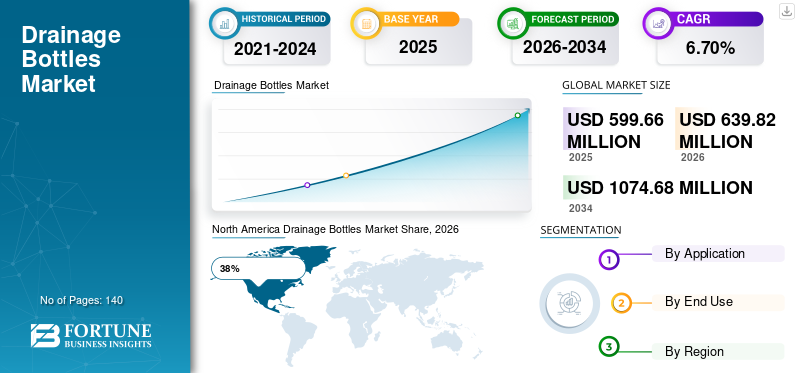
The global drainage bottles market size was valued at USD 599.66 billion in 2025. The market is projected to grow from USD 639.82 billion in 2026 to USD 1074.68 billion by 2034, exhibiting a CAGR of 6.70% during the forecast period.

The drainage bottles market plays a critical role in modern healthcare systems by supporting fluid collection and drainage procedures across surgical, trauma, urology, thoracic, and wound care applications. Drainage bottles are widely utilized in hospitals, ambulatory surgical centers, specialty clinics, and long-term care facilities for the safe collection and monitoring of bodily fluids. The market is influenced by the growing volume of surgical procedures, increasing incidence of chronic diseases requiring drainage management, and rising adoption of disposable medical devices. Healthcare providers are prioritizing infection control, patient safety, and workflow efficiency, driving demand for advanced drainage bottle systems. The drainage bottles market Report indicates continuous product innovation focused on improved measurement accuracy, leak prevention, and enhanced portability.
The United States represents one of the most significant contributors to the drainage bottles market due to its advanced healthcare infrastructure and high procedural volumes. More than 51 million inpatient surgeries and numerous outpatient interventions performed annually create sustained demand for drainage management products. Hospitals continue investing in infection prevention protocols, encouraging the adoption of sterile and single-use drainage bottles. The increasing prevalence of thoracic disorders, urological conditions, abdominal surgeries, and wound management procedures further supports market expansion. The Drainage Bottles Industry Analysis highlights strong procurement activity among healthcare systems seeking reliable drainage solutions that improve patient outcomes, reduce contamination risks, and support regulatory compliance across clinical settings.
Download Free sample to learn more about this report.
 Global Market Size & Forecast
 Market Share
 Key Regional Highlights
North America
North America held the largest regional share at 38% in 2025.
Europe
Europe accounted for 29% of the global market.
Asia-Pacific
Asia-Pacific represented 25% of the global market, supported by increasing surgical procedures and healthcare infrastructure.
U.S
The U.S. is a major market due to advanced healthcare infrastructure and high surgical procedure volumes.
Japan
Japan accounted for 10% of the Asia-Pacific market, supported by established healthcare facilities and demand for advanced drainage solutions.
Read More

The drainage bottles market Trends demonstrate a transition toward technologically enhanced drainage systems designed to improve fluid monitoring and patient management. Manufacturers are introducing lightweight products with integrated measurement indicators, improved vacuum control capabilities, and enhanced safety mechanisms. Demand for disposable drainage bottles continues to increase due to growing concerns regarding hospital-acquired infections and cross-contamination.
Download Free sample to learn more about this report.
Healthcare facilities are increasingly adopting closed drainage systems that minimize fluid exposure and improve clinical safety. Another notable trend involves the development of transparent, high-visibility collection chambers that allow healthcare professionals to accurately assess drainage output. The drainage bottles market research report also identifies growing interest in eco-conscious manufacturing processes and recyclable medical-grade materials.
Increasing Volume of Surgical Procedures Worldwide
The primary driver supporting drainage bottles market growth is the increasing number of surgical interventions performed globally. Surgical procedures involving thoracic, abdominal, orthopedic, cardiovascular, and urological treatments frequently require post-operative drainage management. Drainage bottles help healthcare professionals monitor fluid accumulation, prevent complications, and improve recovery outcomes. Aging populations contribute to higher procedure rates, particularly among patients requiring chronic disease management and complex surgeries. Healthcare systems are expanding surgical capacities to address growing patient demand, leading to increased procurement of drainage equipment. The drainage bottles market analysis indicates that advancements in minimally invasive surgery are also supporting product demand because drainage management remains a critical component of post-procedural care. As healthcare accessibility improves across multiple regions, drainage bottle utilization continues to expand in both public and private healthcare institutions.
Availability of Alternative Fluid Management Systems
One significant restraint affecting the drainage bottles market is the availability of alternative drainage and fluid management technologies. Certain healthcare providers are increasingly utilizing integrated drainage systems that combine collection, monitoring, and disposal functions into a single platform. These alternatives may reduce dependence on traditional drainage bottles in selected applications. Cost pressures within healthcare systems also influence purchasing decisions, particularly in developing regions where budget limitations impact procurement cycles. Product standardization challenges and varying regulatory requirements across different markets can further slow adoption. The drainage bottles industry report highlights that competition from advanced drainage solutions requires manufacturers to continuously improve product performance, usability, and safety features. As healthcare facilities seek comprehensive solutions, suppliers must demonstrate clear clinical and operational advantages to maintain market competitiveness.
Expansion of Ambulatory Surgical Centers and Specialty Clinics
The rapid growth of ambulatory surgical centers and specialty treatment facilities presents a major opportunity for the drainage bottles market. These healthcare settings increasingly perform procedures that traditionally occurred in hospitals, creating new demand channels for drainage products. Ambulatory centers prioritize efficient workflows, infection prevention, and cost-effective patient management solutions. Disposable drainage bottles align well with these operational objectives. The drainage bottles market Opportunities continue to expand as outpatient care models gain popularity worldwide. Manufacturers can benefit by developing compact, portable, and easy-to-use products specifically tailored to ambulatory environments. Emerging healthcare investments across Asia-Pacific, Latin America, and Middle Eastern countries are also creating substantial opportunities. Increased healthcare access, growing surgical volumes, and expanding medical infrastructure support stronger demand for drainage bottle systems across diverse clinical applications.
Regulatory Compliance and Product Quality Requirements
Manufacturers operating within the drainage bottles market face significant challenges related to regulatory compliance and quality assurance requirements. Medical devices used in fluid collection applications must meet stringent safety, sterility, and performance standards before entering commercial markets. Regulatory approvals often involve extensive testing, documentation, and validation processes. Maintaining consistent product quality while controlling manufacturing costs remains a critical challenge. Healthcare providers increasingly demand products with enhanced safety features, improved durability, and reliable performance. The drainage bottles market forecast indicates that manufacturers must continue investing in research, development, and quality management systems to remain competitive. Supply chain disruptions, raw material fluctuations, and changing regulatory expectations add further complexity. Successfully addressing these challenges is essential for sustaining long-term market participation and customer trust.
Chest drainage bottles account for approximately 31% of the drainage bottles market share due to their extensive use in thoracic surgery, trauma care, and pulmonary treatment procedures. These products are designed to remove air, blood, and fluid from the pleural cavity while supporting lung re-expansion. Increasing cases of respiratory disorders, chest injuries, and cardiothoracic interventions continue to support demand. Hospitals frequently utilize chest drainage systems in intensive care units and post-operative recovery settings. Manufacturers are focusing on improved vacuum regulation, leak detection mechanisms, and enhanced fluid measurement capabilities.
Accel evacuated drainage bottles hold an estimated 14% share of the drainage bottles market. These systems utilize controlled vacuum technology to facilitate efficient fluid collection and drainage management. Healthcare providers value evacuated systems for their ability to maintain consistent suction levels and reduce manual intervention. Such products are commonly used in surgical recovery environments where controlled drainage is required. Advancements in vacuum stability and collection chamber design continue improving product performance. Growing emphasis on infection prevention further supports adoption because sealed evacuated systems minimize exposure risks.
Peritoneal drainage bottles represent approximately 17% of the drainage bottles market share. These products are primarily utilized for abdominal fluid management associated with surgical procedures, liver disorders, infections, and other medical conditions. Rising incidence of abdominal interventions and chronic diseases requiring fluid drainage supports steady demand. Healthcare professionals rely on peritoneal drainage systems for accurate monitoring and safe fluid collection. Product innovation focuses on enhanced capacity, leak prevention, and user-friendly operation.
Urostomy and urinary drainage bottles account for approximately 18% of the global drainage bottles market. These products are widely utilized in urology departments, post-surgical recovery units, and long-term patient care environments. Growing prevalence of urinary disorders, bladder surgeries, and catheter-associated treatments supports demand. Healthcare providers prioritize drainage systems that offer secure fluid containment, accurate volume measurement, and enhanced patient mobility. Manufacturers are introducing designs with improved anti-reflux mechanisms and ergonomic handling features.
Wound drainage bottles contribute approximately 20% of total drainage bottles market share. These products are commonly used following orthopedic, plastic, cardiovascular, and general surgical procedures. Effective wound drainage reduces fluid accumulation, minimizes infection risks, and supports tissue healing. Healthcare facilities increasingly adopt advanced wound management protocols, driving demand for reliable drainage solutions. Manufacturers focus on compact designs, secure sealing systems, and improved fluid collection efficiency.
To know how our report can help streamline your business, Speak to Analyst
Hospitals account for approximately 62% of the drainage bottles market share and remain the largest end-use segment. High patient admissions, large surgical volumes, and specialized treatment departments contribute significantly to product demand. Ambulatory surgical centers represent approximately 18% of the drainage bottles market share. These facilities perform a growing number of same-day surgical procedures, creating demand for efficient drainage management products. Healthcare providers prefer drainage bottles that support quick setup, easy monitoring, and safe disposal. Specialty clinics contribute approximately 12% of the global drainage bottles market share. These facilities focus on specific treatment areas such as urology, thoracic care, wound management, and chronic disease treatment. Long-term care facilities and home healthcare settings account for approximately 8% of the drainage bottles market share.
North America Drainage Bottles Market Share, 2026 (%)
To get more information on the regional analysis of this market, Download Free sample
North America commands approximately 38% of the global drainage bottles market share. The region benefits from sophisticated healthcare infrastructure, strong regulatory oversight, and extensive adoption of advanced medical technologies. Hospitals and ambulatory surgical centers maintain high procurement volumes due to increasing numbers of thoracic, orthopedic, cardiovascular, and urological procedures. Demand for disposable drainage bottles continues to rise because healthcare providers The United States remains the primary contributor within the region, supported by large healthcare expenditures, widespread surgical activity, and extensive hospital networks. Canada also contributes to regional growth through investments in healthcare modernization and patient care improvements. Manufacturers operating in North America focus heavily on innovation, product reliability, and compliance with stringent quality standards. The drainage bottles market analysis identifies strong demand for chest drainage systems, wound drainage products, and urinary drainage solutions throughout the region. Healthcare institutions increasingly prefer products featuring enhanced measurement accuracy, improved fluid visibility, and user-friendly operation.
Europe accounts for approximately 29% of the drainage bottles market share and remains a major regional market. Countries across the region maintain well-established healthcare systems and emphasize high standards of patient safety. Demand for drainage bottles is supported by increasing surgical procedures, aging populations, and growing prevalence of chronic diseases requiring drainage management. Healthcare providers across Europe prioritize sterile and disposable drainage systems to minimize infection risks. Hospitals continue upgrading clinical equipment while implementing advanced post-operative care protocols. The drainage bottles market research report highlights sustained demand from thoracic surgery, wound management, and urological treatment applications. European manufacturers play a significant role in product innovation, focusing on ergonomic designs, improved fluid measurement capabilities, and environmentally responsible production methods. Regulatory frameworks encourage continuous product quality improvement, supporting healthcare provider confidence.
Germany accounts for approximately 41%. The country benefits from advanced medical infrastructure, strong hospital networks, and extensive adoption of modern medical technologies. High volumes of surgical procedures support consistent demand for drainage bottles across multiple specialties. German healthcare providers emphasize product quality, safety, and regulatory compliance when selecting drainage solutions. Demand remains particularly strong for chest drainage and wound drainage applications. Continuous investment in healthcare facilities and medical device innovation contributes to market development. The drainage bottles market insights indicate that Germany will remain a key market due to its established healthcare ecosystem and commitment to clinical excellence.
The United Kingdom contributes approximately 38% of the global drainage bottles market share. Demand is supported by ongoing healthcare modernization initiatives and increasing surgical procedure volumes. Hospitals and specialized treatment centers rely heavily on drainage management systems to support post-operative care and chronic disease treatment. Healthcare providers prioritize disposable products that align with infection control objectives. The drainage bottles industry report highlights growing utilization of advanced drainage solutions across both public and private healthcare sectors. Product innovation, patient safety initiatives, and continued investments in healthcare infrastructure support market expansion. Rising awareness regarding effective fluid management practices further strengthens demand for drainage bottles throughout the United Kingdom.
Asia-Pacific represents approximately 25% of the global drainage bottles market share and is among the fastest-expanding regional markets. Healthcare infrastructure development, population growth, and increasing access to medical services are key factors driving demand. Countries throughout the region continue investing in hospitals, surgical facilities, and specialty care centers, creating substantial opportunities for drainage bottle manufacturers. Growing prevalence of chronic diseases and increasing numbers of surgical interventions contribute to rising product utilization. Healthcare providers are progressively adopting disposable drainage systems to improve infection control and clinical efficiency. The drainage bottles market Opportunities within Asia-Pacific are enhanced by government healthcare initiatives and rising healthcare awareness. Manufacturers are expanding regional production capabilities to meet increasing demand while maintaining competitive pricing. Technological improvements, product accessibility, and growing medical tourism activities further support market growth.
Japan accounts for approximately 10% of the global drainage bottles market share. The country’s advanced healthcare system and aging population support consistent demand for drainage management products. Hospitals frequently utilize drainage bottles across surgical, thoracic, and urological treatment applications. Healthcare providers emphasize precision, quality, and patient safety when selecting medical devices. Product innovation and technological integration remain important characteristics of the Japanese market. The drainage bottles market Report indicates that increasing healthcare requirements associated with age-related conditions continue supporting demand. Strong regulatory standards and high clinical expectations encourage adoption of advanced drainage solutions throughout Japanese healthcare facilities.
China contributes approximately 11% of the global drainage bottles market share and represents a major growth market. Expanding healthcare infrastructure, increasing hospital capacity, and rising surgical procedure volumes support strong product demand. Government healthcare investments continue improving access to medical services across urban and rural regions. Hospitals increasingly adopt disposable drainage systems to align with infection prevention initiatives. Domestic manufacturing capabilities and growing healthcare expenditures strengthen market development. The drainage bottles market forecast highlights significant opportunities arising from healthcare modernization programs and expanding patient populations. Continuous improvements in clinical standards and medical technology adoption further support long-term market expansion throughout China.
The Rest of World region accounts for approximately 8% of the global drainage bottles market share. This segment includes Latin America, the Middle East, and Africa, where healthcare infrastructure improvements continue driving product demand. Increasing access to surgical care, growing hospital investments, and rising awareness regarding infection prevention contribute to market development. Governments and private healthcare providers are expanding treatment capabilities, creating opportunities for drainage bottle suppliers. Demand remains particularly strong in urban healthcare centers where modernization initiatives are accelerating. Manufacturers are focusing on affordable and reliable products suited to varying healthcare environments. The drainage bottles market growth within these regions is supported by population expansion, increasing disease burden, and improved healthcare accessibility. As healthcare systems continue evolving, demand for drainage management solutions is expected to strengthen across emerging markets.
The drainage bottles market presents attractive investment opportunities driven by increasing surgical volumes, healthcare infrastructure development, and rising emphasis on infection control. Investors are focusing on manufacturers that demonstrate strong product innovation capabilities and diversified healthcare portfolios. Expansion of ambulatory surgical centers and specialty treatment facilities continues generating new demand channels for drainage management products.
Emerging markets provide significant opportunities due to healthcare modernization initiatives and expanding patient populations. Companies investing in advanced materials, disposable product technologies, and environmentally sustainable manufacturing processes are gaining competitive advantages. Strategic partnerships between manufacturers and healthcare institutions support product adoption and market penetration.
The drainage bottles market is witnessing significant innovation as manufacturers focus on improving drainage efficiency, patient safety, and clinical usability. Recent product development efforts have concentrated on lightweight materials, enhanced transparency, and improved fluid measurement systems. Manufacturers are introducing bottles with advanced calibration markings that allow healthcare professionals to monitor drainage output more accurately during post-operative care. Several companies are developing drainage bottles with integrated anti-reflux mechanisms that prevent backflow contamination and reduce infection risks.
Improved sealing technologies are also gaining traction, ensuring leak resistance and secure fluid containment during transportation and disposal. These enhancements support compliance with strict infection control standards implemented by healthcare institutions. Portable drainage systems represent another important area of innovation. Healthcare providers increasingly require compact products suitable for ambulatory surgical centers and home healthcare environments. Manufacturers are responding by designing user-friendly systems that improve mobility while maintaining drainage effectiveness.
This drainage bottles market Report provides a comprehensive assessment of industry trends, competitive dynamics, product segmentation, regional performance, investment opportunities, and technological developments. The report evaluates market demand across chest drainage, evacuated drainage, peritoneal drainage, urinary drainage, and wound drainage applications. Detailed analysis of end-use sectors including hospitals, ambulatory surgical centers, specialty clinics, and long-term care facilities is included to provide a complete understanding of consumption patterns.
Request for Customization to gain extensive market insights.
The drainage bottles market analysis examines factors influencing procurement decisions, healthcare infrastructure development, surgical procedure volumes, and infection control requirements. Regional assessments cover North America, Europe, Asia-Pacific, and Rest of World markets while providing dedicated insights into major national markets including the United States, Germany, the United Kingdom, Japan, and China.
Fortune Business Insights says that the global market value stood at USD 599.66 billion in 2025 and is projected to reach USD 1,074.68 billion by 2034.
The market is expected to exhibit a CAGR of 6.70% during the forecast period of 2026-2034.
Chest drainage bottles led the application segment with approximately 31% market share, owing to their extensive use in thoracic surgery, trauma care, and pulmonary treatment procedures.
Key players include B. Braun Medical Inc., ROCKET MEDICAL PLC, STERIMED GROUP, PFM Medical, Inc., Lily Medical Corporation, and Hospitech.
Major trends include the shift toward technologically enhanced, lightweight drainage systems and rising demand for disposable products driven by infection-control concerns; North America leads regionally with approximately 38% market share.


(Offer valid till 31st Oct 2026)
Get 30-60 hrs Free Customization
Expand Regional and Country Coverage, Segments Analysis, Company Profiles, Competitive Benchmarking, and End-user Insights.













.webp)






Get In Touch With Us
US +1 833 909 2966 ( Toll Free )
Receive a tailored pricing based on your needs.
Discuss your questions with our industry experts.
Have questions? Get quick answers before you purchase.

