Drinking Water Adsorbents Market Size, Share & Industry Analysis, By Product (Activated Carbon, Zeolite, Alumina, Clay, Manganese Oxide, Cellulose), and Regional Forecast, 2026-2034
 Download Free Sample
Drinking Water Adsorbents Market Size & Overview
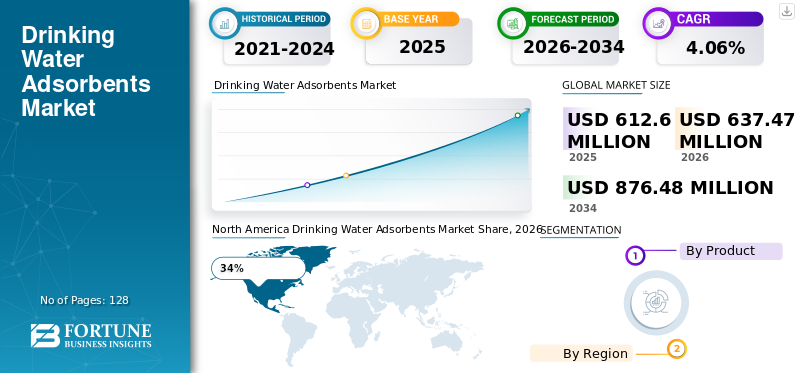
The global drinking water adsorbents market size was valued at USD 612.6 billion in 2025. The market is projected to grow from USD 637.47 billion in 2026 to USD 876.48 billion by 2034, exhibiting a CAGR of 4.06% during the forecast period.

The drinking water adsorbents market is experiencing significant expansion due to increasing concerns regarding water contamination, growing investments in municipal water treatment infrastructure, and rising adoption of advanced purification technologies. Drinking water adsorbents are widely used to remove contaminants such as arsenic, fluoride, lead, pesticides, pharmaceutical residues, and organic compounds from potable water supplies. Growing industrialization and urbanization have increased pressure on freshwater resources, encouraging the deployment of adsorption-based treatment solutions. drinking water adsorbents market analysis indicates that activated carbon, zeolite, alumina, and advanced composite adsorbents are becoming integral components of water treatment systems. Continuous innovation in adsorption efficiency and regeneration capabilities is further strengthening market demand.
The United States represents a major portion of the drinking water adsorbents market due to extensive water treatment infrastructure and stringent drinking water quality regulations. More than 85% of the population relies on public water systems, driving continuous investments in contaminant removal technologies. Activated carbon remains the most widely adopted adsorbent owing to its effectiveness against organic pollutants and taste-and-odor compounds. Municipal utilities are increasingly deploying advanced adsorption systems to address emerging contaminants such as PFAS and pharmaceutical residues. drinking water adsorbents industry analysis highlights strong demand from both municipal and residential sectors. Ongoing replacement of aging water treatment facilities and increased monitoring of water quality standards continue to support market expansion across the country.
Download Free sample to learn more about this report.
Drinking Water Adsorbents Market Key Takeaways
 Global Market Size & Forecast
- 2025 Market Size: USD 612.60 Billion
- 2026 Market Size: USD 637.47 Billion
- 2034 Forecast Market Size: USD 876.48 Billion
- CAGR: 4.06% from 2026-2034
 Market Share
- The market in North America dominated with a revenue share of 34% in 2025.
- The activated carbon segment accounted for approximately 38% of the market share.
- The zeolite segment accounted for approximately 19% of the market share.
 Key Regional Highlights
North America
North America held the largest regional share at 34% in 2025.
Europe
Europe accounted for 28% of the global market.
Asia-Pacific
Asia-Pacific represented 27% of the global market, supported by growing demand for advanced water treatment solutions.
U.S
The U.S. is a major market due to established water treatment infrastructure and stringent drinking water quality standards.
Japan
Japan accounted for 15% of the Asia-Pacific market, supported by advanced water treatment technologies and strong focus on water quality.
Read More

drinking water adsorbents market Latest trends
The drinking water adsorbents market trends indicate a growing shift toward high-performance and sustainable adsorption materials. Water treatment facilities are increasingly adopting engineered adsorbents capable of targeting specific contaminants while maintaining operational efficiency. Advanced activated carbon products with enhanced pore structures are gaining widespread acceptance due to improved adsorption capacities. Another major trend involves the development of bio-based and renewable adsorbents derived from agricultural waste and natural materials. These products are attracting attention because of their environmental compatibility and lower disposal concerns. Nanotechnology-enabled adsorbents are also entering commercial applications, providing improved removal of heavy metals and trace organic pollutants.
Download Free sample to learn more about this report.
drinking water adsorbents market research report findings show increasing deployment of hybrid treatment systems that combine adsorption with membrane filtration and oxidation technologies. Smart monitoring solutions integrated into water treatment plants are enabling real-time optimization of adsorbent usage. The market is also witnessing growing adoption of reusable and regenerable adsorbents that reduce operating costs and environmental impact. Rising concerns regarding PFAS contamination, microplastics, and emerging pollutants continue to accelerate research and commercialization activities across the global drinking water treatment sector.
drinking water adsorbents market Dynamics
DRIVER
Increasing Demand for Safe and Contaminant-Free Drinking Water
Growing awareness regarding waterborne contaminants is a major driver for the drinking water adsorbents market growth. Increasing concentrations of heavy metals, industrial chemicals, pesticides, and pharmaceutical residues in water sources are prompting governments and utilities to enhance treatment standards. Urban population growth and industrial expansion have increased pressure on water infrastructure, resulting in higher adoption of adsorption technologies. Water treatment operators are investing in advanced adsorbent materials to achieve regulatory compliance and improve public health outcomes. The demand for effective removal of arsenic, fluoride, lead, and PFAS contaminants is significantly contributing to market development. Rising consumer preference for high-quality drinking water is further supporting demand across municipal, commercial, and residential applications.
RESTRAINT
High Operational and Replacement Costs
Despite strong demand, the market faces challenges related to operational expenditures and adsorbent replacement requirements. Many advanced adsorbents require periodic regeneration or replacement to maintain performance levels. Municipal water treatment facilities often encounter budget constraints that can delay technology upgrades. Disposal and regeneration processes may increase lifecycle costs, particularly for specialized adsorbents used in contaminant-specific applications. Small-scale treatment facilities may find high-performance adsorption systems financially demanding. Additionally, fluctuations in raw material availability can influence manufacturing costs and pricing structures. These factors can limit adoption rates in cost-sensitive regions and developing economies.
OPPORTUNITY
Expansion of Advanced Water Treatment Infrastructure
Rapid investments in water treatment modernization present substantial opportunities for the drinking water adsorbents market Outlook. Governments worldwide are allocating significant resources to improve drinking water quality and expand treatment capacity. Emerging economies are implementing large-scale water purification projects to address growing urban populations. Advanced adsorption technologies are increasingly incorporated into treatment plant upgrades due to their efficiency and adaptability. Growing interest in decentralized water treatment systems also creates opportunities for compact adsorption solutions. research into multifunctional adsorbents capable of removing multiple contaminants simultaneously is expected to enhance market penetration. These developments are creating attractive opportunities for manufacturers and technology providers.
CHALLENGE
Managing Emerging Contaminants
The emergence of new contaminants presents a significant challenge for market participants. Compounds such as PFAS, microplastics, pharmaceutical residues, and endocrine-disrupting chemicals require highly specialized treatment approaches. Traditional adsorbents may not always provide adequate removal efficiency for these contaminants. Continuous research and product development are necessary to address evolving water quality concerns. Regulatory standards are becoming increasingly stringent, requiring manufacturers to develop innovative adsorption materials. Balancing treatment effectiveness, cost efficiency, and environmental sustainability remains a critical challenge. The need for extensive testing and certification can also lengthen commercialization timelines for new products.
drinking water adsorbents market Segmentation
By Product
Activated carbon accounts for approximately 38% of the drinking water adsorbents market share. The material is widely recognized for its extensive surface area and superior adsorption capacity. It is extensively used to remove organic compounds, chlorine byproducts, pesticides, odors, and taste-related contaminants from drinking water. Municipal treatment plants continue to invest heavily in granular and powdered activated carbon systems. The material’s ability to address a broad spectrum of contaminants makes it the preferred solution across multiple applications. Ongoing innovations in pore structure optimization and regeneration technologies are enhancing product performance.
Zeolite represents approximately 19% of the drinking water adsorbents market. Natural and synthetic zeolites are widely utilized for their ion-exchange capabilities and effectiveness in removing ammonia, heavy metals, and radioactive substances. Water treatment facilities increasingly deploy zeolite-based systems to address contaminant-specific challenges. The material’s porous structure enables efficient adsorption while maintaining operational stability. Zeolite products are particularly attractive in regions facing groundwater contamination issues. Manufacturers continue to develop modified zeolite formulations with enhanced adsorption performance.
Alumina holds nearly 14% of the global drinking water adsorbents market share. Activated alumina is extensively used for fluoride and arsenic removal, making it highly valuable in regions with naturally occurring groundwater contamination. The material demonstrates strong adsorption performance and regeneration capability. Municipal authorities increasingly utilize alumina-based treatment systems to meet stringent drinking water standards. Continuous advancements in surface modification technologies are improving contaminant selectivity and treatment efficiency. Demand remains particularly strong in areas affected by elevated fluoride concentrations.
Clay-based adsorbents account for approximately 10% of market share. These materials are valued for their natural abundance, affordability, and environmental compatibility. Modified clay formulations are increasingly used for heavy metal and organic contaminant removal. researchers continue exploring advanced clay composites to improve adsorption efficiency. Growing interest in sustainable water treatment technologies is supporting adoption of clay-based adsorbents. Municipal and community-level treatment projects are utilizing these materials due to their cost-effectiveness and local availability.
Manganese Oxide: Manganese oxide adsorbents contribute nearly 9% of the market. These materials are particularly effective in removing arsenic, iron, manganese, and other trace contaminants. Their strong oxidation and adsorption properties make them valuable in specialized drinking water treatment applications. Utilities increasingly incorporate manganese oxide media into filtration systems targeting contaminant-specific challenges. research efforts continue to improve adsorption capacity and operational longevity. Growing regulatory focus on trace contaminant removal supports demand for manganese oxide-based solutions.
Cellulose-based adsorbents hold approximately 10% of the market share. Derived from renewable resources, these materials are gaining popularity due to sustainability advantages and environmental compatibility. Modified cellulose adsorbents demonstrate effectiveness against heavy metals and organic pollutants. research institutions and manufacturers are investing in advanced cellulose composites to improve treatment efficiency. Increasing emphasis on green water treatment technologies supports segment growth. The renewable nature of cellulose aligns with broader sustainability objectives across the water treatment industry.
To know how our report can help streamline your business, Speak to Analyst
drinking water adsorbents market Regional Outlook
North America Drinking Water Adsorbents Market Share, 2026 (%)
To get more information on the regional analysis of this market, Download Free sample
North America
North America holds approximately 34% of the global drinking water adsorbents market share. The region benefits from advanced water treatment infrastructure, strong regulatory oversight, and continuous investments in drinking water quality improvement. Municipal authorities actively deploy adsorption technologies to address contaminants such as PFAS, lead, arsenic, and industrial pollutants. The United States and Canada continue upgrading treatment facilities to meet evolving standards. Growing awareness regarding emerging contaminants has increased adoption of specialized adsorbent materials. drinking water adsorbents industry report findings indicate substantial investments in activated carbon systems and advanced treatment technologies. Industrial facilities also contribute significantly to market demand due to stringent environmental regulations and water reuse initiatives.
Europe
Europe accounts for approximately 28% of the drinking water adsorbents market share. The region maintains rigorous drinking water quality standards and extensive environmental protection policies. Water utilities invest heavily in advanced treatment systems to ensure compliance with regulatory requirements. Activated carbon, zeolite, and specialized adsorbents are widely utilized across municipal treatment facilities. Sustainability initiatives encourage the adoption of environmentally friendly and regenerable adsorption materials. Several countries are investing in infrastructure upgrades to address aging water networks and emerging contamination challenges. Industrial demand remains significant due to strict discharge regulations and growing emphasis on water recycling. Innovation remains a key characteristic of the European market. research organizations collaborate with manufacturers to develop high-efficiency adsorbents capable of removing complex contaminants.
Germany drinking water adsorbents market
Germany represents approximately 24% of the European drinking water adsorbents market. The country possesses advanced water treatment infrastructure and strong environmental regulations. Municipal utilities continuously invest in adsorption technologies to maintain high drinking water quality standards. Activated carbon remains extensively used across treatment facilities. Growing attention to emerging contaminants, including pharmaceutical residues and industrial chemicals, supports demand for advanced adsorbent materials. research and development activities contribute significantly to technological innovation. Germany's emphasis on sustainability, resource efficiency, and environmental protection strengthens adoption of regenerable and eco-friendly adsorption solutions across municipal and industrial applications.
United Kingdom drinking water adsorbents market
The United Kingdom accounts for approximately 18% of the European market. Water companies continue upgrading treatment infrastructure to address water quality challenges and comply with regulatory requirements. Adsorbent technologies play a critical role in removing organic contaminants, pesticides, and taste-related compounds. Investments in infrastructure modernization support market growth. Growing public awareness regarding drinking water quality encourages adoption of advanced treatment solutions. research initiatives focused on contaminant removal and sustainable treatment technologies further contribute to market development. The country's commitment to environmental protection continues driving demand for efficient adsorption systems.
Asia-Pacific
Asia-Pacific holds approximately 27% of the global drinking water adsorbents market share and represents one of the most dynamic regions. Rapid urbanization, industrialization, and population growth are increasing pressure on water resources. Governments across the region are investing heavily in drinking water infrastructure and contamination control programs. Countries including China, Japan, India, South Korea, and Australia are expanding treatment capacity to meet rising demand for safe drinking water. drinking water adsorbents market Forecast assessments indicate growing adoption of activated carbon, alumina, and advanced composite adsorbents. Industrial sectors also contribute significantly to demand due to water reuse requirements and environmental regulations.
Japan drinking water adsorbents market
Japan accounts for approximately 15% of the Asia-Pacific market. The country maintains sophisticated water treatment infrastructure and stringent drinking water standards. Municipal utilities frequently deploy advanced adsorption technologies to ensure high-quality water supplies. Activated carbon remains widely used for contaminant removal and taste improvement. research institutions continue developing next-generation adsorbents with enhanced efficiency and sustainability characteristics. Demand is supported by infrastructure modernization projects and increasing attention to emerging contaminants. Japan's technological expertise contributes significantly to innovation within the regional drinking water treatment industry.
China drinking water adsorbents market
China represents approximately 43% of the Asia-Pacific market. Rapid industrialization and urban expansion have increased demand for advanced water treatment technologies. Government initiatives focused on environmental protection and drinking water safety are driving investments in treatment infrastructure. Activated carbon and specialized adsorbents are widely adopted across municipal facilities. Industrial water treatment requirements also contribute substantially to market demand. Continued development of large-scale purification projects and expansion of domestic manufacturing capabilities support market growth. Increasing public awareness regarding water quality further strengthens demand for adsorption technologies.
Rest of World
The Rest of World region accounts for approximately 11% of the drinking water adsorbents market share. Latin America, the Middle East, and Africa are increasingly investing in water treatment infrastructure to improve access to safe drinking water. Population growth and urban development are creating significant demand for purification technologies. Many countries face challenges related to water scarcity, groundwater contamination, and aging infrastructure. Adsorbent technologies provide practical and effective solutions for addressing these issues. Government-supported water projects and international development initiatives contribute to market expansion. Municipal treatment facilities increasingly deploy activated carbon, alumina, and other adsorption materials to meet water quality objectives. Growing industrial development and environmental awareness further support adoption. Investments in desalination, water reuse, and decentralized treatment systems create additional opportunities for manufacturers operating within these regions.
List of Top Drinking Water Adsorbents Companies
- Purolite
- BASF SE
- KMI Zeolite
- Kuraray Co. Ltd.
- Lenntech B.V.
- Evoqua Water Technologies LLC
- TIGG LLC
- DuPont
- The Dow Chemical Company
- CycloPure Inc.
Top Two Companies with Highest Market share
- BASF SE – 14%
- DuPont – 12%
Investment analysis and Opportunities
The drinking water adsorbents market is attracting substantial investment due to growing concerns regarding water quality, tightening regulatory requirements, and increasing infrastructure modernization projects. Public and private sector investments are focused on improving contaminant removal capabilities and expanding access to safe drinking water. Municipal authorities across developed and developing economies continue allocating significant budgets toward treatment plant upgrades, creating opportunities for adsorbent manufacturers.
Investment activity is increasingly directed toward advanced adsorption materials capable of removing PFAS, arsenic, fluoride, pharmaceutical residues, and other emerging contaminants. Venture capital firms and institutional investors are supporting companies developing next-generation adsorbents with higher efficiency and lower operating costs. Growing adoption of decentralized treatment systems also creates investment opportunities in portable and modular adsorption technologies.
New Product Development
Innovation remains a central focus within the drinking water adsorbents market. Manufacturers are developing advanced materials designed to improve adsorption efficiency while reducing operational costs. Significant research efforts are focused on engineered activated carbon products with optimized pore structures capable of removing complex contaminants more effectively. Nanotechnology-based adsorbents have emerged as an important area of development. These materials demonstrate enhanced adsorption performance for heavy metals, PFAS compounds, and trace organic pollutants.
researchers are also developing hybrid adsorbents that combine adsorption with catalytic and filtration functions, enabling multi-contaminant treatment within a single system. Bio-based adsorbents derived from agricultural residues and renewable materials are gaining attention due to sustainability advantages. Modified cellulose and advanced clay composites are increasingly being evaluated for commercial deployment. Product development initiatives also emphasize regenerable materials that extend service life and reduce waste generation.
Five Recent Developments (2023–2025)
- DuPont expanded advanced ion-exchange and adsorption technology solutions for emerging contaminant removal applications during 2023.
- Kuraray Co. Ltd. increased production capacity for activated carbon products supporting global water treatment demand in 2024.
- BASF SE introduced enhanced adsorbent materials designed for improved removal of industrial and drinking water contaminants during 2024.
- CycloPure Inc. expanded commercialization activities for PFAS removal technologies targeting municipal and residential water treatment markets in 2025.
- Evoqua Water Technologies LLC advanced deployment of integrated adsorption-based treatment systems supporting drinking water quality improvement projects during 2025.
report Coverage
The drinking water adsorbents market report provides comprehensive analysis of industry developments, technological advancements, competitive dynamics, and growth opportunities across global markets. The study evaluates major adsorbent categories including activated carbon, zeolite, alumina, clay, manganese oxide, and cellulose-based materials. Detailed assessment of application segments highlights demand patterns across municipal water treatment, industrial water treatment, residential purification, commercial facilities, rural projects, and emergency response systems.
Request for Customization to gain extensive market insights.
The report examines key market drivers, restraints, opportunities, and challenges influencing industry development. It includes detailed evaluation of emerging contaminants and their impact on treatment technology adoption. Regional analysis covers North America, Europe, Asia-Pacific, and Rest of World markets, identifying major demand centers and investment trends.
Frequently Asked Questions
Fortune Business Insights says that the global market value stood at USD 612.6 billion in 2025 and is projected to reach USD 876.48 billion by 2034.
The market is expected to exhibit a CAGR of 4.06% during the forecast period of 2026-2034.
Activated carbon was the leading product segment, accounting for approximately 38% of the market, due to its high adsorption capacity and effectiveness in removing a broad range of drinking water contaminants.
Key players include Purolite, BASF SE, KMI Zeolite, Kuraray Co. Ltd., Lenntech B.V., and Evoqua Water Technologies LLC.
Major trends include the adoption of high-performance, sustainable adsorbents and growing development of bio-based and nanotechnology-enabled materials; North America leads regionally with approximately 34% market share.



- 2021-2034
- 2025
- 2021-2024
- 128
-

(Offer valid till 31st Oct 2026)
Get 30-60 hrs Free Customization
Expand Regional and Country Coverage, Segments Analysis, Company Profiles, Competitive Benchmarking, and End-user Insights.


















-
US +1 833 909 2966 ( Toll Free )
-
Get In Touch With Us