Drone Communication Market Size, Share & Industry Analysis, By Application (Surveillance, Aerial Mapping, Agriculture, Delivery, Inspection, and Military Operations), By Network Type (Mesh Networks, Cellular Networks, and Satellite Links), By Component (Controller, Transceiver, Antenna, Onboard Flight Control System (FCS), GPS and Positioning Systems, Telemetry Systems, and Data Link Systems), By End User (Government Agencies, Commercial Sectors, and Defense), and Regional Forecast, 2026–2034
 Download Free Sample
KEY MARKET INSIGHTS
 Listen to Audio Version
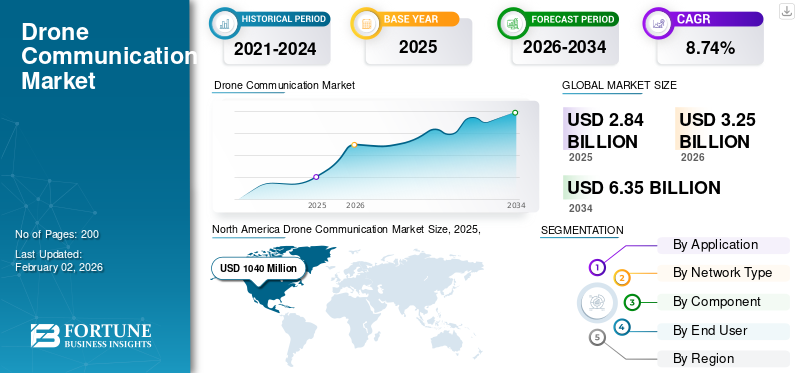
The global drone communication market size was valued at USD 2,839.7 million in 2025 and is expected to grow from USD 3250.0 million in 2026 to USD 6350.1 million by 2034, exhibiting a CAGR of 8.74% during the forecast period. North America dominated the drone communication market with a market share of 36.72% in 2025.
Drones are becoming essential in applications such as surveillance, agriculture, delivery, and military activities, the need for strong communication networks has experienced massive growth. Good communication solutions, such as mesh networks, cellular networks, and satellite connectivity, are improving the performance and reliability of drones, enabling real-time data transmission and command control. The market is rapidly changing with advancements in technology and demand across various industries. Major elements such as transceivers, antennas, and onboard flight control systems play a vital role in providing reliable connectivity. The industry is dominated by varied end users such as government agencies and commercial industries looking for efficient communication systems to streamline drone operations. With continuous innovation and increased interest in regulatory compliance, the market is expected to grow rapidly as it addresses the varied requirements of industries looking forward to utilizing the complete potential of drones.
The market is led by key players such as DJI, Parrot Drones SAS, Aerovironment Inc., Skydio, Inc., Freefly Systems, and others. These players specialize in the development of drone communication technologies to improve connectivity and performance. The competitive advantage comes from cutting-edge advancements in high-speed data transmission, secure network protocols, and effortless integration with already established systems. Through the application of their technical know-how, these companies are becoming industry leaders in this rapidly growing market, ensuring that their products satisfy the growing need for efficient and reliable drone communication technologies across various industries.
The market was greatly impacted by the COVID-19 pandemic. In the beginning, the pandemic caused a holdup in manufacturing and a drop in demand for drone services, as supply chain disruptions and regulations hindered manufacturers and operators. But with the way the world shifted to accommodate the pandemic-induced transformations, there came a significant shift toward remote work and contactless technologies, which increased the significance of drone technology across industries. It prompted companies to invest in cutting-edge communication systems for drones that facilitated more efficient and dependable operations. In addition, the growing recognition of value proposition of drones in terms of delivery operations, emergency response, and infrastructure inspections amid the crisis highlighted the potential of such a market, eventually contributing to a post-pandemic surge in innovation and investment.
Download Free sample to learn more about this report.
Drone Communication Market Key Takeaways
 Global Market Size & Forecast
- 2025 Market Size: USD 2.84 billion
- 2026 Market Size: USD 3.25 billion
- 2034 Forecast Market Size: USD 6.35 billion
- CAGR: 8.74% from 2026–2034
 Market Share
- North America dominated the drone communication market with a 36.72% share in 2025.
- The surveillance segment is projected to account for 25.63% of the market in 2026.
- The cellular networks segment is expected to hold 43.06% of the market in 2026.
 Key Regional Highlights
North America
North America reached USD 1.04 billion and held 36.72% of the global market in 2025.
Asia Pacific
Asia Pacific accounted for USD 0.68 billion and 24.01% of the global market in 2025.
Europe
Europe generated USD 0.63 billion, representing 22.32% of the global market in 2025.
U.S
The market is projected to reach USD 0.98 billion by 2026.
Japan
The market is projected to reach USD 0.15 billion by 2026.
Read More

Impact of Russia-Ukraine Conflict on the Market
Conflict Gave a Push to Sophisticated Drone Technologies with Soaring Demand
The Russia-Ukraine war has had far-reaching consequences for the market, redefining the essence of how drones are perceived to contribute to modern warfare. The escalation of the conflict demonstrated the strategic relevance of drones for reconnaissance, surveillance, and combat missions, leading to an unprecedented explosion in the demand for sophisticated drone communication technologies. With each side employing drones for tactical purposes and intelligence, manufacturers have been challenged to develop secure and robust communication systems ahead of schedule that can fend off countermeasures as well as electronic warfare. The war has also encouraged more investment in innovative solutions to further solidify the position of drones in defense and military operations and create interest in their potential uses in commercial and humanitarian affairs.
Impact of Israel-Iran Conflict on the Market
Heightened Significance of Drones in Geopolitical Conflict to Bolster Industry Expansion
The latest Israel-Iran war has significantly impacted the drone communication market growth, highlighting the geopolitical importance of drones in aggression. With both countries increasingly using drones for intelligence and surveillance activities, there has been an increased pressure for advanced communication technologies that provide real-time data transmission and operational security. The war has triggered rapid development in encrypted communication technologies that have allowed drones to function successfully in hostile environments. In addition, such geopolitical tensions have spurred neighboring nations and world powers to rethink their drone capabilities, which has led to investing and innovating more in the industry. Generally, the tensions reaffirm the role of drone technology as a strategic resource in modern warfare and battlefields.
MARKET DYNAMICS
Market Drivers
Rising Military Expenditure to Propel Market Expansion
Increasing military spending is a key factor contributing to the growth of the drone communication market share. As governments invest more to improve their defense systems, the level of military spending on advanced drone technology has increased significantly. The investment primarily goes into applications such as surveillance, reconnaissance, and logistical support, which depend much on efficient and secure communication systems. In addition, the use of drones in border patrol missions has increased the demand for strong communication networks that provide real-time information transfer and effectiveness in operations. As a result, the increase in military expenditures enhances the pace of innovation in drone technology and aids in the expansion of drone communication solutions, driving the market during the forecast period.
- For instance, in June 2025, Russia began to equip newly produced Shahed-136 strike drones with mobile communication and data transmission systems that connect to Ukrainian networks.
Market Restraints
Weather Dependency of Drones and Infrastructure Limitations May Restrain Market Growth
One of the major restraining factors that impact the growth of the market is the weather dependence of drones and the inadequacy of existing infrastructure. Drones are usually challenged by operation in bad weather, including heavy rainfall, high winds, or low visibility, which can compromise their efficiency and reliability. Such weather-related limitations limit the nature of missions that drones can be used to carry out and affect their ability to communicate during flight. Furthermore, poor infrastructure, especially in remote or underdeveloped areas, may limit the efficiency of drone activity and communication systems. Such factors may hinder the market growth during the forecast period.
Market Challenges
Cybersecurity Risks and Regulatory Compliance Challenge Market Growth
One of the greatest challenges for the drone communications market is the threat of cybersecurity and regulatory compliance. As drones increasingly use interconnected systems and data transmission to operate, they are exposed to cyberattacks that may compromise drones and the sensitive data they transmit and capture. This hacking vulnerability creates an urgent demand for strong security protocols, which can add costs and complexity to manufacturing and operating businesses. In addition, fulfilling the regulatory framework is another challenge since different regions have varied regulations, complicating the deployment and operation of drone technologies. Adherence to these regulations necessitates ongoing updates and changes, which are a challenge to resources and hinder innovation in the market.
Market Opportunities
Development of Secure and Encrypted Communication Solutions Can be a Major Opportunity for Driving Market Demand
The drone communication market has excellent expansion opportunities, especially in the development of secure and encrypted communication solutions. With the demand for drones in various industries increasing, keeping data transmission secure is critical. This offers a profitable opportunity for firms to innovate and provide communication systems that are insulated against unauthorized access and cyberattacks. Improved security functions will increase user trust and meet increasing regulatory needs, eventually fueling market demand. Additionally, as industries and agencies continue to use drones for essential functions such as surveillance, emergency response, and delivery systems, the focus on secure communication channels will open doors to next-generation technologies and collaborations, propelling market growth and innovation.
For instance, in May 2025, the Centre for Development of Telematics (C-DOT) entered a collaboration with Synergy Quantum India for developing Quantum Key Distribution (QKD) technologies particularly optimized for drone-based systems. This partnership intends to strengthen India’s capabilities in the area of quantum-secure communications. Drone-based Quantum Key Distribution (QKD) is a cutting-edge method for securely transmitting encryption keys using quantum mechanics, but with the added mobility of drones. These systems are targeted to operate at Technology Readiness Level (TRL) 6 or above, signaling readiness for real-world testing and deployment. Link
Drone Communication Market Trends
Integration of Artificial Intelligence (AI) into Drone Systems to Fuel the Market Growth
One of the major trends is the incorporation of Artificial Intelligence (AI) in systems. As drone technology advances, AI improves its performance, enhancing navigation better, obstacle detection, and data analysis. This enables drones to work more independently and effectively, making them important in many industries, ranging from logistics to farming. The growing need for intelligent, data-driven solutions continues to drive the market forward, as companies look to utilize AI-based drones for enhanced communication and operational efficiency. On the whole, the combination of drone technology and AI is revolutionizing the market landscape, driving innovation and broadening application opportunities.
For instance, in February 2025, Vedanta Aluminium, India's largest aluminium producer, launched an AI-powered drone system at a coal mine in Odisha. This drone is aimed at enhancing safety by providing real-time alerts for obstructions in blasting clearance zones.
Download Free sample to learn more about this report.
Segmentation Analysis
By Application
Surveillance Segment Leads due to Widespread Adoption of Drones for Security, Intelligence, and Surveillance
By application, the market is classified into surveillance, aerial mapping, agriculture, delivery, inspection, and military operations.
The surveillance segment dominates mainly due to the extensive use of drones for surveillance, intelligence, and security. With governments and private entities continuing to make greater use of drones to monitor activities, gather intelligence, and augment security operations, the requirement for communication technologies that can ensure real-time transmission and reliability has skyrocketed. This has driven the development of surveillance apps, owing to which the segment holds the largest market share. The surveillance segment is projected to dominate the market with a share of 25.63% in 2026.
The delivery segment is expected to show the fastest growth during the forecast period. This growth is due to the rising demand for efficient and fast logistics services such as last-mile delivery and emergency delivery services with drones. As developments continue, this segment is expected to show the fastest growth during the forecast period.
For instance, in May 2025, IIT Varanasi (BHU), India, developed a drone-based system using relays that can operate without internet connectivity and have virtually infinite range.
By Network Type
Cellular Networks Dominates the Market, Driven by the Wide-Scale Integration and Availability of Cellular Infrastructure
Based on network type, the market is classified into mesh networks, cellular networks, and satellite links.
Cellular networks have an upper hand in the market at present due to the wide integration and existence of cellular infrastructure that enables dependable connectivity. With advancements in cellular technologies such as 4G/LTE and 5G, data transmission rates have increased. This segment is, therefore, expected to show good growth during the forecast period. The cellular networks segment is projected to dominate the market with a share of 43.06% in 2026.
The satellite link segment is expected to show the fastest growth during the analysis period. This growth is due to global coverage and uninterrupted communication in remote or unserved locations. The links are becoming critical for many drone operations, especially military and emergency response missions.
To know how our report can help streamline your business, Speak to Analyst
By Component
Controller Segment Holds the Largest Market Share as it is one of the Most Essential Components of a Drone
Depending on component, the market is divided into onboard Flight Control System (FCS), transceiver, antenna, controller, GPS and positioning systems, telemetry systems, and data link systems.
The Onboard Flight Control System (FCS) segment captures the largest share of the market due to its central role in coordinating and controlling drone operations. The FCS serves as the brain of the drone, enabling effective navigation and control, which is paramount for various uses such as delivery and surveillance. Further, innovation is rising in FCS technology, with such initiatives enhancing the functionality and efficiency of drones. The controller segment is expected to lead the market, contributing 34.05% globally in 2026.
The data link systems segment is set to have the highest growth. The industry is growing due to the demand for new communication technologies, extensive use of cellular networks, and accelerating adoption of drones that need to rely on secure communication. As technology continues to evolve in Data Link Systems, drones will become more connected and efficient to operate, resulting in overall market expansion as businesses make investments in new solutions.
By End User
Commercial Segment Leads Propelled by Expansion of Drone Applications
Based on end user, the market is categorized into defense, government agencies, and commercial sectors.
The market is dominated by the commercial sector. This dominance is due to the rapid growth of drone applications in logistics, agriculture, and infrastructure surveillance. Companies are leveraging drones for operations such as aerial observation and crop health monitoring, requiring robust communication systems to facilitate real-time data transmission. This emphasis on cost-effectiveness and efficiency is compelling the demand for advanced drone communication technologies, further solidifying the commercial industry's dominance in the market. The government agencies segment will account for 58.79% market share in 2026.
The defense segment is expected to show the fastest growth during the forecast period. The rapid growth is due to rising military expenditure on drones for surveillance, reconnaissance, and tactical missions. Furthermore, the convergence of sophisticated communication technologies is promoting the capability and efficiency of drones for defense usage, positioning them as key components in modern warfare tactics.
Drone Communication Market Regional Outlook
By region, the market is studied across North America, Europe, Asia Pacific, and the rest of the world.
North America
North America Drone Communication Market Size, 2025, (USD Million)
To get more information on the regional analysis of this market, Download Free sample
In 2025, North America represented USD 1.04 billion, accounting for 36.72% of the worldwide market, and is projected to grow to USD 1.19 billion in 2026. The region is expected to show rapid growth owing to the growing adoption of sophisticated drone technologies across industries such as agriculture, logistics, and surveillance. Further, friendly regulations and an increasing focus on aerial data gathering are bound to fuel market growth in the foreseeable future. With companies looking for creative ways to improve operational effectiveness, the need for drone communication systems is expected to increase. The growth is also fueled by the presence of multiple key players in this market.
The U.S. holds the largest market share of 82.7% in 2024 in North America. The U.S. is expected to show great growth as investments in drone technology continue to surge, especially in application areas such as delivery services and emergency response. Further, constant developments in communication protocols are set to improve the efficiency and reliability of drone operations within the region. The U.S. market is valued at USD 0.98 billion by 2026.
Asia Pacific
Asia Pacific contributed 24.01% to the global market in 2025, with a valuation of USD 0.68 billion, and is projected to reach USD 0.78 billion in 2026. The Asia Pacific region is expected to see excellent growth in the market for drone communications, driven by accelerated technological development and growing investments in drone use in different industries. China, India, and Japan are at the forefront, using drones for agriculture, surveillance, and logistics. The use of drones for smart city initiatives and disaster mitigation, also supported by government initiatives, further sustains market growth. Furthermore, the growing need for effective communication networks to accommodate these applications is driving manufacturers toward innovation and the development of connectivity solutions, creating a competitive environment that is propelling the market in this region. The Japan market is estimated at USD 150.0 million by 2026, the China market is set to reach USD 350.0 million by 2026, and the India market is anticipated to achieve USD 230.0 million by 2026.
Europe
The Europe market generated USD 0.63 billion in 2025, representing 22.32% of the global market landscape, and is expected to reach USD 0.72 billion in 2026. Drone communication across Europe is witnessing high growth, fueled by strict emphasis on regulatory guidelines and the integration of drones into different sectors. Policies developed within the European Union are promoting the use of drone technology while maintaining regulatory compliance with safety and operational requirements. Countries such as the U.K., Germany, and France are seeing an upsurge in investment in drone infrastructure and communication systems, boosting the market. The focus on sustainable and efficient technology is also driving innovation in connectivity technology, turning Europe into a driver of innovative advancements in the drone communication sector. The UK market is expected to reach USD 190.0 million by 2026, while the Germany market is assessed at USD 140.0 million by 2026.
Rest of the World
Rest of the World contributed approximately USD 0.48 billion to the global market in 2025, accounting for 16.94% share, and is expected to reach USD 0.55 billion in 2026. In the rest of the world, the market is slowly unfolding, with the Middle East and Africa and Latin America being the regions that have identified the value of drones in boosting operational efficiencies in agriculture, delivery, and disaster management. Though adoption levels are slower in some regions, the increasing awareness of the advantages of drone technology is encouraging government and private investment in communication systems that enable these uses. The need for drones in humanitarian responses, especially in crises, is further driving market development, which reflects the global trend toward the use of sophisticated communication technologies for drones in varied environments. The ROW market is valued at USD 550.0 million by 2026.
Competitive Landscape
KEY INDUSTRY PLAYERS
Key Players Emphasize Communication System Advancements such as Integration of AI and Enhanced Security
The market is dynamic and competitive, with major players constantly evolving to improve system capabilities. Key players are increasingly concentrating on the development of communication systems, focusing on the inclusion of artificial intelligence to better process data and make decisions in real-time. Additionally, greater security functionality is being emphasized to safeguard sensitive data and provide stable operations for diverse applications, ranging from commercial to defense. Since such players aim to distinguish themselves, collaborations and technological alliances are becoming typical strategies as they can utilize the latest innovations and stay ahead in this fast-changing market.
List of Key Drone Communication Companies Profiled
- SZ DJI Technology Co., Ltd. (China)
- Parrot SAS (France)
- BAE Systems plc. (U.K.)
- Skydio, Inc. (U.S.)
- RTX Corp. (U.S.)
- Draganfly Inc. (Canada)
- Yuneec International Co., Ltd. (China)
- Teal Drones Innovations Inc. (U.S.)
- Iridium Communications Inc. (U.S.)
- Freefly Systems Inc. (U.S.)
- AeroVironment Inc. (U.S.)
- Honeywell International Inc. (U.S.)
- Northrop Grumman Corp. (U.S.)
- Israel Aerospace Industries Ltd. (Israel)
- L3Harris Technologies, Inc. (U.S.)
- Lockheed Martin Corp. (U.S.)
- ViaSat, Inc. (U.S.)
KEY INDUSTRY DEVELOPMENTS
- June 2025: Adax Inc., announced a new control and communications protocol for UAVs and drones. The protocol helps improve drone survival in hostile environments where they are being shot down due to excessive radio communications. Adax MAVCP produces greater likelihood of mission success given that it has been designed for drone survival in hostile environments.
- April 2025: SpiderOak, a U.S.-based data software company that has developed a zero-trust system to ensure the security of satellite transmissions, offered a similar blanket of protection for data sent to and collected by drones.
- April 2025: A Bangladeshi researcher based in Turkey developed drone-based technology that could significantly enhance emergency communication during natural disasters. His work, which has secured notable coverage in Turkish media, addressing the critical problem of the collapse of communication networks following disasters such as floods and earthquakes.
- February 2025: ZenaTech, Inc., a technology company specialized in Drone as a Service (DaaS), AI (Artificial Intelligence) drones, quantum computing, and enterprise SaaS solutions, announced that its subsidiary ZenaDrone developed and is currently testing a proprietary drone communications management system called “DroneNet”. The system enables direct and secure drone communications in situations without reliable internet, cellular, or satellite communications.
- December 2024: Japanese industrial conglomerate SoftBank Corp., announced that they had recently deployed a tether drone system to aid in flood recovery efforts across Monzencho, as part of a broader attempt to restore the telecommunications network.
REPORT COVERAGE
The market research report provides a detailed analysis and focuses on key aspects such as leading market participants, competitive landscape, and type. Besides this, it includes insights into the market trends and highlights key industry developments. In addition to the factors above, the report encompasses several factors that have contributed to the market's growth in recent years.
Request for Customization to gain extensive market insights.
REPORT SCOPE & SEGMENTATION
|
ATTRIBUTE |
DETAILS |
|
Study Period |
2021-2034 |
|
Base Year |
2025 |
|
Estimated Year |
2026 |
|
Forecast Period |
2026-2034 |
|
Historical Period |
2021-2024 |
|
Growth Rate |
CAGR of 8.74% from 2026 to 2034 |
|
Unit |
Value (USD Million) |
|
Segmentation |
By Application
|
|
By Network Type
|
|
|
By Component
|
|
|
By End User
|
|
|
By Region
|
Frequently Asked Questions
As per a study by Fortune Business Insights, the market was valued at USD 2,839.7 million in 2025.
The market is poised to grow at a CAGR of 8.74% during the forecast period.
By network type, the cellular network segment captures the largest share due to widespread adoption.
The market size in North America stood at USD 1040.5 million in 2025.
Leading companies such as Umicore NV/SA, Neometals Ltd., Li-Cycle Holdings Corp., Recyclico Battery Materials Inc., and Accurec-recycling GmbH dominate the electric vehicle battery recycling market.
North America held the largest share of 36.72% of the market in 2025.



- 2021-2034
- 2025
- 2021-2024
- 200
Get 30-60 hrs Free Customization
Expand Regional and Country Coverage, Segments Analysis, Company Profiles, Competitive Benchmarking, and End-user Insights.




















-
US +1 833 909 2966 ( Toll Free )
-
Get In Touch With Us