Drone Sensors Market Size, Share & Industry Analysis, By Sensor Type (Inertial Sensors, Image Sensors, Speed & Distance Sensors, Position Sensors, Pressure Sensors, Ultrasonic Sensors, Altimeter Sensors, Current Sensors, Light Sensors, Others), By Application (Navigation, Data Acquisition, Collision Detection and Avoidance, Power Monitoring, Motion Detection, Air Pressure Measurement, Others), By Platform (Fixed-wing, Hybrid, VTOL), and Regional Forecast, 2026-2034
 Download Free Sample
Drone Sensors Market Size Overview
 Listen to Audio Version
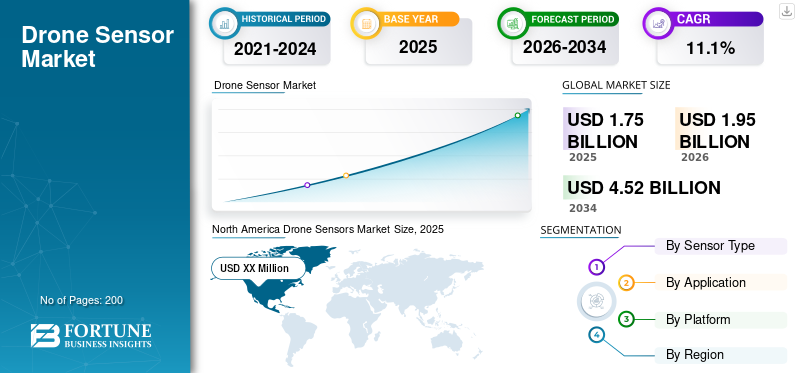
The global drone sensors market size was valued at USD 1.75 billion in 2025. The market is projected to grow from USD 1.95 billion in 2026 to USD 4.52 billion by 2034, exhibiting a CAGR of 11.10% during the forecast period.
The growing adoption of unmanned systems in commercial applications is likely to fuel the drone sensors market growth during the forecast period. Drone technology is continuously expanding its reach in various countries by maximizing the range of commercial applications of drones such as aerial photography, shipping, logistics & delivery, precision agriculture, and wildlife monitoring. Unmanned systems have broad use in industrial and civil applications owing to excellent imaging and security surveillance capabilities. These applications are possible owing to superior quality sensors that provide accurate information to the system for successful long-range flights. Unmanned systems are fully dependent on system sensors for correct decisions and successful flights. The system sensors mainly include inertial sensors, image sensors, speed & distance sensors, position sensors, pressure sensors, and other supportive sensors for correct decisions. The increasing demand for unmanned systems is projected to fuel market growth globally in the upcoming years.
COVID-19 to Accelerate Demand for Drone Sensors
The covid-19 pandemic has affected millions of people in more than 200 countries across the globe. The pandemic has disrupted several supply chains due to severe lockdown by various governments. These restrictions have affected the global economy and trade volume due to disturbing supply and demand. However, drone technology has become most useful in numerous applications to fight against the spread of the virus in public places. The drones were widely used for sanitization, medical transportation, blood sample delivery, and public monitoring. These factors increased the demand for drones in the commercial and government sector across the globe due to effective no-contact delivery. This, in turn, is projected to fuel market growth in the future.
Download Free sample to learn more about this report.
Drone Sensors Market Key Takeaways
 Market Size & Forecast
- 2025 Market Size: USD 1.75 billion
- 2026 Market Size: USD 1.95 billion
- 2034 Forecast Market Size: USD 4.52 billion
- CAGR: 11.10% from 2026–2034
 Market Share
- North America dominated the drone sensors market due to strong adoption across defense, commercial, and smart agriculture applications.
- The inertial sensors segment is projected to generate USD 312.5 million in revenue by 2025.
- The navigation segment is expected to hold a 29% market share in 2025.
 Key Regional Highlights
North America
North America reached USD 143.2 million in 2020 and dominated the market due to increasing drone adoption across military, defense, commercial, and smart agriculture applications.
Europe
Expected to grow at a CAGR of 24.57%, driven by increasing commercial drone demand.
Asia Pacific
Growth is supported by rising defense spending and expanding drone manufacturing capabilities.
U.S.
Market growth is driven by drone adoption across military, industrial, and agriculture applications.
Japan
Market is projected to reach USD 48.79 million by 2025, supported by unmanned systems and automation.
Read More

Drone Sensors Market Trends
Download Free sample to learn more about this report.
Introduction of IoT, Machine Learning, and Artificial Intelligence to Drive Market Growth
Drone technology is gaining tremendous attention from various industrial sectors owing to its excellent capability for photography and surveillance. Most of the companies are focused on enhancing the capabilities of the sensors to attain superior functionality that will help in sensing various major factors for successful operations. Sensors are used for navigation, motion, and collision detection. These systems provide accurate information by sensing various parameters that are necessary for high altitude unmanned systems. Several companies are focused on developing smart sensors that can sense multiple parameters in one system such as temperature, rainfall, humidity, and rainfall. This integration of advanced technologies, such as the Internet of Things (IoT), machine learning, and artificial intelligence, is widely used for making new generation sensors. The increasing demand for autonomous drones across the globe in a broad range of industrial applications is projected to fuel market growth in the upcoming years.
- North America witnessed drone sensors market growth from USD 116.7 Million in 2019 to USD 143.2 Million in 2020.
Drone Sensors Market Growth Factors
High Adoption of Unmanned System Military Operations to Boost Demand for Advanced Sensors
Globally, the increasing adoption of the unmanned system in military operations, such as intelligence, surveillance, reconnaissance, and targeting, owing to excellent automated flight capabilities is projected to propel market growth in the next few years. Global military defense spending has surpassed USD 1.9 trillion in 2019 as per the Stockholm International Peace Research Institute (SIPRI) and it is growing regularly. This growth is credited to the rising need for new intelligence gathering and striking capabilities in unmanned systems.
The increase in procurement of UAVs in various countries to modernize the existing fleet and enhance military and defense capabilities for counter insurgencies, terrorism, and border crossing is driving the market growth. The broad range of unmanned systems uses various sensors, such as infrared, and Lidar, for surveillance. Some important sensors such as air pressure sensors to stabilize the body, accelerometer, gyro-meter, and barometric pressure sensors, are widely used to enable flight with smooth precision. Increased integration of artificial intelligence in automation technology is expected to drive the drone sensor market during the forecast period.
Rapid Adoption of Drones in Commercial Sector is Propelling Growth of the Market
Technological developments in unmanned systems in the past few years owing to high investments from private players are fueling the demand for advanced sensors. These developments are transforming the traditional ways of aerial photography and videography owing to excellent camera sensors deployed on unmanned systems. Excellent data collection ability with the help of analytics software and are enhancing the overall performance of unmanned systems. According to Goldman Sachs, the global drone market holds a potential of USD 11 billion in the construction sector and USD 5.9 billion in the agriculture sector in the future years. The strong growth of the agriculture industry owing to the rising demand for food and vegetables across the globe has fueled the need for technological equipment. Precision farming has a requirement for soil monitoring, disease monitoring, growth monitoring, and pesticide spraying, which can be done through drone technology to increase production yield. The growing involvement of numerous technologies in smart farming is projected to propel the market growth in the upcoming years.
RESTRAINING FACTORS
Limited performance and High Cost Associated with System to Limit Market Adoption
The increasing utilization of unmanned systems in commercial and military & defense sectors owing to excellent data collection, mapping ability, surveillance, and striking capabilities is projected to fuel the demand for drone sensors in the future years. Small-size drones are also making a huge impact in the applications such as commercial delivery services & logistics, aerial photography, and agriculture. The sensors are capable of providing accurate information by sensing, position, altitude, pressure, flow, and temperature. However, the sensor system is sensitive to extreme environmental conditions, which can make drones non-functional in some areas. The sensors system is expensive owing to complicated circuit designs and dependency on other factors. These key factors are projected to hamper the future growth of the market across the growth.
Drone Sensors Market Segmentation Analysis
By Sensor Type Analysis
Image Sensor to Grow at Faster Pace during 2021-2028
Based on the sensor, the market includes inertial sensors, image sensors, speed & distance sensors, position sensors, pressure sensors, ultrasonic sensors, altimeter sensors, current sensors, light sensors, and other sensors. The inertial sensor segment is further segmented into accelerometers, gyroscopes, tilt sensors, and magnetometers. The image sensors segment is further divided into thermal, infrared, and multispectral. Speed and distance sensors are further divided into radar, LiDAR, and proximity. The position sensor segment is further sub-segmented into GPS and GNSS. The image sensors segment is projected to register a higher CAGR by 2027 due to the increasing application of aerial photography in the commercial sector. The inertial sensors segment is projected to generate USD 312.5 million in revenue by 2025.
By Platform Analysis
To know how our report can help streamline your business, Speak to Analyst
VTOL Segment Dominated the Market in 2020
Based on indication, the market is segmented into VTOL, fixed-wing, and hybrid. The fixed-wing segment is projected to hold maximum share in the upcoming years owing to extensive use in military and defense applications worldwide. Most of the military operations have strong requirements in key applications such as image mapping, information collection, data gathering, and intelligence. These applications require highly advanced sensors, systems, and components for excellent data capturing. The growing use of high-quality drone components and systems is likely to fuel segment growth. The VTOL segment is projected to register the highest CAGR during the forecast period. The increasing adoption of the unmanned system in commercial logistics services, such as food delivery, parcel deliveries, medicine supply, and sample collection, is likely to fuel segment growth in the future years.
- The VTOL segment is expected to hold a 29.7% share in 2020.
By Application Analysis
Navigation Segment to Register a Key Share in the Market during the Forecast Period
In terms of application, the market is segmented into navigation, collision detection & avoidance, data acquisition, motion detection, air pressure measurement, power monitoring, and others. The navigation segment is expected to hold the largest share in the market and is projected to lead during the forecast period. The wide range of unmanned systems is highly reliable in finding accurate positions and directions for flight operations.The navigation segment is expected to hold a 29% share in 2025.
The GPS sensors & navigation system provide accurate information including proper direction and distances. Emergency applications, such as disaster management, search & rescue operations, and remote sensing, need advanced mapping & positioning systems. The emergence of smart navigation systems is projected to fuel segment growth in the future years.
Regional Analysis
North America
North America Drone Sensors Market Size, 2025 (USD Billion)
To get more information on the regional analysis of this market, Download Free sample
The market size in North America stood at USD 143.2 million in 2020. The dominance of this region is attributable to the increasing adoption of drones in the military & defense sector and commercial industry. The developed economies, such as the U.S. and Canada, have excellent integration of technology through smart & advanced equipment for improving production output over the past several years. Several farmers are dependent on smart agriculture equipment, including drone technology, to enhance productivity. Strong growth in the U.S and Canada, is responsible for the dominance of North America in the advanced drone sensor market.
Europe
The European market is expected to grow at a strong CAGR owing to the increasing demand for commercial drones in Germany, France, and Russia, which will support regional growth. Europe is anticipated to grow at a CAGR of 24.57% during the forecast period.
Asia Pacific
The market in the Asia Pacific is expected to exhibit healthy growth owing to the surging spending on military & defense in countries for enhancing capabilities and fleet size during the forecast period. In addition to this, market players in this region are focused on expanding production activity to supply their products across the globe, which in turn, will fuel the demand for drone sensor products.
- The drone sensors market in Japan is expected to reach USD 48.79 million by 2025.
- China is projected to witness a strong CAGR of 25.33% during the forecast period.
Rest of the World
The rest of the world accounted for a relatively lower share of the market owing to the limited purchase of unnamed systems by the military sector of various counties.
KEY INDUSTRY PLAYERS
Strong Portfolio of Raytheon, Trimble, and KVH Industries to Lead the Global Market.
The market is fragmented owing to the strong product portfolio and widespread distribution network of major companies in developed and emerging countries. Currently, Raytheon, Trimble, and KVH Industries lead the market with a dominant market share in 2020. However, widespread global customers in the commercial and defense sector are projected to increase in the number of domestic players entering the global market. This is projected to result in a highly fragmented market by 2028.
Other key players, such as AMS AG, Flir Systems, Lord Microstrain, Bosch Sensortec, Sparton Navex, and TE Connectivity., have also entered the market competition with advanced drone sensor products. The introduction of innovative these sensor products and huge investment in the development of smart sensors are some of the major strategies adopted by market players operating in the market.
List of Top Drone Sensors Companies:
- Trimble (US)
- Bosch Sensortec (Germany)
- TDK InvenSense (U.S.)
- Sparton NavEx (US)
- Raytheon (US)
- AMS AG (Austria)
- Flir System (U.S.)
- KVH Industries (U.S.)
- TE connectivity (Switzerland)
- Lord MicroStrain (U.S.)
- Other Players
KEY INDUSTRY DEVELOPMENTS:
- November 2020 – The U.S. Department of Defense awarded a contract worth USD 93.3 million to General Atomics to develop excellent sensors for the MQ-9 Reaper. The contract was under Joint Artificial Intelligence Center’s Smart Sensor Project to develop artificial intelligence to control aircraft sensors by demonstrating object recognition algorithms.
- October 2020 – Hartford-based UAV manufacturing company Aquiline Drones signed licensing agreement with French sensor manufacturing company Drone Volt. The company will get a manufacturing and distribution facility through the agreement across the U.S. The Aquiline drone will be the single manufacturer of the multispectral sensor, smart camera and artificial intelligence & edge computing.
REPORT COVERAGE
The drone sensors market research report provides a detailed analysis of the market and focuses on key aspects such as leading companies, product types, and leading applications of the product. Besides this, the report offers insights into the market trends and highlights key industry developments. In addition to the aforementioned factors, the report encompasses several factors that have contributed to the growth of the advanced market over recent years.
Request for Customization to gain extensive market insights.
Report Scope & Segmentation
|
ATTRIBUTE |
DETAILS |
|
Study Period |
2021-2034 |
|
Base Year |
2025 |
|
Forecast Period |
2026-2034 |
|
Historical Period |
2021-2024 |
|
Unit |
Value (USD Million) |
|
Segmentation |
By Sensor Type
|
|
By Application
|
|
|
By Platform
|
|
|
By Geography
|
Frequently Asked Questions
According to Fortune Business Insights, the global drone sensors market size was valued at USD 1.75 Billion in 2025 and is projected to grow to USD 4.52 Billion by 2034, exhibiting a CAGR of 11.1% during the forecast period (2021–2028).
Key growth drivers include the increasing adoption of unmanned systems in commercial applications such as aerial photography, logistics, and agriculture, along with rising demand for military surveillance and reconnaissance drones. Technological advancements in AI, IoT, and machine learning are also enhancing sensor capabilities.
Growing at a CAGR of 25.08%, the market will exhibit steady growth in the forecast period (2026-2034).
North America dominated the drone sensors market with a 36.28% share in 2020, driven by high military spending, robust technological infrastructure, and strong demand for commercial drone applications in the United States and Canada.
Major sensor types include inertial sensors, image sensors, speed and distance sensors, position sensors, and pressure sensors. Among these, inertial sensors are projected to generate USD 312.5 million by 2025, while image sensors are expected to grow rapidly due to their use in aerial photography.
The navigation segment dominates the market and is expected to hold around 29% share by 2025, owing to the demand for accurate GPS and positioning systems in both commercial and defense drone operations.
Industries such as military & defense, agriculture, logistics, construction, and environmental monitoring are leading adopters. The agriculture sector alone has a strong potential, with drones being used for precision farming, pesticide spraying, and crop health monitoring.
The integration of IoT, artificial intelligence, and machine learning in sensor systems is enabling multi-parameter sensing (temperature, humidity, altitude) and improving collision avoidance, navigation, and data acquisition for drones.
Leading companies include Trimble, Bosch Sensortec, TDK InvenSense, Raytheon, AMS AG, Flir Systems, KVH Industries, TE Connectivity, and Lord MicroStrain. These companies focus on innovative sensor technologies and strategic partnerships to expand their market presence.
The market is expected to witness significant growth driven by military modernization, expanding commercial drone usage, and demand for precision sensors. Emerging markets in Asia-Pacific, particularly China and Japan, are projected to record the fastest growth rates.



- 2021-2034
- 2025
- 2021-2024
- 200
Get 30-60 hrs Free Customization
Expand Regional and Country Coverage, Segments Analysis, Company Profiles, Competitive Benchmarking, and End-user Insights.




















Related Reports
-
US +1 833 909 2966 ( Toll Free )
-
Get In Touch With Us