Drug Reference Apps Market Size, Share & Industry Analysis, By Product Type (Comprehensive Professional Apps, Formulary Apps, and Consumer Drug Information Apps), By Delivery Mode (Mobile-only, Web-only, and Integrated/EHR-embedded Solutions), By Business Model (Individual Subscription, Institutional Licensing, and Advertising & Sponsored Access), By Function (Drug Monographs, Medication Safety & Interaction Screening, and Drug Identification & Verification), By End User (Hospitals & Health Systems, Pharmacies & Pharmacists, and Patients & Caregivers), and Regional Forecast, 2026-2034
 Download Free Sample
Drug Reference Apps Market Size and Future Outlook
 Listen to Audio Version
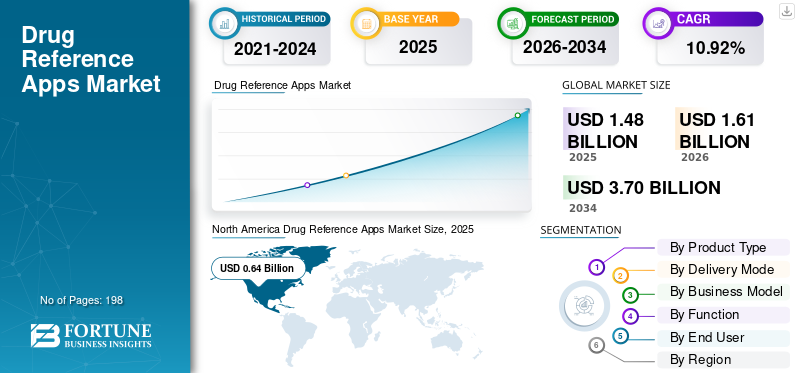
The global drug reference apps market size was valued at USD 1.48 billion in 2025 and is projected to grow from USD 1.61 billion in 2026 to USD 3.70 billion by 2034, exhibiting a CAGR of 10.92% during the forecast period. North America dominated the drug reference apps market with a market share of 43.24% in 2025.
The global market includes mobile, web-based, and workflow-integrated solutions that provide various helpful tools for healthcare professionals and consumers. Major products include UpToDate Lexidrug, Micromedex, Epocrates, Drugs.com, Medscape, and institutional drug-information platforms. The market is expanding due to the growing need for point-of-care medication decision support, frequent drug-information updates, rising polypharmacy, and increasing use of smartphones across hospitals, pharmacies, clinics, and academic institutions.
Key players operating in the global market include Wolters Kluwer N.V., Merative, epocrates, and WebMD LLC. These firms are focusing on advanced products and geographical expansion to maintain their market positions.
Download Free sample to learn more about this report.
Drug Reference Apps Market KEY Takeaways
 Global Market Size & Forecast
- 2025 Market Size: USD 1.48 billion
- 2026 Market Size: USD 1.61 billion
- 2034 Forecast Market Size: USD 3.70 billion
- CAGR: 10.92% from 2026–2034
 Market Share
- North America dominated the drug reference apps market with a 43.24% share in 2025.
- Comprehensive professional drug reference apps held the leading segment share in 2025.
- Integrated/EHR-embedded drug reference solutions led the market and are expected to hold a 49.1% share in 2026.
 Key Regional Highlights
North America
North America dominated the market with USD 0.64 billion in 2025, supported by certified EHR penetration and clinical workflow integration.
Europe
Europe is projected to grow at a 9.39% CAGR, driven by digital health systems, cross-border ePrescriptions, and multilingual medicine databases.
Asia Pacific
Asia Pacific is expected to reach USD 0.37 billion in 2026 and remain the fastest-growing region, supported by mobile-first healthcare and hospital modernization.
U.S
The U.S. market is projected to reach approximately USD 0.62 billion in 2026, representing about 38.4% of global revenues.
Japan
The Japan market is estimated at around USD 0.08 billion in 2026, accounting for roughly 4.9% of global revenues.
Read More

DRUG REFERENCE APPS MARKET TRENDS
AI-powered Drug-information Search is a Significant Trend Observed in the Global Market
Providers of drug reference applications are progressively incorporating generative AI and natural-language search to assist clinicians in swiftly accessing intricate drug and toxicology data. These tools transform conversational clinical inquiries into brief responses based on selected drug databases, minimizing the need for extensive searches through long monographs. Suppliers are highlighting clinical validation, clear source references, and risk management to tackle issues related to erroneous or false AI responses. This trend is anticipated to enhance business adoption by boosting workflow efficiency while maintaining evidence-based decision-making.
- In September 2025, Merative launched AI powered search in Micromedex, enabling clinicians to obtain cited answers from its curated drug and toxicology content.
MARKET DYNAMICS
MARKET DRIVERS
Download Free sample to learn more about this report.
Rising Focus on Medication Safety and Reduction of Prescribing Errors to Drive Market Growth
Rising polypharmacy, complex treatment regimens, and medication discrepancies are increasing the need for reliable digital drug-reference tools. Hospitals and pharmacies are adopting interaction checkers, dosing guidance, contraindication alerts, and continuously updated drug monographs to reduce preventable medication errors. Point-of-care access enables clinicians to verify prescriptions and medication combinations before administration or dispensing. This strengthens institutional subscriptions and routine usage of mobile and workflow-integrated reference applications. All these factors cumulatively drive the overall market growth.
- In November 2024, Spain’s Ministry of Health renewed nationwide access to Wolters Kluwer’s UpToDate, which was used across nearly 400 hospitals and over 13,000 primary care centers to support clinical and medication decisions. Further, clinicians recorded nearly 4.8 million searches in 2023.
|
Rank |
Market Drivers |
Overall Impact Rank |
CAGR Contribution (2026-2034) |
Impact 2026-2028 |
Impact 2029-2031 |
Impact 2032-2034 |
|
1 |
Growing focus on medication safety and reduction of prescribing errors |
High |
+3.62% |
High |
High |
High |
|
2 |
Increasing integration with EHR, e-prescribing, and pharmacy systems |
High |
+3.20% |
High |
High |
High |
|
3 |
Adoption of AI-enabled drug-information search and clinical decision support |
Medium-High |
+2.80% |
Medium |
High |
High |
|
4 |
Expansion of mobile and point-of-care clinical information access |
Medium-High |
+2.40% |
High |
High |
Medium |
|
5 |
Growth in institutional digital-content spending and enterprise subscriptions |
Medium-High |
+2.10% |
High |
High |
Medium |
|
6 |
Others |
Low |
+1.60% |
Medium |
Low |
Low |
|
|
Total Positive Growth Contribution |
|
+15.72% |
|
|
|
MARKET RESTRAINTS
Data Privacy and Cybersecurity Concerns to Limit Market Growth
Drug reference apps that store medication profiles or connect with EHRs may process sensitive patient and prescribing information, increasing exposure to privacy breaches and unauthorized data sharing. Vendors must invest in encryption, access controls, consent management, breach monitoring, and regulatory compliance, which raises development and operating costs. Hospitals and pharmacy groups also conduct lengthy security and vendor-risk assessments before approving connected applications. These requirements can delay enterprise deployment and restrict adoption among smaller providers.
- In April 2024, the U.S. FTC finalized an expanded Health Breach Notification Rule covering health apps and unauthorized disclosures, with civil penalties for non-compliance.
|
Rank |
Market Restraints |
Overall Impact Rank |
Negative CAGR Contribution (2026-2034) |
Impact 2026-2028 |
Impact 2029-2031 |
Impact 2032-2034 |
|
1 |
Availability of free drug-reference platforms and online resources |
High |
-1.80% |
High |
High |
Medium |
|
2 |
Data privacy, cybersecurity, and compliance concerns |
Medium-High |
-1.30% |
Medium |
High |
High |
|
3 |
High subscription, implementation, and system-integration costs |
Medium |
-1.10% |
High |
Medium |
Medium |
|
4 |
Others |
Low |
-0.60% |
Low |
Low |
Low |
|
|
Total Negative Growth Impact |
|
-4.80% |
|
|
|
MARKET OPPORTUNITIES
Integration with EHR, E-prescribing, and Pharmacy Systems to Offer Market Growth Opportunities
Integrating drug information, interaction checks, medication education, and adherence tools directly into EHR and e-prescribing processes presents a significant enterprise revenue opportunity. Delivery through APIs minimizes individual app searches and enables vendors to establish ongoing licensing contracts with hospitals, clinics, pharmacies, and healthcare software companies. It also enhances platform utilization by providing medication guidance at the time of prescribing and dispensing. All these factors would drive the drug reference apps market growth in the coming years.
- In December 2025, Tebra partnered with DrFirst to integrate RxInform into its EHR+ platform, providing prescription details, medication education, interaction information, and automated reminders within the existing clinical workflow.
MARKET CHALLENGES
Maintaining Continuously Updated and Validated Content to Pose a Prominent Challenge to Market Growth
Providers of drug reference applications must quickly refresh monographs when regulators change warnings, contraindications, dosage recommendations, or post-market safety data. Every modification necessitates specialist evaluation, editorial approval, database modifications, and alignment across mobile, web, and EHR-integrated offerings. Slow updates may leave clinicians reliant on obsolete prescribing information, undermining their trust in the platform. The difficulty increases for vendors operating across various nations, formulations, and regulatory databases. All these factors hinder the market growth up to a certain extent.
- In February 2025, the U.S. FDA required class-wide testosterone labeling changes, including new blood-pressure warnings and removal of cardiovascular-risk language from the boxed warning.
Segmentation Analysis
By Product Type
Comprehensive Professional Drug Reference Apps Segment Led the Market Due to Broad Clinical Utility
In terms of product type, the market is divided into comprehensive professional drug reference apps, formulary and regulatory drug reference apps, specialty and workflow-specific drug reference apps, consumer drug information and medication management apps, and others.
The comprehensive professional drug reference apps segment led the global drug reference apps market share in 2025. This is primarily due to its extensive use across various end users. These platforms combine several functions such as drug monographs, dosing guidance, interaction screening, patient education, and others within a single subscription. Moreover, enterprise licensing, EHR integration, frequent evidence updates, and higher revenue per institutional customer further supported the segment’s leading share. Their ability to serve physicians, pharmacists, and nurses across multiple clinical workflows also strengthened adoption over single-function and consumer applications.
- In November 2025, Wolters Kluwer announced the integration of UpToDate Lexidrug’s comprehensive medication information into UpToDate Expert AI. Further, noting that around 30% of clinicians’ UpToDate searches are drug-related and that the AI solution was being deployed with more than 50 major U.S. health systems.
The specialty and workflow-specific drug reference apps segment is anticipated to rise with a CAGR of 14.39% over the forecast period.
To know how our report can help streamline your business, Speak to Analyst
By Delivery Mode
Point-of-care Accessibility Supported the Dominance of Integrated/EHR-embedded Drug Reference Solutions Segment
Based on delivery mode, the market is segmented into mobile-only applications, web-only applications, integrated/EHR-embedded drug reference solutions, and others.
The integrated/EHR-embedded drug reference solutions segment captured the leading position in the global market in 2025. This is due to their direct use within prescribing, order-entry, dispensing, and medication-administration workflows. These solutions provide drug monographs, interaction checks, dosing guidance, formulary status, and patient-specific alerts without requiring clinicians to switch applications. Strong adoption across hospitals and ambulatory practices, combined with high-value enterprise licensing and recurring integration contracts, supported the segment’s leading share. Integration with patient records also enables more contextual medication guidance and improves clinical efficiency and safety. Furthermore, the segment is set to hold 49.1% share in 2026.
- In October 2024, Bizmatics and FDB highlighted the integration of FDB’s comprehensive drug knowledge into the PrognoCIS EHR, providing medication decision support directly to ambulatory healthcare providers.
The web-only applications segment is anticipated to rise with a CAGR of 6.00% over the forecast period.
By Business Model
Institutional and Enterprise Licensing Segment Dominated the Market Due to High-value Organization-wide Contracts
In terms of business model, the market is segmented into individual subscription and paid app/in-app purchase, institutional and enterprise licensing, advertising and sponsored access, publicly funded or association-supported access, and others.
In 2025, the institutional and enterprise licensing segment dominated the market due to large-scale adoption across hospitals, health systems, pharmacy networks, and academic institutions. These contracts provide multi-user access, EHR integration, single sign-on, administrative controls, usage analytics, and centralized content updates under recurring agreements. Higher contract values and organization-wide deployments generate significantly greater revenue than individual subscriptions or advertising-supported models. Long renewal cycles and the need for standardized drug information across care teams further supported the segment’s leading position. Furthermore, the segment is set to hold 61.8% share in 2026.
- In March 2024, Wolters Kluwer launched the UpToDate Enterprise Suite for health systems and health plans, with its Enterprise Edition already in use across more than 100 healthcare organizations at launch.
The advertising and sponsored access segment is anticipated to rise with a CAGR of 10.02% over the forecast period.
By Function
Drug Monographs and Prescribing Information Segment Dominated the Market Due to Their Essential Role in Medication Decisions
On the basis of function, the market is segmented into drug monographs and prescribing information, medication safety and interaction screening, drug identification and verification, medication management, adherence and alerts, and others.
In 2025, the market share was primarily led by the drug monographs and prescribing information segment. This is owing to the fact that these resources form the core content of most professional drug reference applications. They provide essential information on indications, dosage, administration, contraindications, adverse reactions, pregnancy considerations, and approved or off-label uses. Physicians, pharmacists, nurses, and students routinely access monographs during prescribing, dispensing, medication review, and clinical education. Their broad applicability across specialties, continuous regulatory updates, and inclusion within premium institutional subscriptions supported the segment’s leading revenue share. Furthermore, the segment is set to hold a share of 44.0% in 2026.
- In June 2025, Pharmaceutical Press updated Martindale: The Complete Drug Reference by adding 25 new drug monographs, revising 14 existing monographs, and updating product preparations across four countries.
The drug identification and verification segment is anticipated to rise with a CAGR of 9.22% over the forecast period.
By End User
Hospitals and Health Systems Segment Led the Market Due to Large-scale Clinical Adoption
Based on end user, the market is segmented into hospitals and health systems, pharmacies and pharmacists, patients and caregivers, ambulatory and specialty clinics, universities and academic institutions, and others.
The hospitals and health systems segment accounted for the dominant market share in 2025 as high organization-wide demand for reliable drug information across physicians, pharmacists, nurses, and medication-safety teams. These organizations purchase high-value enterprise licenses covering drug monographs, interaction screening, dosage guidance, formulary management, and patient education. Integration with EHRs, order-entry systems, and hospital pharmacy workflows increases routine usage at multiple points of care. Large user bases, recurring subscription contracts, and the need to standardize medication decisions across departments further supported the segment’s leading share. Furthermore, the segment is set to hold a share of 41.8% in 2026.
- In February 2026, FDB announced that ChristianaCare and St. Mary’s Healthcare would present their real-world use of FDB Medication and AlertSpace to improve patient medication understanding, safe medication ordering, and clinician experience.
In addition, the patients and caregivers segment is projected to witness a growth rate of 15.10% during the forecast period.
Drug Reference Apps Market Regional Outlook
By region, the market is divided into Latin America, Asia Pacific, Europe, North America, and the Middle East & Africa.
North America
North America Drug Reference Apps Market Size, 2025 (USD Billion)
To get more information on the regional analysis of this market, Download Free sample
The North America region accounted for the largest share of the global market and was valued at USD 0.59 billion in 2024. In 2025, the region maintained its dominance, with USD 0.64 billion. Growth in North America is supported by the high penetration of certified EHRs, enabling drug databases and interaction-screening tools to be embedded directly into clinical workflows. Moreover, consumer medication-management applications and pharmacy-system integration also support recurring revenue.
U.S. Drug Reference Apps Market
The U.S. market led the North American region and is projected to be approximately USD 0.62 billion by 2026, representing about 38.4% of the global market.
Europe
The Europe market is growing at a CAGR of 9.39% during the forecast period. The European Health Data Space, cross-border ePrescription infrastructure, and continued digitization of national health systems are key growth enablers. Moreover, the demand will also rise due to country-specific medicine databases, multilingual content, and compliance with national prescribing guidelines.
U.K. Drug Reference Apps Market
The U.K. market in 2026 is estimated at around USD 0.07 billion, representing roughly 4.0% of global revenues.
Germany Drug Reference Apps Market
The Germany market size is projected to reach approximately USD 0.08 billion by 2026, equivalent to around 4.8% of global sales.
Asia Pacific
The Asia Pacific market size is expected to reach a valuation of USD 0.37 billion by 2026. The region is expected to be the fastest-growing region in the global market. Rapid digital-health adoption, mobile-first access, hospital modernization, and expansion of digitally enabled primary care are supporting market growth.
Japan Drug Reference Apps Market
The Japan market size in 2026 is estimated at around USD 0.08 billion, accounting for roughly 4.9% of global revenues.
China Drug Reference Apps Market
China’s market is projected to reach revenues of around USD 0.11 billion in 2026, representing roughly 7.0% of global sales.
India Drug Reference Apps Market
The Indian market size in 2026 is estimated at around USD 0.04 billion, accounting for roughly 2.7% of global revenues.
Latin America and Middle East & Africa
The growth in Latin America and the Middle East & Africa regions is anticipated to be slower over the forecast period. The Latin America market in 2026 is estimated at around USD 0.08 billion. The regional growth is driven by the expansion of telehealth, electronic medical records, and digital tools for remote and primary healthcare delivery.
In the Middle East & Africa region, the GCC market is projected to reach approximately USD 0.03 billion by 2026, representing about 2.0% of worldwide revenues. Government-led digital-health strategies, new hospital infrastructure, and increasing EHR and e-prescribing implementation particularly across GCC countries would support market expansion.
COMPETITIVE LANDSCAPE
Key Industry Players
Focus on Comprehensive Clinical Content, EHR Integration, and Enterprise Licensing by Key Players to Expand Market Position
The global drug reference apps market is moderately concentrated in the professional and institutional segment, with Wolters Kluwer N.V., Merative, epocrates, and WebMD LLC representing a significant portion of the market. The competitive position of these players is supported by their strong presence across geographies, extensive drug monographs, and other factors.
Other significant participants include Elsevier B.V., MIMS Pte Ltd., Pharmaceutical Press Limited, PDR, LLC, Drugs.com, and CPhA. These firms are anticipated to focus on product improvement, expansion of product offerings, and workflow-embedded medication guidance to strengthen their market position throughout the forecast period.
- In August 2025, FDB launched its Medication Bedside Solution, integrating medication education directly into electronic medication administration records to strengthen its position in hospital-based medication decision support.
LIST OF KEY DRUG REFERENCE APPS COMPANIES PROFILED
- Wolters Kluwer N.V. (Netherlands)
- Merative (U.S.)
- Epocrates (U.S.)
- WebMD LLC (U.S.)
- Elsevier B.V. (Netherlands)
- MIMS Pte Ltd. (Singapore)
- Pharmaceutical Press Limited (U.K.)
- PDR, LLC (U.S.)
- com (U.S.)
- CPhA (Canada)
KEY INDUSTRY DEVELOPMENTS
- May 2026: Wolters Kluwer implemented Medi-Span medication decision support at The Christie NHS Foundation Trust, marking its first NHS deployment. The solution was embedded into the hospital’s electronic patient record and e-prescribing system to deliver patient-specific allergy, contraindication, and medication alerts.
- May 2026: Merative partnered with Perplexity to integrate selected Micromedex drug information into Perplexity’s AI search experience. The collaboration enables consumers to access evidence-based medication information with greater transparency and source attribution.
- April 2026: FDB launched the Gravimetric Drug Density Module within FDB MedKnowledge. The module provides NDC-level drug-density data to help hospital pharmacies verify compounded infusion weights and identify preparation discrepancies in high-risk medications.
- April 2026: FDB and RxEOB launched the RxWallet consumer app on the FDB Vela e-prescribing network. The integration allows users to view personalized prescription prices and compare pharmacy options before filling their medication.
- December 2025: Merative and EBSCO announced the expansion of Dyna AI with Micromedex drug content. The enhancement integrates dosing and medication-safety information into DynaMedex to support faster point-of-care clinical decisions.
REPORT COVERAGE
The global drug reference apps market analysis includes a thorough evaluation of the market size and forecasts for every segment highlighted in the report. It offers insights into the market dynamics and trends expected to drive the market throughout the forecast period. It provides understanding of essential factors, including technological progress, product innovations, the regulatory environment, pipeline analysis, and the launch of new products. Additionally, it details partnerships, mergers & acquisitions, as well as key developments in the industry within the market. The global market forecast report also provides an in-depth competitive landscape, including information on market share and profiles of key active players.
Request for Customization to gain extensive market insights.
Report Scope & Segmentation
| ATTRIBUTE | DETAILS |
| Study Period | 2021-2034 |
| Base Year | 2025 |
| Estimated Year | 2026 |
| Forecast Period | 2026-2034 |
| Historical Period | 2021-2024 |
| Growth Rate | CAGR of 10.92% from 2026-2034 |
| Unit | Value (USD Billion) |
| Segmentation | By Product Type, Delivery Mode, Business Model, Function, End User, and Region |
| By Product Type |
|
| By Delivery Mode |
|
| By Business Model |
|
| By Function |
|
| By End User |
|
| By Region |
|
Frequently Asked Questions
According to Fortune Business Insights, the global market value stood at USD 1.48 billion in 2025 and is projected to reach USD 3.70 billion by 2034.
In 2025, North America’s market value stood at USD 0.64 billion.
In 2025, North America’s market value stood at USD 0.64 billion.
By product type, the comprehensive professional drug reference apps segment is expected to lead the market.
Growing focus on medication safety and need for rapid point-of-care drug information are primarily driving market expansion.
Wolters Kluwer N.V., Merative, epocrates, and WebMD LLC are some of the prominent players in the global market.
North America dominated the market in 2025.



- 2021-2034
- 2025
- 2021-2024
- 198
Get 30-60 hrs Free Customization
Expand Regional and Country Coverage, Segments Analysis, Company Profiles, Competitive Benchmarking, and End-user Insights.













.webp)






-
US +1 833 909 2966 ( Toll Free )
-
Get In Touch With Us