Dual Interface Payment Card Market Size, Share & Industry Analysis, By Type (Plastic, Metal), By End-use (Retail, Healthcare, Transportation, Hospitality), and Regional Forecast, 2026–2034
 Download Free Sample
Dual Interface Payment Card Market Overview
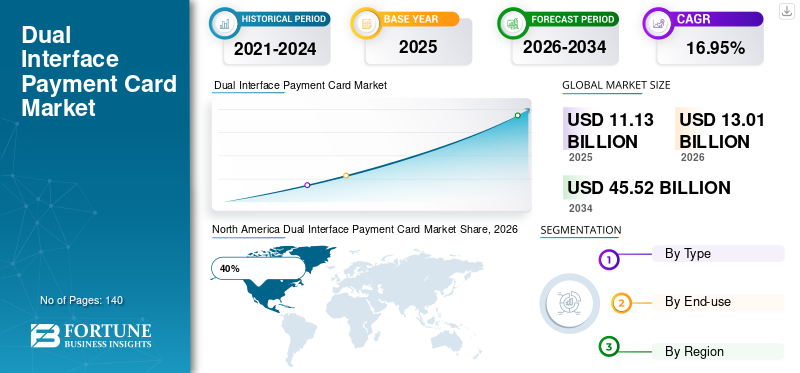
The dual interface payment card market size was valued at USD 11.13 Billion in 2025. The market is projected to grow from USD 13.01Billion in 2026 to USD 45.52 Billion by 2034, exhibiting a CAGR of 16.95% during the forecast period.

The dual interface payment card market is witnessing strong adoption across banking, financial services, transportation, and digital commerce ecosystems. Dual interface payment cards combine contact-based EMV chip functionality with contactless NFC capabilities, enabling consumers to perform secure transactions through either insertion or tap-and-pay methods. The growing preference for seamless payment experiences, enhanced fraud protection, and faster transaction processing is driving card issuance globally. Financial institutions are increasingly replacing traditional chip cards with dual interface payment cards to improve customer convenience. The dual interface payment card market Report indicates expanding demand from retail payments, transit ticketing, and integrated financial platforms, making dual interface cards a key component of modern payment infrastructure.
The United States remains the largest adopter of dual interface payment cards due to widespread contactless payment acceptance, advanced payment infrastructure, and strong consumer preference for digital transactions. Most newly issued credit and debit cards in the country now support dual interface functionality. Banks are focusing on card upgrades that integrate enhanced authentication, tokenization, and mobile wallet compatibility. The USA dual interface payment card market analysis highlights increasing deployment across retail stores, quick-service restaurants, transportation systems, and e-commerce-linked payment ecosystems. Growing use of tap-to-pay transactions and continuous investment in payment security technologies continue to strengthen market penetration across the country.
Download Free sample to learn more about this report.
Dual Interface Payment Card Market Key Takeaways
 Global Market Size & Forecast
- 2025 Market Size: USD 11.13 Billion
- 2026 Market Size: USD 13.01 Billion
- 2034 Forecast Market Size: USD 45.52 Billion
- CAGR: 16.95% from 2026-2034
 Market Share
- The market in North America dominated with a revenue share of 40% in 2025.
- Plastic dual interface payment cards dominated by type with a market share of approximately 82%.
- Retail applications dominated by end-use with a market share of approximately 48%.
 Key Regional Highlights
North America
North America led the market with a 40% share, supported by widespread contactless payment adoption and advanced payment infrastructure.
Europe
Europe accounted for 29% of the market, driven by strong adoption of contactless transactions and modern payment technologies.
Asia-Pacific
Asia-Pacific held a 24% share, supported by expanding digital payment infrastructure and increasing contactless payment adoption.
U.S
The U.S. remains a key market, supported by advanced payment infrastructure and growing demand for contactless transactions.
Japan
Japan accounted for approximately 18% of the Asia-Pacific market, supported by advanced payment technologies and growing adoption of contactless payment solutions.
Read More

Dual Interface Payment Card Market Latest Trends
The dual interface payment card market trends indicate rapid migration from conventional chip cards toward multifunctional payment solutions. Financial institutions are increasingly adopting dual interface cards because they provide flexibility between contact and contactless payment methods while maintaining compliance with modern security standards. The expansion of NFC-enabled point-of-sale terminals has significantly accelerated market acceptance.
Download Free sample to learn more about this report.
Another important trend involves premium metal dual interface cards, biometric payment cards, and sustainable card materials manufactured from recycled plastics. Issuers are also integrating dynamic authentication features and tokenized payment credentials to improve fraud prevention. The Dual Interface Payment Card Industry Analysis further highlights growing compatibility with mobile wallets and digital banking applications. Transit systems in major metropolitan regions are increasingly accepting open-loop dual interface cards, reducing dependence on dedicated transport cards. These developments are creating substantial opportunities for manufacturers, payment processors, and issuing banks while supporting the broader digital payments ecosystem.
Dual Interface Payment Card Market Dynamics
DRIVER
Rising Demand for Contactless and Secure Payment Transactions
The primary driver supporting dual interface payment card market growth is the increasing adoption of contactless payments worldwide. Consumers prefer payment methods that reduce transaction times and improve convenience at checkout counters. Dual interface payment cards provide flexibility by supporting both tap-and-pay and traditional chip-based transactions, making them suitable for diverse merchant environments.
Banks and financial institutions continue upgrading card portfolios to support digital payment ecosystems. The rise in e-commerce, mobile banking, and integrated payment solutions has increased demand for secure authentication technologies embedded within dual interface cards. Payment networks are promoting contactless transaction acceptance among merchants, further encouraging card replacement programs. The dual interface payment card market research report shows that security enhancements such as dynamic cryptograms, encrypted communication protocols, and tokenization technologies are strengthening consumer confidence. Growing deployment across transit systems, retail chains, and hospitality establishments further supports market expansion and enhances transaction efficiency.
RESTRAINT
High Manufacturing and Personalization Costs
One of the primary restraints affecting the dual interface payment card market is the higher production cost associated with embedded chips, antennas, and advanced security components. Compared with traditional magnetic stripe cards, dual interface cards require more sophisticated manufacturing processes and quality control measures.
Card issuers must also invest in personalization infrastructure, certification procedures, and secure data management systems. Smaller financial institutions often face budget limitations when transitioning large card portfolios to dual interface technology. Additionally, premium variants such as metal cards and biometric cards further increase production expenses. The dual interface payment card industry report identifies cost sensitivity in developing economies as a factor slowing adoption rates. Merchant terminal upgrades and certification requirements also contribute to implementation challenges. These factors can delay modernization initiatives despite the operational advantages offered by dual interface payment solutions.
OPPORTUNITY
Expansion of Digital Banking and Fintech Ecosystems
The rapid expansion of digital banking platforms and fintech services presents significant dual interface payment card market opportunities. Financial technology companies are increasingly issuing branded payment cards that combine physical and digital transaction capabilities. Dual interface cards serve as a bridge between conventional banking and modern digital finance ecosystems.
The growth of digital-only banks, prepaid card programs, and embedded finance solutions creates substantial demand for innovative card products. Biometric authentication, cloud-based card issuance, and instant digital provisioning are transforming the competitive landscape. The dual interface payment card market forecast highlights growing opportunities in emerging economies where digital financial inclusion initiatives are accelerating. Transportation systems, healthcare payment platforms, and loyalty-driven retail ecosystems also provide new deployment opportunities. Manufacturers capable of delivering secure, sustainable, and customizable card solutions are positioned to benefit from increasing market demand.
CHALLENGE
Evolving Cybersecurity and Fraud Risks
Maintaining security against increasingly sophisticated cyber threats remains a major challenge for the Dual Interface Payment Card Market. Fraudsters continuously develop new methods targeting payment infrastructure, transaction authentication systems, and cardholder credentials.
Card manufacturers and issuing institutions must regularly update security protocols to address emerging vulnerabilities. Regulatory compliance requirements vary across regions, increasing complexity for global market participants. The growing integration of payment cards with mobile applications, digital wallets, and cloud-based platforms introduces additional cybersecurity considerations. The dual interface payment card market insights indicate that maintaining interoperability while ensuring maximum security requires continuous investment in encryption technologies, authentication mechanisms, and fraud detection systems. Balancing user convenience with robust security remains a critical challenge for industry stakeholders.
Dual Interface Payment Card Market Segmentation
By Type
Plastic dual interface payment cards account for approximately 82% of the global market share. Their dominance is attributed to cost efficiency, manufacturing scalability, durability, and widespread acceptance among issuing banks. Most debit cards, credit cards, prepaid cards, and transit-linked payment cards utilize plastic substrates due to established production infrastructure.
Plastic cards support advanced chip technologies, NFC antennas, secure operating systems, and customized branding. Financial institutions continue adopting environmentally friendly plastic alternatives, including recycled PVC and bio-based materials. The dual interface payment card market size for plastic cards remains substantial because large-scale card replacement programs prioritize affordability and operational efficiency. Plastic cards are particularly prevalent in mass-market banking programs where millions of cards are issued annually. Enhanced durability and compatibility with contactless transaction systems further reinforce their market position.
Metal dual interface payment cards represent approximately 18% of market share and are increasingly associated with premium banking and affluent customer segments. These cards offer enhanced aesthetics, durability, and exclusivity while maintaining full contact and contactless functionality.
Banks frequently issue metal dual interface cards as part of premium account packages and high-value loyalty programs. Advanced engineering techniques allow embedded antennas to function effectively despite metallic card structures. The dual interface payment card market analysis highlights growing demand for premium customer experiences and differentiated financial products. Metal cards often include advanced security features, concierge services, and exclusive rewards programs. As financial institutions compete for affluent customers, adoption of metal dual interface payment cards continues expanding across developed markets.
To know how our report can help streamline your business, Speak to Analyst
By End-use
Retail applications account for approximately 48% of total market share. Retailers benefit from faster checkout processes, reduced transaction times, and improved customer experiences enabled by contactless payments. The widespread deployment of NFC-enabled point-of-sale terminals supports extensive card usage.
Large retail chains, supermarkets, convenience stores, and specialty retailers increasingly encourage contactless transactions. The dual interface payment card market outlook indicates continued expansion as consumers prefer convenient payment methods for everyday purchases. Retail payment ecosystems are also integrating loyalty rewards and digital promotions with card transactions, enhancing engagement and transaction frequency.
Healthcare applications hold approximately 12% market share. Hospitals, clinics, pharmacies, and healthcare networks increasingly utilize dual interface cards for secure payment processing and patient identification functions.
The integration of healthcare payment systems with digital records and insurance platforms supports growing adoption. Contactless functionality reduces transaction times and improves operational efficiency. The Dual Interface Payment Card Industry Analysis highlights increasing use of secure authentication methods within healthcare environments to protect sensitive information while facilitating convenient payments.
Transportation applications represent approximately 22% of market share. Transit operators increasingly support open-loop payment systems that allow passengers to use standard dual interface payment cards instead of dedicated transit cards.
Urban transportation networks benefit from reduced infrastructure complexity and improved passenger convenience. Contactless fare collection systems accelerate boarding times and improve operational efficiency. The dual interface payment card market research report identifies transportation modernization projects as significant contributors to market growth across developed and emerging economies.
Hospitality applications account for approximately 18% of market share. Hotels, restaurants, resorts, and entertainment venues increasingly deploy contactless payment systems to improve customer experiences.
Dual interface cards support seamless payment processing across booking platforms, dining establishments, and recreational services. Hospitality providers benefit from enhanced transaction security and reduced checkout times. The dual interface payment card market opportunities within hospitality continue expanding as tourism recovery and digital service adoption drive payment modernization initiatives.
Dual Interface Payment Card Market Regional Outlook
North America
North America Dual Interface Payment Card Market Share, 2025 (%)
To get more information on the regional analysis of this market, Download Free sample
North America accounts for approximately 40% of the global market share. The region benefits from advanced payment infrastructure, widespread contactless terminal deployment, and strong consumer acceptance of digital payments. Financial institutions continue replacing legacy payment cards with dual interface alternatives. Retail, transportation, and hospitality sectors contribute significantly to transaction volume. Strong cybersecurity investment and regulatory compliance frameworks support continued adoption across the region.
Europe
Europe represents approximately 29% of global market share. The region has been a pioneer in contactless payment adoption, supported by mature banking systems and extensive NFC terminal penetration. Financial institutions continue issuing dual interface cards as standard payment products. Public transportation integration and regulatory support for secure electronic payments further strengthen market demand. European consumers demonstrate high acceptance of contactless transaction technologies, contributing to widespread market maturity.
Germany Dual Interface Payment Card Market
Germany accounts for approximately 24% of the European dual interface payment card market. The country's strong banking sector, advanced payment infrastructure, and increasing consumer preference for digital payments support continued market expansion. German financial institutions actively upgrade card portfolios to include contactless functionality as standard features.
The retail sector plays a significant role in adoption, with supermarkets, transportation networks, and service providers expanding contactless acceptance. Growing demand for secure payment methods and enhanced fraud protection encourages banks to accelerate dual interface card issuance. Corporate payment programs and business banking services also contribute to market development. Continued modernization of payment ecosystems supports long-term growth opportunities within Germany.
United Kingdom Dual Interface Payment Card Market
The United Kingdom holds approximately 21% of the European market. The country demonstrates one of the highest levels of contactless payment adoption globally. Consumers frequently utilize dual interface cards for retail purchases, transportation services, and hospitality transactions.
Financial institutions continue introducing advanced card technologies that integrate seamlessly with digital wallets and mobile banking applications. Transportation systems extensively support open-loop payment models, encouraging everyday use of dual interface cards. The strong fintech ecosystem further contributes to innovation and market penetration. High merchant acceptance and consumer familiarity continue strengthening the UK's market position.
Asia-Pacific
Asia-Pacific accounts for approximately 24% of global market share. Rapid urbanization, expanding financial inclusion initiatives, and growing digital payment adoption are driving regional growth. Governments and financial institutions are investing heavily in modern payment infrastructure.
Large consumer populations and increasing smartphone penetration support widespread acceptance of contactless transactions. Banks across major economies are accelerating migration toward dual interface payment technologies. Retail modernization and transportation digitization further enhance market prospects across the region.
Japan Dual Interface Payment Card Market
Japan represents approximately 18% of the Asia-Pacific dual interface payment card market. The country's advanced payment ecosystem and strong emphasis on technological innovation support increasing adoption. Financial institutions continue promoting cashless payment initiatives while integrating dual interface capabilities into new card programs.
Transportation systems have played a major role in familiarizing consumers with contactless technologies. Retailers increasingly support tap-to-pay transactions, encouraging broader usage. Security, convenience, and compatibility with digital payment platforms continue driving demand. Premium card offerings and innovative authentication technologies further contribute to market expansion.
China Dual Interface Payment Card Market
China accounts for approximately 35% of the Asia-Pacific market. The country's extensive digital payment ecosystem supports significant demand for advanced payment technologies. Banks and financial institutions continue expanding dual interface card issuance programs alongside mobile payment services.
Retail modernization, transportation digitization, and financial inclusion initiatives contribute to market growth. Domestic manufacturers play an important role in supplying secure payment cards for banking and government programs. Increasing emphasis on payment security and interoperability supports continued adoption across multiple sectors.
Rest of World
The Rest of World region accounts for approximately 7% of global market share. Adoption is increasing across Latin America, the Middle East, and Africa as financial institutions modernize payment infrastructure. Governments and banks are promoting electronic payment systems to improve financial inclusion and transaction transparency.
Retail expansion, growing smartphone penetration, and increasing acceptance of contactless payment technologies support market development. Financial institutions continue replacing legacy cards with more secure dual interface alternatives. Investment in payment infrastructure and digital banking platforms creates additional opportunities for manufacturers and service providers.
List of Top Dual Interface Payment Card Companies
- Thales Group
- IDEMIA
- VALID
- Giesecke+Devrient GmbH
- Eastcompeace Technology Co., Ltd.
- DATANG
- Paragon Group Limited
- CPI Card Group Inc.
- Watchdata Co., Ltd.
- Wuhan Tianyu
Top Two Companies by Market Share
- Thales Group – 18%
- IDEMIA – 16%
Investment Analysis and Opportunities
Investment activity within the dual interface payment card market is concentrated on advanced card manufacturing, secure chip development, biometric authentication technologies, and sustainable card materials. Financial institutions continue allocating resources toward portfolio upgrades as contactless transactions become standard consumer behavior.
Significant opportunities exist in emerging economies where payment infrastructure modernization remains underway. Manufacturers investing in environmentally sustainable card materials, cloud-based issuance platforms, and next-generation authentication technologies are positioned for competitive advantage. The dual interface payment card market forecast also highlights opportunities associated with transit payments, digital banking ecosystems, and premium metal card programs. Strategic partnerships between fintech providers, payment processors, and card manufacturers continue creating new investment avenues across global markets.
New Product Development
Innovation within the dual interface payment card market focuses on enhanced security, sustainability, and customer experience. Manufacturers are developing biometric-enabled payment cards that authenticate users through fingerprint recognition while maintaining contactless functionality.
Sustainable card production has become a major area of innovation, with recycled plastics, bio-based materials, and eco-friendly manufacturing processes gaining traction. Premium metal dual interface cards continue evolving through improved antenna designs and enhanced durability. Cloud-connected card issuance systems, instant personalization technologies, and digital wallet integration capabilities are also transforming product development strategies. These innovations support stronger security, improved convenience, and broader market adoption.
Five Recent Developments (2023-2025)
- Thales expanded cloud-based payment card issuance capabilities for large-scale banking programs.
- IDEMIA introduced advanced biometric dual interface payment card solutions with mobile enrollment functionality.
- Giesecke+Devrient expanded secure payment card production capacity to support increasing contactless card demand.
- CPI Card Group enhanced fraud prevention integration through strategic collaboration with AI-driven security platforms.
- Eastcompeace introduced upgraded dual interface card technologies supporting enhanced NFC payment performance.
Report Coverage
The dual interface payment card market Report provides comprehensive evaluation of industry structure, technological developments, competitive positioning, and demand patterns across global markets. The report examines adoption trends among financial institutions, payment processors, retailers, transportation operators, and hospitality providers.
Request for Customization to gain extensive market insights.
Coverage includes detailed analysis of market segmentation by type and end-use application, alongside regional assessments covering North America, Europe, Asia-Pacific, and Rest of World markets. The dual interface payment card market research report further evaluates competitive strategies, product innovations, investment activities, and emerging opportunities. Market share assessments, technology adoption patterns, security developments, and customer behavior trends are analyzed to provide stakeholders with actionable business intelligence and strategic planning insights.
Frequently Asked Questions
Fortune Business Insights says that the global market value stood at USD 11.13 billion in 2025 and is projected to reach USD 45.52 billion by 2034.
The market is expected to exhibit a CAGR of 16.95% during the forecast period of 2026-2034.
Plastic dual interface payment cards led the type segment with approximately 82% market share, driven by their cost efficiency, manufacturing scalability, durability, and widespread acceptance among issuing banks.
Key players include Thales Group, IDEMIA, VALID, Giesecke+Devrient GmbH, Eastcompeace Technology Co., Ltd., and DATANG.
Major trends include rapid migration from conventional chip cards to multifunctional contact/contactless cards and growing adoption of biometric, sustainable, and tokenized payment solutions. North America dominated with approximately 40% market share.



- 2021-2034
- 2025
- 2021-2024
- 140
-

(Offer valid till 15th Oct 2026)
Get 30-60 hrs Free Customization
Expand Regional and Country Coverage, Segments Analysis, Company Profiles, Competitive Benchmarking, and End-user Insights.












-
US +1 833 909 2966 ( Toll Free )
-
Get In Touch With Us