Contactless Payment Market Size, Share & Industry Analysis, By Payment Mode (Smart Cards, Mobile Handset, and Wearables), By Technology (Near Field Communication (NFC), Radio Frequency Identification (RFID), Host Card Emulation (HCE), QR Code & Tokenization, and Others), By Application (Retail & E-Commerce, Healthcare, BFSI, Government, Travel & Transportation, and Others), and Regional Forecast, 2026-2034
 Download Free Sample
KEY MARKET INSIGHTS
 Listen to Audio Version
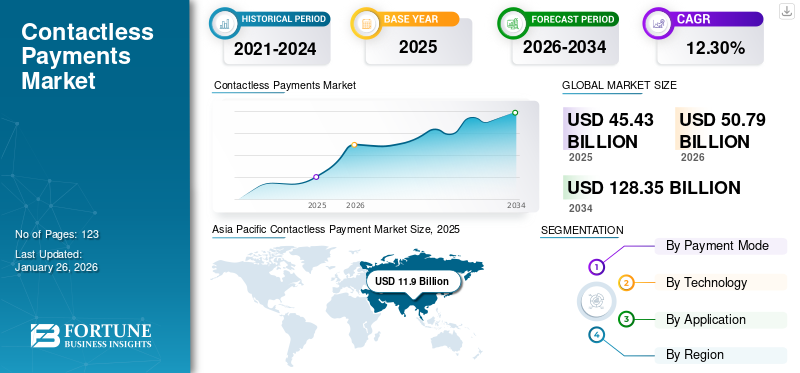
The global contactless payment market size was valued at USD 45.43 billion in 2025. The market is projected to grow from USD 50.79 billion in 2026 to USD 128.35 billion by 2034, exhibiting a CAGR of 12.30% during the forecast period. Asia Pacific dominated the global market with a share of 26.20% in 2025.
Contactless payment is a reliable and touch-free method of making payments by tapping (or waving) a card, smartphone, or wearable device at a payment terminal. It uses the Near-Field Communication (NFC) to transfer encrypted data about the payment without any physical contact, thus making transactions faster than traditional methods such as inserting a card or handling cash.
Market growth can be attributed to consumer convenience, increased security by utilizing tokenization technology, and the increased availability of smartphones and wearables capable of integrating payment systems. Other factors that facilitate contactless payments include growing merchant acceptance, government support for a cashless payment system, and post-pandemic hygiene preferences for contactless methods.
The top companies in the market are Infineon Technologies, Ingenico, Wirecard, Verifone, Giesecke+Devrient, and IDEMIA.
Download Free sample to learn more about this report.
CONTACTLESS PAYMENT MARKET KEY TAKEAWAYS
 Market Size & Forecast
- 2025 Market Size: USD 45.43 billion
- 2026 Market Size: USD 50.79 billion
- 2034 Forecast Market Size: USD 128.35 billion
- CAGR: 12.30% from 2026–2034
 Market Share
- Asia Pacific dominated the contactless payment market with a 26.20% share in 2025.
- The smart cards segment held the largest share of the market in 2024, generating USD 12.01 billion in revenue.
- The NFC segment is projected to lead the market with a 69.52% share in 2026.
 Key Regional Highlights
North America
North America generated USD 8.39 billion in 2025 and is projected to grow to USD 9.32 billion in 2026, driven by widespread NFC adoption and growing use of contactless cards.
Europe
Europe was the largest regional market, valued at USD 19.26 billion in 2025 and projected to reach USD 21.14 billion in 2026, accounting for 42.40% of global revenue in 2025.
Asia Pacific
Asia Pacific recorded USD 11.90 billion in 2025 and is expected to reach USD 13.70 billion in 2026, supported by strong digital wallet adoption and government-led cashless payment initiatives.
U.S.
The market is expected to reach USD 5.01 billion in 2026, supported by increasing mobile wallet penetration and expansion of contactless-enabled payment terminals.
Japan
The market is expanding alongside the country's growing cashless payment ecosystem, supported by advanced payment infrastructure and increasing adoption of contactless transaction technologies.
Read More

MARKET DYNAMICS
Market Drivers
Surge in Cloud-Native Cores and Improved KYC/AML Drives Market Growth
The expansion of the contactless payments market is largely underpinned by the increase in cloud-native payment cores and the enhancement of KYC/AML systems. Cloud-native architectures support fast tokenization, real-time risk scoring (within milliseconds), and practically no downtime, while still handling high transaction volumes. The advancements in the KYC/AML processes can assist in distinctly lowering fraud or false declines, resulting in issuers and merchants having a higher acceptance rate for contactless transactions. The combined impact of these technological advancements enables contactless payments to be processed more quickly, safely, and reliably, leading to the wider adoption of contactless payments by consumers across various sectors, including retail and hospitality, globally. This, in turn, drives growth and innovation in the payments market.
Market Restraints
Heightened Regulatory Scrutiny and Consent Orders Hinder Growth
The contactless payments sector is faced with obstacles due to tougher regulatory inspections and frequent consent orders. Increasing consideration of data privacy, security in transactions, and governance of digital wallets can result in compliance load and increased approval time. Regulations, although they are important to safeguard consumers, retard product introductions, incite innovation, and augment expenses incurred by the provision of services. The constant modification of the policies and the absence of universal norms between jurisdictions contribute to the further complexity, which can easily prevent the market development and slow the speed of technological upgrade. To conclude, regulatory limitations remain one of the main causes of inhibiting the frictionless evolution of contactless payment technologies.
Market Opportunities
Multi-bank Orchestration and Daily Reconciliation Drive Growth, Creating Growth Opportunities
The increased interest in multi-bank orchestration and automated daily reconciliation is provide great growth potential in the contactless payment sector. Through intelligent routing of transactions to the best-fitting issuer or acquirer based on Bank Identification Number (BIN), geography, or risk profile, a business can increase the success of authorization and reduce the cost of transactions. This progressive orchestration model will guarantee real time optimization and more transparency in operations, facilitating efficiency of merchants and acquirers. With the continued growth of digital networks around the world, the ability to consolidate multiple banking partners and settle payments on a daily basis reinforces the liquidity control and scalability, which is the next frontier of the contactless payment developments.
CONTACTLESS PAYMENT MARKET TRENDS
Embedded Finance Adoption Across Retail, SaaS, and Marketplaces Emerges as a Major Trend
The adoption of embedded finance is driving the development of the contactless payments landscape, with rapid growth in use across the retail and SaaS sectors and online marketplaces. With the implementation of financial features such as digital wallets, buy-now-pay-later (BNPL) options, loyalty programs, and others, directly integrated into the customer experience, organizations are seeing higher conversion rates and average order values. This tendency gives platforms the authority to manage the checkout process and provide more user interactions and acceptance points for tap-to-pay transactions. Embedded finance is a fundamental digital capability that strengthens customer connections and accelerates the worldwide transformation to smooth and frictionless payment systems.
Download Free sample to learn more about this report.
SEGMENTATION ANALYSIS
By Payment Mode
Widespread Adoption of Wearable Devices Boosts Smart Cards Segment Growth
Based on the payment mode, the market is segmented into smart cards, mobile handset, and wearables.
The smart cards segment held the largest share of USD 12.01 billion in the overall global market in the year 2024. The revenue for the segment is driven by the widespread adoption of wearable devices such as smartwatches and fitness bands that enable convenient and secure contactless payments across retail, e-commerce, and everyday transactions.
The wearables segment holds the highest CAGR of 24.3% in the global market. The segment’s growth is attributable to the growing consumer preference for convenient, on-the-go payment options and the increasing integration of contactless payment technology in smartwatches and fitness devices.
By Technology
Near Field Communication (NFC) Segment Dominates Market Owing to Its Widespread Adoption for Tap-And-Pay Transactions
Based on technology, the market is divided into Near Field Communication (NFC), Radio Frequency Identification (RFID), Host Card Emulation (HCE), QR code & tokenization, and others.
The Near Field Communication (NFC) segment is projected to dominate the market with a share of 69.52% in 2026. The segment continues to generate the major revenue due to widespread adoption for tap-and-pay transactions, supported by secure, fast, and user-friendly payment experiences across smartphones and payment terminals.
QR code & tokenization holds the highest CAGR of 21.8% in the global market. The segment’s growth is attributable to the increasing adoption of digital wallets and e-commerce platforms, which rely on secure, easy-to-implement, and contactless payment methods for transactions.
By Application
To know how our report can help streamline your business, Speak to Analyst
High Volume of Consumer Transactions Augments the Retail & E-Commerce Segment Growth
Based on the application, the market is divided into retail & e-commerce, healthcare, BFSI, government, travel & transportation, and others.
The retail & e-commerce segment is projected to dominate the market with a share of 54.81% in 2026. The segment’s growth is attributable to the high volume of consumer transactions and the growing preference for convenient, contactless payment options in online shopping and physical retail stores.
Travel & transportation represent the largest CAGR at 21.9% in the global market. The segment’s growth is attributable to the increasing demand for fast, hygienic, and contactless ticketing and fare collection solutions in public transport, airlines, and ride-hailing services.
CONTACTLESS PAYMENT MARKET REGIONAL OUTLOOK
Geographically the market is segmented into North America, Europe, Asia Pacific, South America and Middle East & Africa.
North America
In 2025, North America generated USD 8.39 billion, contributing 18.40% to global market revenue, and is projected to grow to USD 9.32 billion in 2026. The North America market is rapidly expanding. The region’s growth is attributable to high consumer demand for speed, convenience, and security, and facilitated by widespread adoption of NFC technology in the U.S. and Canada. Key players such as Visa and Mastercard have driven growth through the issuance of contactless cards and the integration of payment options into mobile wallets and public transit systems.
The U.S. is at the forefront of the North American market, with expected revenue of USD 5.01 billion in 2026. The growth is attributable to the widespread adoption of mobile wallets and increased availability of contactless-enabled point-of-sale terminals in retail.
Europe
The Europe market accounted for USD 19.26 billion in 2025, representing 42.40% of the global industry, and is expected to reach USD 21.14 billion in 2026. The region’s growth is attributable to consumer preference for speed and convenience, increased adoption of smartphones and digital wallets, and a strong push towards cashless economies in many countries.
The U.K., Germany, and France are some of the leading contributors to the growth in the market, with the required revenue stake of USD 5.81 billion, USD 4.06 billion in 2026 and USD 0.68 billion in 2025.
Asia Pacific
Asia Pacific Contactless Payment Market Size, 2025 (USD Billion) To get more information on the regional analysis of this market, Download Free sample
Asia Pacific is currently at the forefront of the global market. Asia Pacific recorded a market size of USD 11.9 billion in 2025, capturing 26.20% of the global market share, and is projected to reach USD 13.7 billion in 2026. The region’s growth is attributable to high smartphone penetration, widespread adoption of digital wallets, and supportive government initiatives promoting contactless payment transactions across the region.
At the same time, Asia Pacific is also expected to have the highest CAGR of 20.3%, further solidifying the market as the fastest growing. The growth is due to pro-digital regulation, instant payment rails integrating with wallets, and cross-border contactless payments.
India and China are major contributors to the contactless payment market growth with an expected revenue share of USD 2.2 billion, and USD 4.23 billion respectively by 2026.
South America and Middle East & Africa
The markets of South America and Middle East & Africa are growing with an expected share of USD 0.51 billion and USD 0.84 billion respectively in 2025. The growth is attributable to increased smartphone penetration, fintech innovations, and government initiatives. The Middle East & Africa market generated USD 2.44 billion in 2025, representing 5.40% of the global market landscape, and is expected to reach USD 2.7 billion in 2026. The market in South America reached USD 3.44 billion in 2025, representing 7.60% of total market revenue, and is projected to reach USD 3.92 billion in 2026.
GCC countries are predicted to have a market share of USD 0.41 billion by 2025.
COMPETITIVE LANDSCAPE
Key Industry Players
Key Players Focus On Partnerships and Acquisitions to Lead the Industry
The key players in the industry are Infineon Technologies, Ingenico, Wirecard, Verifone, Giesecke+Devrient, and IDEMIA. These companies are focusing on security enhancements such as tokenization and biometrics, expanding partnerships to integrate with more devices and POS systems, and innovating through wearables and mobile-based solutions. They also leverage partnerships and strategic collaborations to expand market reach and develop new solutions.
LIST OF KEY CONTACTLESS PAYMENT COMPANIES PROFILED
- Infineon Technologies (Germany)
- Ingenico (France)
- Wirecard (Germany)
- Verifone (U.S.)
- Giesecke+Devrient (Germany)
- IDEMIA (France)
- On Track Innovations (Israel)
- Identiv (U.S.)
- CPI Card Group (U.S.)
- Bitel (South Korea)
- Setomatic Systems (U.S.)
- Valitor (Iceland)
- PAX Global Technology (China)
- MYPINPAD (U.K.)
- Mobeewave (Canada)
- Alcineo (South Africa)
KEY INDUSTRY DEVELOPMENTS
- October 2025- CPI Card Group Inc., a payments technology company formed a strategic partnership with, and a minority equity investment in, Karta, an Australia-based prepaid program manager and payments technology firm. The partnership offers CPI clients an innovative solution for prepaid card security by integrating Karta’s patent-pending SafeToBuy technology with CPI’s U.S. prepaid solutions, driving a digital experience with a physical card.
- April 2025- IDEMIA Secure Transactions (IST) partnered with the National Payment Corporation of Vietnam (NAPAS) to help expand the country’s digital payments Through the partnership, NAPAS will integrate IST’s tokenisation technology into its domestic payment network, which connects over 40 banks.
- March 2025- Surfboard Payments, a leading Swedish paytech company, announced the launch of Tap to Pay on iPhone for merchants in Finland. This new feature enables businesses to accept contactless in-person payments using only an iPhone and the CheckoutX app, with no additional hardware required.
- October 2024- Infineon Technologies AG announced the launch of SECORA™ Pay Green which enables card designs allowing production of the world’s first fully recyclable contactless (dual-interface) payment card bodies based on environmentally friendly and locally sourced materials.
- August 2024- Interswitch East Africa (Kenya) Limited partnered with Elie Technologies to unveil a contactless payment solution for merchants and customers in Kenya. The solution, dubbed Tumatap, will enable Micro, Small, and Medium Enterprises (MSMEs) to accept contactless payments on smartphones, thus transforming the devices into point of sale (POS) systems without the need for additional hardware.
REPORT COVERAGE
The global report provides a detailed analysis of the market and focuses on key aspects such as prominent companies, deployment modes, types, and end users of the product. Besides this, it offers insights into the contactless payment market trends and highlights key industry developments and market share analysis for key companies. In addition to the aforementioned factors, the report encompasses several factors that have contributed to the growth of the market over recent years.
Request for Customization to gain extensive market insights.
Report Scope & Segmentation
|
ATTRIBUTE |
DETAILS |
|
Study Period |
2021-2034 |
|
Base Year |
2025 |
|
Estimated Year |
2026 |
|
Forecast Period |
2026-2034 |
|
Growth Rate |
CAGR of 12.30% from 2026-2034 |
|
Historical Period |
2021-2024 |
|
Unit |
Value (USD Billion) |
|
Segmentation |
By Payment Mode, Technology, Application, and Region |
|
By Payment Mode |
|
|
By Technology |
|
|
By Application |
|
|
By Region |
North America (By Payment Mode, Technology, Application and Country/Sub-region)
Europe (By Payment Mode, Technology, Application and Country/Sub-region)
Asia Pacific (By Payment Mode, Technology, Application and Country/Sub-region)
South America (By Payment Mode, Technology, Application and Country/Sub-region)
Middle East & Africa (By Payment Mode, Technology, Application and Country/Sub-region)
|
Frequently Asked Questions
Fortune Business Insights says that the global market stood at USD 50.79 billion in 2026 and is projected to reach USD 128.35 billion by 2034.
The market is expected to exhibit steady growth at a CAGR of 12.30% during the forecast period.
Surge in cloud-native cores and improved KYC/AML is speeding up the market growth.
Infineon Technologies, Ingenico, Wirecard, Verifone, Giesecke+Devrient, and IDEMIA are some of the top players in the market.
Asia Pacific dominated the global market with a share of 26.20% in 2025.
Asia Pacific was valued at USD 11.9 billion in 2025.



- 2021-2034
- 2025
- 2021-2024
- 123
Get 30-60 hrs Free Customization
Expand Regional and Country Coverage, Segments Analysis, Company Profiles, Competitive Benchmarking, and End-user Insights.












-
US +1 833 909 2966 ( Toll Free )
-
Get In Touch With Us