E-Book Reader Market Size, Share & Industry Analysis, By Display Output (Monochrome E-Paper Readers and Color E-Paper Readers), By Screen Size (Below 6.0 Inches, 6.0-7.9 Inches, 8.0-9.9 Inches, and 10 Inches & Above), By Connectivity (Wi-Fi-Only and Cellular-Enabled), By Price Range (Economy, Mid-Range, Premium, and Luxury), By Purchasing Entity (Individual Consumers, Educational Institutions, Libraries, and Commercial Enterprises), By Distribution Channel (Electronic Stores, Supermarkets & Hypermarkets, Direct Sales, Online Marketplaces, and Others), and Regional Forecast, 2026-2034
 Download Free Sample
(Offer valid till 15th Oct 2026)

E-Book Reader Market Size and Future Outlook
 Listen to Audio Version
The global e-book reader market size was valued at USD 3.11 billion in 2025 and is projected to grow from USD 3.29 billion in 2026 to USD 5.13 billion by 2034, exhibiting a CAGR of 5.72% during the forecast period. North America dominated the e-book reader market with a market share of 39.22% in 2025.
E-book readers are devices designed for reading digital books, periodicals, comics, academic materials, and documents. Modern digital book reader devices exhibit color displays, large-format screens, waterproof models, and hybrid reading-note-taking features. In the global market, brands differentiate their products based on screen size, adjustable front lighting, battery performance, cloud synchronization, handwriting capabilities, and waterproofing features. Advancements in the development of such integrated technology-based devices are favoring the global market growth.
- In May 2026, Amazon Kindle introduced an all-new Kindle Scribe lineup of e-reader devices, including the standard Kindle Scribe, Kindle Scribe Colorsoft, and front-light-free variant. Therefore, exhibiting front light system LEDs, Alexa+ connectivity, notebook sharing capability with OneNote, and AI-powered search features.
Prominent companies in the global market include Amazon.com, Inc., Rakuten Group, Inc., Onyx International Inc., PocketBook International SA, and Hanvon Technology Co., Ltd.
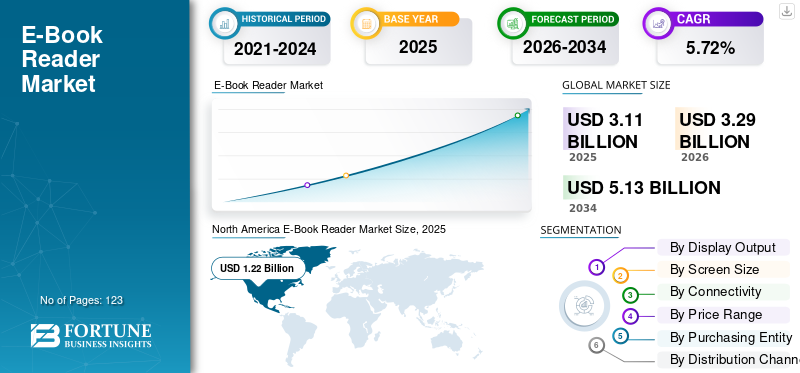
Download Free sample to learn more about this report.
E Book Reader Market Key Takeaways
 Global Market Size & Forecast
- 2025 Market Size: USD 3.11 billion
- 2026 Market Size: USD 3.29 billion
- 2034 Forecast Market Size: USD 5.13 billion
- CAGR: 5.72% from 2026-2034
 Market Share
- North America dominated the e-book reader market with a 39.22% share in 2025.
- The 6.0–7.9 inches segment held a 67.41% share in 2025.
- The Wi-Fi-only readers segment is projected to grow at a 5.60% CAGR from 2026-2034.
 Key Regional Highlights
North America
North America held a 39.22% share in 2025, with the market projected to reach USD 1.28 billion in 2026.
Asia Pacific
Asia Pacific held a 26.39% share in 2025 and is projected to grow at 7.10% from 2026–2034.
Europe
Europe accounted for a 29.21% share in 2025, with the regional market reaching USD 0.91 billion.
U.S.
The market reached USD 0.93 billion in 2025, accounting for approximately 29.97% of global sales.
Japan
The market stood at around USD 0.18 billion in 2025, accounting for roughly 5.64% of global revenues.
Read More

E-BOOK READER MARKET TRENDS
Rising Demand for E-book Readers Combining Handwriting and Document Management Functions to Favor Market Growth
Premium digital book readers equipped with generative AI features combine reading with handwriting and document management functions. These features help users summarize notes, identify key points, refine handwriting, support natural-language notebook searches, translate content, and convert notes into task lists or reminders. Rising demand among students, researchers, professionals, and institutional users for such innovative devices is favoring market growth by reducing the effort required to organize and review information.
MARKET DYNAMICS
MARKET DRIVERS
Download Free sample to learn more about this report.
Expansion of E-Book Libraries, Subscription Platforms, Digital Publishing, and Content Ecosystems to Drive Product Demand
Continued expansion of the digital content publishing ecosystem increases readers’ accessibility to books, textbooks, periodicals, comics, and professional publications in digital formats, driving product demand globally. According to the Association of American Publishers (AAP), U.S. e-book publishing revenues reached USD 2.10 billion in 2024, up 1.5% over the previous year. In addition, the growing number of subscription-based online book platforms allows consumers to access extensive libraries for recurring fees, reducing their dependence on individual title purchases. These platforms encourage frequent reading, thereby driving product sales and global e-book reader market growth.
|
Rank |
Market Drivers |
Expected Impact on Market Growth |
Estimated Gross Market Growth Contribution (USD Billion) |
Impact: 2026-2028 |
Impact: 2029-2031 |
Impact: 2032-2034 |
|
1 |
Expansion of e-book libraries, subscription platforms, digital publishing, and content ecosystems |
High |
0.58 |
High |
High |
High |
|
2 |
Advancements in color e-paper, display quality, battery performance, and note-taking functionality |
High |
0.49 |
Medium |
High |
High |
|
3 |
Increasing adoption in education, libraries, research, and professional document reading |
High |
0.43 |
Medium |
High |
High |
|
4 |
Rising preference for distraction-free, paper-like, glare-reduced digital reading |
Medium |
0.38 |
High |
Medium |
Medium |
|
5 |
Wider online availability and expansion of local-language digital content in emerging markets |
Medium |
0.36 |
Medium |
Medium |
High |
|
6 |
Others (audiobook integration, accessibility features, waterproof designs, sustainable materials, trade-in programs, cloud synchronization, and children-focused e-book readers, etc.) |
Low |
0.31 |
Low |
Medium |
Medium |
|
Total Gross Growth Contribution |
2.55 |
MARKET RESTRAINTS
Greater Usage of Substitute Products, Including smartphones and Tablets, for E-book Reading to Restrain Market Growth
Consumers can easily use Kindle, Apple Books, Google Play Books, Kobo Books, and library-lending platforms on their smartphones and tablets to download and access digital books. The growing usage of substitute products, including smartphones, tablets, and other multifunctional devices, is reducing the need to use additional digital book reader devices, restraining the global market growth. In addition, increasing consumer access to tablets featuring color displays, faster refresh rates, video playback, web browsing, productivity tools, and larger application e-book ecosystems is reducing the need for dedicated e-book readers. These features, along with stronger support for interactive textbooks, comics, magazines, and illustrated publications, are hampering product demand across many countries.
|
Rank |
Market Restraints |
Expected Impact on Market Growth |
Estimated Reduction in Market Size (USD Billion) |
Impact: 2026-2028 |
Impact: 2029-2031 |
Impact: 2032-2034 |
|
1 |
Greater accessibility to substitute products including smartphones, tablets, and other multifunctional devices |
High |
0.30 |
High |
High |
High |
|
2 |
Long device-replacement cycles due to durable hardware and limited need for frequent upgrades |
High |
0.23 |
High |
High |
Medium |
|
3 |
High prices of premium devices and dependence on proprietary content ecosystems |
Medium |
0.12 |
Medium |
Medium |
Medium |
|
4 |
Others (e-paper supply constraints, limited color-display performance, digital-rights-management restrictions, repairability concerns, software-support limitations, and consumer preference for printed books, etc.) |
Low |
0.06 |
Low |
Low |
Low |
|
Total Market Reduction |
0.71 |
MARKET OPPORTUNITIES
Manufacturers’ Partnerships with Education Institutes to Develop Specific Devices and Drive B2B Sales
Schools, universities, and research institutions deploy dedicated readers to provide centralized access to textbooks, academic journals, research papers, policy documents, and professional learning materials. This aspect creates new opportunities for manufacturers to develop institution-specific digital reading devices featuring preloaded curricula, multilingual content, annotation tools, dictionaries, accessibility functions, and other features. Increasing manufacturers’ partnerships with educational institutions and universities to drive B2B product sales are creating new market growth opportunities.
MARKET CHALLENGES
Limited Component Suppliers and Rising Freight Costs are Challenging Industry Growth
Manufacturing digital book readers requires specialized components, including e-paper display panels, display controllers, integrated circuits, touch sensors, front-light modules, batteries, memory chips, and other components. Unlike smartphone and tablet components, several e-paper parts are supplied by a comparatively limited supplier base. Limited availability and higher prices of components used in such products are hampering the key players’ profit margins. In addition, increasing freight and component procurement costs are impacting the manufacturers’ e-book device production efficiencies, further hindering industry growth.
Segmentation Analysis
By Display Output
Significant Adoption of Affordable Monochrome Display-based Products Led to Dominance of Monochrome E-Paper Readers Segment
By display output, the market is bifurcated into monochrome e-paper readers and color e-paper readers.
The monochrome e-paper readers segment accounted for the leading global market share during 2026-2034. The segment is projected to grow at a CAGR of 4.68% from 2026 to 2034. The segment’s leading share is attributed to the significant adoption of monochrome display-based online book readers due to their affordability and suitability for text-intensive reading. Monochrome display-based devices usually consume less battery power and provide a sharper display of text, contrast, and better readability than color display-based products. Increasing demand for such battery-saving devices is driving the segment’s growth.
The color e-paper readers segment is projected to grow at the fastest CAGR of 11.26% during 2026-2034. Increasing consumer demand for the colored display-based devices of improved refresh performance, color presentation, and display resolution is augmenting the segment’s growth.
To know how our report can help streamline your business, Speak to Analyst
By Screen Size
Most Practical Balance of Readability, Portability, and Price Led to Dominance of 6.0–7.9 Inches Segment
Based on screen size, the market is segmented into below 6 inches, 6.0-7.9 inches, 8.0-9.9 inches, and 10 inches & above.
The 6.0-7.9 inches segment exhibited a leading global e-book reader market share of 67.41% in 2025. The segment is projected to grow at a CAGR of 4.68% from 2026 to 2034. The segment’s leading share is attributed to the most practical balance of affordability, readability, portability, and battery efficiency provided by the reader devices with screen size between 6.0–7.9 inches, compared to the products of counterpart screen sizes. In addition, compared to products of other screen sizes, products falling within the 6.0–7.9 inches screen size require smaller e-paper panels and less material, helping manufacturers maintain competitive retail prices and generate considerable product revenues. This aspect mainly generates considerable segmental revenues worldwide.
The 10 inches & above segment is projected to grow at the fastest CAGR of 8.92% from 2026 to 2034. Rising adoption of large screen-sized devices among commercial institutions and government offices where research papers, legal documents, technical manuals, and academic textbooks are accessed and edited is driving this segment’s growth.
By Connectivity
Significant Demand for Affordable Wi-Fi Connectivity-based Reader Devices Led to Dominance of Wi-Fi-only Readers Segment
Based on connectivity, the market is bifurcated into Wi-Fi-only readers and cellular-enabled readers.
The Wi-Fi-only readers segment will exhibit a leading global market share from 2026 to 2034. The segment is projected to grow at a CAGR of 5.60% from 2026 to 2034. Wi-Fi-only models are less expensive as they do not require cellular modems, SIM/eSIM components, carrier certification, or mobile-data plans. Significant consumer demand for the Wi-Fi-only models of reader devices to better download e-books and access them offline is generating considerable revenues from the segment. In addition, rising adoption of such devices due to their features of bookstore access support, cloud synchronization, software updates, library borrowing, and document transfers for mainstream users is augmenting the segment’s growth.
The cellular-enabled readers segment is projected to grow at the fastest CAGR of 7.39% from 2026 to 2034. The growing number of consumers seeking travel-friendly cellular-enabled reader devices to access books and documents, where Wi-Fi connectivity is not available, is driving the segment’s growth.
By Price Range
Perfect Balance of Affordability and Reading Comfort Led to Dominance of Mid-range Segment
Based on the price range, the market is divided into economy (below USD 100), mid-range (USD 100-199), premium (USD 200-349), and luxury (USD 350 & above).
The mid-range segment exhibited a leading global market share of 45.49% in 2025. The segment is growing at a CAGR of 5.21% from 2026 to 2034. Reader devices falling within mid-range prices (USD 100 to USD 199) provide a perfect balance of affordability, reading comfort, durability, and advanced functionality, compared to the products falling within other price ranges. This aspect mainly generates considerable revenues from such a segment. In addition, the growing popularity of the Kindle Paperwhite and comparable Kobo and PocketBook models available at mid-range prices is augmenting the segmental growth.
The luxury segment is projected to grow at a CAGR of 7.72% during the forecast period. The rising demand for high-end digital book reader devices among affluent consumers, professionals, and technology enthusiasts seeking advanced capabilities, premium materials, and a superior reading and writing experience is driving the segment’s growth.
By Purchasing Entity
Significant Individuals’ Demand for Reader Devices for Self-Learning and Reading Leisure Led to Dominance of Individual Consumers Segment
Based on the purchasing entity, the market is divided into individual consumers, educational institutions, libraries, commercial enterprises, government & public sector organizations, and others.
The individual consumers segment exhibited a leading global market share of 87.46% in 2025. The segment is growing at a CAGR of 5.44% from 2026 to 2034. Significant individual consumers’ purchases of dedicated readers for personal leisure reading, self-learning, commuting, and traveling are generating considerable revenues from the individual consumers segment. In addition, the growing number of adults and aged individuals seeking affordable devices to read newspapers, magazines, and books is driving the segment’s growth.
The commercial enterprises segment is projected to grow at a CAGR of 8.17% during the forecast period. The growing number of researchers, working professionals, and other enterprise workers seeking advanced display technology-based products is driving the segment’s growth.
By Distribution Channel
Greater Accessibility to Broader Assortment of Reader Devices Led to Dominance of Online Marketplaces Segment
Based on the distribution channel, the market is divided into electronic stores, supermarkets & hypermarkets, direct sales, online marketplaces, brand-owned websites, and others.
The online marketplaces segment exhibited a leading global market share of 38.21% in 2025. The segment is growing at a CAGR of 6.13% from 2026 to 2034. Amazon.com and other marketplaces' provision of reader devices of broader ranges, competitive pricing options, customer reviews, and convenient delivery options is generating considerable revenues from the online marketplaces segment. In addition, the consistent provision of products at discounted prices by online marketplaces, along with trade-in offers during festive shopping seasons, is augmenting the segment’s growth.
The brand-owned websites segment is projected to grow at the fastest CAGR of 7.28% during the forecast period. The emergence of brand-owned websites, offering website-exclusive configurations, new launch models, refurbished devices, and personalized bundles with extended warranties and accessories including chargers, covers, and styluses, is driving the segment’s growth.
E-Book Reader Market Regional Outlook
By region, the market is categorized into North America, Europe, Asia Pacific, South America, and the Middle East & Africa.
North America
North America E-Book Reader Market Size, 2025 (USD Billion)
To get more information on the regional analysis of this market, Download Free sample
North America held the largest global market share of 39.22% in 2025. The region’s market size is estimated to reach USD 1.28 billion by 2026 and is projected to grow at 4.90% during 2026-2034. Robust digital literacy, advanced technology infrastructure, and significant demand for premium, color display-based e-book reading devices featuring visually rich genres of comics, graphic novels, and children’s literature are generating considerable product revenues across the region. In addition, rising adoption of large-sized devices among working professionals for better annotation, cloud document synchronizing, and digital textbook use is driving the region’s market growth.
U.S. E-Book Reader Market
The U.S. market size reached USD 0.93 billion in 2025, accounting for around 29.97% of the global sales. High per-capita spending on consumer electronic devices and consistent initiatives by educational institutions and universities to reduce paper use, encouraging consumers to use digital reader devices over paper manuals, are supporting the country’s market growth. Advancements in electronic reading technologies are improving screen clarity, battery life, portability, and access to digital content, thereby supporting the wider adoption of e-book readers and driving product demand nationwide.
Europe
The European region exhibited a second-leading global market share during the forecast period. The region’s market size reached USD 0.91 billion in 2025, accounting for approximately 29.21% of the global product sales. Further, the market is projected to grow at 5.20% during 2026-2034. Mature digital publishing industries and a robust base of digital book readers seeking dedicated smart reading devices are generating considerable product revenues across the region. The growing popularity of using compact monochromatic readers among children and school students for novel and educational book reading is augmenting the European market growth.
U.K. E-Book Reader Market
The U.K.’s market reached around USD 0.15 billion in 2025, representing approximately 4.94% of global sales. Rising demand for portable reading devices, supported by their lightweight design, long battery life, large content storage, and convenient access to digital books, is augmenting the country’s market growth.
Germany E-Book Reader Market
Germany’s market reached approximately USD 0.17 billion in 2025, equivalent to around 5.36% of global sales. The expansion of digital library solutions, enabling users to remotely access, borrow, and manage e-books, supporting demand for compatible e-book readers across educational institutions, public libraries, and individual consumers, is driving the country’s market growth.
Asia Pacific
The Asia Pacific market is projected to grow at the second-fastest rate of 7.10% from 2026 to 2034. The region held a third-leading global market share of 26.39% and a market size of USD 0.82 billion in 2025. The emergence of educational content, digital publishing platforms, and rising literacy rates is driving the demand for dedicated digital book readers across China, India, and Southeast Asia. In addition, the increasing popularity of manga comics, novels, and light novels, and digital content stores is driving product sales across South Korea and Japan.
China E-Book Reader Market
China’s market is projected to be one of the largest in the Asia Pacific, with revenues valued at around USD 0.29 billion in 2025, representing roughly 9.39% of global product sales. The growing adoption of e-ink display technology is improving the e-book reading experience through paper-like visibility, low power consumption, reduced screen glare, and longer battery life, driving Chinese market growth.
India E-Book Reader Market
The Indian market in 2025 stood at around USD 0.070 billion, accounting for roughly 2.24% of global market revenues. The increasing adoption of wireless e-readers, allowing consumers to download books, synchronize reading progress, and access digital libraries conveniently through Wi-Fi or cellular networks, is driving Indian market growth.
Japan E-Book Reader Market
The Japanese market stood at around USD 0.18 billion in 2025, accounting for roughly 5.64% of global revenues. The growing popularity of touchscreen e-readers, enabling users to turn pages, search content, highlight text, adjust settings, and navigate digital libraries through simple touch controls, is driving the country’s market growth.
South America and Middle East & Africa
The markets in South America and the Middle East & Africa regions are expected to grow at a moderate pace from 2026 to 2034. The South American market in 2025 reached a valuation of USD 0.077 billion. Rising adoption of digital book readers supporting downloads, subscription, and cloud synchronization features is augmenting the product demand across Brazil and Colombia. In addition, increasing internet penetration and rising demand for affordable digital notebook devices are driving market growth across the South American region. Growing investment in digital education and rising online shopping trends are driving market growth across the Middle East & African region. In the Middle East & African region, the UAE reached a valuation of USD 0.016 billion in 2025. Increasing digital content consumption, enabling youngsters to invest in refurbished or affordable tablets and digital file reader devices, is driving the country’s market growth.
South Africa E-Book Reader Market
The South African market size reached approximately USD 0.012 billion in 2025, accounting for roughly 0.39% of global revenues.
COMPETITIVE LANDSCAPE
Key Industry Players
Product Innovation and Competitive Pricing Strategies to Help Key Players Maintain Market Position
The key players in the global market are Amazon.com, Inc., Rakuten Group, Inc., Onyx International Inc., PocketBook International SA, and Hanvon Technology Co., Ltd. These players compete through device innovation, competitive pricing, content ecosystem, and geographic reach. The consistent focus of these players on launching products equipped with Android support, large screens, color displays, and stylus-compatibility is favoring their product revenues worldwide.
LIST OF KEY E-BOOK READER COMPANIES PROFILED
- com, Inc. (U.S.)
- Rakuten Group, Inc. (Japan)
- PocketBook International S.A. (Switzerland)
- Onyx International Inc. (China)
- Xiaomi Corporation (China)
- Huawei Investment & Holding Co., Ltd. (China)
- iReader Technology Co., Ltd. (China)
- Hanvon Technology Co., Ltd. (China)
- reMarkable AS (Norway)
- Netronix, Inc. (Taiwan)
KEY INDUSTRY DEVELOPMENTS
- May 2026: Rakuten Group, Inc., through Rakuten Kobo, expanded its Kobo Plus subscription service into the Czech Republic, Greece, Luxembourg, the Philippines, Poland, and Romania. These subscription options support the usage of e-books and audiobooks through digital reader devices.
- October 2025: Onyx International Inc. introduced the BOOX Note Air5 C, a 10.3-inch color e-paper device designed for reading, note-taking, document review, and light office work.
- April 2025: Onyx International Inc. introduced the BOOX Go 7 and Go Color 7 (Gen II), a pair of 7-inch Android-based electronic book readers. The Go 7 uses a monochrome Carta 1300 display, while the Go Color 7 uses an E Ink Kaleido 3 color screen.
- April 2024: Rakuten Group, Inc., through Rakuten Kobo, expanded its portfolio of products by launching Kobo Libra Color and Kobo Clara Color products, supporting the visually rich content of comics, graphic novels, and children’s books. These products are made of recycled materials, have waterproof construction, and a repair-friendly battery design.
- March 2024: PocketBook International SA launched PocketBook Era Color, a 7-inch e-book reading device equipped with an E Ink Kaleido 3 color display. The display supports 4,096 colors and was designed for comics, textbooks, business publications, illustrated non-fiction, and other color-rich content.
REPORT COVERAGE
The global e-book reader market analysis provides an in-depth study of market insights, size, and market forecasts by product type and all other key market segments included in the market report. In addition, the report provides details on the market outlook, market dynamics, and trends expected to drive the market during the forecast period. The market report includes information on technological advancements, new product launches, key product developments, partnerships, mergers, and acquisitions. The market research report also includes a detailed competitive landscape, with market share and profiles of key players.
Request for Customization to gain extensive market insights.
Report Scope & Segmentation
| ATTRIBUTE | DETAILS |
| Study Period | 2021-2034 |
| Base Year | 2025 |
| Estimated Year | 2026 |
| Forecast Period | 2026-2034 |
| Historical Period | 2021-2024 |
| Growth Rate | CAGR of 5.72% from 2026 to 2034 |
| Unit | Value (USD Billion) |
| Segmentation | By Display Output, Screen Size, Connectivity, Price Range, Purchasing Entity, Distribution Channel, and Region |
| By Display Output |
|
| By Screen Size |
|
| By Connectivity |
|
| By Price Range |
|
| By Purchasing Entity |
|
| By Distribution Channel |
|
| By Region |
|
Frequently Asked Questions
Fortune Business Insights says that the global market value stood at USD 3.11 billion in 2025 and is projected to reach USD 5.13 billion by 2034.
In 2025, the market value stood at USD 1.22 billion.
At a CAGR of 5.72%, the global market is forecasted to grow from 2026 to 2034.
By display output, the monochrome segment is projected to hold the leading global market share throughout the forecast period.
The expansion of e-book libraries, subscription platforms, digital publishing, and content ecosystems is driving product demand and global market growth.
Amazon.com, Inc., Rakuten Group, Inc., Onyx International Inc., PocketBook International SA, and Hanvon Technology Co., Ltd. are the leading players in the market.
North America dominated the market in 2025.
The manufacturers’ partnerships with education institutes to develop specific devices and drive sales are expected to create new market growth opportunities.



- 2021-2034
- 2025
- 2021-2024
- 123
-
(Offer valid till 15th Oct 2026)
Get 30-60 hrs Free Customization
Expand Regional and Country Coverage, Segments Analysis, Company Profiles, Competitive Benchmarking, and End-user Insights.



















Related Reports
-
US +1 833 909 2966 ( Toll Free )
-
Get In Touch With Us