Diabetic Foot Ulcer Treatment Market Size, Share & Industry Analysis, By Ulcer Type (Neuropathic Ulcers, Ischemic Ulcers, and Neuro-Ischemic Ulcers), By Product (Wound-Care Dressings [Antimicrobial Dressings, Foam Dressings, and Hydrogel Dressings], Wound-Care Devices [Negative Pressure Wound Therapy, Ultrasound Therapy, and Hyperbaric Oxygen Therapy], and Active Therapies [Skin Grafts & Substitutes and Growth Factors]), By Severity (Mild, Moderate, and Severe), By End User (Hospitals, Clinics, Ambulatory Surgical Centers, Homecare Settings, and Others), and Regional Forecast, 2026-2034
 Download Free Sample
Diabetic Foot Ulcer Treatment Market Size and Future Outlook
 Listen to Audio Version
The global diabetic foot ulcer treatment market size was valued at USD 7.14 billion in 2025 and is expected to grow from USD 7.53 billion in 2026 to USD 12.46 billion by 2034, exhibiting a CAGR of 6.5% during the forecast period. North America dominated the diabetic foot ulcer (DFU) treatment market with a market share of 38.94% in 2025.
Diabetic Foot Ulcers (DFUs) are wounds that develop in patients with type 1 and type 2 diabetes. DFUs are common complications of diabetes characterized by non-healing wounds typically located on the feet, which can lead to severe infections and, in extreme cases, amputation. Diabetic foot ulcer care comprises a wide range of products, including advanced wound dressings such as antimicrobials, hydrogel, and others, devices such as negative pressure wound therapy (NPWT), Hyperbaric Oxygen Therapy (HBOT), and active therapies such as skin graft substitutes.
Supportive products such as offloading devices are also used to reduce pressure on the ulcer. The increasing prevalence of diabetic foot ulcers among the diabetic population is expected to boost the adoption of DFU treatment products and thus propel the growth of the market.
- For instance, according to a 2023 article published by JAMA Network, it was reported that diabetic foot ulcers affected about 18.6 million people across the globe and 1.6 million in the S. annually.
The increasing R&D activities to introduce novel products, including Smith+Nephew and Solventum, among others, are further contributing to the demand for these products in the market.
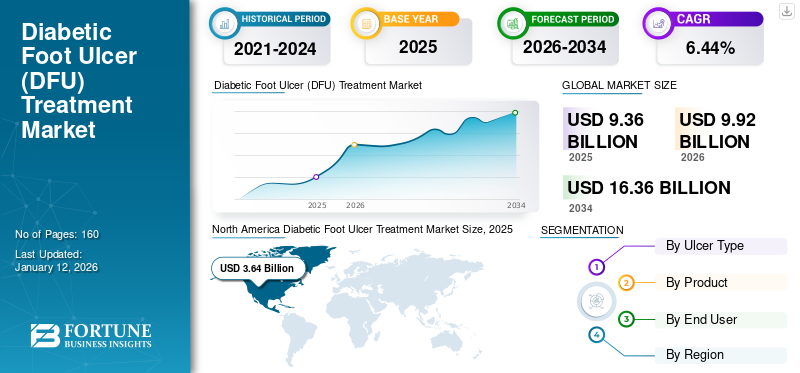
Download Free sample to learn more about this report.
Diabetic Foot Ulcer Treatment Market Trends
Shift from Traditional to Advanced Wound Management Products to Promote Market Growth
Over the past few years, one of the most prominent trends in the global market is the shift from traditional to advanced wound management products.
Antimicrobial dressings, alginate dressings, and other innovative wound dressings are gradually becoming more popular due to their clinical effectiveness over film, foam, and other dressings used in wound care. This has led to a shift away from gauze and other traditional wound dressings to more innovative wound dressings.
- For instance, according to an article published by Wound Management & Prevention in 2022, the demand for advanced wound care products will continue to grow as the population older than 65 years is projected to increase by 25.0% by 2060.
Market players are constantly engaging in R&D initiatives to introduce new, advanced dressings with established clinical efficiency to tap into lucrative opportunities. As a player in wound care, ConvaTec has a strong portfolio of advanced dressings, including the world-renowned Aquacel Ag+ anti-microbial dressing line. ConvaTec’s patented hydrofiber dressing technology has been proven to provide superior wound control, including improved infection prevention. The advancements in wound care technology are increasing the global demand for these products in the market.
Market Dynamics
Market Drivers
Download Free sample to learn more about this report.
Increasing Prevalence of Diabetic Foot Ulcer is Driving Market Growth
The growing prevalence of diabetes across the globe is the leading factor contributing to the rising number of diabetic foot ulcer cases, which is a major complication associated with diabetes.
The rising geriatric population, lifestyle modification, and obesity are key factors associated with the burden of diabetes globally. Additionally, various clinical studies demonstrate that there is a significantly higher probability of foot ulcers in a diabetic person compared to a non-diabetic patient.
- For instance, according to an article published by the International Wound Journal in 2023, the prevalence of diabetic foot ulcers is 6.3% as per the rare studies investigating its global epidemiology.
Technological advancements in DFU treatment products are augmenting the adoption of smart wound dressings. The growing emphasis of key companies on introducing R&D activities to launch novel products is fueling the global diabetic foot ulcer treatment market growth.
Market Drivers - Impact & CAGR Contribution (2026–2034)
| Rank | Market Drivers | Overall Impact Rank | CAGR Contribution (2026-2034) |
Impact: 2026-2028 | Impact: 2029-2031 | Impact: 2032-2034 |
|---|---|---|---|---|---|---|
| 1 | Expanding global diabetic population and aging demographic | High | 2.4% | High | High | High |
| 2 | Rising incidence, recurrence and clinical complexity of diabetic foot ulcers | High | 1.9% | High | High | High |
| 3 | Growing adoption of advanced wound-care and regenerative products | High | 1.7% | Medium | High | High |
| 4 | Expansion of multidisciplinary limb-salvage, outpatient and home-care pathways | Medium | 1.4% | Medium | Medium | High |
| 5 | Improving healthcare access, reimbursement and wound-care investment in emerging markets | Medium | 1.0% | Medium | Medium | High |
| 6 | Others (government and nonprofit diabetic-foot awareness programs, increasing clinical trials and evidence generation, adoption of digital wound imaging and remote monitoring tools, improvements in offloading devices, expansion of local wound-care product manufacturing) | Low | 0.5% | Low | Low | Low |
| Total Positive Growth Contribution | 8.90% | |||||
Source: Fortune Business Insights
Market Restraints
Lower Diagnosis and Treatment Rates in Emerging Countries to Limit Adoption of Advanced Wound Care Products
Chronic wounds such as diabetic foot ulcers can progress from mild to severe cases without timely assessments, routine diagnoses, and treatment. This is leading to foot amputations in otherwise healthy patients. Globally, various regional & national organizations and for-profit and non-profit organizations are constantly undertaking initiatives to create awareness among the general public and are implementing various plans to promote early and efficient diagnosis of patients suffering from chronic wounds.
However, despite the efforts of these organizations, there are many cases of delayed diagnosis of diabetic foot ulcers due to factors such as delayed referrals of patients and lack of expertise among the physicians to identify DFU/ Neuropathic Ulcerss, especially in the emergency departments.
- For instance, according to the data published by The Diabetic Foot Journal in 2023, a study was conducted to review the delays in the management of chronic limb-threatening ischemia and foot ulceration in people with diabetes. This study reported that the median times from symptom onset to specialist healthcare assessment ranged from 15 to 126 days. Also, the subsequent median times from assessment to treatment ranged from 1 to 91 days.
Market Restraints - Impact & Negative CAGR Contribution (2026–2034)
| Rank | Market Restraints | Overall Impact Rank | Negative CAGR Contribution (2026-2034) |
Impact: 2026-2028 | Impact: 2029-2031 | Impact: 2032-2034 |
|---|---|---|---|---|---|---|
| 1 | Lower diagnosis and treatment rates in emerging countries | High | -1.0% | High | High | Medium |
| 2 | Uncertain reimbursement and changing payment policies | High | -0.7% | High | Medium | Medium |
| 3 | Limited access to multidisciplinary care, delayed diagnosis and poor treatment adherence | Medium | -0.5% | High | Medium | Medium |
| 4 | Others (limited high-quality comparative evidence for certain advanced treatments, regulatory approval delays, inconsistent DFU classification and treatment protocols, antimicrobial resistance) | Low | -0.2% | Low | Low | Low |
| Total Negative Growth Contribution | -2.40% | |||||
Source: Fortune Business Insights
Market Opportunities
Rapid Expansion of Healthcare Infrastructure to Create New Market Growth Opportunities
There is an ongoing expansion of healthcare facilities in emerging economies, including Brazil, India, and others. The growing prevalence of chronic diseases, expansion of hospital infrastructure, and growing number of specialty clinics are consequently increasing the adoption of wound dressings, wound care devices, and others in healthcare facilities. This, along with growing healthcare expenditure, is creating a lucrative opportunity for key companies to strengthen their presence in the market.
- According to 2025 data published by the International Trade Administration (ITA), healthcare expenditure is USD 135.0 billion in Brazil.
Market Challenges
Inadequate Reimbursement and Changing Payment Framework to Hamper Market Growth
Inadequate reimbursement and variations in payment policies represent a key challenge for the global market. Advanced therapies, including skin substitutes, cellular and tissue-based products, bioactive dressings, negative-pressure wound therapy, and adjunctive wound-healing devices, are associated with high cost and depend heavily on insurance coverage. Differences in insurance policy criteria across countries, payers, and treatment settings are limiting patient access, delaying formulary inclusion, and creating uncertainty for companies when planning product introductions, pricing, and capacity investments. Furthermore, a limited number of healthcare facilities and limited specialists, among others, are some of the vital factors resulting in delayed treatment among the patient population, especially in emerging nations, such as China and Brazil.
- For instance, according to 2023 data published by The World Bank Group (WBG), approximately 4.5 billion people lack full access to essential health services globally.
Segmentation Analysis
By Ulcer Type
Increasing Prevalence of Neuro-Ischemic Ulcers Led to Segmental Dominance
Based on ulcer type, the global market is segmented into neuro-ischemic ulcers, Neuropathic ulcers, and ischemic ulcers.
The neuro-ischemic ulcers segment held the highest diabetic foot ulcer treatment market share in 2025. The growth is due to the increasing prevalence of neuro-ischemic ulcers among patients, resulting in a growing adoption of DFU treatment products across the globe. This, coupled with the growing focus of key players on launching novel products, skin substitutes, and negative pressure wound therapy (NPWT), is further expected to contribute to the global market growth.
- According to an article published by Sage Journal in 2023, a study was performed at Dr. Kariadi General Hospital, Indonesia, involving 1,429 diabetic foot patients to determine the disease burden regarding the clinical profile and outcome of diabetic foot ulcer admissions. It was found that around 29.9% of registered patients were suffering from neuro-ischemic ulcers in that patient population. Such a large number of cases associated with neuro-ischemic ulcers promotes the adoption of DFU treatment products and is expected to boost the segment's growth.
The ischemic ulcers segment is expected to grow at a CAGR of 5.3% over the forecast period.
To know how our report can help streamline your business, Speak to Analyst
By Product
Wound-Care Dressings Led Market Due to Their Several Benefits in DFU Treatments
Based on product, the market is segmented into wound-care dressings, wound-care devices, active therapies, and others. The wound-care dressings segment is divided into antimicrobial dressings, foam dressings, film dressings, alginate dressings, hydrogel dressings, and other dressings. Wound-care devices are classified into negative pressure wound therapy (NPWT), ultrasound therapy, hyperbaric oxygen therapy (HBOT), and others. The active therapies segment is further divided into skin grafts & substitutes, growth factors, and others.
The wound-care dressings segment held the largest market share of 42.4% in 2025. The segmental growth is augmented by the benefits associated with the dressings for treating DFU among patients. This, along with the increasing R&D initiatives among the major companies to introduce advanced wound-care dressings for the treatment of DFU, is fueling the segmental growth.
- For instance, in March 2026, Smith+Nephew launched ALLEVYN COMPLETE CARE Foam Dressing, featuring proprietary technologies to strengthen the product channel globally.
The wound-care devices segment is set to grow at a CAGR of 6.7% over the forecast period.
By Severity
Growing Prevalence of Mild DFUs Led to Dominance of Segment
Based on severity, the market is segmented into mild, moderate, and severe.
The mild segment dominated the global market with a 44.0% share in 2025. The segment growth is driven by the growing prevalence of chronic disorders, including mild diabetic foot ulcers.
- For instance, according to the data published by Springer Nature, it was reported that in a clinical study involving 513 diabetic foot ulcer patients found that 89.6% of ulcers were classified as Wagner Grade 1 or Grade 2, highlighting the high treatment volume associated with superficial and other mild-severity ulcers.
The severe segment is projected to grow at a CAGR of 6.6% during the forecast period.
By End User
Increasing Number of Hospitals Led to the Segmental Dominance
Based on end user, the global market is segmented into hospitals, clinics, ambulatory surgical centers, and homecare settings.
The hospitals segment dominated the market in 2025. The rising number of patient admissions and the growing number of hospitals are some of the key factors contributing to the growth of the segment in the market. Furthermore, the segment is set to hold a 39.5% share in 2026.
- For instance, according to 2025 statistics published by Statistisches Bundesamt, it was reported that there are about 1,874 hospitals in Germany.
The clinics segment is projected to grow at 6.3% CAGR during the forecast period.
Diabetic Foot Ulcer Treatment Market Regional Outlook
The market is segmented geographically into North America, Europe, Asia Pacific, Latin America, and the Middle East & Africa.
North America
North America Diabetic Foot Ulcer Treatment Market Size, 2025 (USD Billion)
To get more information on the regional analysis of this market, Download Free sample
North America held the dominant share in 2024, valued at USD 2.65 billion, and also took the leading share in 2025 with USD 2.78 billion. High adoption of wound care products, advanced hospital infrastructure, and growing healthcare spending are contributing to market growth.
- For instance, according to 2024 statistics published by the Center for Medicare & Medicaid Services (CMS), it was reported that healthcare expenditure reached approximately USD 5.3 trillion in the U.S.
U.S. Diabetic Foot Ulcer Treatment Market
Based on North America’s strong contribution and the U.S. dominance within the region, the U.S. market can be analytically approximated at around USD 2.70 billion in 2026, accounting for roughly 35.8% of global sales.
Europe
Europe is projected to record a CAGR of 6.2% in the coming years, which is the second highest among all regions, and reach a valuation of USD 2.05 billion in 2026. A rise in diabetic patients and an advanced healthcare system are likely to support the market growth.
U.K. Diabetic Foot Ulcer Treatment Market
The U.K. market in 2026 is estimated at around USD 0.26 billion, representing roughly 3.4% of global revenues.
Germany Diabetic Foot Ulcer Treatment Market
The German market is projected to reach approximately USD 0.53 billion in 2026, equivalent to around 7.0% of global sales.
Asia Pacific
Asia Pacific is estimated to reach USD 1.54 billion in 2026 and secure the position of the third-largest region in the market. The expanding hospital capacity and rising healthcare access are likely to support the growth of the market.
Japan Diabetic Foot Ulcer Treatment Market
The Japanese market in 2026 is estimated at around USD 0.41 billion, accounting for roughly 5.4% of global revenues.
China Diabetic Foot Ulcer Treatment Market
The market in China is projected to be one of the largest across the globe, with 2026 revenues estimated at around USD 0.44 billion, representing roughly 5.9% of global sales.
India Diabetic Foot Ulcer Treatment Market
The Indian market size in 2026 is estimated at around USD 0.15 billion, accounting for roughly 2.0% of global revenues.
Latin America and Middle East & Africa
The Latin America and Middle East & Africa regions are expected to witness moderate growth in this market space during the forecast period. The Latin America market is set to reach a valuation of USD 0.53 billion in 2026 due to the increasing number of diabetic patients and public healthcare investment in the region. The Middle East & Africa is also expected to grow with a considerable CAGR in the coming years due to increasing focus on diabetes management and the number of key companies focusing on acquisitions and mergers among other companies in the market. In the Middle East & Africa, the GCC is set to reach a value of USD 0.28 billion in 2026.
South Africa Diabetic Foot Ulcer Treatment Market
The South Africa market is projected to reach around USD 0.15 billion in 2026, representing roughly 2.0% of global revenues.
Competitive Landscape
Key Industry Players
Increasing Number of Product Launches by Major Companies to Support Their Dominance
A significant product portfolio, coupled with a strong emphasis on inorganic growth strategies across the globe, is one of the key factors contributing to the dominance of these companies in the market. Smith+Nephew and Solventum are major companies in the market. Moreover, the growing focus of key companies on R&D activities to introduce novel products is likely to strengthen their presence and support the global market share.
- For instance, in April 2024, Smith+Nephew launched its RENASYS EDGE Negative Pressure Wound Therapy (NPWT) System in the U.S. as a patient-centric option for treating chronic wounds.
Other key players, including Coloplast A/S and Cardinal Health, are focusing on acquisitions and collaborations with other companies to strengthen their presence in the market.
List of Key Diabetic Foot Ulcer Treatment Companies Profiled
- Coloplast A/S (Denmark)
- Smith+Nephew (K.)
- Solventum (U.S.)
- Convatec Inc. (U.K.)
- Integra LifeSciences (U.S.)
- Braun SE (Germany)
- Cardinal Health (U.S.)
- Mölnlycke Health Care AB (Sweden)
- Essity Aktiebolag (publ). (Sweden)
- MIMEDX Group, Inc. (U.S.)
Key Industry Developments
- July 2026: Convatec, a medical products and technologies company focused on solutions for the management of chronic conditions, announced the completion of a multi-year expansion of over USD 27.1 million at its manufacturing site in Rhymney, South Wales.
- May 2026: MiMedx Group, Inc. launched G4Derm Plus, with an aim to broaden its product portfolio in the market.
- April 2024: Smith+Nephew announced that the U.K. National Institute for Health and Care Excellence (NICE) reviewed the PICO Single Use Negative Pressure Wound Therapy System (sNPWT). NICE found that it provides better clinical outcomes than standard dressings to reduce the risk of surgical site infection.
- March 2023: Convatec Inc. received U.S. FDA approval for InnovaBurn placental extracellular matrix medical device. It is designed for managing complex surgical wounds and burns, including partial-thickness second-degree burns, and can be used for diabetic ulcers to strengthen its product offerings.
- August 2022: 3M launched a new 3M Veraflo Cleanse Choice Complete Dressing Kit and a software upgrade for the 3M V.A.C. Ulta Therapy Unit, intending to advance the delivery of Veraflo therapy among patients.
- April 2022: MiMedx Group, Inc., a transformational placental biologics company, sponsored a symposium at the Symposium on Advanced Wound Care (SAWC) Spring on April 6-10 in Phoenix, Arizona.
REPORT COVERAGE
The report focuses on an industry overview and global diabetic foot ulcer treatment market analysis, including market dynamics and key industry developments. Besides this, the global market research report provides information on the economic cost burden for wound care in key countries. Furthermore, the report also focuses on the prevalence of key diseases and new product launches.
Request for Customization to gain extensive market insights.
Report Scope and Segmentation
| ATTRIBUTE | DETAILS |
| Study Period | 2021–2034 |
| Base Year | 2025 |
| Estimated Year | 2026 |
| Forecast Period | 2026-2034 |
| Historical Period | 2021-2024 |
| Unit | Value (USD billion) |
| Growth Rate | CAGR of 6.5% from 2026 to 2034 |
| Segmentation | By Ulcer Type, Product, Severity, End User, and Region |
| By Ulcer Type |
|
| By Product |
|
| By Severity |
|
| By End User |
|
| By Region |
|
Frequently Asked Questions
Fortune Business Insights says that the global market is expected to grow from USD 7.14 billion in 2025 to USD 12.46 billion by 2034.
In 2025, the North America market stood at USD 2.78 billion.
The market is expected to exhibit a CAGR of 6.5% during the forecast period.
By product segment, the wound-care dressings segment led the market.
North America dominated the market in 2025.
Growing prevalence of diabetic foot ulcers drives market growth.
Shift from traditional to advanced wound management products is the key market trend.
Smith+Nephew, Integra LifeSciences, B. Braun SE, and Mölnlycke Health Care AB are the top players in the market.



- 2021-2034
- 2025
- 2021-2024
- 160
Get 30-60 hrs Free Customization
Expand Regional and Country Coverage, Segments Analysis, Company Profiles, Competitive Benchmarking, and End-user Insights.













.webp)






-
US +1 833 909 2966 ( Toll Free )
-
Get In Touch With Us