Educational Robot Market Size, Share & Industry Analysis, By Type (Humanoid & Non-Humanoid Robots), By Component (Hardware (Sensors, Controllers & Processors, Actuators, Mechanical Structure & Chassis, Power Source Systems) & Software), By Learning Environment (Classroom-Based, Laboratory-Based, Home-Based, and Others (Competition programs and robotic clubs)), and By End Users (Primary Education Institutions, Secondary Education Institutions, Higher Education Institutions, Coaching & Training Centers, and Others (Special Education Centers and EdTech labs)) & Regional Forecast, 2026–2034
 Download Free Sample
Educational Robot Market Overview
 Listen to Audio Version
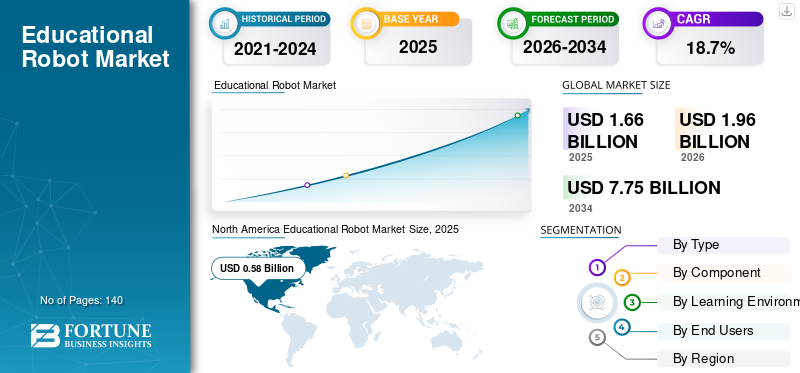
The global educational robot market size was valued at USD 1.66 billion in 2025 and is projected to grow from USD 1.96 billion in 2026 to USD 7.75 billion by 2034, exhibiting a CAGR of 18.7% during the forecast period. North America dominated the educational robot market with a market share of 34.94% in 2025.
Educational robots comprise programmable and interactive robotic systems integrated with sensors, controllers, actuators, processors, connectivity modules, learning software, and curriculum-based coding platforms to support STEM education, robotics learning, AI literacy, computational thinking, and hands-on classroom engagement. These STEM learning robots include humanoid robots, non-humanoid robots, mobile robots, modular robotics kits, robotic arms, robotic teaching assistants, and interactive learning robots designed to enable coding practice, problem-solving, engineering experimentation, language learning, special education support, and project-based learning across primary education institutions, secondary education institutions, higher education institutions, coaching centers, and home-based learning environments. The growing use of coding robots for students, school robotics kits, AI-powered learning tools, and edtech robotics solutions is helping educators improve student engagement, strengthen practical learning outcomes, enhance digital skills, and bridge the gap between theoretical concepts and real-world technology applications. Growing integration of robotics in STEM education, rising adoption of AI education platforms, increasing demand for experiential learning tools, and expanding investment in digital classroom tools and smart education devices are accelerating market growth globally.
- For instance, in January 2026, LEGO Education launched its Computer Science & AI solution for K–8 classrooms. The solution was designed to support hands-on computer science and artificial intelligence learning through classroom-ready materials and student collaboration, strengthening AI literacy and encouraging practical STEM learning adoption.
LEGO Education, VEX Robotics, Makeblock Co., Ltd., UBTECH Robotics Corp., Ltd., SoftBank Robotics Group Corp., Robotis Co., Ltd., are some of the major companies operating in the market.
Download Free sample to learn more about this report.
EDUCATIONAL ROBOT MARKET KEY TAKEAWAYS
 Global Market Size & Forecast
- 2025 Market Size: USD 1.66 billion
- 2026 Market Size: USD 1.96 billion
- 2034 Forecast Market Size: USD 7.75 billion
- CAGR: 18.7% (2026–2034)
 Market Share
- North America dominated the educational robot market with a market share of 34.94% in 2025.
- The software segment is expected to grow at a CAGR of 20.7% during the forecast period.
- The home-based segment is expected to witness the highest growth rate of 20.1% during the forecast period.
 Key Regional Highlights
North America
North America dominated the market, accounting for USD 0.58 billion in revenue in 2025.
Europe
The market in Europe is expected to witness substantial growth during the forecast period.
Asia Pacific
The Asia Pacific market accounted for over USD 0.53 billion in 2025 globally.
U.S.
The U.S. is expected to dominate the market, reaching USD 0.58 billion in 2026.
Japan
The Japanese market is estimated to reach around USD 0.09 billion in 2026, accounting for roughly 4.5% of the global sales.
Read More

EDUCATIONAL ROBOT MARKET TRENDS
Growing Adoption of AI-Enabled Learning Tools and Hands-On STEM Education Solutions is Accelerating Market Expansion
Demand for educational robots is increasingly being driven by the rising adoption of AI-enabled learning tools, programmable robotics kits, interactive classroom robots, coding platforms, and hands-on STEM education solutions across schools, colleges, coaching centers, and home-based learning environments. As educators focus on improving student engagement, digital literacy, computational thinking, and practical problem-solving skills, educational robot manufacturers are integrating artificial intelligence (AI), machine learning, sensors, controllers, computer vision, cloud-based software, and curriculum-aligned programming platforms into classroom-ready robotic systems. The market is witnessing growing deployment of educational robots to support STEM education, coding and programming, robotics competitions, AI literacy, language learning, social interaction, special education, and laboratory-based learning. Humanoid robots, non-humanoid robots, modular robotics kits, mobile robots, robotic arms, and interactive learning robots are helping institutions move beyond textbook-based instruction toward experiential and project-based learning. Across North America, Europe, Asia Pacific, South America, and the Middle East & Africa, rising investment in digital classrooms, growing demand for future-ready skills, expanding robotics clubs, and increasing integration of AI and coding into school curriculum are strengthening educational robot market growth.
- For instance, in March 2025, Sphero, Inc. was named to Fast Company’s list of the World’s Most Innovative Education Companies of 2025. The recognition highlighted the company’s role in programmable robots and hands-on STEM learning tools for classroom-based coding, robotics, and computer science education.
MARKET DYNAMICS
MARKET DRIVERS
Download Free sample to learn more about this report.
Rising STEM Education Adoption and AI-Based Learning Integration to Drive Market Growth
The market is increasingly being driven by the rising adoption of STEM education, growing demand for coding and robotics learning, and increasing integration of artificial intelligence-based learning tools across schools, colleges, coaching centers, and home-based learning environments. Educational institutions are investing in programmable robots, modular robotics kits, humanoid robots, mobile robots, robotic arms, and interactive learning platforms to improve student engagement, practical problem-solving, computational thinking, and hands-on technical skills. Educational robot solutions play a critical role in supporting coding education, AI literacy, engineering experimentation, robotics competitions, language learning, special education support, and project-based classroom learning. The growing adoption of sensors, controllers, actuators, computer vision, cloud-based software, block-based coding platforms, and AI-enabled robotics systems is improving learning personalization and classroom interactivity. Across North America, Europe, Asia Pacific, South America, and the Middle East & Africa, rising digital classroom investments, curriculum modernization, robotics clubs, and demand for future-ready workforce skills are strengthening demand for scalable educational robot solutions.
- For instance, in June 2025, VEX Robotics launched VEX AIR and VEX AIM at ISTE Live. The company introduced its first competition drone and an AI coding robot to help students engage with aerospace, robotics, artificial intelligence, and hands-on STEM learning in classrooms.
MARKET RESTRAINTS
High Initial Cost and Limited Teacher Readiness to Limit Market Expansion
The growth of the market is constrained by high upfront costs, limited teacher training, and uneven adoption readiness across budget-sensitive schools and developing education systems. Educational robots require hardware components, sensors, controllers, actuators, processors, batteries, software licenses, coding platforms, curriculum content, maintenance support, and teacher training, which can increase total ownership cost compared with conventional classroom tools. Many schools lack trained educators capable of integrating robotics into daily lessons, creating challenges in curriculum alignment, classroom management, and learning outcome measurement. In addition, limited IT infrastructure, restricted procurement budgets, fragmented product standards, device maintenance requirements, and shorter technology refresh cycles can slow adoption. In developing markets, low awareness, weak digital infrastructure, and dependence on donor-funded STEM programs may further limit deployment. These factors can delay purchasing decisions, reduce classroom utilization, and limit market expansion despite growing demand for hands-on STEM, AI literacy, and robotics-based learning solutions.
MARKET OPPORTUNITIES
Expanding AI-Enabled Robotics Labs and Curriculum-Based STEM Learning Creating Significant Market Opportunities
A major opportunity emerging within the market is the rapid expansion of AI-enabled robotics labs, curriculum-integrated coding platforms, interactive learning robots, and hands-on STEM education programs across global education systems. These solutions are enabling schools, colleges, coaching centers, and home-learning users to integrate robotics directly into classroom instruction, improving student engagement, AI literacy, computational thinking, and practical problem-solving capabilities. Growing adoption of humanoid robots, modular robotics kits, robotic arms, mobile robots, cloud-based learning platforms, sensors, controllers, and computer vision tools is creating substantial opportunities for manufacturers to expand classroom-ready product portfolios. The opportunity is particularly strong in K-12 schools, higher education labs, robotics clubs, coding academies, special education centers, and private STEM training institutes where future-ready skills, experiential learning, and AI education remain critical priorities.
- For instance, in March 2025, Dobot launched ATOM, its first embodied intelligent humanoid robot, highlighting the company’s continued investment in advanced robotics platforms that can support future education, research, and AI-learning applications.
MARKET CHALLENGES
High Cost, Teacher Training Gaps, and Curriculum Integration Challenges Affecting Market Growth
One of the major challenges affecting the market is the limited readiness of schools to integrate educational robots into regular teaching practices. Many institutions face budget constraints, a lack of trained teachers, limited robotics curriculum alignment, and insufficient technical support, making adoption more difficult despite growing interest in STEM education. Educational robots require hardware, software, batteries, sensors, controllers, cloud platforms, lesson content, maintenance support, and periodic upgrades, which increases total ownership cost. At the same time, schools may struggle to measure learning outcomes, manage classroom deployment, and standardize robotics programs across different grades. In developing markets, weak digital infrastructure, low awareness, and dependence on imported robot kits further increase implementation barriers. These factors create ongoing challenges for educational robot manufacturers and end users seeking scalable, affordable, and curriculum-ready robotics solutions.
Segmentation Analysis
By Type
Non-Humanoid Robots Segment Led the Market Owing to Wider Adoption of Modular Robotics Kits and Classroom Robotics Solutions
By type, the market is segmented into humanoid robots and non-humanoid robots.
Non-humanoid robots held the largest educational robot market share in 2025, driven by the growing adoption of modular robotics kits, mobile robots, robotic arms, programmable coding robots, STEM kits, and competition-based robotics platforms across schools, colleges, coaching centers, and home-based learning environments. Compared with humanoid robots, non-humanoid robots are more affordable, easier to deploy, and better suited for large-scale classroom use, making them the preferred choice for coding education, robotics clubs, engineering projects, and hands-on STEM learning. Their ability to support programming, problem-solving, sensor-based experimentation, mechanical design, and project-based learning continues to strengthen adoption across primary education, secondary education, and higher education institutions. Rising demand for scalable classroom robotics solutions, growing robotics competition participation, and increasing focus on AI and coding literacy continue to reinforce the dominance of non-humanoid robots globally.
- For instance, in January 2025, UBTECH showcased its AI education solutions at BETT 2025, including the advanced humanoid robot Tien Kung and robotics education programs designed to support AI, STEAM learning, research, and classroom-based robotics education.
The humanoid robots segment is expected to witness the highest growth rate of 20.1% during the forecast period, driven by rising demand for interactive learning robots, AI-enabled teaching assistants, language-learning support, social-emotional learning, and special education applications. Growing adoption of humanoid robots in advanced classrooms, universities, research programs, and private STEM labs is accelerating their use for conversational learning, personalized interaction, and human-robot collaboration.
To know how our report can help streamline your business, Speak to Analyst
By Component
Hardware Segment Led the Market Owing to Higher Deployment of Robot Kits, Sensors, and Mechanical Systems
By component, the market is segmented into hardware and software. Hardware is further segmented into sensors, controllers & processors, actuators & drives, mechanical structure & chassis, power source systems, communication & connectivity modules, and others.
Hardware held the largest market share in 2025, driven by the higher unit cost and wider deployment of physical robot components across classrooms, robotics labs, coaching centers, universities, and home-based STEM learning environments. Educational robots depend on sensors, controllers, processors, actuators, motors, batteries, chassis, connectivity modules, and interaction hardware to support movement, programming, object detection, navigation, voice interaction, and hands-on experimentation. Compared with software, hardware accounts for a larger share as schools and institutions primarily invest in robot kits, humanoid robots, mobile robots, robotic arms, and modular robotics platforms for practical learning. Rising demand for classroom robotics kits, AI-enabled learning robots, competition robots, and lab-based STEM equipment continues to strengthen hardware adoption globally.
The software segment is expected to grow at a CAGR of 20.7% during the forecast period, driven by increasing use of coding platforms, AI-learning software, cloud-based classroom management tools, simulation environments, curriculum content, and analytics-enabled learning systems.
By Learning Environment
Classroom-Based Segment Led the Market Owing to Wider Integration of Robotics into STEM Programs
By learning environment, the market is segmented into classroom-based, laboratory-based, home-based, and others.
The classroom-based segment held the largest market share in 2025, driven by the growing integration of educational robots into school curriculum, coding classes, STEM programs, AI learning modules, and project-based classroom activities. Schools are increasingly adopting programmable robots, modular robotics kits, mobile robots, interactive learning robots, sensors, controllers, and coding platforms to improve student engagement, computational thinking, collaboration, and hands-on problem-solving. Compared with other learning environments, classroom-based deployment benefits from structured lesson plans, teacher-led instruction, institutional procurement, and recurring use across multiple student groups. Rising investment in digital classrooms, robotics clubs, AI literacy programs, and curriculum-aligned STEM education continues to support strong adoption of educational robots across primary and secondary institutions globally.
The home-based segment is expected to witness the highest growth rate of 20.1% during the forecast period, driven by increasing demand for coding robots, STEM kits, AI learning tools, and hands-on robotics products for children outside formal classrooms.
By End Users
Secondary Education Institutions Segment Led the Market Owing to Strong Adoption of Robotics to Support STEM Education and Coding Programs
By end users, the market is segmented into primary education institutions, secondary education institutions, higher education institutions, coaching & training centers, and others.
Secondary education institutions held the largest market share in 2025, as middle and high schools increasingly adopt educational robots to support STEM education, coding, AI literacy, engineering projects, robotics competitions, and hands-on problem-solving. These institutions require programmable robots, modular robotics kits, mobile robots, sensors, controllers, processors, actuators, and curriculum-based software to help students build practical technology skills before entering higher education or technical careers. Compared with primary education institutions, secondary schools have a stronger demand for advanced robotics activities, programming languages, competition preparation, and laboratory-based learning. Rising focus on future-ready skills, computer science education, project-based learning, and robotics clubs continues to strengthen adoption across secondary education institutions globally.
The coaching & training centers segment is expected to grow at a CAGR of 20.1% during the forecast period, driven by increasing demand for after-school robotics courses, coding bootcamps, AI learning programs, competition training, and skill-based STEM education.
Educational Robot Market Regional Outlook
By geography, the market is categorized into Europe, North America, Asia Pacific, South America, and the Middle East & Africa.
North America
North America Educational Robot Market Size, 2025 (USD Billion)
To get more information on the regional analysis of this market, Download Free sample
North America dominated the market, accounting for USD 0.58 billion in revenue in 2025, supported by a mature digital education infrastructure, strong STEM curriculum adoption, extensive robotics competition participation, and increasing demand for AI-enabled classroom learning tools across the U.S., Canada, and Mexico. Regional demand is strongly influenced by rising investments in coding education, computer science programs, robotics clubs, digital classrooms, and hands-on STEM learning across schools, universities, coaching centers, and home-learning environments. The region benefits from well-established EdTech distribution channels, advanced school technology budgets, strong teacher training ecosystems, and growing deployment of programmable robots, modular robotics kits, humanoid robots, robotic arms, sensors, controllers, and curriculum-integrated software.
U.S. Educational Robot Market
The U.S. is expected to dominate the market, reaching USD 0.58 billion in 2026, driven by the country’s large K-12 education base, strong STEM funding environment, high adoption of robotics competitions, and advanced integration of coding and AI learning into school programs. Demand for the product remains particularly strong across primary schools, secondary schools, universities, STEM labs, after-school programs, robotics clubs, coaching centers, and home-based learning users requiring programmable robots, modular kits, AI learning platforms, interactive robots, and hands-on engineering tools. The country continues to witness substantial investments from educational robotics companies, EdTech providers, school districts, private learning centers, and STEM organizations seeking to improve experiential learning, digital literacy, and future-ready technology skills.
Europe
The market in Europe is expected to witness substantial growth during the forecast period, driven by rising STEM education initiatives, expanding digital classroom adoption, growing focus on AI literacy, and increasing demand for robotics-based learning across Germany, the U.K., France, Italy, Spain, BENELUX, Nordics, Russia, and the rest of Europe. Regional demand is closely associated with curriculum modernization, coding education, science and engineering labs, robotics clubs, vocational training, and inclusive learning applications. Europe remains one of the most important markets as schools, universities, and training institutions increasingly prioritize hands-on learning, classroom automation, student collaboration, and practical technology exposure.
U.K. Educational Robot Market
The U.K. market is estimated to reach around USD 0.07 billion in 2026, representing roughly 3.6% of global sales.
Germany Educational Robot Market
Germany’s market is projected to reach approximately USD 0.08 billion in 2026, representing around 4.2% of global sales.
Asia Pacific
The Asia Pacific market accounted for over USD 0.53 billion in 2025 globally. Regional growth is strongly supported by rising investment in digital education, expanding coding and robotics curriculum, increasing adoption of hands-on STEM learning tools, and growing demand for the product across China, India, Japan, South Korea, ASEAN, Oceania, and the rest of the Asia Pacific. The region continues to witness rising demand for programmable robots, humanoid robots, modular robotics kits, robotic arms, mobile robots, sensors, controllers, processors, AI learning software, and cloud-based coding platforms that improve student engagement, practical problem-solving, computational thinking, and classroom-based experiential learning.
China Educational Robot Market
China’s market is projected to remain the dominant one in the Asia Pacific region, with 2026 revenues standing at around USD 0.24 billion, representing roughly 12.0% of global sales.
Japan Educational Robot Market
The Japanese market is estimated to reach around USD 0.09 billion in 2026, accounting for roughly 4.5% of the global sales.
India Educational Robot Market
The Indian market in 2026 is estimated to reach around USD 0.11 billion, accounting for roughly 5.4% of global sales.
Middle East & Africa
The Middle East & Africa market is driven by increasing adoption of STEM education, expanding digital classroom initiatives, and rising demand for the product across GCC countries, South Africa, North Africa, Israel, and other regional markets. Demand is closely linked to school modernization, private education expansion, robotics clubs, AI literacy programs, university research labs, coding academies, and the growing deployment of hands-on learning tools that improve student engagement and practical technology skills. GCC countries lead regional adoption due to smart education investments, premium private schools, innovation-focused national programs, and stronger purchasing capacity for humanoid robots, modular robotics kits, interactive learning robots, and AI-enabled classroom solutions.
GCC Educational Robot Market
The GCC market is projected to reach around USD 0.04 billion in 2026, representing roughly 2.1% of the global sales.
South America
The South American market is driven by rising demand for STEM education tools, growing adoption of coding and robotics programs, and increasing digital classroom modernization across Brazil, Argentina, Chile, Colombia, Peru, and other regional economies. Demand for the product is primarily associated with expanding private schools, robotics clubs, university labs, coaching centers, and hands-on learning programs focused on improving student engagement, computational thinking, and practical technology skills.
Brazil Educational Robot Market
The Brazilian market is projected to reach around USD 0.06 billion in 2026, representing roughly 3.0% of the global sales.
COMPETITIVE LANDSCAPE
Key Industry Players
Industry Participants Are Investing in Robotics Curriculum to Improve Student Engagement
The educational robot market is moderately fragmented, with competitive positioning shaped by robotics hardware portfolios, AI-enabled learning platforms, curriculum integration, classroom usability, coding software, and regional distribution strength across developed and emerging education markets. Leading companies, including LEGO Education, VEX Robotics, Makeblock Co., Ltd., UBTECH Robotics Corp., Ltd., and SoftBank Robotics Group Corp., maintain strong market positions through programmable robots, humanoid robots, modular robotics kits, robotic arms, mobile robots, sensors, controllers, processors, and learning software supporting STEM, coding, AI literacy, and project-based education worldwide.
Competitive differentiation is increasingly influenced by the ability to provide classroom-ready robots, teacher-friendly coding platforms, standards-aligned lesson content, AI-enabled interaction, cloud-based learning tools, competition robotics ecosystems, and affordable hardware kits. Companies are continuously investing in humanoid robots, embodied AI platforms, robotics curriculum, computer science learning tools, simulation software, and strategic partnerships to improve student engagement, strengthen practical learning outcomes, and address growing demand for future-ready digital skills across schools, universities, coaching centers, and home-based learning environments.
- For instance, in June 2026, Faraday Future announced the launch of its EAI Robotics Education Ecosystem Strategy, Product Line, and New EAI Device Launch, highlighting growing industry focus on embodied AI and robotics education platforms.
LIST OF KEY EDUCATIONAL ROBOT COMPANIES PROFILED
- LEGO Education (Denmark)
- VEX Robotics (U.S.)
- Makeblock Co., Ltd. (China)
- UBTECH Robotics Corp. Ltd. (China)
- SoftBank Robotics Group Corp. (Japan)
- Robotis Co., Ltd. (South Korea)
- Wonder Workshop (U.S.)
- Sphero, Inc. (U.S.)
- Modular Robotics (U.S.)
- Pitsco Education (U.S.)
KEY INDUSTRY DEVELOPMENTS
- June 2026: RECF announced RECF Robotics as its official robotics competition for the 2026-2027 season, expanding structured student robotics participation and strengthening demand for competition-focused educational robot platforms.
- May 2026: Classover launched an embodied AI robotics education platform featuring humanoid robots and robotic dog systems from Unitree Robotics, supporting hands-on AI, coding, and robotics learning for K-12 students.
- April 2026: Faraday Future partnered with U.S. education institution Triple I to launch the EAI Robotics Summer Camp in the U.S., advancing robot-vehicle education and embodied AI learning scenarios.
- January 2026: ROBOTIS introduced ROBOTIS Lab, a research-oriented simulation repository based on Isaac Lab, enabling reinforcement learning and imitation learning experiments using ROBOTIS robots for advanced robotics education and research.
- April 2025: PAL Robotics advanced Project HumaNova, bringing together educational institutions, research centers, industry stakeholders, and robotics experts to develop humanoid-enabled vocational training models across Europe.
REPORT COVERAGE
The global educational robot market analysis includes a comprehensive study of the market size & forecast by all the market segments included in the report. It includes details on the market dynamics and market trends expected to drive the market over the forecast period. It provides information on key aspects, including an overview of technological advancements, the regulatory environment, and product launches. Additionally, it details partnerships, mergers & acquisitions, and key industry developments and prevalence by key regions. The global market research report also provides a detailed competitive landscape with information on the market share and profiles of key operating players.
Request for Customization to gain extensive market insights.
Report Scope & Segmentation
| ATTRIBUTE | DETAILS |
| Study Period | 2021-2034 |
| Base Year | 2025 |
| Estimated Year | 2026 |
| Forecast Period | 2026-2034 |
| Historical Period | 2021-2024 |
| Growth Rate | CAGR of 18.7% from 2026 to 2034 |
| Unit | Value (USD Billion) |
| Segmentation | By Type, Component, Learning Environment, End Users, and Region |
| By Type |
|
| By Component |
|
| By Learning Environment |
|
| By End Users |
|
| By Region |
|
Frequently Asked Questions
According to Fortune Business Insights, the global market value stood at USD 1.66 billion in 2025 and is projected to reach USD 7.75 billion by 2034.
In 2025, North Americas market value stood at USD 0.58 billion.
The market is expected to exhibit a CAGR of 18.7% during the forecast period (2026-2034).
By end users, the secondary education institutions segment led the market.
Rising STEM education adoption, AI literacy initiatives, coding curriculum integration, robotics competition participation, digital classroom investments, hands-on learning demand, and growing use of programmable educational robots are some of the key factors driving the market.
LEGO Education, VEX Robotics, Makeblock Co., Ltd., UBTECH Robotics Corp. Ltd., SoftBank Robotics Group Corp., Robotis Co., Ltd., Wonder Workshop, Sphero, Inc., Modular Robotics, and Pitsco Education are the top players in the market.
North America held the largest market share in 2025.


- 2021-2034
- 2025
- 2021-2024
- 140
Get 30-60 hrs Free Customization
Expand Regional and Country Coverage, Segments Analysis, Company Profiles, Competitive Benchmarking, and End-user Insights.















Related Reports
-
US +1 833 909 2966 ( Toll Free )
-
Get In Touch With Us