Electric Multiple Units Market Size, Share & Industry Analysis, By Train Set (Up to 2 Cars, 3-6 Cars, and 7-Cars & Above), By Application (Rapid Transit/Metro, Suburban & Commuter Rail, and Intercity Rail), By Component (Propulsion & Power, Carbody & Structures, Bogies & Running Gear, Electrical & Control, Passenger Interior, Braking Systems, Doors & Access, Couplers & Gangways, and Auxiliaries), By Propulsion Type (AC Electric, DC Electric, Dual-Voltage, and Battery-Electric/Hybrid EMUs), and Regional Forecast, 2026-2034
 Download Free Sample
(Offer valid till 30th Sep 2026)

Electric Multiple Units Market Size and Future Outlook
 Listen to Audio Version
The global electric multiple units market size was valued at USD 12.86 billion in 2025 and is projected to grow from USD 13.70 billion in 2026 to USD 21.12 billion by 2034, exhibiting a CAGR of 5.6% during the forecast period. Asia Pacific dominated the electric multiple units market with a market share of 53.17% in 2025.
Electric Multiple Units (EMUs) are trainsets powered by electricity supplied through overhead catenary or third-rail systems, designed to deliver efficient, fast, and environmentally friendly passenger transport. Electric-propelled multiple units integrate distributed traction across multiple cars, enabling higher acceleration, smoother operation, and improved energy utilization compared to locomotive-hauled trains. They are widely adopted in metros, suburban commuter lines, regional networks, and high-speed rail corridors. Market expansion is driven by rising urbanization, government investments in sustainable mobility, and the global shift toward electrification to reduce emissions. Technological advancements in lightweight materials, regenerative braking, digital monitoring, and modular designs further enhance performance, passenger comfort, and operational flexibility, strengthening the role of electric multiple units in modern railway systems.
Key players in the electric multiple units market include Alstom, Siemens Mobility, CRRC Corporation Limited, Hitachi Rail, and Stadler Rail. These companies focus on designing advanced EMUs with features such as high energy efficiency, lightweight modular construction, and regenerative braking to meet growing demand for sustainable passenger transport. Strategic investments in electrification projects, innovation in high-speed and urban transit systems, and expansion of global manufacturing networks strengthen their market footprint. Partnerships with government authorities and rail operators, integration of digital monitoring and predictive maintenance systems, and development of zero-emission and smart mobility solutions further enhance their role in shaping the global market landscape.
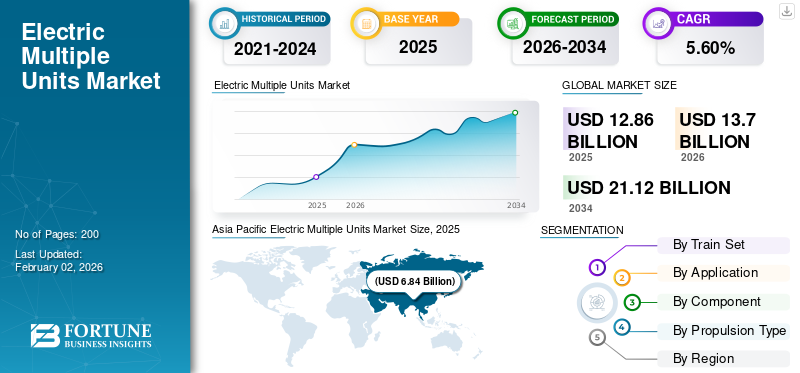
Download Free sample to learn more about this report.
Electric Multiple Units Market Takeaways
 Global Market Size & Forecast
- 2025 Market Size: USD 12.86 billion
- 2026 Market Size: USD 13.70 billion
- 2034 Forecast Market Size: USD 21.12 billion
- CAGR: 5.6% from 2026–2034
 Market Share
- Asia Pacific dominated the electric multiple units market with a 53.17% share in 2025.
- The 3–6 car segment held the largest market share, while the 7 Cars & Above segment is projected to expand at the market's 5.6% CAGR during 2026–2034.
- The rapid transit/metro segment accounted for the largest global market share, driven by rising investments in urban rail infrastructure.
 Key Regional Highlights
North America
North America generated USD 0.46 billion in 2025, capturing 3.59% of the global market, and is expected to reach USD 0.49 billion in 2026.
Europe
Europe accounted for USD 3.66 billion in 2025, representing 28.49% of the global market, and is projected to grow to USD 3.86 billion in 2026.
Asia Pacific
Asia Pacific led the global market with USD 6.84 billion in 2025 and is projected to reach USD 7.29 billion in 2026, supported by expanding metro and high-speed rail projects.
U.S.
The electric multiple units market is projected to reach USD 0.42 billion by 2026, driven by metro fleet modernization and investments in commuter rail infrastructure.
Japan
The market is projected to reach USD 0.91 billion by 2026, supported by continued deployment of energy-efficient EMUs and expansion of advanced railway networks.
Read More

MARKET DYNAMICS
MARKET DRIVERS:
Expanding Rail Infrastructure and Regulatory Compliance to Propel Market Demand
The growing investments in electrified rail infrastructure and strict environmental regulations are driving global electric multiple units market growth. Governments are prioritizing low-emission, high-capacity transport solutions to address urban congestion, reduce carbon emissions, and enhance regional connectivity. EMUs, with their superior energy efficiency, regenerative braking, and scalability, are increasingly adopted in commuter, regional, and high-speed segments. Policy-driven funding and public–private partnerships for sustainable mobility further strengthen adoption. Additionally, electric multiple units meet regulatory requirements for noise reduction and safety, making them an attractive choice for both developed and emerging economies, where modernization of railway systems remains a national priority.
In September 2025, ScotRail in the U.K. issued a market engagement notice for procuring 69 new trainsets, including 41 Electric Multiple Units and 28 Battery-Electric Multiple Units (BEMUs). The order aims to replace aging fleets, support decarbonization goals, and ensure compliance with evolving rail infrastructure and environmental regulations across Scotland’s passenger rail network.
MARKET RESTRAINTS:
High Procurement Cost of Electric Propelled Multiple Units to Restrain Product Adoption
Despite their operational efficiency and sustainability benefits, EMUs require significant upfront capital investments in electrification infrastructure, rolling stock, and signaling systems. Many developing regions lack the necessary overhead catenary or third-rail networks, which slows adoption. The high procurement cost of electric propelled multiple units, compared to diesel alternatives, makes them less feasible for rail operators with limited budgets. Retrofitting existing non-electrified lines for EMU operations also presents challenges, requiring extensive planning and construction work. For countries with large geographic spreads and low rail passenger densities, such costs create financial strain, restricting market growth and delaying the replacement of diesel-powered trainsets. In July 2025, Poland’s PKP Intercity cancelled two previous tenders after bids exceeded budget by 45 % in the first round and 28 % in the second, before reissuing the procurement.
MARKET OPPORTUNITIES:
Growing Adoption of Smart Mobility Solutions Creates Market Opportunities
The shift toward smart, sustainable transport offers substantial opportunities for the electric multiple units market. With rising demand for real-time monitoring, predictive maintenance, and digital passenger services, manufacturers can integrate advanced IoT, AI, and cloud-based platforms into trainsets. This reduces lifecycle costs for operators and enhances reliability and safety for passengers. Furthermore, the global focus on decarbonization and smart city development encourages the adoption of electrified commuter and high-speed systems. Public investment in rail infrastructure programs in Europe, Asia, and the Middle East to build intelligent, interconnected rail corridors creates lucrative opportunities for players to position EMUs as core elements of next-generation mobility.
ELECTRIC MULTIPLE UNITS MARKET TRENDS:
Integration of Lightweight Materials and Green Technologies to Bolster Market Growth
One of the major electric multiple units market trends driving the demand is the integration of lightweight materials and environmentally sustainable technologies. Manufacturers are increasingly using aluminum, composites, and modular components to reduce weight, enhance efficiency, and lower energy consumption. Coupled with regenerative braking and onboard energy storage systems, these innovations support net-zero emission goals. Moreover, the trend toward hybrid multiple units that combine battery-electric technology for non-electrified sections is gaining traction, offering flexible deployment. Rail operators also emphasize passenger comfort, accessibility, and digital services, aligning with urban mobility demands. Together, these trends highlight a future where EMUs form the backbone of cleaner, smarter, and more adaptable rail transport systems.
Download Free sample to learn more about this report.
MARKET CHALLENGES:
Supply Chain Dependencies and Standardization Pose Market Challenges
The market faces challenges in securing resilient supply chains and ensuring interoperability across diverse rail networks. Critical components such as traction motors, control systems, and advanced electronics often rely on specialized suppliers, making the sector vulnerable to disruptions. Varying regional standards for electrification (such as voltage levels and signaling systems) complicate deployment across borders, requiring customization and raising costs. Additionally, ensuring compatibility with existing infrastructure in aging rail networks is difficult, particularly in developing regions. These complexities slow project execution, add technical risks, and increase procurement timelines, posing challenges for manufacturers and operators aiming for rapid adoption worldwide.
Segmentation Analysis
By Train Set
3–6 Cars Segment Lead the Market, Driven by Shorter Dwell Times
Based on train set, the market is divided into up to 2 cars, 3-6 cars, and 7 cars & above.
The 3–6 car segment dominates as they are ideal for urban metro and suburban commuter services, balancing capacity with operational flexibility. They suit medium-density passenger corridors where longer trains are not required, making them the standard configuration in Europe, Asia, and North America. Their modularity allows easy expansion, while shorter dwell times enhance network efficiency. Supported by strong metro and commuter rail investments, the segment remains the backbone of global electric multiple units deployment.
The 7 Cars & Above segment grows fastest, driven by demand in high-speed and intercity corridors requiring higher capacity operations. In February 2025, Iyo Railway in Japan began operations of its 7000 series 3-car trainsets, replacing older units and achieving 50% energy savings through lightweight stainless steel bodies and regenerative braking systems.
By Application
Urbanization and the Growing Automation Trend Drive Rapid Transit Segment Growth
Based on application, the market is divided into rapid transit/metro, suburban & commuter rail, and intercity rail.
The rapid transit/metro segment holds the largest electric multiple units market share globally, fueled by urbanization, congestion reduction, and strong government investment in metro expansion. Metros provide affordable, high-capacity, and sustainable solutions in Asia (China and India), Europe, and the Middle East. This segment is also the fastest growing, driven by automation trends such as driverless metros and increasing focus on reducing private vehicle dependence. With megacities prioritizing clean mobility, rapid transit multiple units remain dominant. In September 2025, the New York MTA approved a USD 2.3 billion order for 316 Alstom M-9A EMU cars to modernize its metro and commuter fleet.
By Component
Traction Efficiency and Energy Savings Drive Propulsion & Power Segment Growth
By component, the market is segmented into propulsion & power, carbody & structures, bogies & running gear, electrical & control, passenger interior, braking systems, doors & access, couplers & gangways, and auxiliaries.
The propulsion & power segment dominates as it is the core of EMU traction and efficiency. It includes traction motors, converters, and transformers, which directly determine acceleration, regenerative braking capability, and reduced operating costs. Operators prioritize propulsion investments to meet energy efficiency and emission-reduction goals. OEMs also focus heavily on propulsion R&D, as performance here defines competitiveness.
The electrical & control segment grows fastest, driven by digitalization, predictive maintenance, automation, and real-time monitoring systems, enhancing operational efficiency. In October 2024, NJ Transit previewed its Multilevel III hybrid electric multiple unit power cars, rated at 3,082 HP traction power at the wheels with 160 kN starting tractive effort, featuring redundant traction motors (4 total), twin transformer+converter modules, and regenerative braking.
By Propulsion Type
AC Segment Leads due to its High Operational Efficiency
Based on propulsion type, the market is segmented into AC Electric, DC Electric, Dual-Voltage, and Battery-Electric/Hybrid EMUs.
The AC Electric segment dominates due to the prevalence of overhead AC catenary systems in major markets such as Europe, China, India, and Japan. AC systems enable long-distance electricity transmission and high operational efficiency, making them suitable for both regional and high-speed applications. Since most new electrification projects favor AC, this segment remains the backbone of EMU deployment worldwide, underpinning both commuter and intercity passenger operations.
The Battery-Electric/Hybrid EMUs segment grows fastest as operators adopt it for non-electrified routes, aligning with sustainability targets and zero-emission mandates. In June 2025, the Integral Coach Factory (ICF) confirmed delivery of Chennai’s second AC EMU train by October, following trials and safety approvals. Southern Railway had launched its first AC EMU in April 2025 on the Beach-Tambaram and Beach-Chengalpattu routes. The new units feature automatic doors, sensors, and passenger information systems, supporting India’s suburban electrification push with modernized, commuter-friendly designs.
Electric Multiple Units Market Regional Outlook
By geography, the market is categorized into Europe, North America, Asia Pacific, and the Rest of the World.
Asia Pacific
Asia Pacific Electric Multiple Units Market Size, 2025 (USD Billion)
To get more information on the regional analysis of this market, Download Free sample
Asia Pacific dominated the market with a valuation of USD 6.84 billion in 2025 and USD 7.29 billion in 2026, led by China, Japan, and India’s massive investments in electrified rail and high-speed networks. Growing urbanization, surging passenger volumes, and government-backed sustainability initiatives drive adoption. China’s extensive high-speed rail system sets a global benchmark, while India accelerates metro expansion and semi-high-speed corridors. Japan continues upgrading Shinkansen fleets with advanced EMUs. Regional policies focused on reducing emissions and improving connectivity reinforce the Asia Pacific’s leadership in EMU deployment. In June 2025, Indian Railways announced plans to roll out 50 Namo Bharat AC trains and 100 new MEMUs to strengthen short-distance electric services. The Japan market is projected to reach USD 0.91 billion by 2026, the China market is projected to reach USD 4.68 billion by 2026, and the India market is projected to reach USD 1.04 billion by 2026. The Asia Pacific market was valued at USD 6.84 billion in 2025, capturing 53.17% of global revenue, and is estimated to reach USD 7.29 billion in 2026.
North America
In North America, the electric multiple units market is driven by the modernization of commuter rail networks and federal support for electrification under clean energy policies. Urban congestion and rising demand for efficient regional mobility encourage investment in EMUs. Projects such as California’s high-speed rail and Northeast Corridor upgrades highlight growing adoption. Additionally, the push for sustainable transit solutions and the gradual shift away from diesel fleets strengthen demand across metropolitan and intercity services. North America contributed 3.59% to the global market in 2025, with a valuation of USD 0.46 billion, and is projected to reach USD 0.49 billion in 2026.
In the U.S., demand is fueled by large-scale infrastructure initiatives, including Amtrak’s modernization program and state-level high-speed rail projects. Federal climate targets and the Infrastructure Investment and Jobs Act are boosting electrification investments. The need for energy-efficient, high-capacity trains in densely populated corridors such as New York, California, and the Northeast drives the product adoption. Strategic partnerships with global OEMs further support technology transfer and accelerate the deployment of advanced electric-propelled multiple-unit systems nationwide. In June 2025, New York’s Metropolitan Transportation Authority approved the purchase of 316 Alstom M-9A EMU cars for its commuter rail network, with deliveries expected by 2029, strengthening fleet modernization. Earlier, in August 2024, NJ Transit sanctioned an order for 36 additional Alstom Multilevel III EMU cars to expand capacity and replace aging rolling stock, underscoring the U.S. push toward modern, efficient electric commuter rail solutions. The U.S. market is projected to reach USD 0.42 billion by 2026.
Europe
Europe holds the second-largest position in the market, driven by stringent EU decarbonization policies, well-established electrified rail networks, and strong government funding for sustainable transport. Countries such as Germany, France, and the U.K. prioritize EMUs for regional, suburban, and high-speed services. The EU’s Green Deal, cross-border interoperability initiatives, and emphasis on reducing reliance on fossil fuels boost demand. High passenger density, mature operators, and proven urban rail infrastructure make Europe a core growth hub for the market. In September 2025, Romania’s Railway Reform Authority (ARF) accepted the first PESA interregional EMU unit under its contract for 20 RE-IR2 trains, scheduling delivery for late September and certification to follow under EU and national standards. The UK market is projected to reach USD 0.52 billion by 2026, and the Germany market is projected to reach USD 0.79 billion by 2026. Europe accounted for USD 3.66 billion in 2025, representing 28.49% of the global market share, and is projected to reach USD 3.86 billion in 2026.
Rest of the World
The Rest of the World witnessed the fastest growth, driven by rising urbanization, new metro projects, and government investments in sustainable transport in South America and the Middle East Africa. The Middle East is adopting electric-propelled multiple units for modern metro and high-speed projects such as Riyadh Metro and Etihad Rail. Africa focuses on electrification for urban mobility, while South America expands metros in Brazil and Chile. Support from international lenders and infrastructure partnerships accelerates EMU penetration in these emerging markets. In August 2025, Saudi Arabia Railways released an expression of interest for 20 high-speed trainsets to operate on its Haramain (Mecca–Medina) corridor, signaling a major deployment of electric-propelled multiple units in the Middle East. The Rest of the World region captured 14.75% of the global market in 2025, generating USD 1.9 billion in revenue, and is projected to reach USD 2.06 billion in 2026.
COMPETITIVE LANDSCAPE
Key Industry Players:
Major Players Focus on Advanced Lightweight Design to Meet Sustainability Goals
The electric multiple units (EMU) market is highly competitive, with major players such as Alstom, Siemens Mobility, CRRC, Hitachi Rail, and Stadler Rail. Companies emphasize advanced lightweight designs, digital integration, and energy-efficient technologies to meet global sustainability goals. Strategic collaborations with governments and operators, investments in high-speed and urban transit projects, and regional manufacturing expansions strengthen market presence. Intense competition drives continuous innovation, ensuring reliable, scalable, and eco-friendly solutions worldwide. In March 2025, Japan’s Tobu Railway unveiled its 80000 series EMU (5-car sets), featuring a SynTRACS variable-frequency traction system using synchronous reluctance motors (SynRMs) (avoiding rare-earth magnets), onboard battery backup to capture regenerative braking energy, and modern digital passenger displays and control systems. The design achieves 40% energy savings over older 8000 series units.
LIST OF KEY Electric Multiple UnitsCOMPANIES PROFILED:
- Alstom (France)
- Siemens Mobility (Germany)
- CRRC Corporation Limited (China)
- Hitachi Rail (Japan)
- Stadler Rail (Switzerland)
- CAF (Construcciones y Auxiliar de Ferrocarriles) (Spain)
- Hyundai Rotem (South Korea)
- Kawasaki Heavy Industries (Railway Division) (Japan)
- Škoda Transportation (Czech Republic)
- Talgo (Spain)
- Pesa SA (Poland)
- Transmashholding (TMH) (Russia)
- Titagarh Rail Systems Limited (India)
KEY INDUSTRY DEVELOPMENTS:
- April 2025- Indonesia’s KAI Commuter introduced the SFC120-V series EMUs (12-car sets built by CRRC Qingdao Sifang) into service on the Bogor and Cikarang lines, delivering 3,360 kW power output and advanced IGBT-VVVF traction systems.
- April 2025- Stadler delivered the first of seven dual-system narrow-gauge EMUs for the Mont Blanc Express, designed for international service between France and Switzerland.
- June 2025- Poland’s Lubuskie voivodship awarded a 245 million złoty contract to FPS H Cegielski for six 3-car EMUs to expand regional services.
- June 2025- Romania’s ARF ordered an additional nine 3-car inter-regional EMUs from Pesa, specifying 160 km/h capability, under its ongoing fleet renewal.
- April 2025- Bulgaria and Alstom finalized a EUR 720 million (USD 770.4 million) EMU order following a protracted procurement process, aimed at renewing the national suburban and regional fleet.
REPORT COVERAGE
The global electric multiple units market analysis provides an in-depth study of the market sizing & forecast by all the market segments included in the report. It includes details on the market dynamics and market trends expected to drive the market in the forecast period. It offers information on the technological advancements, new product launches, key industry developments, and details on partnerships, mergers & acquisitions. The market research report also encompasses a detailed competitive landscape with information on the market share and profiles of key operating players.
Request for Customization to gain extensive market insights.
Report Scope & Segmentation
|
ATTRIBUTES |
DETAILS |
|
Study Period |
2021-2034 |
|
Base Year |
2025 |
|
Forecast Period |
2026-2034 |
|
Historical Period |
2021-2024 |
|
Growth Rate |
CAGR of 5.60% from 2026-2034 |
|
Unit |
Value (USD Billion) |
|
By Train Set |
|
|
By Application |
|
|
By Component |
|
|
By Propulsion Type |
|
|
By Geography |
|
Frequently Asked Questions
Fortune Business Insights says that the global market value stood at USD 13.70 billion in 2026 and is projected to reach USD 21.12 billion by 2034.
In 2025, the market value stood at USD 6.84 billion.
The market is expected to exhibit a CAGR of 5.60% during the forecast period (2026-2034).
The rapid transit/metro segment leads the market by application.
Expanding rail infrastructure and regulatory compliance is a key factor driving the market.
Leading players such as Alstom, Siemens Mobility, CRRC, Hitachi Rail, and Stadler Rail dominate the market.
Asia Pacific dominated the electric multiple units market with a market share of 53.17% in 2025.



- 2021-2034
- 2025
- 2021-2024
- 200
-
(Offer valid till 30th Sep 2026)
Get 30-60 hrs Free Customization
Expand Regional and Country Coverage, Segments Analysis, Company Profiles, Competitive Benchmarking, and End-user Insights.




















-
US +1 833 909 2966 ( Toll Free )
-
Get In Touch With Us