Electric Pickup Truck Market Size, Share & Industry Analysis by Truck Type (Small, Medium, and Large), By Component (Drivetrain, Chassis, Body, Electronics, and Interior), and Regional Forecast, 2026-2034
 Download Free Sample
(Offer valid till 15th Oct 2026)

KEY MARKET INSIGHTS
 Listen to Audio Version
The global electric pickup truck market size was valued at USD 4.5 billion in 2025 and is projected to grow from USD 4.8 billion in 2026 to USD 8.15 billion by 2034, exhibiting a CAGR of 6.80% during the forecast period. North America dominated the global electric pickup truck market with a market share of 67.33% in 2025.
An electric pickup truck is a type of battery electric vehicle (BEV) specifically designed to offer the strength, utility, and versatility of a traditional pickup while operating solely on electric power. These vehicles are built with powerful electric drivetrains and large batteries, enabling them to perform heavy-duty tasks such as towing, carrying cargo, and off-road driving, all without producing tailpipe emissions. Electric pickup trucks often feature innovative technologies, including connectivity, advanced driver-assistance systems, and the ability to act as mobile power sources at job sites or during emergencies.
Key players in the market include Ford (with the F-150 Lightning), Rivian (R1T), Tesla (Cybertruck), Chevrolet (Silverado EV), and GMC (Hummer EV), along with newer entrants and startups that continue to drive innovation in this field.
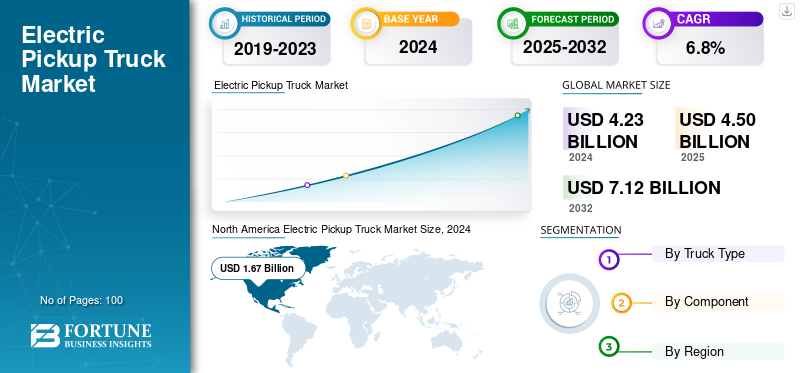
Download Free sample to learn more about this report.
Electric Pickup Truck Market Key Takeaways
 Market Size & Forecast
- 2025 Market Size: USD 4.50 billion
- 2026 Market Size: USD 4.81 billion
- 2034 Forecast Market Size: USD 7.12 billion
- CAGR: 6.8% from 2026–2034
 Market Share
- North America dominated the electric pickup truck market with a 67.33% share in 2025.
- The large pickup trucks segment held the largest market share in 2025.
- The drivetrain segment accounted for the leading component share in 2025.
 Key Regional Highlights
North America
North America led the market with USD 3.03 billion in revenue and a 67.33% share in 2025.
Asia Pacific
Asia Pacific accounted for USD 1.07 billion and 23.78% of global demand in 2025 and is projected to grow at a 7.1% CAGR.
Europe
Europe generated USD 0.11 billion in revenue and represented 2.44% of the global market in 2025.
U.S.
Strong consumer demand for pickup trucks and supportive electrification policies are driving market growth.
Japan
Government support for electric mobility and investments in EV infrastructure support market expansion.
Read More

ELECTRIC PICKUP TRUCK MARKET TRENDS
Growth in Battery Technology is a Prominent Market Trend
Electric pickup trucks are rapidly advancing with developments in battery technology, enabling longer driving ranges and faster charge times. Automakers are unveiling both all-new electric models and electrified versions of their popular pickups, reflecting strong competition and investment in the segment. Additionally, features such as regenerative braking, improved towing capabilities, and smart connectivity are becoming standard, while vehicle-to-grid capabilities further expand the practical value of owning an electric pickup.
MARKET DYNAMICS
MARKET DRIVERS
Growth in Electric Vehicle Production Owing to Regulations to Drive the Market
Government regulations mandating stringent emissions standards have become a powerful catalyst for growth in electric vehicle production across the automotive industry. Many countries have set ambitious targets for electric vehicle sales, with requirements for automakers to ensure that a substantial proportion of their new vehicles are electric within specific timeframes.
To accelerate the transition from traditional to EV trucks, governments have formulated various policies and incentives such as tax breaks, subsidies for both buyers and manufacturers, and refunds on charging infrastructure to drive product demand and reduce the cost gap with traditional internal combustion vehicles.
MARKET RESTRAINTS
Higher Initial Cost to Hamper the Market Growth
The market faces notable restraints that slow down its mainstream adoption despite growing interest from both consumers and manufacturers. A major restraint is the high upfront cost, largely driven by the expense of lithium-ion batteries. Even though operating costs such as fuel and maintenance are lower, the sticker price of electric pickups is still significantly higher than traditional models, which limits appeal among budget-conscious buyers and small businesses.
MARKET OPPORTUNITIES
Expanding Charging Infrastructure to Create Growth Opportunities
Expanding charging infrastructure is a critical and emerging opportunity anticipated to significantly drive the adoption of electric pickup trucks. As these vehicles increasingly enter commercial and personal markets, the availability of fast, reliable, and widespread charging stations becomes essential. Furthermore, investments by governments and private enterprises in high-capacity charging hubs, especially along freight corridors, urban centers, and logistics hubs, are improving the practicality of electric pickups for long-haul routes and heavy-duty applications. These developments reduce downtime for commercial fleets and enable everyday consumers to charge conveniently, making electric pickups more appealing across diverse user groups.
MARKET CHALLENGES
Regional Specific Constraints to Create Challenges for Market Expansion
Differences in infrastructure, consumer choices, and legislation are few regional and market-specific restrictions impacting the market expansion. Full-size pickups are discouraged in Europe and some areas of Asia by stringent emissions regulations, high gas prices, and narrow streets, which favor small automobiles. The adoption of new markets is often slowed by underdeveloped road networks, inconsistent safety standards, and little after-sales assistance. Additionally, prices are increased by import taxes and limitations on domestic production. Moreover, cultural attitudes that view pickups as work vehicles rather than lifestyle options lower their popularity in certain areas, which stifles market expansion.
Download Free sample to learn more about this report.
Segmentation Analysis
By Truck Type
Large Pickup Trucks Dominated the Market Due to their Higher Capabilities and Consumer Demand
The market is segmented into small, medium, and large based on truck type.
The large trucks segment accounted for a dominating market share in the year 2024. Government incentives promoting zero-emission transportation, improvements in battery technology, and high consumer demand for powerful, adaptable trucks have all contributed to the growth of the segment.
The medium segment is likely to grow at the highest CAGR during 2025-2032. These trucks generate high power, which is suitable for various operating conditions. Furthermore, medium-size pickup trucks come with a flexible price range which is anticipated to drive the segment growth.
By Component
Drivetrains Segment Accounted for the Largest Share Owing to Constant Technological Advancements
Based on component, the market is divided into drivetrain, interior, body, electronics, and chassis.
Among these, the drivetrain segment dominated the global electric pickup truck market share in 2024. The drivetrain component in electric pickup trucks is rapidly evolving owing to the technological advancements within battery systems and power electronics (such as inverters and converters).
Electric Pickup Truck Market Regional Outlook
By region, the market is categorized into North America, Europe, Asia Pacific, and the rest of the world.
North America
North America Electric Pickup Truck Market Size, 2025 (USD Billion) To get more information on the regional analysis of this market, Download Free sample
North America dominated the market in 2025, reaching a valuation of USD 3.03 billion and accounting for 67.33% of global revenue. The regional market is projected to expand to USD 3.19 billion in 2026, supported by strong consumer preference for pickup trucks and favorable government policies aimed at reducing transportation-related emissions. Regulatory incentives promoting vehicle electrification, combined with investments in charging infrastructure and battery technologies, continue to strengthen market adoption. The presence of leading automotive manufacturers such as Ford, General Motors, and Rivian has further accelerated product innovation and commercialization, reinforcing North America’s leadership position in the electric pickup truck market.
Europe
Europe contributed approximately USD 0.11 Billion to the global market in 2025, accounting for 2.44% share, and is expected to reach USD 0.12 Billion in 2026. Growth in the region is primarily supported by stringent environmental regulations and ambitious decarbonization targets that encourage the adoption of zero-emission vehicles. Regulatory frameworks promoting fleet electrification and sustainable mobility solutions continue to create favorable market conditions. Increasing investments by automakers in electric vehicle development, coupled with expanding charging networks and rising consumer awareness regarding sustainability, are expected to drive demand for electric pickup trucks across the region.
Asia Pacific
In 2025, the Asia Pacific market stood at USD 1.07 Billion, representing 23.78% of global demand, and is projected to grow to USD 1.17 Billion in 2026. Asia Pacific is anticipated to be the fastest-growing regional market during the forecast period, registering a CAGR of 7.1%. Rapid urbanization, expanding industrial activities, and supportive government initiatives aimed at reducing air pollution are key factors driving market growth. Several countries across the region are implementing incentive programs, emission reduction policies, and infrastructure development projects to accelerate electric vehicle adoption. Growing investments in battery manufacturing, local vehicle production, and charging infrastructure are further enhancing market prospects. Rising demand for commercial and utility vehicles in emerging economies is also expected to contribute significantly to the adoption of electric pickup trucks.
Rest of the World
Rest of the World recorded a market size of USD 0.29 Billion in 2025, capturing 6.44% of the global market share, and is projected to reach USD 0.32 Billion in 2026. Market expansion is being supported by increasing investments in electric mobility initiatives and growing research and development activities focused on vehicle electrification. Governments in several countries are gradually introducing policies to encourage the adoption of cleaner transportation technologies, while automotive manufacturers continue to explore new market opportunities. Improvements in charging infrastructure and advancements in battery performance are expected to support the gradual growth of the electric pickup truck market across these regions.
COMPETITIVE LANDSCAPE
Key Industry Players
Leading Firms Emphasize Ongoing Advancements and Innovation to Strengthen Market Presence
The competitive landscape of electric pickup trucks is marked by a mix of established automotive giants and emerging players, each striving to capture market share with unique offerings and innovations. Major traditional manufacturers such as Ford, General Motors, and Tesla lead the pack by leveraging their brand recognition, extensive dealer networks, and significant investments in battery and electric drivetrain technology. These companies have introduced high-profile models such as the Ford F-150 Lightning, Chevrolet Silverado EV, Rivian R1T, and Tesla Cybertruck that emphasize a blend of rugged utility and advanced technology to appeal to both commercial and personal users.
LIST OF KEY ELECTRIC PICKUP TRUCK COMPANIES PROFILED
- Ford Motor Company (U.S.)
- FAW Group (China)
- Fiat Chrysler Automobile (Netherlands)
- General Motors (U.S.)
- Honda Motor (Japan)
- Isuzu Motor (Japan)
- Mercedes Benz (Germany)
- Nissan Motor Company (Japan)
- Toyota Motor Corporation (Japan)
- Mahindra & Mahindra (India)
- Volkswagen AG (Germany)
- Tesla (U.S.)
KEY INDUSTRY DEVELOPMENTS
- August 2025: Ford announced a USD 2 billion transformation of its Louisville Assembly Plant in Kentucky, plus nearly USD 3 billion for battery production at BlueOval Battery Park in Michigan. These investments are aimed at producing a new midsize electric pickup truck, slated to be launch in 2027. This reflects a manufacturer’s capital and production commitment, rather than a procurement contract.
- August 2025: South Korea's energy giant SK Group's battery subsidiary, K On Co., reached a supply deal with an electric vehicle manufacturing start up Slate Auto.
- April 2025: Isuzu began the mass production of its first fully electric 1-ton pickup, the D-MAX EV, at its Thailand plant. Initially launching the left-hand drive version targeted at European markets, the shipment is set for set for Q3 2025.
- April 2025: Slate unveiled an electric pickup truck that the manufacturer claims will cost less than USD 20,000 once the federal USD 7,500 EV tax credit is applied. By the end of 2026, they will start making deliveries.
- March 2025: According to KG Mobility (KGM), the "Musso EV," its electric pickup truck, surpassed 3,200 cumulative contracts in the two weeks following the primary agreement.
REPORT COVERAGE
Request for Customization to gain extensive market insights.
Report Scope & Segmentation
|
ATTRIBUTE |
DETAILS |
|
Study Period |
2021-2034 |
|
Base Year |
2025 |
|
Estimated Year |
2026 |
|
Forecast Period |
2026-2034 |
|
Historical Period |
2021-2024 |
|
Growth Rate |
CAGR of 6.80% from 2026-2034 |
|
Unit |
Value (USD Billion) |
|
Segmentation |
By Truck Type · Small · Medium · Large |
|
By Component · Drivetrain · Chassis · Body · Electronics · Interior |
|
|
By Geography North America (By Truck Type, Component, and Country) · U.S. · Canada Europe (By Truck Type, Component, and Country) · U.K. · Germany · Italy · France · Rest of Europe Asia Pacific (By Truck Type, Component, and Country) · China · Japan · India · Thailand · South Korea · Rest of Asia Pacific Rest of the World (By Truck Type, Component and Country) |
Frequently Asked Questions
Fortune Business Insights says that the global market value stood at USD 4.8 billion in 2026 and is projected to reach USD 8.15 billion by 2034.
In 2025, the North America market value stood at USD 3.03 billion.
The market is expected to exhibit a CAGR of 6.80% during the forecast period of 2026-2034.
The growth in electric vehicle production owing to regulations is a key factor driving the market.
Ford, General Motors, Rivian, Isuzu, and Tesla, among others, are the top players in the market.



- 2021-2034
- 2025
- 2021-2024
- 100
-
(Offer valid till 15th Oct 2026)
Get 30-60 hrs Free Customization
Expand Regional and Country Coverage, Segments Analysis, Company Profiles, Competitive Benchmarking, and End-user Insights.




















Related Reports
-
US +1 833 909 2966 ( Toll Free )
-
Get In Touch With Us