Pickup Truck Market Size, Share & Industry Analysis By Truck Type (Small Size, Midsize, and Full Size), By Propulsion Type (Diesel, Gasoline, Hybrid, and Electric), By Component (Drivetrain, Interior, Body, Electrical & Electronics, and Chassis), and Regional Forecast, 2026-2034
 Download Free Sample
(Offer valid till 30th Sep 2026)

KEY MARKET INSIGHTS
 Listen to Audio Version
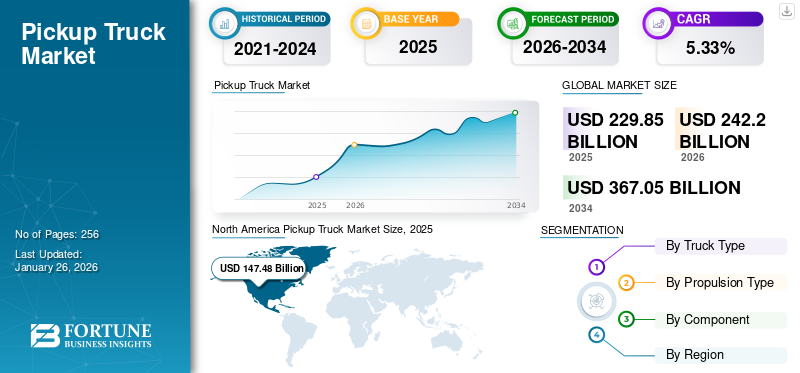
The global pickup truck market size was valued at USD 229.85 billion in 2025 and is expected to grow from USD 242.20 billion in 2026 to USD 367.05 billion by 2034, exhibiting a CAGR of 5.33% during the forecast period (2026-2034). North America dominated the pickup truck market with a market share of 64.87% in 2025.
Pickup trucks are light-duty vehicles mostly used to transport products and freight. Several North American nations, such as Mexico and the U.S., use such trucks as passenger vehicles. These trucks feature enormous cargo spaces, making them ideal for various commercial uses. They are popular as they can be used for multiple tasks, including hauling carriages and transporting cargo.
Major automotive players such as Ford, General Motors, Toyota, Nissan, and Stellantis, among others lead the market. These companies leverage on strong brand loyalty, wide dealer networks, and continuous innovation in performance, safety, and technology, providing competitive edge.
Factors such as the growing consumer preference for online shopping and the heightened demand for fuel-efficient vehicles for outdoor pursuits such as boating and camping are expected to fuel the growth of the market. Another key market driver is the growing customer preference for these trucks over passenger vehicles. Due to rising industrialization, infrastructure development, and goods carrier activity, utility trucks are preferred in developing countries. Developed nations that aggressively promote Do-It-Yourself (DIY) services witness high penetration of utility trucks compared to other vehicles, as these trucks are multifunctional. They can be useful for carrying modest cargo and pulling caravans and other carriages.
In both developed and developing nations, the growth of SMEs has been a significant driver for the light-duty truck industry during the last five years. A substantial rise in last-mile delivery services over the previous decade remarkably increased the demand for utility trucks.
Nevertheless, the high expenses associated with full-size pickups and the tightening emission regulations impede the global market's progress. The economic uncertainty exacerbated by the COVID-19 pandemic led to a downturn in consumer spending, including new vehicle purchases. Consequently, numerous potential buyers deferred their plans to buy a new car due to financial limitations, resulting in a decline in both personal and commercial vehicle sales.
Download Free sample to learn more about this report.
Pickup Truck Market Takeaways
 Global Market Size & Forecast
- 2025 Market Size: USD 229.85 billion
- 2026 Market Size: USD 242.20 billion
- 2034 Forecast Market Size: USD 367.05 billion
- CAGR: 5.33% from 2026–2034
 Market Share
- North America dominated the pickup truck market with a 64.87% share in 2025.
- The midsize segment is projected to account for 48.50% of the market in 2026, supported by the market's 5.33% CAGR during 2026–2034.
- The diesel segment is expected to lead with a 77.73% share in 2026.
 Key Regional Highlights
North America
North America remained the leading regional market, generating USD 147.48 billion in 2025 and continuing its strong growth trajectory during the forecast period.
Europe
Europe contributed USD 3.57 billion in 2025, capturing 1.54% of global revenue, and is expected to increase to USD 3.78 billion in 2026.
Asia Pacific
Asia Pacific accounted for USD 60.09 billion in 2025, representing 25.28% of the global market, and is projected to reach USD 64.06 billion in 2026.
U.S.
The U.S. held the largest regional market share of 82.3% in 2024 and is projected to reach USD 127.18 million by 2026, driven by sustained demand for pickup trucks.
Japan
The pickup truck market is projected to reach USD 4.57 million by 2026, supported by growing demand for versatile commercial and recreational vehicles.
Read More

Market Dynamics
Market Drivers
Soaring Use of Trucks in E-commerce Sector and Rise in Off-Road Activities to Propel Market Growth
Globally, online retail platforms are becoming extremely popular and anticipated to drive the pickup truck market growth over the forecast period. Customers shifted to online purchases; hence, the use of such trucks in the e-commerce sector has increased to offer last-mile delivery services. Increasing demand for lightweight transportation solutions in various industries and commercial sectors will contribute to market growth over the next few years. The growing interest of manufacturers in developing lightweight, highly efficient, and technologically advanced utility trucks is expected to open up new market growth opportunities during the forecast period.
The growing popularity of off-road activities in North America is anticipated to increase the demand for pickup trucks. These trucks are widely preferred in off-road activities owing to their ruggedness, versatility, and ability to handle rough terrains. They can navigate through deep mud and traverse over large rocks and boulders. With the rapid growth of e-commerce platforms, there has been a corresponding increase in the demand for efficient transportation and delivery services. Pickup trucks are well-suited for last-mile delivery tasks, offering versatility, maneuverability, and ample cargo space. As more consumers turn to online shopping, the need for reliable pickup vehicles to facilitate deliveries is expected to surge, thereby driving market growth.
Moreover, noticeable pickup truck market trends such as its utilization in outdoor recreational activities, such as camping, boating, and off-roading are boosting the market growth. The trucks are favored by outdoor enthusiasts for their ruggedness, towing capacity, and ability to navigate rough terrain. Additionally, manufacturers are introducing new features and technologies geared toward enhancing the off-road capabilities of pickup trucks, further increasing their appeal to adventure-seekers. As the demand for vehicles suitable for off-road adventures continues to rise, it is expected to contribute significantly to the growth of the market.
Market Restraints
Strict Government Regulations May Increase Vehicle Costs, Inhibiting Market Growth
Governments across the world are taking essential steps to develop and grow their automobile industry to match the frequency of developed countries. They have strict regulations in place to reduce the frequency of road accidents, keep passengers & drivers safe, and curb fuel emissions. They are also imposing strict legislation on automakers to curb the rise in emissions, which lead to a global environmental crisis such as global warming. In addition, governments in some countries have developed emission guidelines, such as BS VI emission standards for India, Europe VI for Europe, and China VI for China to reduce emissions by setting emission limits. In some countries, gasoline and diesel trucks must be fitted with catalytic converters.
Engine miniaturization has also led to higher vehicle costs. However, the government's initiatives and restrictions on the automotive industry have driven manufacturers to comply with these laws and implement energy-efficient systems, resulting in higher production costs and truck purchase prices. These factors may impede the market’s progress in the future.
Market Opportunities
Lifestyle and Leisure Segment Growth Provides Market Opportunity
In countries such as the U.S., Canada, Australia, and increasingly in parts of Europe and Asia, consumers are purchasing pickups for their image and utility combined. Pickups such as the Ford F-150 platinum, Ram 1500 limited, and Toyota Tundra Capstone offer luxury level interiors, panoramic sunroofs, leather seating and advanced tech.
These vehicles are often used for commuting, weekend gateways, towing boats or trailers, and other leisure activities. For many buyers, especially in North America, owning a high-end pickup is a status symbol, similar to luxury SUVs. Manufacturers can generate higher margins by developing premium and performance variants of their pickup lineups and targeting affluent buyers with emotional brand appeal. With increased interest in outdoor lifestyles, off-roading, and camping, there is a surge in the demand for off-road capable pickups. Models such as Ford Range Raptor, Jeep Gladiator Rubicon, and Chevrolet Colorado ZR2 cater to consumers looking for rugged vehicles equipped with all-terrain tires, high ground clearance, skid plates and locking differentials. In April 2024, Kia unveiled an Australian inspired camouflage wrap for its first ever Tasman pickup, dubbed “The Path Never Taken”. Set to debut in 2025, the C-segment Tasman embodies adventure, reliability, and versatility across global markets.
Market Challenges
Regional and Market Specific Constraints Limit Market Expansion
Due to varying infrastructure, consumer prefereces, and regulations, the regional and market specific constraints limit the market growth. In Europe and parts of Asia, narrow streets, high fuel prices, and emissions rules discourage full-size pickups, favoring compact vehicles. Emerging markets often face underdeveloped road networks, inconsistent safety standards, and limited after-sales support, slowing adoption. Import tariffs and local manufacturing restrictions further raise prices. Additionally, cultural perceptions, where pickups are seen as work vehicles rather than lifestyle choices, reduce appeal in some regions, limiting the market growth.
Impact of Tariffs
Tariff Limited Market Competition and Distorted Supply Chain
The impact of U.S. tariffs on the global pickup truck market is substantial and multifaceted, shaping trade flows, manufacturer strategies, vehicle pricing, and investment decisions. The most influential tariff in this context is the so-called “Chicken Tax”, a 25% tariff imposed by the U.S. on imported light trucks since 1964. The 25% tariff has effectively shut out foreign built pickup trucks from the U.S. market, which is the largest and most profitable pickup truck market globally. Foreign automakers such as Volkswagen, Toyota, Nissan, and Isuzu have been forced to either avoid selling certain models in U.S. or build them locally increasing production costs.
Pickup Truck Market Trends
Download Free sample to learn more about this report.
Increasing Electrification of Vehicles and Adoption of Autonomous Vehicles
The rising air pollution caused by fossil-fueled vehicles led to several environmental crises. This has encouraged auto manufacturing companies to shift toward sustainable sources of energy. They are adopting electrification in their pickup vehicles to promote zero emissions while protecting the environment.
Moreover, utility truck manufacturers are also reacting to the demand from truck owners for additional customization and choices in their vehicles. For instance, Chevy offers eight trim levels, while Ram offers six trim levels and sixteen-wheel design possibilities. Similarly, Ford Motor Company provides buyers with various options including six engine selections. In addition, some truck manufacturers have recently developed advanced camera technology by adding an optional hitch-assist feature that superimposes guidance on the rearview mirror, allowing to line up tow hitch with the trailer directly. For instance, the Ford F-150 and Ram 1500 pickups' zoom function will let users look closer at the tow hitch. Other models now include mirror-mounted cameras that allow users to view the downside of a towed trailer, which helps them handle trucks and trailers easily once they are connected directly. New generation trucks have advanced features, such as improved connectivity, brake assistance, forward collision warning, an all-wheel-drive system, and automatic transmission. Hence, advanced technologies in light-duty vehicles will boost the market expansion during the projection period.
Segmentation Analysis
By Truck Type
Midsize Trucks to Dominate the Market Due to their Versatility and Price Flexibility
The market is segmented into small size, midsize, and full size based on truck type.
The midsize segment is poised to account for 48.50% of the market share in 2026. These trucks generate high power, which is suitable for various operating conditions. Furthermore, midsize pickup trucks come with a flexible price range. Hence, these trucks are highly used in emerging and developed countries.
The full size segment held a significant market share in terms of revenue in 2026. It is the most demanded truck type in the U.S. and Canada owing to its strong performance and multipurpose applications. The high demand for full-size pickup vehicles can be attributed to their advanced safety features, powerful engines, and robust towing capacities, making them an ideal choice for outdoor enthusiasts.
To know how our report can help streamline your business, Speak to Analyst
By Propulsion Type
High Efficiency of Diesel Propulsion Systems to Boost their Demand
Based on propulsion type, the market is divided into gasoline, diesel, electric, and hybrid.
The diesel segment is projected to dominate the market with a share of 77.73% in 2026. The segmental growth is driven by demand for high torque, better towing capacity, and superior fuel efficiency compared to gasoline. Fleet operators, construction, agriculture, and logistics industries favor diesel pickups for their durability and lower running costs. Additionally, advancements in cleaner diesel technologies and compliance with emission norms support continued adoption, especially in markets where long-haul and heavy-duty usage dominate operational requirements..In January 2025, Cummins unveiled its next-gen 6.7 L turbo diesel engine system for 2025 Ram Heavy Duty pickups, delivering enhanced power, towing, and serviceability.
The hybrid segment is projected to grow significantly during the forecast period. Demand for hybrid utility trucks is expected to rise as several governments are financially supporting consumers purchasing vehicles across the world. Moreover, these trucks provide various benefits over gasoline and diesel trucks such as regenerative braking systems, higher mileage, lightweight, and small engines. In April 2025, JAC debuted the Hunter PHEV at Auto Shanghai, China’s first hybrid pickup exceeding 1000 Nm torque, combining a plug-in hybrid drive with strong off-road credentials. In late 2024, Stellantis moved up the launch of the Ram 1500 Ramcharger hybrid, citing strong customer demand, ahead of its battery-electric version.
By Component
Drivetrains to be Widely Used Owing to Constant Technological Advancements
Based on component, the market is subdivided into drivetrain, interior, body, electrical & electronics, and chassis.
The drivetrain segment is expected to lead the market, contributing 9.01% globally in 2026. Drivetrain is a vital component and consists of an engine, transmissions, fuel system, exhaust system, cradle, and oil & grease. Suspensions, steering & braking systems, and axles can be more complex and 5-15% more expensive for an electric pickup vehicle. Moreover, technological innovations in drivetrains have contributed to its high market share. For instance, in March 2021, Magna, a mobility tech firm, introduced its new drivetrain technology for pickup trucks to make it easy for automakers to convert existing Internal Combustion Engine (ICE) designs into hybrid or electric powertrain vehicles.
The electrical & electronics segment is anticipated to register a CAGR of 5.9% over the forecast period. The continuous development in a vehicle's electronics including battery, lighting system, ignition system, HVAC, Advanced Driver Assistance Systems (ADAS), other accessories, and controls will contribute to this segment's strong growth. As the infrastructure in developed countries changes and newer battery systems are designed, consumers want to buy EVs with longer ranges and faster charging times. All this relies on more advanced power management systems, which depend on various electronic components.
Pickup Truck Market Regional Outlook
By region, the market is categorized into North America, Europe, Asia Pacific, and the rest of the world.
North America
North America Pickup Truck Market Size, 2025 (USD Billion)
To get more information on the regional analysis of this market, Download Free sample
The North America market accounted for USD 147.48 Billion in 2025 and is projected to reach USD 205.89 billion by 2032 at a CAGR of 4.9% during the forecast period. North America holds he largest market share in 2026. The growth of the regional market is driven by their seamless integration into both lifestyle and work environments. Consumers in the U.S. and Canada value pickups for recreational use, daily commuting, and heavy-duty work, especially in rural and suburban areas. Medium and large trucks are preferable in the region, offering towing capacity, off-road capability, and advanced comfort features. Thus, strong consumer preference continues to reinforce pickups as a cornerstone of the North American automotive market, sustaining long-term demand.
The U.S. held the largest regional market share of 82.3% in 2024. The U.S. market is projected to reach USD 127.18 Million by 2026. The growth of the U.S. market is driven by the utility and verstality, and consumers seeking pickup trucks as a lifestyle appeal. Trucks are prized for work-related uses, recreation, off-roading, and everyday commuting. The consumer preference for large, tech-laden, and luxurious models has encouraged automakers to offer multiple trims and customizations. Rural and suburban geographies further enhance demand, while high disposable incomes support purchases of premium variants such as the Ford F-150 and Ram 1500. In May 2024, Chevrolet started the production of the 2024 Silverado EV First Edition RST, featuring up to 754 hp, 785 lb-ft torque in Wide Open Watts mode, and up to 440 mi EPA-estimated range. It supports 350 kW DC fast-charging and delivers up to 10.2 kW off board power, and is built on GM’s Ultium platform at Factory Zero.
Europe
Europe recorded a market size of USD 3.57 billion in 2025, capturing 1.54% of the global market share, and is projected to reach USD 3.78 billion in 2026. The market is driven by the demand from farmers and tradespeople in rural areas. Pickups offer practically where vans fall short, with added off-road ability and increased payload capacities. In addition, EU policies promoting low emission vehicles also fuels market growth. Hybrid and electric pickups are gaining traction in urban zones due to strict environmental compliance and sustainability goals. The UK market is projected to reach USD 1.34 Million by 2026, while the Germany market is projected to reach USD 0.22 Million by 2026.
In September 2024, Ford unveiled the Ranger Plug-in Hybrid (PHEV), Europe’s one of the first hybrid mid-size pickup. Featuring a 2.3L EcoBoost engine, 75 KW motor, and 11.8 kWh battery, it delivers 279 PS, 690 Nm torque, 45 km EV range, and 3,500 kg towing. In March 2024, FOTON Motors secured 400 cumulative orders for its Tunland G7 pickups in Italy, with 200 units delivered in March. Tunland G7 has cleared the stringent EU WVTA certification and features a 162 hp Euro 6 Diesel engine, Bosch systems, BorgWarner 4WD, and premium safety/interior specs.
Asia Pacific
In 2025, Asia Pacific represented USD 60.09 billion, accounting for 25.28% of the worldwide market, and is projected to grow to USD 64.06 billion in 2026. The market growth in the Asia Pacific is driven by rapid urbanization and a rising number of small and medium sized enterprises. Countries such as India, Thailand, and Indonesia are experiencing a boom in logistics, agriculture, and construction, all sectors needing versatile and affordable transport. Compact and medium sized pickups are favored for their cost-efficiency, ease of maintenance, and adaptability in congested environments. The Japan market is projected to reach USD 4.57 Million by 2026, the China market is projected to reach USD 19.84 Million by 2026, and the India market is projected to reach USD 11.42 Million by 2026.
Automakers offer tailor made models for urban deliveries, intercity logistics, and vendor operations. As cities expand and infrastructure projects proliferate, pickups serve as essential utility vehicles, especially for first time commercial vehicle buyers and micro business operators, driving market growth in the region. In June 2025, Mahindra disrupted India’s pickup segment by launching the Bolero Maxx Pik-Up HD 1.9 CNG variant. Designed for business use, it offers a payload packed performance, delivering 400 km per full tank.
Rest of the World
In 2025, Rest of the World held 8.31% of the global market, reaching a valuation of USD 18.7 billion, and is projected to grow to USD 19.6 billion in 2026. The market is driven by investment in roads, mining, and energy. Pickups serve essential roles in rugged terrains, providing utility for industrial and government sectors. Moreover, use of pickups as family and work vehicles also propels the market growth in the region. Additionally, OEMs such as Toyota, Nissan, Ford, and others offer region specific models with diesel engines and flexible configurations, which further boosts the market growth in the region.
In April 2025, Chery launched HIMLA, a mid-size pickup sub-brand, targeting Toyota Hilux and Ford Ranger across the Middle East and beyond. The first model, a mid-size dual cab built on a ladder frame,will be offered with petrol, diesel, hybrid, and EV powertrains. In October 2024, AGMC introduced the RIDDARA RD6, a fully electric 4x4 pickup in the UAE. The vehicle boasts 595 Nm torque, 455 km NEDC range, 865 kg payload, and 21 kWh discharge capability for on-site power.
COMPETITIVE LANDSCAPE
Key Industry Players
Key Companies Developing Trucks with Adaptability to Regional Preferences Drive Competitive Edge
The competitive landscape is characterized by several major and emerging players. Ford, General Motors, Toyota, Nissan, and Stellantis lead the global pickup truck market, maintaining their positions through strong model lineups, consistent innovation, and extensive distribution networks. Ford’s F-Series dominates North America, while GM’s Chevrolet Silverado and GMC Sierra capture significant market share. Toyota’s Tacoma and Nissan’s Frontier cater to the mid-size segment, and Stellantis, with brands like Ram, leverages product diversity to reach multiple consumer segments. Competitive edge is driven by brand reputation, advanced technology integration, fuel efficiency, and adaptability to regional preferences.
LIST OF TOP PICKUP TRUCK COMPANIES
- Ford Motor Company (U.S.)
- FAW Group (China)
- Fiat Chrysler Automobile (Netherlands)
- General Motors (U.S.)
- Honda Motor (Japan)
- Isuzu Motor (Japan)
- Mercedes Benz (Germany)
- Nissan Motor Company (Japan)
- Toyota Motor Corporation (Japan)
- Mahindra & Mahindra (India)
- Volkswagen AG (Germany)
KEY INDUSTRY DEVELOPMENTS
- April 2025 - Isuzu began the mass production of its first fully electric 1-ton pickup, the D-MAX EV, at its Thailand plant. The company reported the commencement of the left-hand drive model targeted at European markets, with its shipment set for Q3 2025.
- November 2024 -Stellantis unveiled its new STLA Frame platform, a battery electric vehicle native, multi energy foundation for full-size, body-on-frame pickups and SUVs, boasting up to 500 miles/800 km of range in BEV and 690 miles/1,100 km with its range-extender electric vehicle (REEV) setup. Additional features comprise a 14,000 lb towing capacity, 2,700 lb payload rating, and 800 V fast charging up to 350 kW in the BEV configuration or 400 V at 175 kW in the REEV configuration.
- June 2023 – GM announced an investment of over USD 1 billion in its Flint plants to boost heavy-duty pickup vehicle production. The company also announced spending USD 579 million at its Flint Engine Operations to develop a sixth-generation V-8 combustion engine. Another USD 103.5 million will be spent on upgrading a separate Flint facility that supports pickup truck production.
- April 2023 - Reading Truck Group officially sealed a deal to take over Mastercraft Truck Equipment, a reputable commercial truck and van solutions provider in Colorado. This strategic acquisition, encompassing Mastercraft's two Colorado-based locations, marks a significant step forward in Reading Truck's expansion plan. As a result, the company now boasts a total of 24 Reading Truck outlets across the nation.
- October 2022 - GMC introduced the first-ever Sierra EV, which will be available in early 2024. The new pickup truck is designed with the latest technology including an infotainment touchscreen, customizable drive modes, EV-enabled propulsion technologies, and a weatherproof compartment at the front of the vehicle.
- November 2021 – Ford unveiled the all-electric F-100 Eluminator concept, a zero-tailpipe-emission demonstration truck powered by the all-new Ford Performance Parts Eluminator electric crate motor, which was made available online.
- July 2021- GMC stated that it would offer an electric GMC full-size light-duty truck, its third vehicle, as part of a USD 35 billion investment in electric and self-driving cars.
- June 2020 - Ford Motor Company and Volkswagen AG signed agreements to expand their global alliance to support the rapidly evolving needs of their customers in Europe and other regions by leveraging their strengths in mid-size light-duty trucks and commercial EVs. The partnership aimed to enhance driving experiences for current and future customers by innovating their vehicle offerings, incorporating the latest technologies, delivering better utility, and providing more model choices.
Investment Analysis and Opportunities
Moves to Expand Production to Meet Soaring Demand Drive Investment Opportunities
Growing urbanization, rising disposable incomes, and expanding e-commerce are fueling demand, particularly in North and Asia Pacific. Opportunites include electrification, advanced safety and connectivity features, and customization-driven lifestyle models also drives growth in the market. Moreover, strategic investments from OEMs to increase production capacity and cater to the growing demand in regions such as North America enhances the development of the market. For instance, in July 2024, Ford invested USD 3 billion, including USD 2.3 billion at its Ontario Oakville plant to expand large pickup trucks, the F-Series Super Duty truck production to meet soaring demand.
REPORT COVERAGE
The market research report provides a detailed analysis and focuses on crucial aspects, such as key companies, product types, competitive landscape, and leading product applications. Besides this, the report offers insights into the latest market trends and highlights vital industry developments. In addition to the factors above, the report encompasses several factors contributing to the market's growth in recent years.
Request for Customization to gain extensive market insights.
Report Scope & Segmentation
|
ATTRIBUTE |
DETAILS |
|
Study Period |
2021-2034 |
|
Base Year |
2025 |
|
Estimated Year |
2026 |
|
Forecast Period |
2026-2034 |
|
Historical Period |
2021-2024 |
|
Growth Rate |
CAGR of 5.33% from 2026 to 2034 |
|
Unit |
Value (USD Billion) & Volume (Thousand Units) |
|
Segmentation |
By Truck Type · Small Size · Midsize · Full Size |
|
By Propulsion Type · Diesel · Gasoline · Hybrid · Electric |
|
|
By Component · Drivetrain · Interior · Body · Electrical & Electronics · Chassis |
|
|
By Geography · North America (By Truck Type, By Propulsion Type, By Component) o U.S. (By Truck Type) o Canada (By Truck Type) o Mexico (By Truck Type) · Europe (By Truck Type, By Propulsion Type, By Component) o U.K. (By Truck Type) o Germany (By Truck Type) o France (By Truck Type) o Rest of Europe (By Truck Type) · Asia Pacific (By Truck Type, By Propulsion Type, By Component) o China (By Truck Type) o Japan (By Truck Type) o India (By Truck Type) o Thailand (By Truck Type) o South Korea (By Truck Type) o Rest of Asia Pacific (By Truck Type) · Rest of the World (By Truck Type, By Propulsion Type, By Component) o GCC ü United Arab Emirates (UAE) (By Truck Type and By Propulsion) ü Saudi Arabia (By Truck Type and By Propulsion) ü Kuwait (By Truck Type and By Propulsion) ü Bahrain (By Truck Type and By Propulsion) ü Oman (By Truck Type and By Propulsion) ü Qatar (By Truck Type and By Propulsion) |
Frequently Asked Questions
Fortune Business Insights says that the global market size was valued at USD 229.85 billion in 2025.
In 2025, North America stood at USD 147.48 billion.
The market is projected to record a CAGR of 5.33% and exhibit steady growth during the forecast period.
The midsize segment is the leading segment in this market.
The growing use of trucks by the e-commerce sector and rise in off-road activities in North America will be the driving factors for the market growth.
Ford Motor Company, GMC, and Fiat Chrysler Automobile are the major players in the market.
North America dominated the pickup truck market with a market share of 64.87% in 2025.



- 2021-2034
- 2025
- 2021-2024
- 256
-
(Offer valid till 30th Sep 2026)
Get 30-60 hrs Free Customization
Expand Regional and Country Coverage, Segments Analysis, Company Profiles, Competitive Benchmarking, and End-user Insights.




















-
US +1 833 909 2966 ( Toll Free )
-
Get In Touch With Us