Electric Transporters Market Size, Share & Industry Analysis, By Vehicle Type (Van, Bus, and Truck), By Application (Passenger and Goods), By Type (BEV and Hybrid), and Regional Forecast, 2026-2034
 Download Free Sample
(Offer valid till 15th Oct 2026)

Electric Transporters Market Size and Future Outlook
 Listen to Audio Version
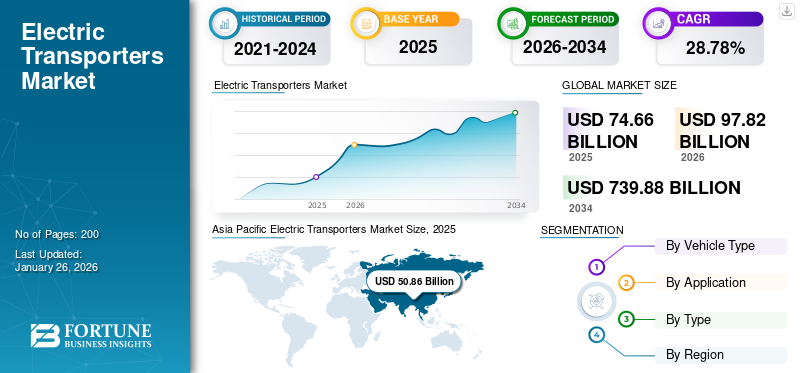
The global electric transporters market size was valued at USD 74.66 billion in 2025 and is projected to grow from USD 97.82 billion in 2026 to USD 739.88 billion by 2034, exhibiting a CAGR of 28.78% during the forecast period.
There is a rapid shift toward sustainable and efficient transportation, and one of the most stimulating innovations within this transformation is the rise of electric transporters. From last-mile delivery robots to personal mobility devices, these battery-powered vehicles are transforming how people and goods move from one place to another.
Electric transporters are powered by electricity, whether through a rechargeable battery, fuel cell, or other forms of electric energy storage. They support sustainable goals by replacing or complementing traditional fossil-fuel-powered vehicles, offering cleaner, discreet, and more efficient mobility solutions. Key players in the market include Mercedes-Benz, BYD, Scania, General Motors, Paccar, Volkswagen, and AB Volvo, which compete in the development of new products and pricing.
A key distinguishing feature of electric transporters is their reliance on electric motors, which are highly efficient as compared to combustion engines, offering impressive energy-to-motion conversion rates. In addition, electric transporters are known for their lower operating costs, reduced dependence on oil, and the innovative advancements they bring to mobility solutions, such as autonomous driving, regenerative braking, and smart connectivity.
As governments and private industries globally invest in EV infrastructure, from charging stations to battery technology enhancements, electric transporters are becoming an integral part of modern urban planning, fostering the development of sustainable cities and reducing global carbon footprints. With increasing strides in technology, range, and affordability, the adoption of these vehicles is rapidly accelerating, signaling a transformative era in transportation that prioritizes both efficiency and ecological responsibility.
Download Free sample to learn more about this report.
Electric Transporters Market Key Takeaways
 Market Size & Forecast
- 2025 Market Size: USD 74.66 Billion
- 2026 Market Size: USD 97.82 Billion
- 2034 Forecast Market Size: USD 739.88 Billion
- CAGR: 28.78% from 2026–2034
 Market Share
- Asia Pacific dominated the electric transporters market, generating USD 50.86 billion in 2025.
- The van segment is projected to account for 72.75% of the market share in 2026.
- The BEV segment is expected to hold 97.31% of the market share in 2026.
 Key Regional Highlights
Asia Pacific
Asia Pacific generated USD 50.86 billion in 2025 and is projected to reach USD 67.49 billion in 2026.
Europe
Europe accounted for USD 14.83 billion in 2025 and is expected to reach USD 19.01 billion in 2026.
North America
North America reached USD 8.64 billion in 2025 and is projected to grow to USD 10.89 billion in 2026.
U.S.
The electric transporters market is projected to reach USD 8.14 billion in 2026.
Japan
The market is projected to reach USD 3.02 billion in 2026.
Read More

Market Dynamics
Market Drivers
Environmental Awareness and Sustainability Efforts to Augment the Market Growth
One of the most compelling driving factors for the market is the growing awareness of environmental issues. Concerns about air pollution, greenhouse gas emissions, and the reduction of natural resources have compelled governments and consumers to seek out cleaner transportation options. Electric vehicles (EVs) produce zero tailpipe emissions, offering a viable solution to combat urban air quality challenges and contributing to lowering the global carbon footprints significantly.
Government initiatives, such as incentives for EV purchases, stricter emissions regulations, and ambitious carbon neutrality targets, have catalyzed the transition toward electric transport. Several nations have set deadlines for phasing out internal combustion engines, which further intensifies the market's momentum. Consumers are increasingly becoming environmentally conscious and are inclined to support brands that promote sustainability, driving manufacturers to prioritize electric vehicle innovation.
Market Restraints
Issues in Battery Technology to Hamper Market Growth
The core of an electric transporter lies in its battery system. Although technological advancements have led to improvements in energy density and charging speed, several challenges hamper the market growth. Battery production requires significant lithium, cobalt, and nickel, resources that are limited in supply and often draw upon environmentally destructive mining processes.
Moreover, the degradation of batteries over time is another concern, which leads to diminished performance and costly replacements. As electric vehicles' range is inherently associated with battery life, any negative perception surrounding battery performance can adversely affect consumer trust and market penetration. The development of sustainable battery technologies is crucial for mitigating these issues, yet the progress is relatively slow compared to the increasing demand.
Market Opportunities
Innovations in Charging Infrastructure to Support Market Growth
The expansion and improvement of the charging network are providing a huge opportunity for the electric transporters market growth. Public and private sectors are collaborating to develop comprehensive charging networks, alleviating range anxiety and making electric transporters a practical choice for consumers.
Innovations, such as fast-charging stations, wireless charging, and battery-swapping technology, are being explored to expedite and enhance the charging process. Some companies are engaging in pilot projects to test these concepts, gaining a first-mover advantage in a highly competitive space. With the electrification of fleets, organizations can improve their operational efficiencies and reduce downtimes, creating a compelling case for the transition to electric transporters.
Market Challenges
High Initial Costs of Electric Transporters Challenge Product Demand
One of the most significant barriers to the growth of the market is the high upfront costs. While buying an electric car, scooter, or bike, consumers often face price tags that are steeper than traditional combustion-engine alternatives.
The high cost of batteries is a key reason for the inflated prices of the product. While lithium-ion battery prices have dropped significantly in recent years, they still constitute about 30-40% of the cost of an EV. This financial hurdle can deter many middle- and lower-income consumers, especially in developing nations where affordability is a crucial factor in purchase decisions. Though subsidies and incentives offered by governments are helping bring prices down, the affordability gap remains one of the toughest challenges for widespread adoption.
Electric Transporters Market Trends
Rising Demand for Autonomous and Connected Vehicles to Positively Influencing Market Growth
The integration of autonomous technology and Internet of Things (IoT) capabilities is reshaping the market. Autonomous vehicles equipped with sensors, cameras, and artificial intelligence (AI) can reduce human error and make transportation safer and more efficient. Additionally, connected vehicles enhance communication between transporters and infrastructure, facilitating smart traffic management and reducing road congestion.
One of the most notable developments in this area is the rise of electric autonomous shuttles and delivery bots. Companies, including Nuro, Cruise, and Arrival, are advancing the vision of self-driving electric delivery systems. By combining electrification and automation, the market is setting a foundation for highly sustainable and intelligent mobility systems.
Download Free sample to learn more about this report.
Impact of COVID-19
Production Delays and Supply Chain Issues Hampered the Market Growth during Initial Stages of Pandemic
When the pandemic struck in early 2020, governments around the world implemented stringent lockdown measures, restricting movement and halting non-essential business activities. This led to a sharp decline in demand for electric transporters. With people restricted to staying in homes, daily commutes and travel plummeted, reducing the immediate need for personal transporters options, such as electric cars, bikes, and electric scooters.
The market also faced severe supply chain disruptions. Manufacturing plants were forced to shut down or operate at reduced capacity, causing delays in production. Different components of electric vehicles—such as lithium-ion batteries—are sourced from global supply chains, which were heavily impacted by restrictions on international trade. China, a major hub for EV production and battery manufacturing, was among the first countries hit by the pandemic, further exacerbating global shortages.
Despite the initial slump in demand, the market began to see a gradual recovery as the pandemic progressed. One significant factor driving this recovery was a shift in consumer preferences toward more sustainable and eco-friendly modes of transportation.
Segmentation Analysis
By Vehicle Type
Increasing Demand for Online Delivery Drives the Growth of Electric Vans
On the basis of vehicle type, the market has been segmented into van, bus, and truck.
The van segment is expected to dominate the market with a significant market share of 72.75% in 2026. While the initial purchase price of electric vans might be higher than their gasoline counterparts, the long-term savings they offer are hard to ignore. Furthermore, electric vans require less maintenance than internal combustion engine vans, as they have fewer moving parts and do not require oil changes or emission control systems. The increasing use of vans for delivery purposes and rising demand for online delivery are creating a demand for electric van market growth.
The bus segment is expected to grow at a rapid CAGR during the forecast period from 2025 to 2032. Government policies and incentives play a key role in accelerating the adoption of electric buses. Many countries offer subsidies for purchasing electric vehicles, tax incentives, and grants for transit authorities to invest in charging infrastructure. These measures reduce the initial financial burden on transit agencies, making electric buses a more feasible option. Moreover, stringent emission regulations and low-emission zones in urban areas are allowing transport companies to lower the production of diesel buses compared to electric alternatives. Policies that prioritize sustainability are growing, encouraging investments in greener public transport options.
To know how our report can help streamline your business, Speak to Analyst
By Application
Rise of E-commerce to augment the Growth of Electric Transporters for Goods Transport
Based on the application, the market is divided into passenger and goods.
The goods segment is expected to dominate the market share of 74.19% in 2026. and captured the majority of the electric transporters market share. The rise of e-commerce and the increasing demand for rapid delivery have reshaped the need for urban transportation. Electric cargo vans and small-scale transporters are uniquely suited to cities and urban environments. They yield no tailpipe emissions, helping to address air quality concerns in densely populated areas. Additionally, its discreet operation makes it more attractive for night-time deliveries or restrictions in noise-sensitive zones. Retail giants, such as Amazon, DHL, and FedEx have already begun electrifying their fleets for last-mile deliveries, underscoring the pivotal role that play in urban logistics. The segment is poised to capture 70% of the market share in 2025.
The passenger segment is expected to develop at a steady growth rate with a CAGR of 37.50% during the forecast period (2025-2032). The passenger segment offers quieter rides, reducing noise pollution, which is a significant benefit for urban areas. This shift in consumer attitudes is increasingly reflected in government policies. Cities around the globe are implementing stringent emissions regulations and offering incentives for electric vehicle adoption, further fueling the demand for electric transporters.
By Type
Stringent Regulatory Environment Boosted BEV Segment Growth
Based on the type, the market is categorized into BEV and hybrid.
The BEV segment is expected to capture a significant share of the market of 97.31% in 2026. Governments globally are introducing stringent regulations that favor zero-emission vehicles. Incentives, such as tax rebates, subsidies, and exceptions from congestion charges, are making battery electric vehicles more appealing. Additionally, low-emission zones in certain urban areas restrict the use of traditional internal combustion engine vehicles, further boosting the demand for electric transporters. Many companies are committing to aggressive sustainability targets as a part of their corporate social responsibility (CSR) programs. Fleet operators are progressively shifting to BEVs to meet these goals while also benefiting from lower total cost of ownership (TCO) due to reduced fuel and maintenance expenses. The segment is expected to attain 98% of the market share in 2025.
The hybrid segment will grow steadily with a considerable CAGR of 31.20% during the forecast period (2025-2032), due to its cost-effectiveness. Over the last decade, advancements in battery technology have substantially improved energy efficiency, battery life, and charging capabilities. The latest hybrid systems are capable of recovering energy through regenerative braking, enhancing overall efficiency by recharging batteries using energy that would otherwise be lost during braking.
Electric Transporters Market Regional Outlook
The market is studied across different regions, including North America, Europe, Asia Pacific, and the Rest of the World.
Asia Pacific Electric Transporters Market Size, 2025 (USD Billion)
To get more information on the regional analysis of this market, Download Free sample
Asia Pacific
Asia Pacific dominated the market with a valuation of USD 50.86 billion in 2025 and is projected to reach USD 67.49 billion in 2026. Currently, Asia Pacific region is dominating the market. Asia Pacific is expected to grow at the highest CAGR over the forecast period. Urbanization is a crucial factor contributing to the rise in demand for electric transporters. Cities across the Asia Pacific are rapidly expanding, with millions flocking to urban areas in search of better opportunities. This urban migration creates a pressing demand for efficient public transport systems, particularly in mega-cities, including Tokyo, Jakarta, and Mumbai. The Chinese market is expected to gain USD 43.42 billion in 2025. The global demand for sustainability primarily drives the electric transporter market in Asia Pacific. Several countries in the region are committed to reducing greenhouse gas emissions. With the Paris Agreement and other international commitments, these nations aim to cut down on their carbon footprint significantly. Transitioning to electric transporters is a promising solution for achieving these targets. India is expected to acquire USD 0.98 billion in 2026, while Japan is foreseen to stand at USD 3.02 billion in the same year.
North America
North America contributed approximately USD 8.64 billion to the global market in 2025, accounting for 11.57% share, and is expected to reach USD 10.89 billion in 2026. North America will grow at a steady pace during the forecast period. As cities in North America develop, congestion and air quality have become a growing concern. Urban areas are dealing with increasing traffic, leading to longer delivery times and heightened pollution levels. Electric transporters offer a viable solution, promising to reduce emissions and navigate urban environments more quietly and efficiently. Rising penetration of electrification in U.S. and robust support from the government in terms of funding, incentive benefits, and stringent regulation are propelling the demand for market growth in U.S. The U.S. market is projected to reach a market value of USD 8.14 billion in 2026.
Europe
In 2025, the Europe market stood at USD 14.83 billion, representing 19.86% of global demand, and is projected to grow to USD 19.01 billion in 2026. The region held a considerable market share in 2024. One of the primary drivers of the rising demand for electric transporters in Europe is the urgent need to combat climate change. The U.K. market is estimated to be worth USD 5.18 billion in 2026. The transport sector is responsible for a substantial portion of greenhouse gas emissions, and European nations have been at the forefront of implementing stringent environmental regulations aimed at mass decarbonization. The European Union has set ambitious targets, such as reducing carbon dioxide emissions by at least 55% by 2030. Germany is estimated to be valued at USD 4.71 billion in 2026, while France is projected to hit USD 2.65 billion in the same year.
Rest of the World
The rest of the world is the fourth largest market expected to stand at USD 0.33 billion in 2025. The rest of the world is expected to grow at a rapid CAGR during the forecast period. Governments in both Latin America and the Middle East & Africa are implementing aggressive policies to promote electric vehicles. Countries, such as Chile, Colombia, and Brazil are introducing incentives, including tax breaks, grants, and subsidies for electric vehicle purchases and infrastructures, such as charging stations. Similarly, nations in the Middle East & Africa region, particularly the UAE and Saudi Arabia, are heavily investing in electric mobility as part of their broader sustainability visions, such as Saudi Arabia’s Vision 2030.
Competitive Landscape
Key Market Players
Key Market Players are Investing in R&D Activities to Make Accessibility Easy for End-Users
The global market is highly competitive. The market has a large number of brands that hold a strong foothold. These players have adopted various strategies, such as product differentiation & development, contracts, acquisitions, and collaborations, to gain a competitive advantage. Various regional and international players are consistently working on the electric transporters. The key market leaders invest in R&D and commercialize their products on a large scale, making accessing easier to the end user. The company focuses on partnerships to provide a wide range of electric transporters.
List of Key Electric Transporters Companies Profiled
o Mercedes-Benz Group AG (Germany)
o BYD (China)
o General Motors (U.S.)
o Volkswagen (Germany)
o Toyota (Japan)
o AB Volvo (Sweden)
o CRRC Corporation Limited (China)
o Zhengzhou Yutong Bus Co., Ltd. (China)
o Scania AB (Sweden)
o PACCAR Inc. (U.S.)
Key Industry Developments
- October 2024 – Volvo Buses announced that it is expanding its electric bus offer for European customers. This will aid the company in expanding its footprint across Europe.
- September 2024 – BYD unveiled a new line-up of electric vans and trucks, including the E-Vali, a new zero-emission light commercial vehicle (LCV). This will help the company to diversify its product portfolio.
- August 2024 – General Motors announced that it would fold its electric BrightDrop commercial vans into the Chevrolet brand to expand the selling and service points from a handful of dealers to Chevrolet’s large network of North American dealers.
- February 2024 – Mercedes-Benz Group AG introduced its first fully electric van, eSprinter. It will be available as a 170'' wheelbase cargo van with a 113 kilowatt hour (kWh) battery.
- October 2023 – Scania launched a new battery-electric bus platform covering vehicles, services, and systems
Investment Analysis and Opportunities
Favorable Trends Associated with Battery Technology, Software, and Connectivity to Generate Opportunities for Market Growth
Batteries are the core of electric vehicles. Lithium-ion batteries are highly used battery types, and manufacturers, including CATL, Panasonic, and LG Energy Solution, are playing a critical role in the EV ecosystem. Additionally, innovations in battery recycling and next-generation technologies, such as solid-state batteries, promise to redefine the economics of EVs, creating opportunities for early-stage investments.
Electric transporters rely heavily on complex software for navigation, energy management, and autonomous driving. Connected ecosystems and IoT-enabled services for EV fleets could create new categories of investments in mobility-as-a-service (MaaS) platforms, payment gateways for charging, and predictive maintenance software.
Report Coverage
The global electric transporters market report analyzes the market in-depth and highlights crucial aspects such as prominent companies, market segmentation, competitive landscape, and technology adoption. Besides this, the market research report provides insights into market trends and highlights significant industry developments. In addition to the aspects mentioned earlier, the report encompasses several factors contributing to the market growth over recent years.
Request for Customization to gain extensive market insights.
Report Scope & Segmentation
|
ATTRIBUTE |
DETAILS |
|
Study Period |
2021-2034 |
|
Base Year |
2025 |
|
Estimated Year |
2026 |
|
Forecast Period |
2026-2034 |
|
Historical Period |
2021-2024 |
|
Growth Rate |
CAGR of 28.78% from 2026 to 2034 |
|
Unit |
Value (USD Billion) |
|
Segmentation |
By Vehicle Type
By Application
By Type
By Region
|
Frequently Asked Questions
Fortune Business Insights says that the market size was USD 74.66 billion in 2025 and is anticipated to reach USD 739.88 billion by 2034.
The market will exhibit a CAGR of 28.78% over the forecast period.
By vehicle type, the van segment dominated the market in 2025.
Supportive government policies for the electrification of vehicles to augment the market growth.
Leading companies in the market include Mercedes-Benz, BYD, Scania, General Motors, Paccar, Volkswagen, and AB Volvo.
Asia Pacific dominated the global market in 2025.



- 2021-2034
- 2025
- 2021-2024
- 200
-
(Offer valid till 15th Oct 2026)
Get 30-60 hrs Free Customization
Expand Regional and Country Coverage, Segments Analysis, Company Profiles, Competitive Benchmarking, and End-user Insights.




















Related Reports
-
US +1 833 909 2966 ( Toll Free )
-
Get In Touch With Us