Electric Vehicle Control Unit Market Size, Share & Industry Analysis, By Vehicle Type (Passenger Car and Commercial Vehicle), By Propulsion Type (Battery Electric Vehicle and Hybrid Vehicle), By Application (ADAS, Body & Comfort, Infotainment, and Others), and Regional Forecast, 2026-2034
 Download Free Sample
(Offer valid till 15th Oct 2026)

KEY MARKET INSIGHTS
 Listen to Audio Version
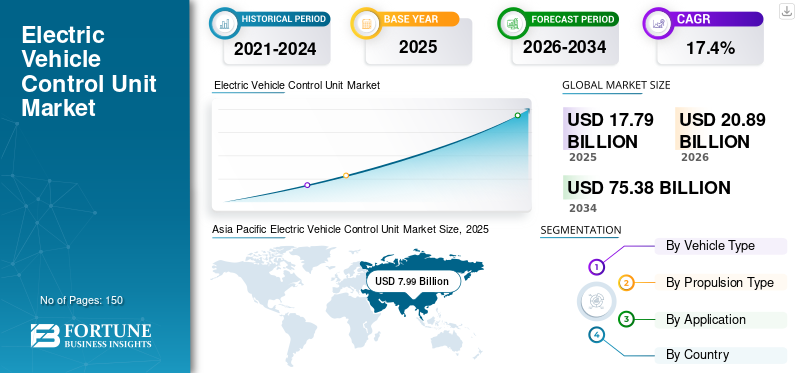
The global electric vehicle control unit market size was estimated at USD 17.79 billion in 2025 and is expected to rise from USD 20.89 billion in 2026 to USD 75.38 billion by 2034, expanding at a CAGR of 17.40% from 2026 to 2034. Asia Pacific dominated the electric vehicle control unit market with a market share of 44.92% in 2025.
The electric vehicle control unit controls vehicle function in complex vehicle wiring systems or as a gateway between separate Controller Area Network (CAN). The control unit is used for different applications, such as evaluating and controlling the lighting system and providing anti-theft protection. The vehicle control unit delivers torque, operation, and gearshift strategies, high-voltage and 48V coordination, charging control, onboard diagnosis, monitoring, thermal management, and more for electrified and connected powertrains. The Vehicle Control Unit (VCU) can be used in electric passenger cars, trucks, off-highway vehicles, and combustion engine applications. The growing integration of advanced technologies in recent electric vehicles for enhanced performance is anticipated to propel the electric vehicle control unit industry’s growth.
Download Free sample to learn more about this report.
Electric Vehicle Control Unit Market Key Takeaways
 Market Size & Forecast
- 2025 Market Size: USD 17.79 billion
- 2026 Market Size: USD 20.89 billion
- 2034 Forecast Market Size: USD 75.38 billion
- CAGR: 17.40% from 2026–2034
 Market Share
- Asia Pacific dominated the electric vehicle control unit market with a 44.92% share in 2025.
- The BEV segment is projected to exhibit a CAGR of 72.7%.
- The ADAS segment is estimated to reach a value of USD 8,843.16 million in 2025.
 Key Regional Highlights
Asia Pacific
Asia Pacific led the market with a valuation of USD 7.99 billion in 2025 and is expected to remain the fastest-growing region.
Europe
Europe holds the second-largest market position, supported by strong EV adoption and stringent emission regulations.
North America
North America is witnessing growth due to increasing commercial EV adoption and supportive government incentives.
U.S.
Government subsidies, tax rebates, and incentives are accelerating electric vehicle adoption.
Japan
The electric vehicle control unit market is estimated to reach USD 63.82 million in 2025.
Read More

ELECTRIC VEHICLE CONTROL UNIT MARKET TRENDS
Increased Integration of AI and Machine Learning in ADAS is an Ongoing Trend in the Market
The advanced integration of machine learning and AI in Advanced Driver Assistance Systems (ADAS) is an ongoing trend in the market. The trend is driven by the need to enhance safety systems, efficiency, and overall driving experience. By leveraging AI and machine learning technologies, EV control units can process and analyze vast amounts of actual data from sensors, cameras, and other sources. This enables enhanced features, such as adaptive cruise control, lane departure warnings, autonomous emergency braking, and self-parking capabilities. The electric vehicle control unit market growth is attributed to the growing adoption of AI technology in electric vehicles. AI can optimize energy management in electric vehicles by predicting driving patterns and adjusting power distribution to maximize efficiency. This can extend the range of the EV and enhance battery life.
Download Free sample to learn more about this report.
- For instance, in July 2023, Horizon signed a strategic corporation agreement with NavInfo to research and develop new-generation solutions for self-driving passenger cars. The pair will also promote the mass production of cost-effective autonomous car driving solutions. The two companies will create high-end intelligent driving solutions based on the full-scenario vehicle intelligent central computing chip - Horizon Journey 5 and NavInfo's intelligent driving system capabilities.
DRIVING FACTORS
Growing Demand for Energy-Efficient Vehicles to Propel Market Growth
Electric vehicles have intricate systems that require control units to manage various functions, such as battery management systems, motor control, regenerative braking, and power distribution. This complexity leads to a higher demand for vehicle control units. EV control units play a crucial role in optimizing the performance of electric vehicles. The control unit manages power delivery, torque distribution, and other critical parameters, resulting in improved acceleration, efficiency, and overall driving experience. Therefore, increasing sales and demand for electric vehicles drive the market growth.
Additionally, the transition toward autonomous driving features in electric vehicles require a standard/advanced control unit to operate sensor data fusion, object detection, and decision-making algorithms. This trend further drives the demand for electric vehicle control units in forecasting years.
RESTRAINING FACTORS
High Development Cost May Hamper Market Growth
The high cost associated with the development of electric vehicle control units hampers market share. Developing advanced control units and incorporating them into electric vehicles involve significant research, development, and testing. Control units that can effectively manage the complex systems of electric vehicles require a sustainable research and development process. Designing control algorithms, ensuring compatibility with various vehicle components, and conducting extensive testing contribute to higher development costs. This can lead to challenges and limitations for market growth.
SEGMENTATION ANALYSIS
By Vehicle Type Analysis
Passenger Segment’s Growth Driven by Rising Sales of Passenger Cars
Based on vehicle type, the market is segmented into passenger car and commercial vehicle. The passenger car segment holds the highest market share and is anticipated to dominate during the forecast period. Higher consumer awareness and rising demand for electric passenger cars accelerates market growth. Moreover, the government’s focus on promoting the adoption of electric passenger vehicles by implementing regulations and offering attractive incentives, drives market growth.
The commercial vehicle is the second leading segment in the electric vehicle control unit industry. The segment growth is attributed to increasing innovation, R&D, and vehicle launches.
By Propulsion Type Analysis
BEV Segment Leads due to Increasing Sales and Launches of Battery Electric Vehicles
Based on propulsion type, the market is projected into Battery Electric Vehicles (BEV) and Hybrid Vehicles (HV). The BEV segment holds the maximum market share. The BEV is projected to exhibit a CAGR of 72.7%. The growth is attributed to increasing battery electric vehicle sales and EV infrastructure. Furthermore, the popularity has grown due to advancements in battery technology, increasing driving range.
- For instance, in May 2023, BYD introduced two new full-electric vehicles at Automobile Barcelona 2023. The company unveils BYD DOLPHIN and BYD SEA in the Spanish market at Automobile Barcelona 2023. The BYD DOLPHIN offers three power levels (95 hp, 177 hp, and 204 hp), two batteries (44.9 kWh and 60.4 kWh), and four trim levels (active, boost, comfort, and design).
The hybrid segment is the second dominating segment. Hybrid vehicles provide improved fuel efficiency and reduced emissions than traditional internal combustion engines. Increasing consumer transition toward environmentally friendly options while having the convenience of the gasoline engine is estimated to drive the segment’s growth in the electric vehicle control unit industry.
By Application Analysis
ADAS Segment Dominates due to its Advanced Feature and Technology in EV
Based on application, the market is projected into ADAS, body & comfort, infotainment, and others. The ADAS (Advanced Driver Assistance Systems) segment accounts for the largest market share globally. The ADAS segment is estimated to reach a value of USD 8843.158 million in 2025. The growth is attributed to increasing ADAS adoption in electric vehicles due to their potential to enhance safety features, convenience, and overall driving experience. The ADAS features include lane departure warning, adaptive cruise control, automatic emergency braking, parking assistance, and others. This development is estimated to drive the electric vehicle unit sector’s growth during the forecast period. The body and comfort segment holds the second largest market share. The growth is attributed to the rising demand for advanced features related to vehicle comfort, convenience, and interior functions.
To know how our report can help streamline your business, Speak to Analyst
REGIONAL ANALYSIS
This market is analyzed across North America, Europe, Asia Pacific, and the rest of the world.
Asia Pacific
Asia Pacific Electric Vehicle Control Unit Market Size, 2025 (USD Billion)
To get more information on the regional analysis of this market, Download Free sample
Asia Pacific stood at USD 7.99 billion in 2025.The region dominated the market in 2025 and is expected to continue its dominance throughout the forecast period, with the fastest CAGR. The electric vehicle control unit market in Japan is expected to reach an estimated value of USD 63.82 million in 2025. The existence of a strong automotive sector in developing economies including China, India, Japan, and others, is supporting the market growth in the region. Additionally, high electric vehicle sales in India, China, and South Korea further propel the region's demand in this market. The market in China is expected to grow at a steady CAGR of 17.9%.
Europe
Europe holds the second dominant position in the electric vehicle control unit sector as the region is an early adopter of electric vehicles. It is the second largest manufacturing hub for electronic components and electric vehicles globally. Europe is projected to exhibit a CAGR of 17.4%. Increasing environmental concerns and stringent vehicle emission norms in European economies are impacting the manufacturers to adopt advanced features for efficient working to meet consumer preferences.
North America
North America’s market growth is attributed to the increasing adoption of commercial transportation. The favorable incentives, subsidies, and tax rebate programs from governments is anticipated to boost the adoption of electric vehicles in the region.
KEY INDUSTRY PLAYERS
Market Players Focus on Increasing Product Portfolio to Secure Prominent Position
Major market players include Continental AG, Denso Corporation, and Hitachi Automotive Systems Ltd. Manufacturers of vehicle control units focus on offering cutting-edge electric vehicle control units for various vehicles worldwide.
Continental AG is one of the leading vehicle control unit manufacturers. The company focuses on research and development activities to develop new products with improved capabilities. The company provides an Electric Vehicle Control Module (VCU). The EV control module is a low-voltage control module and is responsible for most processes related to the functional aspects of electric or hybrid-electrical vehicles.
List of Key Companies Profiled:
- DELPHI Technologies (U.K.)
- Continental AG (Germany)
- Denso Corporation (Japan)
- Texas Instruments Incorporated (U.S.)
- HELLA GmbH & Co (Germany)
- Hitachi Automotive Systems Ltd. (Japan)
- Hyundai Mobis (South Korea)
- Robert Bosch GmbH (Germany)
- ZF Friedrichshafen AG (Germany)
- Panasonic Corporation (Japan)
KEY INDUSTRY DEVELOPMENTS:
- In August 2023, Continental AG signed an agreement with Amazon Web Services to accelerate automotive software development. The company introduced virtual ECU Creator software (vECU Creator). The virtual ECU Creator is part of the Continental Automotive Edge (CAEdge) framework, which runs on Amazon Web Services (AWS). The new solution will drive development for software-defined vehicles from conceptualization to real-world application.
- In January 2023, NVIDIA signed a strategic partnership agreement with Hon Hai Technology Group (Foxconn) to Hon Hai Technology Group (Foxconn). As per the partnership, Foxconn produces electronic control units (ECUs) based on NVIDIA DRIVE Orinfor the global automotive market. Foxconn-manufactured Electric Vehicles (EVs) will feature DRIVE Orin ECUs and DRIVE Hyperion sensors for highly automated driving capabilities.
- In December 2022, HELLA received a customer order for its innovative Coolant Control Hub (CCH). The company will also get the Coolant Control Hub into series production for its all-electric pick-up or light truck platform. The company also received a series of orders for the performance line of a German premibutum manufacturer.
- In May 2022, Tokai Rika Co., Ltd. (Tokai Rika) announced the progress of its mid-term business plan for the period ending in March 2031 (FY 2030). Tokai Rika plans to strengthen its semiconductor and Electronic Control Unit (ECU) businesses. The company will start external sales of semiconductors. It also aims to expand marketing channels for the sensors and actuators associated with the ‘zone ECUs’ and ECUs used in automakers’ next-generation electric platforms.
- In October 2021, Continental signed a joint venture contract with Horizon Robotics to provide hardware and software-integrated solutions for Advanced Driver Assistance systems (ADAS) and automated driving. The company also signed an investment contract with Shanghai Jiading Industrial Zone for the new JV in Jiading District Shanghai.
REPORT COVERAGE
The electric vehicle control unit market research report provides a detailed analysis and focuses on key aspects such as leading market players, competitive landscape, and vehicle type. Besides, the report includes insights into the market trends and highlights key industry developments. In addition to the factors above, the report encompasses several factors that contributed to the market's growth in recent years.
Request for Customization to gain extensive market insights.
REPORT SCOPE & SEGMENTATION
|
ATTRIBUTE |
DETAILS |
|
Study Period |
2021-2034 |
|
Base Year |
2025 |
|
Estimated Year |
2026 |
|
Forecast Period |
2026-2034 |
|
Historical Period |
2021-2024 |
|
Growth Rate |
CAGR of 17.4% from 2026 to 2034 |
|
Unit |
Value (USD Billion) |
|
Segmentation |
By Vehicle Type
|
|
By Propulsion Type
|
|
|
By Application
|
|
|
|
By Region
|
Frequently Asked Questions
As per the Fortune Business Insights study, the market size was USD 17.79 billion in 2025.
The market is anticipated to grow at a CAGR of 17.4% over the forecast period (2026-2034).
The passenger cars segment is expected to lead the market due to the adoption of passenger vehicles globally.
The market size in Asia Pacific stood at USD 7.99 billion in 2025.
Continental AG, Denso Corporation, and Hitachi Automotive Systems Ltd. are some of the top key players in the market.
Asia Pacific held the largest share of the market in 2025.



- 2021-2034
- 2025
- 2021-2024
- 150
-
(Offer valid till 15th Oct 2026)
Get 30-60 hrs Free Customization
Expand Regional and Country Coverage, Segments Analysis, Company Profiles, Competitive Benchmarking, and End-user Insights.




















-
US +1 833 909 2966 ( Toll Free )
-
Get In Touch With Us