Endometriosis Treatment Market Size, Share & Industry Analysis, By Drug (Orilissa, Myfembree/Ryeqo, and Others), By Drug Class (GnRH Antagonists, GnRH Agonists, and Others), By Route of Administration (Oral and Others), By Distribution Channel (Hospital Pharmacies, Retail Pharmacies, and Online Pharmacies), and Regional Forecast, 2026-2034
 Download Free Sample
Endometriosis Treatment Market and Industry Overview
 Listen to Audio Version
The global endometriosis treatment market size was valued at USD 2.39 billion in 2025 and is projected to grow from USD 2.58 billion in 2026 to USD 5.03 billion by 2034, exhibiting a CAGR of 8.70% during the forecast period. North America dominated the endometriosis treatment market with a market share of 49.60% in 2025.
The endometriosis treatment market is experiencing steady growth, driven by rising disease awareness and improved diagnosis rates among women of reproductive age. The increasing prevalence of endometriosis, coupled with its strong association with infertility and chronic pain, is fueling demand for effective therapies. Furthermore, to bridge the gap and meet clinical demands for endometriosis, various major operating players are focusing on new clinical studies and their rapid commercialization.
- For instance, in September 2025, EndoCyclic Therapeutics was awarded a grant from the National Institutes of Health (NIH) Commercialization Readiness Pilot (CRP) Program, specifically from the Eunice Kennedy Shriver National Institute of Child Health and Human Development (NICHD). This funding accelerated the commercialization of ENDO-205, a non-hormonal, disease-modifying therapeutic designed to treat endometriosis. Such developments are expected to support market growth further.
Furthermore, the market is dominated by several major players with AbbVie Inc., Pfizer Inc., and AstraZeneca at the forefront. A broad portfolio with innovative product launch, and strong geographic presence expansion have supported the dominance of these companies in the global market.
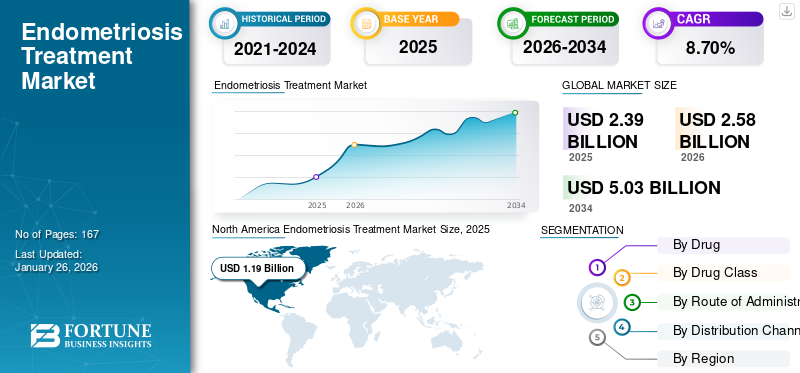
Download Free sample to learn more about this report.
Endometriosis Treatment Market Key Takeaways
 Market Size & Forecast
- 2025 Market Size: USD 2.39 billion
- 2026 Market Size: USD 2.58 billion
- 2034 Forecast Market Size: USD 5.03 billion
- CAGR: 8.70% from 2026–2034
 Market Share
- North America dominated the endometriosis treatment market with a 49.60% share in 2025.
- The Orilissa drug segment accounted for 11.18% of the market share in 2026.
- The GnRH antagonists segment is projected to grow at the highest CAGR of 21.87% during the forecast period.
 Key Regional Highlights
North America
North America held a 49.60% market share in 2025 and is projected to reach USD 1.28 billion in 2026.
Europe
Europe accounted for 23.22% of global revenue in 2025 and is expected to reach USD 0.59 billion in 2026.
Asia Pacific
Asia Pacific represented 19.29% of the global market in 2025 and is projected to reach USD 0.51 billion in 2026.
U.S.
The endometriosis treatment market is estimated to reach USD 2.03 billion.
Japan
The market is supported by increasing awareness, diagnosis rates, and adoption of advanced treatment options.
Read More

MARKET DYNAMICS
MARKET DRIVERS
Increasing demand for Innovative Treatment Alternatives to Drive Market Growth
The global endometriosis treatment market demand is increasingly driven by the growing need for non-hormonal and disease-modifying therapies that target the root cause rather than providing symptomatic relief. Current therapeutic options largely rely on hormonal suppression, which is often associated with side effects such as bone density loss, mood disturbances, and impacts on fertility, leading to poor long-term adherence.
These factors create a need for safer alternatives that can directly target the underlying pathways of inflammation, immune dysfunction, and lesion growth. This shift in focus is becoming a central growth driver as both patients and clinicians seek sustainable solutions for chronic management.
Moreover, the key players are focusing on bridging this gap and investing in research and development for innovative therapies through resource pooling and collaborations.
- For instance, in January 2025, Celmatix Therapeutics launched an innovative drug program for a novel Jun-N-terminal kinase (JNK) inhibitor targeting pain and inflammation, addressing unmet needs in first-line treatments for various indications such as endometriosis, Polycystic Ovary Syndrome (PCOS), and ovarian aging, among others.
MARKET RESTRAINTS
High Cost Associated with Therapeutic Treatment to Limit Market Expansion
One of the crucial factors limiting the growth of the market is the high cost associated with endometriosis treatment, which hampers adoption. Advanced alternatives including oral GnRH antagonists and combination therapies are priced at a premium compared to generics such as oral contraceptives and progestins, making them less accessible to patients without comprehensive insurance coverage.
Such high out-of-pocket costs can lead to non-adherence or discontinuation, reducing the overall treated patient pool. This cost barrier not only slows market penetration of innovative therapies but also widens disparities in care across geographies and patient populations.
- For instance, in January 2022, the list price of Orilissa for one dose was reported to be USD 1,046.66. Such high prices per dose limit adoption.
MARKET OPPORTUNITIES
Increasing Investment for Research and Development to Create Lucrative Growth Opportunities
Rising investments in endometriosis treatment present a lucrative growth opportunity,accelerating the development of innovative and effective therapies. Pharmaceutical companies are increasingly channeling funds into R&D to address the high unmet need for safer, long-term treatment options. Current first-line treatments, including pain medications and hormonal contraceptives, provide inadequate relief for many patients or cause intolerable side effects which leaving a major unaddressed medical need for safe and effective novel therapies.
- For instance, in January 2025, Gesynta Pharma AB secured USD 28.7 million in a Series B financing round. The funding program aimed for a Phase II clinical trial of Vipoglanstat, a drug candidate for the treatment of endometriosis. Such developments offer a significant opportunity for the global endometriosis treatment market growth.
ENDOMETRIOSIS TREATMENT MARKET TRENDS
Expansion of Awareness Campaigns and Patient Support is One of the Global Endometriosis Treatment Market Trends
Expansion of awareness campaigns and patient support programs is a major trend observed in the endometriosis treatment market. These campaigns promote early diagnosis and assist in reducing stigma around menstrual pain and improving education among both patients and clinicians. These combined efforts are expanding the diagnosed patient pool and boosting demand for advanced therapeutic options.
- For instance, in March 2025, the International Society of Ultrasound in Obstetrics and Gynecology (ISUOG) organized Endometriosis Awareness Month 2025 to provide access and share resources towards endometriosis through clinicians and patients. Such activities are a prominent trend in the market.
MARKET CHALLENGES
Patent Infringement for New Drugs Poses a Critical Challenge to Market Growth
Patent infringement poses a significant challenge in the endometriosis treatment market as it threatens the exclusivity period of innovative drugs and hampers the potential revenue generation. The entry of generics or biosimilars due to patent disputes can lead to steep price erosion, reducing profitability and discouraging further R&D investment. High-profile cases around hormonal therapies highlight the vulnerability of novel treatments to early competition. This legal uncertainty creates market instability, particularly for companies relying on a narrow product portfolio in womens health.
- For instance, in May 2025, AbbVie Inc. sued Hetero Labs Ltd. for patent infringement related to the endometriosis drug Orilissa. Such factors pose a challenge for market growth.
Download Free sample to learn more about this report.
Endometriosis Treatment Market Segmentation Analysis
By Drug
Widespread Utilization to Lead to the Dominance of Others Segment
On the basis of the segmentation of drugs, the market is classified into Orilissa, Myfembree/Ryeqo, and others.
The others segment accounts for the dominant proportion of the market as it comprises of numerous drugs that were earlier approved and utilized for the treatment and management of endometriosis symptoms. They are often prescribed as first-line therapies, and have a wider regulatory reach across numerous regions. Coupled with the fact that these drugs are often in-expensive for the patient to adopt them, this segment accounts for the majority of the market value.
The Orilissa drug led the second dominated the segmental share 11.18% for the endometriosis treatment market in 2026. The dominant share is owing to its status as the first oral GnRH antagonist approved specifically for endometriosis pain. Its oral convenience, proven efficacy, and strong commercial presence of the company support broad adoption.
- For instance, as of March 2023, Orilissa was prescribed to over 125,000 women for endometriosis.
On the other hand, the drug of Myfembree/Ryeqo is anticipated to grow with substantial CAGR due to its recent approval in August 2022.
To know how our report can help streamline your business, Speak to Analyst
By Drug Class
Increased Collaborations to Manufacture New Products Will Drive the Gnrh Antagonists Segment
On the basis of drug class, the market is categorized into GnRH antagonists, GnRH agonists, and others.
The GnRH antagonists segment is expected to account as the dominant segment in 2025. In 2026, the segment is anticipated to dominate with a 40.17% of market share.
The GnRH antagonists segment is projected to grow at the highest CAGR of 21.87%, during the forecast period. GnRH antagonists are positioned to dominate the drug class segment due to their rapid onset of action and better safety compared to older GnRH agonists. Their effectiveness has been reflected in consecutive approvals for drugs in these drug classes.
- For instance, in November 2023, Gedeon Richter Plc., in collaboration with Sumitomo Pharma, received approval from the European Commission for a Type II Variation application for Ryeqo, a non-peptide gonadotropin releasing hormone GNRH antagonists receptor antagonist for the symptomatic treatment of endometriosis in women with a history of previous medical or surgical treatment for their endometriosis.
By Route of Administration
Widespread Usage of Oral Therapeutic as Standard Endometriosis Treatment Supplemented Segment Growth
Based on the route of administration, the market is segmented into oral and other.
The oral segment held the dominating position in 2025. By route of administration, the segment held a share of 65.46% in 2026. The oral route of administration is set to dominate the endometriosis treatment market due to its convenience, higher patient adherence, and growing availability of innovative oral therapies. Availability of orally administered therapeutics such as Orilissa and Myfembree/Ryeqo highlights a shift toward oral formulations.
- For instance, in March 2025, National Institute for Health and Care (NICE) published review for oral Relugolix–estradiol–norethisterone for treating symptoms of endometriosis.
The others segment by route of administration is expected to grow significantly with a CAGR of 5.06% during the forecast period.
By Distribution Channel
Increasing Number of Drug Stores & Retail Pharmacies Openings Strengthen the Distribution Network to Drive Segmental Growth
Based on distribution channel, the market is segmented into hospital pharmacies, drug stores & retail pharmacies, and online pharmacies.
In 2025, drug stores & retail pharmacies are expected to dominate the distribution channel for endometriosis treatments, as they act as the primary center to dispense prescription medicines. They ensure accessibility to large medicines and have vast distribution networks. Furthermore, the segment is set to hold 59.20% share in 2026.
- For instance, in February 2025, Loblaws Inc. announced the launch of 80 new grocery and pharmacy stores with of USD 2,200 million investment for 2025. Such rising investment underscores the rising demand for retail pharmacy and reinstates the segmental growth.
In addition, hospital pharmacies as a distribution channel is projected to grow at a CAGR of 5.99% during the study period.
Endometriosis Treatment Market Regional Outlook
By region, the market is categorized into Europe, North America, Asia Pacific, Latin America, and Middle East, and Africa.
North America
North America Endometriosis Treatment Market Size, 2025 (USD Billion) To get more information on the regional analysis of this market, Download Free sample
In 2025, North America held 49.60% of the global market share, reaching a valuation of USD 1.19 billion, and is projected to grow to USD 1.28 billion in 2026. The region is experiencing strong growth in the endometriosis treatment market due to a combination of clinical, economic, and regulatory factors. With the rising prevalence of endometriosis among women of reproductive age, coupled with higher diagnosis rates is expanding the treated patient pool is expanding. Strong presence of leading pharmaceutical players, ongoing clinical trials, and increasing awareness initiatives by advocacy groups’ further drive uptake. In 2026, the U.S. market is estimated to reach USD 2.03 billion. The strong growth anticipated in the country is due to rising prevalence, robust reimbursement infrastructure, and high healthcare spending.
- For instance, in June 2021, NIH published a study titled ‘Incidence, prevalence, and trends in endometriosis diagnosis: a U.S. population-based study from 2006 to 2015 ’ that reported that among 332,056 eligible women during the 10-year study period, 2863 incident endometriosis cases were identified for an average incidence of 24.3 cases per 10,000 person-years in the U.S.
Other regions, such as Europe and the Asia Pacific, are anticipated to witness a notable growth in the coming years.
Europe
The market in Europe reached USD 0.56 billion in 2025, representing 23.22% of total market revenue, and is projected to reach USD 0.59 billion in 2026. During the forecast period, European region is projected to record the growth rate of 7.01%, which is the second highest amongst all the regions and touch the valuation of USD 0.56 billion in 2025. High disease burden and rising awareness of endometriosis led to market growth in Europe. Backed by these factors, countries including U.K. anticipates to record the valuation of USD 0.12 billion, Germany to record USD 0.15 billion, and France to exhibit a value of USD 0.11 billion in 2026.
Asia Pacific
Asia Pacific contributed approximately USD 0.46 billion to the global market in 2025, accounting for 19.29% share, and is expected to reach USD 0.51 billion in 2026 and secure the position of the third-largest region in the market. In the region, India and China are both estimated to reach USD 0.07 and USD 0.16 billion respectively in 2026.
Latin America, Middle East & Africa
In 2025, Latin America generated USD 0.09 billion, contributing 3.86% to global market revenue, and is projected to grow to USD 0.1 billion in 2026. The Middle East & Africa region captured 4.04% of the global market in 2025, generating USD 0.1 billion in revenue, and is projected to reach USD 0.1 billion in 2026. Over the forecast period, Latin America and Middle East & Africa regions would witness a moderate growth in this marketspace. Latin America market in 2025 is set to record USD 0.09 billion as its valuation. Increasing diagnostic rates and heightened awareness in the region will further drive usage of endometriosis drugs in these regions, resulting in growth. In the Middle East and Africa, GCC is set to attain the value of USD 0.05 billion in 2025.
COMPETITIVE LANDSCAPE
Key Industry Players
Wide Range of Product Offerings, Coupled with a Strong Distribution Network of Key Companies, Supported their Leading Position
The global endometriosis treatment market shows a semi-concentrated structure with numerous small- to mid-size companies actively operating across the globe. These players are actively involved in product innovation, strategic partnerships, and geographic expansion.
Bayer AG, AbbVie Inc., and Pfizer Inc. are some of the dominating players in the market. Recent approvals for endometriosis specific drugs, robust pipeline and rising number of clinical trials to provide comprehensive endometriosis treatment, global presence through a strong distribution network, and collaborations with research and academic institutes are a few characteristics of these players that support their dominance.
Apart from this, other prominent players in the market include Organon group of companies, Bayer AG, AstraZeneca, Sumitomo Pharma Co., Ltd., and others. These companies are undertaking various strategic initiatives, such as investments in R&D and partnerships with pharmaceutical companies to enhance their market presence.
LIST OF KEY ENDOMETRIOSIS TREATMENT COMPANIES PROFILED
- Gesynta Pharma AB (Sweden)
- AbbVie Inc. (U.S.)
- Pfizer Inc. (U.S.)
- Organon group of companies (U.S.)
- Bayer AG (Germany)
- AstraZeneca (U.K.)
- Sumitomo Pharma Co., Ltd. (Japan)
KEY INDUSTRY DEVELOPMENTS
- May 2024: TiumBio Co., Ltd. showcased positive topline results from its Phase 2a clinical trial of Merigolix, an oral gonadotropin-releasing hormone (GnRH) receptor antagonist, in patients with moderate to severe endometriosis-associated pain.
- May 2024: Neurocrine Biosciences, Inc. announced the initiation of its Phase I first-in-human clinical study to evaluate the safety, tolerability, pharmacokinetics, and pharmacodynamics of investigational compound NBI-1117567 in healthy adult participants. NBI-1117567 is an investigational, oral, M1/M4 (M1 preferring) selective muscarinic agonist for the potential treatment of neurological and neuropsychiatric conditions.
- May 2023: Gesynta Pharma AB assigned the substance name vipoglanstat (drug candidate GS-248) as the recommended non-proprietary name (INN) by the WHO.
- August 2022: Myovant Sciences and Pfizer Inc. received approval from the U.S. FDA for MYFEMBREE/RYEQO (relugolix 40 mg, estradiol 1 mg, and norethindrone acetate 0.5 mg) as a one-pill, once-a-day therapy for the management of moderate to severe pain associated with endometriosis in pre-menopausal women.
REPORT COVERAGE
Request for Customization to gain extensive market insights.
Report Scope & Segmentation
|
ATTRIBUTE |
DETAILS |
|
Study Period |
2021-2034 |
|
Base Year |
2025 |
|
Estimated Year |
2026 |
|
Forecast Period |
2026-2034 |
|
Historical Period |
2021-2024 |
|
Growth Rate |
CAGR of 8.70% from 2026-2034 |
|
Unit |
Value (USD Billion) |
|
Segmentation |
By Drug, Drug Class, Route of Administration, Distribution Channel, and Region |
|
By Drug |
· Orilissa · Myfembree/Ryeqo · Others |
|
By Drug Class |
· GnRH Antagonists · GnRH Agonists · Others |
|
By Route of Administration |
· Oral · Others |
|
By Distribution Channel |
· Hospital Pharmacies · Retail Pharmacies · Online Pharmacies |
|
By Geography |
· North America (By Drug, Drug Class, Route of Administration, Distribution Channel, and Country) o U.S. o Canada · Europe (By Drug, Drug Class, Route of Administration, Distribution Channel, and Country/Sub-region) o Germany o U.K. o France o Spain o Italy o Scandinavia o Rest of Europe · Asia Pacific (By Drug, Drug Class, Route of Administration, Distribution Channel, and Country/Sub-region) o China o Japan o India o Australia o Southeast Asia o Rest of Asia Pacific · Latin America (By Drug, Drug Class, Route of Administration, Distribution Channel, and Country/Sub-region) o Brazil o Mexico o Rest of Latin America · Middle East & Africa (By Drug, Drug Class, Route of Administration, Distribution Channel, and Country/Sub-region) o GCC o South Africa o Rest of the Middle East & Africa |
Frequently Asked Questions
The global endometriosis treatment market size is projected to grow from $2.58 billion in 2026 to $5.03 billion by 2034, exhibiting a CAGR of 8.70%
In 2025, the market value stood at USD 1.19 billion.
The market is expected to exhibit a CAGR of 8.70% during the forecast period of 2026-2034.
The others segment led the market by drug.
The key factors driving the market are the increasing prevalence, rising investment and clinical trials for new drugs.
Bayer AG, AbbVie Inc., and Pfizer Inc., are some of the prominent players in the market.
North America dominated the market in 2025.



- 2021-2034
- 2025
- 2021-2024
- 167
Get 30-60 hrs Free Customization
Expand Regional and Country Coverage, Segments Analysis, Company Profiles, Competitive Benchmarking, and End-user Insights.













.webp)






-
US +1 833 909 2966 ( Toll Free )
-
Get In Touch With Us