Environmental Control Systems Market Size, Share & Industry Analysis, By Product Type (Air Conditioning & Ventilation System, Thermal Management Systems, Pressure Control Systems Humidity Control Systems, and Others), By Technology (Conventional ECS, Smart / Automated ECS, and Others), By Application (Commercial & Residential Buildings, Industrial & Manufacturing, Healthcare, Aerospace & Defense, and Others), and Regional Forecast, 2026-2034
 Download Free Sample
KEY MARKET INSIGHTS
 Listen to Audio Version
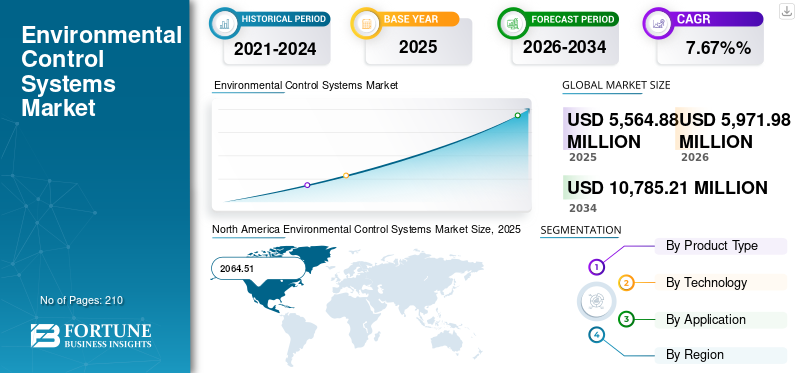
The global environmental control systems market size was valued at USD 5,564.88 million in 2025 and USD 5,971.98 million in 2026. Moreover, the market is projected to reach USD 10,785.21 million by 2034, exhibiting a CAGR of 7.67% during the forecast period of 2026-2034. North America dominated the global environmental control systems market with a market share of 37.09% in 2025. Moreover, North America accounts for the largest market revenue share owing to the rising demand for energy-efficient HVAC systems and the adoption of smart building technology.
Environmental control systems (ECS) are technologies that manage and regulate temperature, humidity, air quality, and pressure to ensure safety and comfort in enclosed spaces, such as aircraft cabins or buildings. These systems utilize a combination of heating, cooling, ventilation, and air filtration to maintain optimal conditions, often integrated with other systems, such as HVAC for buildings or pressurization for aircraft. The primary drivers of the Environmental Control Systems (ECS) market are increasing regulatory scrutiny and a growing emphasis on energy efficiency and sustainability across various industries. These developments are further propelled by technological advancements, including the integration of IoT and AI, growing awareness of air quality, and a rising demand in key sectors such as commercial aviation and green building initiatives.
- In April 2025, the Ministry of Ecology and Environment of China announced its digitalization plans for ecological environment and water monitoring by 2030, integrating aerial, terrestrial, and maritime systems with AI, unmanned operations, and smart sampling, aiming for standardized, intelligent environmental governance and improved data accuracy.
Honeywell holds a prominent position as a market leader in Environmental Control Systems (ECS), particularly within building automation, industrial automation, aerospace, and sustainability solutions. The company is recognized for its extensive product portfolio, integration of advanced technologies such as AI and IoT, and its focus on energy efficiency and sustainability.
Download Free sample to learn more about this report.
Environmental Control Systems MARKET KEY TAKEAWAYS
 Market Size & Forecast
- 2025 Market Size: USD 5,564.88 million
- 2026 Market Size: USD 5,971.98 million
- 2034 Forecast Market Size: USD 10,785.21 million
- CAGR: 7.67% from 2026–2034
 Market Share
- North America dominated the market with a 37.09% share in 2025.
- Air conditioning and ventilation systems held the largest 42.54% market share in 2025.
- Conventional ECS accounted for the leading 66.42% market share in 2025.
 Key Regional Highlights
North American
North America led the market with USD 2,064.51 million in 2025, driven by smart building adoption and energy-efficient HVAC systems.
Europe
Europe recorded USD 1,378.09 million in 2025, driven by green building initiatives and environmental regulations.
Asia Pacific
Asia Pacific reached USD 1,627.17 million in 2025, supported by rapid urbanization and infrastructure expansion.
U.S.
Strong market growth is supported by investments in smart building technologies and energy-efficient infrastructure.
Japan
Demand is supported by the adoption of advanced environmental control and smart building technologies.
Read More

MARKET DYNAMICS
MARKET DRIVERS
Rising Urbanization & Building Infrastructure to Boost Market Growth
Rising urbanization is driving the expansion of building infrastructure globally, intensifying the demand for advanced environmental control systems (ECS) to maintain air quality, energy efficiency, and regulatory compliance in growing cities and industrial zones. The surge in smart city projects, strict emission standards, and heightened awareness of indoor environmental health are pushing governments and businesses to invest in smart and adaptive ECS solutions.
- In April 2024, Johnson Controls launched a new residential HVAC portfolio featuring low global warming potential (GWP) refrigerant R-454B. The portfolio includes entry to high-efficiency heat pumps and air conditioners optimized for faster installation, enhanced serviceability, and eligibility for tax credits, supporting sustainability and regulatory compliance ahead of 2025 standards.
These systems leverage IoT and AI for real-time monitoring, automation, and predictive maintenance, enabling high operational efficiency and sustainable building management. The construction of modern healthcare, data centers, and commercial complexes further amplifies the need for precise climate control, making urbanization and infrastructure growth central drivers of the ECS market.
Rapid Growth of the Aerospace Industry to Propel Market Growth
The rapid growth of the aerospace industry is a significant driver for the environmental control systems (ECS) market. Increasing production of commercial and military aircraft necessitates advanced ECS to maintain cabin pressurization, temperature, humidity, and air quality, ensuring passenger and crew comfort and safety. Technological advancements, such as electric ECS and the integration of real-time monitoring, predictive maintenance, and energy-efficient thermal management systems, are further boosting adoption.
Rising global air travel demands, expanding aircraft fleets, and stringent regulatory standards compel aerospace manufacturers to invest heavily in ECS innovations. Additionally, growth in regions including the Asia-Pacific, driven by modernization and fleet expansion, amplifies market opportunities. Key players are focusing on lightweight, fuel-efficient ECS to meet sustainability goals and operational efficiency in new aircraft programs.
MARKET RESTRAINTS
High Cost Associated with Environmental Control Systems Restraint Market Growth
High costs associated with environmental control systems (ECS) act as a key restraint to the environmental control systems market growth. The development and integration of sophisticated ECS requires substantial capital investment in advanced equipment, specialized materials, and complex system integration, which can be financially challenging, especially for small and medium enterprises.
Additionally, high research and development (R&D) and certification costs, stringent regulatory compliance, and supply chain constraints for critical components such as heat exchangers and compressors further increase overall expenses. These cost factors often hinder market penetration and limit growth, despite the benefits of energy savings and environmental sustainability. Moreover, stagnant product lifecycles and technical complexities add to the financial and operational burdens faced by manufacturers and end-users, restraining the rapid adoption of ECS technologies.
MARKET OPPORTUNITIES
Rapid Expansion of Smart Buildings & Automation to Create Opportunities
The rapid expansion of smart buildings and automation is creating significant growth opportunities for the environmental control systems (ECS) market. Smart buildings integrate IoT, AI, and cloud-based technologies to optimize HVAC, lighting, and energy management systems, enhancing energy efficiency, occupant comfort, and operational control. Increasing urbanization and government initiatives supporting green building certifications such as LEED and BREEAM are driving demand for automated ECS to meet sustainability and regulatory requirements.
- In November 2025, ABB launched Ability Building Pro, a cyber-secure integration platform for smart, sustainable buildings. It connects, monitors, and controls building systems in real time using cloud and on-site intelligence, enhancing energy efficiency, occupant comfort, and decarbonization efforts globally.
Automation enables real-time monitoring, predictive maintenance, and remote management, reducing operational costs while improving air quality and indoor environmental health. The rising adoption of smart building automation systems across commercial, residential, and industrial sectors worldwide, particularly in North America, Europe, and the Asia-Pacific region, is driving the ECS market as part of the broader evolution of smart infrastructure.
MARKET CHALLENGES
High Capital & Operating Costs Create Challenges for Market Energy & Expansion
High energy consumption and rising operating costs pose significant challenges to the environmental control systems (ECS) market. ECS, particularly HVAC systems, are energy-intensive, leading to substantial electricity bills and carbon footprints. Inefficient or outdated systems exacerbate energy waste, resulting in increased operational expenses for building owners and industrial users.
Additionally, fluctuating energy prices and the need for continuous system maintenance add to the financial burden. The complexity of optimizing ECS for maximum energy efficiency necessitates advanced technologies, such as IoT-enabled real-time monitoring and AI-driven automation, which may require substantial initial investments. These factors, when combined, create cost pressures that can slow ECS adoption despite regulatory incentives and sustainability goals, highlighting the need for energy-efficient innovations in this sector.
ENVIRONMENTAL CONTROL SYSTEMS MARKET TRENDS
A Rising Shift Toward Smart and Automated ECS (IoT, AI, ML) Is Emerging as a Key Trend.
The environmental control systems (ECS) market is witnessing a strong shift toward smart, automated solutions powered by IoT, AI, and machine learning technologies. These advancements enable real-time data collection, adaptive climate management, and predictive maintenance, leading to enhanced energy efficiency, operational cost savings, and improved indoor environmental quality. IoT-enabled sensors and AI algorithms for temperature, humidity, and air quality with minimal human intervention, driving demand across commercial, industrial, and healthcare sectors.
Cloud-based platforms enable remote monitoring and analytics, thereby enhancing system reliability and user convenience. This digital transformation aligns with growing regulatory pressures and sustainability goals, making intelligent ECS a critical component of modern smart buildings and infrastructure developments. The rising adoption of these technologies is expected to accelerate ECS market growth significantly in the coming years.
Download Free sample to learn more about this report.
IMPACT OF TARIFFS ON THE GLOBAL ENVIRONMENTAL CONTROL SYSTEMS MARKET
Tariffs negatively impact the environmental control systems market by increasing production costs, creating supply chain disruptions, and reducing global competitiveness for affected companies. Conversely, tariffs can stimulate domestic innovation and market growth for components not subject to tariffs and may encourage some countries to lower environmental standards to remain competitive. Ultimately, the effect depends on the specific market segment and the nature of the tariffs; however, the overall trend is toward increased cost, complexity, and strategic shifts in the supply chain.
SEGMENTATION ANALYSIS
By Product Type
Air Conditioning And Ventilation Systems Are Expected To Dominate The Market Due To Their Widespread Application
Based on product type, the market is segmented into air conditioning and ventilation systems, thermal management systems, pressure control systems, humidity control systems, and others.
The air conditioning and ventilation systems continue to dominate the market, with a 42.54% of the environmental control systems market share in 2025, driven by the widespread application of environmental control systems (ECS) across residential, commercial, and industrial sectors for maintaining indoor air quality and thermal comfort.
Meanwhile, thermal management systems are among the fastest-growing segments, with a CAGR of 10.25%, driven by the rising demand for thermal regulation in electronic devices, electric vehicles, and energy-efficient buildings.
By Technology
Conventional ECS Dominated the Market Due to its Broad Applications in Large-Scale Infrastructure
Based on technology, the market is segmented into conventional ECS, smart/automated ECS, and others.
Conventional ECS accounted for the largest market revenue of 66.42% in 2025, driven by its proven reliability, established technology, and cost-effectiveness, especially in large-scale or legacy infrastructure. These systems are particularly well-suited for sectors such as residential, commercial, and industrial buildings, due to their familiarity and lower initial costs.
Furthermore, Smart/Automated ECS is expected to grow at a significant CAGR of 9.39%. Meanwhile, smart and automated ECS are the fastest-growing segment, propelled by advancements in IoT, AI, and ML, which enable real-time monitoring, predictive maintenance, and increased energy efficiency. The integration of intelligent controls enhances system performance, reduces operational costs, and aligns with global sustainability goals, making automation increasingly attractive for new developments and retrofit projects.
By Application
Increasing Demands for Air Quality and Energy Efficiency Solutions Drive the Commercial & Residential Buildings Segment
Based on the application, the market is segmented into commercial & residential buildings,
industrial & manufacturing, healthcare, aerospace & defense, and others.
Residential and commercial buildings dominated the market in 2025 with a revenue share of 37.61%, due to their vast volume and demand for air quality, temperature control, and energy efficiency solutions in daily life and workplaces. These sectors benefit from established ECS technologies, which focus on HVAC, ventilation, and air purification.
To know how our report can help streamline your business, Speak to Analyst
- In July 2025, Schneider Electric launched EcoStruxure Building Activate, a cloud-based, plug-and-play energy management platform for small and mid-sized buildings. It reduces energy costs by up to 50%, cuts carbon emissions by 60%, improves occupant comfort, and offers scalable, subscription-based solutions.
However, the aerospace & defense segment is expected to witness significant growth, with a CAGR of 8.51%, driven by increasing aircraft production, fleet modernization, and heightened defense budgets. The demand for advanced ECS in aerospace involves critical thermal management, pressurization, and filtration systems tailored for both commercial and military aircraft. The Asia Pacific region is experiencing notable growth, driven by fleet expansion in China and India.
ENVIRONMENTAL CONTROL SYSTEMS MARKET REGIONAL OUTLOOK
By region, the market is categorized into North America, Europe, Asia Pacific, Latin America, and the Middle East & Africa.
North America
North America Environmental Control Systems Market Size, 2025 (USD Million)
To get more information on the regional analysis of this market, Download Free sample
The North America environmental control systems market holds the largest share with a valuation of USD 2,064.51 million in 2025. The market growth is driven by the rising demand for energy-efficient HVAC systems, the adoption of smart building technology, and stringent environmental regulations that focus on indoor air quality and sustainable infrastructure development. For instance, in June 2024, the U.S. General Services Administration (GSA) announced a USD 80 million investment from the Inflation Reduction Act to deploy smart building technologies in approximately 560 federal buildings across 49 states, Puerto Rico, the U.S. Virgin Islands, and Washington, D.C. The initiative aims to reduce emissions, increase energy efficiency, cut costs, and enhance occupant comfort.
Asia Pacific
After North America, the Asia Pacific environmental control systems market was valued at USD 1,627.17 million in 2025 and is estimated to reach USD 1,752.00 million in 2026. The market growth in the region is driven by rapid urbanization, industrialization, infrastructure expansion, and the adoption of IoT-enabled environmental monitoring in countries such as China and India.
Europe
Furthermore, the Europe environmental control systems market is expected to account for the third-largest share with a valuation of USD 1,378.09 million in 2025. Europe exhibits steady demand fueled by environmental compliance mandates, growing awareness of indoor air quality, and investments in green building initiatives.
Latin America and the Middle East & Africa
Latin America’s market growth is driven by urbanization, industrial activities, tightening environmental regulations, and government incentives for cleaner technologies, particularly in Brazil and Mexico. Moreover, the Middle East & Africa market is experiencing significant growth with a CAGR of 5.91%. This strong growth is driven by due to urban growth, industrial emission controls in the oil & gas sectors, diversification policies, renewable energy transitions, and adherence to global climate goals.
COMPETITIVE LANDSCAPE
KEY INDUSTRY PLAYERS
Key Players are Engaged in Product Innovations to Increase Market Share in the Future
The competitive landscape is fragmented, with key players including Honeywell International, Collins Aerospace, Liebherr-Aerospace, Mitsubishi Electric Corporation, Daikin Industries, and others. For instance, in April 2025, Honeywell introduced an end-to-end Emissions Management Suite for offshore oil and gas platforms and marine vessels, providing near real-time visibility to measure, monitor, report, and reduce emissions. Such developments are expected to foster market growth over the forecast period.
List of the key environmental control systems Companies Profiled:
- Honeywell International (U.S.)
- Collins Aerospace (U.S.)
- Liebherr-Aerospace (France)
- Mitsubishi Electric Corporation (Japan)
- Daikin Industries (Japan)
- Trane Technologies / Ingersoll Rand (U.S.)
- Carrier Global Corporation (U.S.)
- Johnson Controls (U.S.)
- LG Electronics (South Korea)
- Bosch Thermotechnology (Germany)
- GEA Group (Germany)
- Eaton Corporation (Ireland)
- Safran Aerosystems (France)
- Parker Hannifin (U.S.)
- Danfoss Group (Denmark)
KEY INDUSTRY DEVELOPMENTS:
- In November 2025, the Maharashtra Pollution Control Board (MPCB), India has launched GreenMind AI, an artificial intelligence-powered environmental information assistant developed by Axion Labs to enhance transparency and accessibility in environmental governance. GreenMind AI enables citizens, industries, and professionals to access MPCB's rules, permissions, and circulars on a single platform, presented in simple language.
- In September 2025, the Delhi Pollution Control Committee (DPCC), India, signed an MoU with the National e-Governance Division (NeGD) to integrate six pollution control portals using AI and advanced data analytics for real-time air quality control systems.
- In August 2025, Trane Technologies launched the BrainBox AI Lab, a dedicated research hub focused on advancing AI-driven HVAC and building management solutions to optimize energy use and sustainability. The Lab builds on Trane’s acquisition of BrainBox AI, aiming to develop autonomous control technologies, predictive models, and advanced algorithms to reduce emissions and operational costs.
- In June 2025, Honeywell was selected by Bell Textron Inc. to provide its 36-150 auxiliary power unit (APU) and Honeywell Attune thermal management system for the U.S. Army's Future Long-Range Assault Aircraft (FLRAA).
- In June 2025, Orica Digital Solutions partnered with Syscom Instruments to deliver comprehensive environmental monitoring solutions in the U.S. market. Their integrated technologies focus on real-time monitoring of noise, dust, and vibration for construction, mining, and industrial sites, thereby enhancing regulatory compliance and risk mitigation.
REPORT COVERAGE
The Global Environmental Control Systems Market report delivers a detailed insight into the market. It focuses on key aspects, such as leading companies in the Environmental Control Systems market. Additionally, the report provides regional insights and global market trends & technology, as well as highlights key industry developments. In addition to the factors mentioned above, the report encompasses several other factors and challenges that contributed to the market's growth and decline in recent years.
Request for Customization to gain extensive market insights.
Report Scope & Segmentation
|
ATTRIBUTE |
DETAILS |
|
Study Period |
2021-2034 |
|
Base Year |
2025 |
|
Forecast Period |
2026-2034 |
|
Historical Period |
2021-2024 |
|
Growth Rate |
CAGR of 7.67% from 2026 to 2034 |
|
Unit |
Value (USD Million) |
|
Segmentation |
By Product Type, By Technology, By Application, and By Region |
|
Segmentation |
By Product Type
|
|
By Technology
|
|
|
By Application
|
|
|
By Region
|
Frequently Asked Questions
As per the Fortune Business Insights study, the market size was USD 5,564.88 million in 2024.
The market is likely to grow at a CAGR of 7.67% over the forecast period (2026-2034).
The Commercial & Residential Buildings segment is expected to lead the market over the forecast period.
The market size of North America stood at USD 2,064.51 million in 2025.
Rising urbanization & building infrastructure to boost market growth.
Some of the top players in the market include Honeywell International, Collins Aerospace, Liebherr-Aerospace, Mitsubishi Electric Corporation, Daikin Industries, and others.
The global market size is expected to reach USD 10,785.21 million by 2032.



- 2021-2034
- 2025
- 2021-2024
- 210
Get 30-60 hrs Free Customization
Expand Regional and Country Coverage, Segments Analysis, Company Profiles, Competitive Benchmarking, and End-user Insights.



















-
US +1 833 909 2966 ( Toll Free )
-
Get In Touch With Us