Epoxy Hardener Market Size, Share & Industry Analysis, By Type (Amine-based Hardeners, Polyamide-based Hardeners, Amidoamine-based Hardeners, Anhydride-based Hardeners, and Others), By End-Use Industry (Building & Construction, Industrial, Electrical & Electronics, Automotive & Transportation, and Others), and Regional Forecast, 2026-2034
 Download Free Sample
Epoxy Hardener Market Size and Future Outlook
 Listen to Audio Version
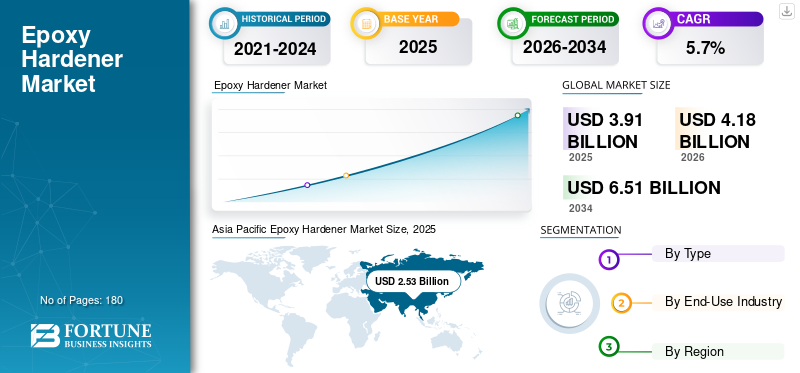
The global epoxy hardener market size was valued at USD 3.91 billion in 2025. The market is projected to grow from USD 4.18 billion in 2026 to USD 6.51 billion by 2034, exhibiting a CAGR of 5.7% during the forecast period. Asia pacific dominated the epoxy hardener market with a market share of 64.70% in 2025.
Epoxy hardeners are curing agents used with epoxy resins to create strong, durable, and high-performance materials. They improve adhesion, chemical resistance, mechanical strength, and long-term reliability in demanding applications. Demand is mainly driven by their use in construction, industrial coatings, electrical and electronics, adhesives, composites, and automotive components. The market benefits from steady adoption in protective coatings, flooring, infrastructure repair, and lightweight materials. Globally, growth is supported by the need for corrosion protection, longer service life, and better material performance, rather than by rapid commodity-style volume expansion across both mature and developing industrial economies.
The market is led by a mix of integrated chemical producers and specialty epoxy hardener manufacturers with established formulation capabilities and strong distribution networks. Major players in the market include Westlake Epoxy, Huntsman, BASF SE, Evonik Industries AG, and KUMHO P&B CHEMICALS., INC. These companies and regional producers focus on product performance, technical support, supply reliability, and application-specific solutions, resulting in a moderately consolidated market characterized by steady demand, high qualification requirements, and strong customer relationships.
Download Free sample to learn more about this report.
Epoxy Hardener Market KEY TAKEAWAYS
 Global Market Size & Forecast
- 2025 Market Size: USD 3.91 billion
- 2026 Market Size: USD 4.18 billion
- 2034 Forecast Market Size: USD 6.51 billion
- CAGR: 5.7% from 2026–2034
 Market Share
- Asia Pacific dominated the epoxy hardener market with a 64.70% share in 2025.
- The anhydride-based hardeners segment is projected to grow at the fastest CAGR of 6.5% during the forecast period.
- The electrical & electronics segment is projected to grow at the fastest CAGR of 6.5% during the forecast period.
 Key Regional Highlights
Asia Pacific
Asia Pacific reached USD 2.53 billion in 2025, driven by manufacturing growth and industrial applications.
North America
North America reached USD 0.41 billion in 2025, supported by construction, coatings, and electronics demand.
Europe
Europe reached USD 0.65 billion in 2025, driven by industrial applications and sustainable epoxy systems.
U.S.
U.S. reached USD 0.31 billion in 2025, fueled by demand for protective coatings and composites.
Japan
Japan is driven by epoxy hardener demand across electronics, automotive, and industrial applications.
Read More

EPOXY HARDENER MARKET TRENDS
Shift Toward Sustainable Epoxy Hardener Technologies is a Key Market Trend
A key trend in the market is the growing shift toward safer, low-emission, and more sustainable curing agent technologies. Manufacturers are developing hardeners that reduce solvent use, improve handling safety, and support lower environmental impact while maintaining strong curing performance. This shift is mainly driven by stricter emissions regulations, customer sustainability goals, and the need for safer products for industrial use. Companies offering waterborne, low-VOC, and renewable-content hardeners are expected to gain stronger market relevance.
- According to the U.S. Environmental Protection Agency’s Electronic Code of Federal Regulations, VOC limits, industrial maintenance coatings are limited to 450 g/L volatile organic compounds. In comparison, floor coatings are limited to 400 g/L volatile organic compounds, supporting the shift toward low-VOC epoxy hardener systems.
MARKET DYNAMICS
MARKET DRIVERS
Download Free sample to learn more about this report.
Rising Use of Epoxy Hardeners in Protective Coatings Supports Market Growth
Epoxy hardener demand is strongly driven by its growing use in protective coatings. These hardeners help epoxy coatings achieve strong adhesion, high chemical resistance, corrosion protection, and long service life. Protective coatings are widely used on steel structures, industrial floors, pipelines, storage tanks, bridges, and marine equipment where surfaces are exposed to moisture, chemicals, abrasion, and harsh operating conditions. As industries continue to focus on asset protection and lower maintenance costs, the use of epoxy-based protective coatings is increasing. This directly supports demand for epoxy hardeners, as they are essential for curing epoxy resins and delivering the required coating performance.
- According to the U.S. Federal Highway Administration, the U.S. had 623,218 bridges in 2024, including 42,080 bridges rated in poor condition, supporting continued demand for protective coating systems used in bridge maintenance, corrosion protection, and infrastructure repair.
MARKET RESTRAINTS
Raw Material Price Volatility and Handling Concerns Limit Market Stability
Fluctuations in key raw material costs and stringent handling requirements restrain the epoxy hardener market growth. Many epoxy hardeners are based on amines, polyamides, and other specialty chemicals, whose prices can vary due to feedstock availability, energy costs, logistics disruptions, and supply-demand imbalances. In addition, some hardeners require careful storage, worker protection, and compliance with safety standards due to potential irritation, toxicity, or sensitization. These factors can increase production costs, affect pricing stability, and limit adoption among smaller formulators and cost-sensitive end users.
MARKET OPPORTUNITIES
Growing Use of Epoxy Systems in Wind Energy Creates New Growth Opportunities
Epoxy hardener demand is expected to benefit from the rising use of epoxy-based composites in wind turbine blades. These materials need strong curing, high strength, fatigue resistance, and long service life as turbine blades operate under heavy stress and changing weather conditions. As countries continue to invest in renewable energy and manufacturers develop larger turbine blades, demand for advanced epoxy systems is likely to increase. This creates growth opportunities for epoxy hardener suppliers that can offer reliable, efficient, and high-performance curing solutions for composite applications.
- According to the U.S. Department of Energy, the U.S. added 6,474 MW of new land-based wind capacity in 2023, supporting demand for epoxy-based turbine blade composites.
MARKET CHALLENGES
Application-Specific Performance Needs Create Technical Challenges for Suppliers
Epoxy hardener suppliers face challenges in developing products that meet the performance needs of various applications. Each use requires the right balance of curing speed, working time, chemical resistance, flexibility, heat resistance, and surface finish. Even small changes in hardener chemistry can affect the final product’s strength, durability, and processing performance. This makes product testing and customer approval more time-consuming, creating a challenge for suppliers to deliver reliable and customized curing solutions with consistent quality.
Segmentation Analysis
By Type
Broad Use in Coatings and Construction Supported Dominance of Amine-based Hardeners
Based on type, the market is segmented into amine-based hardeners, polyamide-based hardeners, amidoamine-based hardeners, anhydride-based hardeners, and others.
Amine-based hardeners accounted for a dominant market share in 2025, as they are widely used in epoxy coatings, flooring, adhesives, repair systems, and construction materials where strong adhesion, chemical resistance, and mechanical strength are important. These hardeners deliver reliable curing performance and can be tailored to meet various application needs, making them suitable for both industrial and commercial use. As demand for durable protective coatings, infrastructure repair, and high-performance epoxy systems continues to grow, amine-based hardeners remain the most widely adopted type in the market.
The anhydride-based hardeners segment is expected to grow at a 6.5% CAGR over the forecast period.
By End-Use Industry
To know how our report can help streamline your business, Speak to Analyst
Building & Construction Segment Led Market Due to Rising Need for Protective Coatings and Flooring
By end-use industry, the market is categorized into building & construction, industrial, electrical & electronics, automotive & transportation, and others.
The building & construction segment accounted for the largest epoxy hardener market share in 2025, as epoxy-based systems are widely used in flooring, protective coatings, concrete repair, adhesives, sealants, and waterproofing applications. These materials provide strong adhesion, chemical resistance, durability, and long service life, making them suitable for residential, commercial, and infrastructure projects. As construction activity continues to focus on durable surfaces, structural repair, and asset protection, building and construction remains the key demand base for epoxy hardeners.
The electrical & electronics segment is expected to grow at a 6.5% CAGR over the forecast period.
Epoxy Hardener Market Regional Outlook
By geography, the market is categorized into North America, Europe, Asia Pacific, Latin America, and the Middle East & Africa.
Asia Pacific
Asia Pacific Epoxy Hardener Market Size, 2025 (USD Billion)
To get more information on the regional analysis of this market, Download Free sample
Asia Pacific held the dominant position in 2025, valued at USD 2.53 billion, and is expected to retain its leading role in 2026, reaching USD 2.72 billion. The region’s leadership is supported by strong demand from building and construction, industrial coatings, electrical and electronics, automotive, and composite applications. Large-scale manufacturing activity in China, India, Japan, and South Korea, along with expanding infrastructure and industrial maintenance needs, supports steady epoxy hardener consumption. Cost-competitive production, availability of epoxy resin value chains, and strong downstream formulation capacity further strengthen the Asia Pacific’s position in the global market.
China Epoxy Hardener Market
Based on Asia Pacific’s strong contribution and China’s manufacturing scale, the China market was valued at USD 1.50 billion in 2025, representing approximately 59.2% of regional revenues. Demand is supported by epoxy use in construction, industrial coatings, electrical and electronics, automotive, and composites, backed by China’s strong epoxy resin systems, formulation base, and export-oriented industrial production, which sustain steady domestic and overseas hardener consumption.
To know how our report can help streamline your business, Speak to Analyst
India Epoxy Hardener Market
The India market in 2025 was valued at around USD 0.35 billion. Growth is supported by expanding construction activity, rising demand for protective coatings and flooring, increasing industrial maintenance needs, and growing domestic epoxy formulation capacity serving the construction, electrical and electronics, automotive, and industrial applications segments.
North America
North America remains a significant regional market and was valued at USD 0.41 billion in 2025. Demand is supported by mature epoxy use in construction, protective coatings, industrial flooring, electrical and electronics, and automotive applications. Established formulation capabilities, infrastructure maintenance needs, and strict performance standards support steady consumption. However, growth remains moderate due to market maturity and slower expansion versus Asia Pacific across the region’s developed industrial base and repair cycles.
U.S. Epoxy Hardener Market
The U.S. market in 2025 was valued at USD 0.31 billion, representing approximately 77.1% of regional revenues. Demand is supported by epoxy hardener use in protective coatings, industrial flooring, construction repair, electrical and electronics, automotive components, and composites requiring strong adhesion, chemical resistance, durability, long service life, and reliable performance in demanding industrial applications.
Europe
Europe was valued at USD 0.65 billion in 2025 and is projected to record modest growth over the forecast period. Strict environmental regulations, high energy costs, and growing demand for low-VOC and sustainable epoxy systems shape the region. Despite these constraints, steady use in construction, protective coatings, industrial flooring, electrical and electronics, and automotive applications supports continued consumption of epoxy hardeners across mature industrial markets in Europe.
Germany Epoxy Hardener Market
Germany’s market was valued at USD 0.20 billion in 2025, equal to around 30.4% of regional revenues. Demand is supported by industrial manufacturing, automotive production, construction and repair, and the use of epoxy hardeners in coatings, flooring, electrical components, adhesives, and composites.
U.K. Epoxy Hardener Market
The U.K. market in 2025 was valued at USD 0.12 billion, accounting for roughly 18.4% of regional revenues. Consumption is concentrated in protective coatings, industrial flooring, construction repair, electrical and electronics, and selected adhesive applications requiring durability, chemical resistance, and reliable curing performance.
Latin America and Middle East & Africa
The Latin America and Middle East & Africa regions are expected to record moderate growth during the forecast period. The Latin America market was valued at USD 0.18 billion in 2025, supported by construction activity, infrastructure repair, protective coatings, and industrial flooring demand. In the Middle East & Africa, demand is driven by construction projects, oil and gas infrastructure, industrial maintenance, and the gradual development of downstream epoxy formulation capacity. These applications require durable, corrosion-resistant, high-performance epoxy systems that support steady hardener consumption. The Middle East & Africa market was valued at USD 0.14 billion in 2025 across construction and industrial end-use markets over the forecast period.
GCC Epoxy Hardener Market
The GCC market accounted for around USD 0.07 billion in 2025, representing approximately 51.3% of regional revenues. Demand is supported by construction activity, infrastructure development, oil and gas maintenance, industrial flooring, petrochemical distribution, and steady downstream epoxy formulation needs in the region.
COMPETITIVE LANDSCAPE
Key Industry Players
High Capital Intensity and Strategic Asset Management Shape Competition in Market
The epoxy hardener market is moderately consolidated and technically specialized, as formulation complexity, customer qualification requirements, and strict safety and environmental compliance create significant barriers to entry. These factors limit new participation and concentrate supply among a group of global specialty chemical producers and regional manufacturers with established formulation expertise and customer relationships.
Leading players such as Westlake Epoxy, Huntsman, BASF, Evonik Industries AG, and KUMHO P&B CHEMICALS., INC., focus primarily on developing application-specific curing systems and strengthening technical support rather than pursuing aggressive capacity expansion. Recent activities across these companies highlight a strategic emphasis on product performance, regulatory alignment, supply reliability, and gradual adoption of low-VOC and sustainable hardener technologies to support long-term market positioning.
LIST OF KEY EPOXY HARDENER COMPANIES PROFILED
- Westlake Epoxy (Netherlands)
- Huntsman (U.S.)
- BASF (Germany)
- Evonik Industries AG (Germany)
- Mitsubishi Chemical Corporation (Japan)
- KUMHO P&B CHEMICALS., INC. (South Korea)
- Incorez Ltd. (U.K.)
- Arkema (France)
- DIC CORPORATION (Japan)
- Resonac Holdings Corporation (Japan)
KEY INDUSTRY DEVELOPMENTS
- February 2022: Westlake completed the acquisition of Hexion’s global epoxy business for approximately USD 1.2 billion, strengthening its epoxy resins, modifiers, and curing agents’ portfolio for coatings, composites, wind energy, automotive, and construction applications.
- January 2021: Huntsman completed the acquisition of Gabriel Performance Products for USD 250 million, expanding its portfolio of specialty additives and epoxy curing agents for coatings, adhesives, sealants, and composite end-use applications.
REPORT COVERAGE
The global epoxy hardener market analysis provides an in-depth study of the market size & forecast by all the market segments included in the report. It includes details on market dynamics and trends expected to drive the market during the forecast period. It offers information on technological advancements, new product launches, key industry developments, and partnerships, mergers & acquisitions. The market research report also includes a detailed competitive landscape, including market share and profiles of key players.
Request for Customization to gain extensive market insights.
Report Scope & Segmentation
| ATTRIBUTE | DETAILS |
| Study Period | 2021-2034 |
| Base Year | 2025 |
| Estimated Year | 2026 |
| Forecast Period | 2026-2034 |
| Historical Period | 2021-2024 |
| Growth Rate | CAGR of 5.7% from 2026 to 2034 |
| Unit | Value (USD Billion) Volume (Kiloton) |
| Segmentation | By Type, End-Use Industry, and Region |
| By Type |
|
| By End-Use Industry |
|
| By Region |
|
Frequently Asked Questions
Fortune Business Insights says that the global market size was valued at USD 3.91 billion in 2025 and is projected to reach USD 6.51 billion by 2034.
Recording a CAGR of 5.7%, the market is slated to exhibit steady growth during the forecast period of 2026-2034.
By end-use industry, the building & construction segment led the market.
Asia Pacific held the highest market share in 2025.
Rising use of epoxy hardeners in protective coatings supports market growth.



- 2021-2034
- 2025
- 2021-2024
- 180
Get 30-60 hrs Free Customization
Expand Regional and Country Coverage, Segments Analysis, Company Profiles, Competitive Benchmarking, and End-user Insights.


















Related Reports
-
US +1 833 909 2966 ( Toll Free )
-
Get In Touch With Us