ESG Investing Market Size, Share & Industry Analysis, By Asset Class (Stocks, Bonds, and Commodities), By Investment Type (Equity Investments, Fixed-Income Investments, Private Equity, Real Estate, and Hedge Funds), By Investor Type (Institutional Investors, Retail Investors, and Corporate Investors), By End User (Utilities, Financial Services, Chemicals, Food & Beverage, Government, Transport & Logistics, and Others), and Regional Forecast, 2026–2034
 Download Free Sample
(Offer valid till 30th Sep 2026)

ESG Investing Market Outlook 2026-2034
 Listen to Audio Version
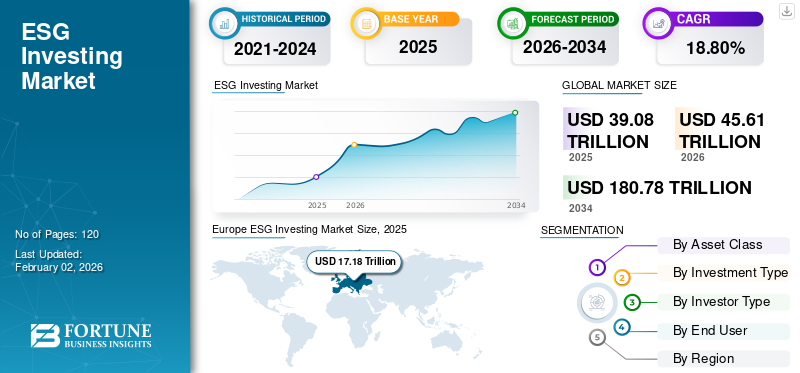
The global ESG investing market size was valued at USD 39.08 trillion in 2025 and is projected to grow from USD 45.61 trillion in 2026 to USD 180.78 trillion by 2034, exhibiting a CAGR of 18.80% during the forecast period. Europe dominated the ESG Investing market with a market share of 44.00% in 2025. Industry growth is driven by sustainable capital allocation, climate risk integration, regulatory disclosure, institutional asset expansion, responsible finance, and ESG data innovation worldwide.
The global ESG investing market has evolved into a core component of institutional portfolio management as investors increasingly incorporate environmental, social, and governance considerations into capital allocation decisions. ESG investing is no longer positioned solely as an ethical investment strategy; it is increasingly recognized as a framework for evaluating long-term financial resilience, operational quality, regulatory preparedness, and enterprise value creation. This structural transition is expanding the ESG investing market size across public and private capital markets while reshaping investment priorities among asset managers, pension funds, insurers, sovereign wealth funds, and corporate investors.
Investors are integrating ESG indicators alongside conventional financial metrics to strengthen risk-adjusted returns, improve portfolio diversification, and identify businesses positioned to benefit from the transition toward lower-carbon and more sustainable economic models. Improvements in sustainability reporting standards, climate-related financial disclosures, and corporate governance practices are supporting more transparent investment analysis and increasing confidence in ESG-focused investment products.
Artificial intelligence, alternative data analytics, natural language processing, and cloud-based ESG data platforms enable investors to evaluate corporate sustainability performance with greater consistency and scale. These capabilities improve portfolio monitoring, climate scenario analysis, stewardship activities, and regulatory reporting while reducing dependence on fragmented disclosure practices.
As concerns about environmental and social issues continue to grow, companies are safeguarding their reputations by actively embracing ESG principles within their strategic and operational strategies. This commitment is often demonstrated through periodic ESG disclosures, such as sustainability reports, which adhere to globally recognized standards. Such transparency enhances trust between companies and their investors and fosters stronger relationships with other stakeholders.
The ESG (Environmental, Social, and Governance) investing space is transforming significantly. Once viewed as a niche market, ESG funds have emerged as a major force in global finance, attracting trillions of dollars in Assets Under Management (AUM). According to PwC’s Global Investor Survey, 79% of investors consider ESG risks and opportunities when making investment decisions. The ESG investment landscape is entering a new phase, influenced by political shifts, regulatory changes, and market maturation. Industry experts project that global ESG AUM is expected to exceed trillions by 2030.
Players in the market, including BlackRock, Vanguard, Amundi, and Invesco, among others, are engaging with governments and regulators to shape sustainable finance frameworks and stay ahead of compliance.
Download Free sample to learn more about this report.
ESG INVESTING MARKET KEY TAKEAWAYS
 Global Market Size & Forecast
- 2025 Market Size: USD 39.08 trillion
- 2026 Market Size: USD 45.61 trillion
- 2034 Forecast Market Size: USD 180.78 trillion
- CAGR: 18.80% from 2026–2034
 Market Share
- Europe dominated the ESG Investing market with a market share of 44.00% in 2025.
- In 2026, the institutional investors segment is expected to dominate the market share of 47.28%.
- The equity investments segment is expected to dominate the market share of 38.09% in 2026.
 Key Regional Highlights
North America
North America reached USD 8.24 trillion in 2025, supported by rising investor interest, regulatory initiatives, and growing adoption of ESG-aligned investment frameworks.
Europe
Europe led the global ESG investing market with USD 17.18 trillion in 2025, accounting for a 44.00% share, driven by strong regulatory frameworks and sustainable finance adoption.
Asia Pacific
Asia Pacific is expected to witness the fastest growth during the forecast period, supported by increasing ESG product demand and sustainability-focused investments across Japan, China, and India.
U.S.
U.S. market growth is supported by increasing demand for sustainable investment products, government initiatives, and integration of ESG criteria across financial services.
Japan
Japan’s ESG investing market is expanding due to increasing sustainable investment adoption, with growth supported by institutional investors and rising demand for responsible finance solutions.
Read More

IMPACT OF GENERATIVE AI
Increasing Demand for Generative AI for Transforming Banking to Boost Market Growth
Generative artificial intelligence is transforming the ESG investing landscape by enhancing the way financial institutions collect, analyze, and report environmental, social, and governance-related data. GenAI models analyze companies’ sustainability reports, regulatory filings, and investor presentations to extract relevant ESG factors such as emission data, gender diversity, or human rights compliance faster than traditional methods.
Furthermore, generative AI enables the creation of personalized ESG investment products. Retail and institutional investors increasingly demand portfolios that reflect their values, such as low-carbon investments, gender equality, or biodiversity. Generative AI models integrated into robo-advisors or ESG screening platforms can help design and adjust these portfolios dynamically by filtering assets based on client-specific ESG preferences and the latest data. For instance, a wealth management app could use generative AI to suggest a sustainable portfolio by matching the client’s values with companies that have a proven track record in reducing carbon emissions.
Gen AI serves as a powerful engine that enhances data quality, accelerates ESG reporting, enables personalized investment solutions, and enforces accountability in ESG Investing.
Key Market Dynamics
ESG Investing Market Trends
Popularity of Blended Finance is Accelerating Market Growth
Blended finance is playing a crucial role in accelerating the growth of the market by mobilizing private capital toward sustainable development projects that might otherwise be considered too risky or low-return. Blended finance refers to the strategic use of public or philanthropic funds to de-risk investments, encouraging private sector participation in ESG-aligned initiatives such as renewable energy, affordable housing, climate resilience, or healthcare access in underserved regions.
Development Finance Institutions (DFIs), such as the International Finance Corporation (IFC), World Bank, and regional development banks, often provide first-loss capital, guarantees, or technical assistance to make ESG-oriented projects more attractive to institutional and commercial investors. As per estimates, around USD 3.9 trillion per year is required to achieve the Sustainable Development Goals (SDGs), and blended finance can attract a portion of the USD 100 trillion of unused private and institutional capital seeking returns annually. Therefore, the popularity of blended finance is driving the ESG investing market growth.
The ESG investing market is transitioning from exclusion-based screening toward integrated investment frameworks that combine sustainability analysis with traditional financial evaluation. Investors increasingly emphasize financially material ESG indicators rather than broad ethical classifications, resulting in more disciplined portfolio construction and improved long-term risk management. This evolution is strengthening the role of ESG integration across equity, fixed-income, private market, and multi-asset investment strategies.
Data quality and analytical sophistication continue shaping ESG investing market trends. Asset managers are adopting artificial intelligence, machine learning, and alternative data sources to evaluate climate exposure, governance performance, supply chain resilience, and human capital management with greater accuracy. These technologies improve portfolio monitoring while enabling more dynamic sustainability assessments across global investment portfolios.
Another notable trend is the expansion of stewardship and shareholder engagement. Institutional investors are increasingly using proxy voting, board engagement, and collaborative initiatives to influence corporate governance, climate transition planning, and sustainability disclosures. Active ownership is becoming a core differentiator as investors seek measurable outcomes rather than passive ESG compliance.
Download Free sample to learn more about this report.
Market Drivers
Increasing Corporate Commitment to Net Zero and ESG Reporting is Boosting Market Growth
In recent years, companies in various sectors, including manufacturing, energy & utilities, financial services, and technology, have pledged to achieve net-zero carbon emissions in line with global climate goals. Net-zero pledges now cover 92% of GDP and 88% of emissions globally. As of 2024, around 6,000 companies globally have made net-zero commitments, with many targeting carbon neutrality by 2050. Major firms such as Microsoft, Unilever, Apple, and Nestlé have announced net-zero ambitions and aligned their capital raising, resource allocation, and supply chain strategies accordingly.
Companies are increasingly adopting ESG-linked financial instruments, such as green bonds, social bonds, and sustainability bonds. In 2023, sustainability-linked bond issuance reached over USD 160 billion, a significant increase from USD 10 billion in 2019. This trend reflects a growing commitment among companies to invest in ESG-related financing. In 2025, the European Union mandates publicly traded companies to disclose ESG-related risks and opportunities. As part of the Corporate Sustainability Reporting Directive (CSRD), the impact of these companies' activities on people and the environment is analyzed to enhance the quality and comprehensiveness of sustainability reporting. Therefore, increasing corporate commitment to net zero and ESG reporting is boosting market share.
The ESG investing market is primarily driven by the institutional integration of sustainability considerations into long-term investment strategies. Pension funds, sovereign wealth funds, insurance companies, and asset managers increasingly evaluate environmental, social, and governance performance alongside traditional financial metrics to improve portfolio resilience and enhance risk-adjusted returns. This shift reflects the growing recognition that climate risk, governance quality, human capital management, and resource efficiency materially influence enterprise value and long-term financial performance.
Regulatory developments continue accelerating market expansion. Governments and financial regulators are strengthening sustainability disclosure requirements, climate reporting frameworks, and corporate governance standards to improve transparency across capital markets. These measures provide investors with more standardized information, enabling better security selection, portfolio construction, and stewardship activities while reducing information asymmetry between issuers and market participants.
Corporate sustainability initiatives further support ESG investing market growth. Public companies are expanding investments in carbon reduction, renewable energy procurement, supply chain resilience, workforce diversity, and governance reforms to strengthen investor confidence and maintain access to institutional capital. These improvements increase the availability of investable ESG-compliant assets across global markets.
Market Restraints
Lack of ESG Investment Opportunities in Emerging Countries Restricts Market Growth
Lack of ESG investment opportunities remains a critical factor that is restraining market growth globally. Developed economies such as the U.S., the U.K., and EU countries have built a robust ecosystem for ESG financing, driven by regulatory mandates, sustainability disclosures, and mature capital markets. However, emerging countries often lag due to structural and institutional gaps. In many developing regions across Africa, South Asia, Latin America, and parts of Southeast Asia, there is a shortage of bankable ESG-aligned projects. The lack of clearly defined ESG frameworks, weak enforcement of environmental and labor laws, limited financial transparency, and inadequate project pipelines often discourage international investors from deploying capital in these regions.
Despite sustained expansion, the ESG investing market faces several structural challenges that continue influencing investment adoption and portfolio construction. The most significant restraint remains the absence of globally harmonized ESG reporting standards. Companies frequently apply different disclosure frameworks, materiality assessments, and sustainability metrics, making cross-sector and cross-border comparisons difficult. This inconsistency limits data comparability and complicates investment analysis for global asset managers.
Greenwashing concerns present another major constraint. Regulators and investors are increasingly scrutinizing investment products marketed as sustainable to ensure portfolio holdings and investment methodologies align with stated ESG objectives. Heightened regulatory oversight has increased compliance costs while requiring firms to strengthen governance, documentation, and transparency surrounding sustainable investment strategies.
Regulatory fragmentation further increases operational complexity. Asset managers operating internationally must comply with different sustainable finance regulations, taxonomies, and disclosure requirements across jurisdictions. These varying standards increase administrative burdens and require continuous investment in compliance systems, ESG data infrastructure, and legal expertise.
Market Opportunities
Rising Investor Preference for Sustainable and Ethical Investments to Create Profitable Opportunities in the Market
The awareness related to environmental degradation, social inequality, and governance failure is rising, and investors are increasingly aligning their portfolios with these values. This shift is especially witnessed among Gen Z and millennial investors as they prioritize sustainability, transparency, and ethical practice in their financial decisions. According to Morgan Stanley, over 85% of individual investors and nearly 95% of millennials are interested in sustainable investing. This trend is also reflected among institutional investors, including pension funds, endowments, and sovereign wealth funds, which are actively seeking ESG-compliant instruments to meet agent duty and stakeholder expectations.
This leads to a surge in demand for ESG-aligned financial products, including green bonds, sustainability-linked loans, ESG equity indices, and impact investing. Therefore, the market players are launching a wide range of sustainable investments and integrating ESG criteria into their investment strategies. For example, BlackRock and Vanguard have significantly expanded their ESG fund offerings to cater to the growing demand.
The ESG investing market presents significant opportunities as sustainability considerations become increasingly embedded within global financial systems. Expanding climate transition investments, decarbonization initiatives, and sustainable infrastructure development are creating new investable opportunities across renewable energy, clean transportation, resource efficiency, and resilient infrastructure. Institutional investors are expected to increase allocations toward sectors benefiting from long-term structural sustainability trends.
Private markets represent one of the most attractive growth opportunities. Private equity, infrastructure, private credit, and venture capital investors are integrating ESG considerations to improve operational performance, mitigate regulatory risks, and enhance long-term enterprise valuations. Growing investment in climate technologies, circular economy solutions, sustainable agriculture, and energy transition assets continues broadening the addressable investment universe beyond publicly traded securities.
Technological innovation offers additional expansion potential. Artificial intelligence-enabled ESG analytics, climate risk modeling, satellite imagery, geospatial intelligence, and automated sustainability reporting platforms are improving investment decision-making while reducing analytical complexity. Financial institutions that develop proprietary ESG data capabilities are expected to strengthen portfolio differentiation and deliver more transparent investment solutions.
Market Segmentation Analysis
By Asset Class
Surge in Individuals’ Awareness about Broader Impact of Investments on Environment Boosted Stocks Segment Expansion
Based on asset class, the market is divided into stocks, bonds, and commodities.
Stocks
Stocks are expected to dominate the market share of 56.05% in 2026. In recent years, investors, including individuals to large institutional asset managers, have become increasingly aware of their investments’ broader impact on the environment, society, and governance structures. This shift is fueled by rising awareness of climate change, social inequality, data privacy issues, and unethical corporate behavior. As a result, investors are actively seeking to align their financial goals with their personal or institutional values by directing capital toward companies and funds that demonstrate strong ESG performance. Therefore, the demand for ESG-related stocks is increasing.
Equities account for the largest ESG investing market share because listed companies provide comparatively comprehensive sustainability disclosures, governance reporting, and financial transparency. Public equity investors can evaluate environmental performance, labor practices, board independence, carbon transition strategies, and operational resilience using increasingly standardized reporting frameworks. These characteristics make equities the preferred asset class for integrating ESG analysis into portfolio construction.
Active equity managers increasingly combine traditional financial analysis with proprietary ESG scoring models to identify companies demonstrating superior governance quality, resource efficiency, innovation capability, and long-term earnings resilience. Passive investment strategies have also expanded significantly through ESG-focused exchange-traded funds and sustainability-oriented index products, broadening market accessibility across institutional and retail investors.
Bonds
The bonds segment is estimated to grow with the highest CAGR during the forecast period. The growing demand for ESG bonds, including green, social, and sustainability-linked bonds, is being driven by the global transition toward more sustainable economies, increasing regulatory pressure, and investor preference for responsible finance.
Fixed-income securities have become one of the fastest-expanding segments within the ESG investing market as governments, supranational organizations, financial institutions, and corporations increasingly issue sustainable debt instruments. Green bonds, sustainability bonds, sustainability-linked bonds, and social bonds enable investors to finance environmentally and socially beneficial projects while maintaining predictable income characteristics.
Institutional investors increasingly allocate capital toward sustainable fixed-income products because they provide diversified exposure while supporting climate transition financing, renewable energy projects, sustainable infrastructure, healthcare, education, and affordable housing initiatives. Growing regulatory support and expanding issuer participation continue strengthening liquidity and product availability across global debt markets.
Credit analysis within ESG investing has also evolved beyond traditional default risk assessments. Investors increasingly evaluate governance quality, transition risks, climate resilience, and sustainability commitments alongside conventional financial metrics when assessing issuer creditworthiness. This broader analytical framework is improving risk identification and long-term portfolio resilience.
Commodities
Commodity-related ESG investing remains comparatively specialized but is expanding as investors increasingly focus on energy transition materials, sustainable agriculture, responsible mining, and resource efficiency. Rather than pursuing broad commodity exposure, ESG-oriented investors increasingly emphasize commodities supporting decarbonization and industrial sustainability objectives.
Growing investment in critical minerals required for renewable energy technologies, battery manufacturing, and electrification is reshaping commodity investment strategies. Investors increasingly evaluate supply chain transparency, environmental stewardship, labor standards, biodiversity impacts, and community engagement when allocating capital across commodity-producing industries.
By Investment Type
Equity Investments Led Market Due to Their Stronger Operational Efficiency
By investment type, the market is classified into equity investments, fixed-income investments, private equity, real estate, and hedge funds.
Equity Investments
The equity investments segment is expected to dominate the market share of 38.09% in 2026, as ESG-focused equity portfolios often outperform or match traditional equity portfolios, particularly in volatile markets. Companies with strong ESG scores tend to manage risks better, have more loyal customers, and showcase stronger operational efficiency, all leading to higher valuations and stable returns.
Equity investments continue to represent the dominant investment structure within the ESG investing market because they provide flexibility, liquidity, active ownership opportunities, and diversified exposure across global industries. Investors increasingly favor companies demonstrating sustainable competitive advantages supported by effective governance, climate resilience, innovation capacity, and responsible capital allocation. Active managers differentiate portfolios through proprietary ESG research while passive products continue broadening access to sustainable investment strategies.
Hedge Funds
The hedge funds segment is expected to grow with the highest CAGR during the forecast period. These funds can provide portfolio diversification and downside protection in an increasingly complex and volatile global financial environment. Hedge funds are gradually incorporating ESG analytics into long-short equity strategies, event-driven investing, credit trading, and quantitative investment models.
Rather than excluding specific sectors, many hedge fund managers increasingly utilize ESG information to identify governance weaknesses, operational risks, regulatory exposures, and market inefficiencies that may influence security valuations. As ESG datasets become more sophisticated, sustainability analysis is expected to become increasingly integrated into alternative investment strategies.
Fixed-Income Investments
ESG integration within fixed-income investing continues expanding beyond green bonds into broader credit markets. Asset managers increasingly assess issuer sustainability performance, governance quality, climate transition preparedness, and operational resilience during credit analysis. This approach enhances portfolio diversification while supporting financing for sustainable infrastructure, renewable energy, healthcare, education, and social development initiatives.
Private Equity
Private equity firms increasingly integrate ESG considerations throughout acquisition, portfolio management, and exit planning processes. Sustainability initiatives frequently focus on operational efficiency, governance improvements, emissions reduction, workforce development, cybersecurity, and regulatory compliance. Strong ESG performance increasingly contributes to enterprise value creation while reducing operational and reputational risks. Limited partners are also requiring more comprehensive sustainability reporting before committing capital to private equity funds.
Real Estate
ESG investing within real estate emphasizes energy-efficient buildings, sustainable construction materials, water conservation, indoor environmental quality, and climate resilience. Investors increasingly prioritize certified green buildings because efficient asset management contributes to lower operating costs, stronger tenant demand, and improved long-term asset valuation. Regulatory requirements supporting building decarbonization further reinforce investment demand across commercial and residential property markets.
By Investor Type
Institutional Investors Dominated Market by Focusing on Long-Term Risk Management
By investor type, the market is further segmented into institutional investors, retail investors, and corporate investors.
In 2026, the institutional investors segment is expected to dominate the market share of 47.28%. Institutional investors, including pension funds, insurance companies, endowments, and sovereign wealth funds, are significantly increasing their exposure to ESG investing as part of a broader shift toward sustainable, resilient, and modern investment strategies.
The retail investors segment is expected to grow with the highest CAGR during the forecast period. Retail investors are increasingly investing in ESG-related funds due to regulatory trends and government incentives such as green tax benefits or ESG-linked retirement schemes.
By End User
Financial Services Led Market, Driven by Strategic ESG Integration
To know how our report can help streamline your business, Speak to Analyst
By end user, the market is categorized into utilities, financial services, chemicals, food & beverage, government, transport & logistics, and others.
Financial Services
In 2026, financial services are expected to dominate the market share of 34.90%. They are expected to grow with the highest CAGR during the forecast period. Financial service players are increasingly integrating ESG criteria into lending, underwriting, and investment processes to meet evolving stakeholder expectations and regulatory requirements. The financial services sector recognizes that aligning with ESG trends enhances brand reputation, investor trust, and long-term resilience.
Financial services represent the largest end-user segment within the ESG investing market. Banks, asset managers, insurers, investment advisors, pension administrators, and wealth management firms increasingly embed ESG analytics into investment research, product development, lending decisions, and portfolio management. Regulatory compliance, investor demand, and competitive differentiation continue driving sustained investment in ESG capabilities across the financial sector.
ESG Investing in Government is growing at a significant pace owing to regulatory policies, climate change mandates, and regulatory pressure. Increasing global commitments, issuance of green bonds for sustainable infrastructure, and investment in renewable energy are all driving the market for ESG Investing in the Government sector.
Utilities
Utility companies increasingly attract ESG investment due to their central role in the global energy transition. Investors evaluate renewable energy deployment, emissions reduction pathways, grid modernization, and long-term climate resilience when allocating capital to utilities. Expanding investments in clean energy infrastructure and sustainable power generation continue to strengthen the sector's attractiveness within ESG-focused portfolios.
Chemicals
The chemicals industry is experiencing increasing ESG scrutiny as investors evaluate emissions intensity, resource efficiency, circular economy initiatives, and product sustainability. Companies investing in low-carbon manufacturing, sustainable feedstocks, recycling technologies, and environmental risk management are generally positioned more favorably within ESG investment strategies, encouraging broader sustainability transformation across the sector.
Food & Beverage
Food and beverage companies increasingly incorporate sustainability initiatives addressing responsible sourcing, water conservation, emissions reduction, food safety, packaging innovation, and supply chain transparency. Investors prioritize organizations demonstrating resilient agricultural sourcing strategies and effective environmental management while responding to evolving consumer preferences for sustainable products.
Government
Governments play an increasingly important role through sovereign green bonds, sustainable infrastructure financing, climate adaptation programs, and policy frameworks supporting responsible investment. Public-sector initiatives encourage private capital participation while strengthening sustainable finance ecosystems and improving market transparency across domestic capital markets.
Transport & Logistics
Transport and logistics companies are attracting greater ESG investment as decarbonization becomes a strategic priority. Investors increasingly evaluate fleet modernization, alternative fuels, supply chain efficiency, digital logistics optimization, and emissions reduction strategies. Organizations successfully transitioning toward lower-carbon transportation systems are strengthening their long-term investment appeal.
Regional Insights
The market is geographically studied across North America, South America, Europe, the Middle East & Africa, and Asia Pacific, and each region is further studied across countries.
Europe ESG Investing Market Analysis
Europe ESG Investing Market Size, 2025 (USD Trillion)
To get more information on the regional analysis of this market, Download Free sample
Europe contributed approximately USD 17.18 trillion to the global market in 2025, accounting for a 44.00% share, and is expected to reach USD 19.97 trillion in 2026. Europe dominated the ESG investing market share with around USD 17.18 trillion in ESG assets under management. This growth is fueled by a rising demand from investors for financial products that offer returns and align with sustainability goals. Key financial instruments, such as ESG-focused Exchange Traded Funds (ETFs), green bonds, and sustainability-linked loans, have gained significant popularity across Europe.
Europe remains a global leader in ESG investing, supported by comprehensive sustainable finance regulations, established stewardship practices, and strong institutional participation. Regulatory initiatives promoting sustainability disclosures and responsible investment continue improving market transparency. Asset managers increasingly prioritize climate transition strategies, biodiversity considerations, and governance quality, reinforcing Europe's position as a benchmark market for sustainable capital allocation.
Green bonds, in particular, have experienced strong growth, largely due to frameworks including the EU Green Bond Standard, which provides issuers and investors with clear guidelines for financing environmentally friendly projects. The United Kingdom market is projected to reach USD 3.72 billion by 2026, while the German market is projected to reach USD 2.64 billion by 2026.
Germany ESG Investing Market
Germany represents a major ESG investing market driven by institutional investors, sustainable banking practices, and strong industrial decarbonization initiatives. Investment strategies increasingly emphasize renewable energy, advanced manufacturing, circular economy development, and corporate governance improvements. Regulatory compliance, climate transition financing, and expanding sustainable investment products continue supporting long-term growth across domestic capital markets.
United Kingdom ESG Investing Market
The United Kingdom maintains a prominent position within the ESG investing market through its globally significant financial services sector, active stewardship culture, and advanced sustainable finance initiatives. Asset managers continue expanding ESG integration across diversified portfolios while strengthening climate-related financial disclosures. London's international capital markets remain important for sustainable bond issuance, responsible investment innovation, and ESG research capabilities.
The U.K. market is projected to experience significant growth during the forecast period. Since 2022, the U.K. has mandated climate-related financial disclosures for large companies and pension funds based on TCFD guidelines. Asset owners and managers in the U.K. are increasingly embedding ESG in investment mandates due to growing demand from institutional and retail investors. As per RFI Global, 21% of U.K. consumers currently hold at least one sustainable finance product.
Asia-Pacific ESG Investing Market Analysis
In 2025, the Asia Pacific market stood at USD 7.93 trillion, representing 20.30% of global demand, and is projected to grow to USD 9.49 trillion in 2026. The Asia Pacific region is expected to grow with the highest CAGR during the forecast period. Asia Pacific’s economic development presents significant opportunities for ESG investment. According to several flow reports, demand for ESG investment products has been rising significantly. As per the Global Sustainable Investment Alliance, sustainable investment assets continue to grow in most regions, with Japan experiencing a 34% growth, followed by Australia (25% growth). The Japan market is projected to reach USD 2.36 billion by 2026, the China market is projected to reach USD 2.84 billion by 2026, and the India market is projected to reach USD 0.72 billion by 2026.
Asia-Pacific is expected to record the fastest ESG investing market growth due to expanding sustainable finance policies, increasing institutional participation, and stronger corporate sustainability reporting. Governments are encouraging green investment through regulatory reforms, climate financing programs, and capital market development. Rapid economic growth and increasing investor awareness continue creating attractive opportunities across regional sustainable investment markets.
Japan ESG Investing Market
Japan continues strengthening its ESG investing market through institutional stewardship reforms, corporate governance improvements, and increasing pension fund participation. Investors are expanding sustainability integration across equity and fixed-income portfolios while supporting corporate transparency and climate-related disclosures. Strong government support for sustainable finance and responsible investment continues encouraging long-term capital allocation toward ESG-focused investment strategies.
China ESG Investing Market
China is rapidly expanding its ESG investing market through green finance initiatives, sustainable infrastructure investment, and stronger environmental disclosure requirements. Institutional investors increasingly evaluate climate risks, governance practices, and transition financing opportunities across domestic capital markets. Continued regulatory development and expanding green bond issuance are strengthening China's role within the global sustainable investment ecosystem.
North America ESG Investing Market Analysis
The market in North America reached USD 8.24 trillion in 2025, representing 21.10% of total market revenue, and is projected to reach USD 9.46 trillion in 2026. North America is expected to exhibit significant market growth during the forecast period. ESG investing is gaining popularity as investors seek to balance financial performance with broader societal and environmental impacts. The United States market is projected to reach USD 7.24 billion by 2026.
North America represents one of the largest ESG investing markets, supported by sophisticated capital markets, institutional asset concentration, and expanding sustainability disclosure requirements. Asset managers increasingly integrate climate risk, governance analysis, and stewardship practices into investment strategies. Growing adoption of sustainable investment products, improved ESG data infrastructure, and regulatory oversight continue strengthening market transparency while supporting long-term responsible capital allocation across diversified asset classes.
United States ESG Investing Market
The United States leads regional ESG investing activity through its extensive institutional investor base, mature asset management industry, and expanding sustainable finance ecosystem. Pension funds, insurers, and investment managers increasingly incorporate ESG analytics into portfolio construction and shareholder engagement. Advances in financial technology, sustainability reporting, and climate risk assessment continue supporting innovation across public and private investment markets.
The U.S. is expected to dominate the market in North America as a result of government policy initiatives, growing demand from investors, and adoption of ESG-aligned frameworks. The market is projected to witness growth in the country as a result of stringent regulatory policies, rising awareness, and a shift in investment strategies.
Middle East & Africa ESG Investing Market Analysis
Middle East & Africa maintained a strong presence in the global market, reaching USD 4.42 trillion in 2025, accounting for a 11.30% share, and is expected to reach USD 5.21 trillion in 2026. The Middle East & Africa region is expected to experience steady growth during the forecast period. The region is highly vulnerable to climate change. Rising temperatures, water scarcity, and extreme weather events drive awareness about environmental risks. Sovereign wealth funds and large institutional investors in the region are aligning with ESG standards to attract foreign capital.
The Middle East and Africa ESG investing market is steadily developing through sustainable infrastructure investment, energy diversification, and expanding green finance initiatives. Governments and financial institutions increasingly promote responsible investment frameworks while improving sustainability disclosures. Continued regulatory progress, sovereign green financing, and international investment partnerships are expected to support gradual long-term market expansion.
Latin America ESG Investing Market Analysis
Latin America is gradually strengthening ESG investing through expanding sustainable finance initiatives, green bond markets, and corporate sustainability programs. Institutional investors increasingly prioritize renewable energy, sustainable agriculture, and climate resilience investments. Although regulatory frameworks remain uneven across the region, growing international capital participation and improving disclosure standards continue supporting long-term market development.
South America is likely to register steady growth during the forecast period. The region is investing in companies that offer renewables, creating ESG-aligned investment opportunities. Brazil’s CVM introduced mandatory ESG disclosure for listed firms in line with TCFD and SASB.
ESG Investing Industry Competitive Landscape
Key Market Players
Market Players Opt for Merger & Acquisition Strategies to Expand Their Presence
Key players in the market are adopting various business strategies to enhance their market presence and capitalize on emerging opportunities. Companies are forming alliances to strengthen their ESG capabilities and market presence, and are collaborating with NGOs, DFIs, or regulators to set up green finance frameworks. Players are expanding to new regions or markets with more ESG Investing regulations or demand.
The ESG investing market remains concentrated among global asset managers, institutional investment firms, sustainable investment specialists, financial data providers, and ESG analytics companies. Competitive positioning is increasingly determined by the quality of proprietary research, portfolio integration capabilities, stewardship effectiveness, and sustainability data infrastructure rather than assets under management alone. As ESG investing becomes embedded within mainstream investment processes, firms that combine financial performance with transparent sustainability methodologies continue strengthening their market position.
Data quality and regulatory complexity continue raising barriers to entry. Investment firms must continuously invest in ESG research, artificial intelligence-enabled analytics, sustainability reporting infrastructure, and governance expertise to remain competitive. Consequently, established financial institutions retain significant scale advantages over emerging market participants.
Strategic partnerships are expanding across asset managers, stock exchanges, ESG rating agencies, climate data providers, and financial technology companies. These collaborations strengthen analytical capabilities, improve reporting consistency, and accelerate product innovation.
Competitive differentiation is expected to shift toward measurable sustainability outcomes, standardized reporting methodologies, and proprietary ESG intelligence. Firms capable of combining investment discipline, transparent governance, scalable technology, and high-quality sustainability research are expected to strengthen ESG investing market share as sustainable finance continues evolving globally.
Long List of ESG Investing Companies Studied
- BlackRock (U.S.)
- Vanguard (U.S.)
- State Street Global Advisors (U.S.)
- Fidelity Investments (U.S.)
- Amundi (France)
- UBS Asset Management (Switzerland)
- Allianz Global Investors (Germany)
- Schroders (U.K.)
- J.P. Morgan Asset Management (U.S.)
- Goldman Sachs Asset Management (U.S.)
- Bloomberg (U.S.)
- S&P Global ESG (U.S.)
….and more
Latest ESG Investing Industry Developments
February 2025: MSCI Inc. introduced enhancements to its ESG Ratings and Climate Solutions portfolio, expanding sustainability datasets and climate analytics to support institutional investment decision-making under evolving global disclosure standards. The strategic objective was to improve portfolio transparency, climate risk assessment, and regulatory alignment. Capabilities involved included ESG ratings, transition risk analytics, financed emissions metrics, and climate scenario modeling.
March 2025: BlackRock expanded its sustainable investing capabilities by integrating additional climate analytics and transition investment strategies across selected active and index-based investment solutions. The initiative aimed to strengthen portfolio resilience, improve long-term risk management, and address growing institutional demand for sustainability-integrated investment products. Capabilities included climate data integration, portfolio analytics, stewardship tools, and ESG risk assessment.
August 2025: Morningstar published its ESG Regulation Year-End Review & What to Expect in 2026, providing institutional investors with updated regulatory guidance covering evolving European sustainability reporting, anti-greenwashing requirements, and Corporate Sustainability Reporting Directive (CSRD) implementation. The objective was to improve regulatory preparedness and investment governance. Capabilities included ESG regulatory intelligence, reporting frameworks, and compliance analytics.
March 2026: Morningstar Sustainalytics released findings from its inaugural State of ESG Data Survey, highlighting increasing institutional demand for integrated ESG and climate data within mainstream investment workflows. The initiative supports asset managers, pension funds, and banks seeking higher-quality sustainability information for investment analysis. Capabilities included ESG ratings, climate analytics, forward-looking risk indicators, and regulatory-aligned sustainability datasets.
March 2026: London Stock Exchange Group (LSEG) launched a new suite of ESG Scores and Sustainability Analytics designed to improve transparency, comparability, and analytical consistency across global financial markets. The strategic purpose was to help financial institutions strengthen ESG integration while meeting increasingly stringent reporting and anti-greenwashing requirements. Capabilities included standardized ESG scores, materiality-based sustainability indicators, modular risk analytics, and AI-enabled data integration across LSEG platforms.
REPORT COVERAGE
The market research report provides a detailed market analysis and focuses on key points, such as leading companies, offerings, and applications. Besides this, the report offers an understanding of the latest market trends and highlights key industry developments. In addition to the above-mentioned factors, the report contains several factors that have contributed to the growth of the market in recent years.
Request for Customization to gain extensive market insights.
REPORT SCOPE & SEGMENTATION
|
ATTRIBUTE |
DETAILS |
|
Study Period |
2021-2034 |
|
Base Year |
2025 |
|
Estimated Year |
2026 |
|
Forecast Period |
2026-2034 |
|
Historical Period |
2021-2024 |
|
Growth Rate |
CAGR of 18.80% from 2026 to 2034 |
|
Unit |
Value (USD Trillion) |
|
Segmentation |
By Asset Class
By Investment Type
By Investor Type
By End User
By Region
|
|
Companies Profiled in the Report |
|
Frequently Asked Questions
The market is projected to reach USD 180.78 trillion by 2034.
In 2025, the market was valued at USD 39.08 trillion.
The market is projected to grow at a CAGR of 18.80% during the forecast period.
The stocks segment led the market in terms of market share.
Increasing corporate commitment to net zero and ESG reporting is boosting market growth.
BlackRock, Vanguard, UBS Asset Management, Amundi, and Fidelity Investments are the top players in the market.
Europe dominated the market in terms of share.
By end user, the financial services segment is expected to grow with the highest CAGR during the forecast period.



- 2021-2034
- 2025
- 2021-2024
- 120
-
(Offer valid till 30th Sep 2026)
Get 30-60 hrs Free Customization
Expand Regional and Country Coverage, Segments Analysis, Company Profiles, Competitive Benchmarking, and End-user Insights.













-
US +1 833 909 2966 ( Toll Free )
-
Get In Touch With Us