Event Management Software Market Size, Share And Industry Analysis By Component (Software, Services), By Deployment (Cloud, On-Premises), By Enterprise Size (SMEs, Large Enterprises), By End-User (Government, Corporate, Event Planners, Education, and Others), and Regional Forecast, 2026-2034
 Download Free Sample
Event Management Software Market Size and Industry Overview
 Listen to Audio Version
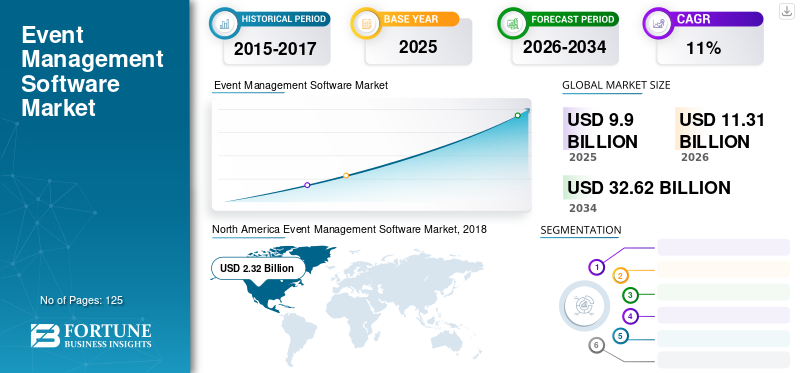
The global event management software market size was valued at USD 9.90 billion in 2025 and is projected to grow from USD 11.31 billion in 2026 to USD 32.62 billion by 2034, exhibiting a CAGR of 14.16% during the forecast period. North America dominated the event management software market with a market share of 34.99% in 2025.
The market is anticipated to flourish over the forecast period, mainly owing to the rising demand for automation among event management companies to simplify event functionalities. Additionally, an increasing focus on gaining actionable insights from the events is driving the growth of the market. event management software facilitates numerous functions such as venue management, ticketing and registration management, event analytics, and lead management, which help event planners to plan and manage events successfully. As it provides different functions in a single platform with reduced costs, event planners need not have to implement various software solutions.
The event management software market has transitioned from a niche operational toolset into a strategic digital backbone for planning, executing, and analyzing events at scale. Organizations increasingly rely on centralized platforms to manage registrations, ticketing, scheduling, attendee engagement, and post-event analytics across physical, virtual, and hybrid formats. This shift reflects broader enterprise digitization priorities and rising expectations for measurable event outcomes.
Market growth is supported by the normalization of hybrid events and the professionalization of event operations. Enterprises, government agencies, and educational institutions now treat events as structured communication channels rather than ad-hoc initiatives. event management software enables consistent governance, brand control, and data capture across distributed teams and geographies. As a result, the event management software market size expands steadily across both mature and emerging economies.
Cloud-based delivery models dominate new deployments due to scalability, rapid configuration, and predictable pricing. Buyers increasingly favor platforms that integrate registration, marketing automation, mobile engagement, and analytics within a unified interface. This convergence reduces reliance on fragmented tools and improves operational visibility. Vendors that deliver modular architectures with strong integration ecosystems gain measurable event management software market share.
From a buyer perspective, return on investment has become a primary evaluation criterion. Decision-makers assess platforms based on attendee conversion rates, engagement metrics, operational efficiency, and data quality. Advanced analytics, real-time dashboards, and post-event reporting are no longer optional features. They directly influence renewal decisions and long-term vendor relationships.
Small and Medium Enterprises (SMEs) adopt lightweight, subscription-based solutions that emphasize ease of use and rapid onboarding. Large enterprises demand enterprise-grade security, customization, and integration with customer relationship management and enterprise resource planning systems. This segmentation shapes product roadmaps and pricing strategies across the event management software industry.
Moreover, geographically, North America showed tremendous growth in adopting this software, mainly attributable to the availability of the latest tools & technologies for ensuring successful event planning. Subsequently, key vendors in the region are continuously investing in research and development to retain their position in the market, which has further fueled growth.
Download Free sample to learn more about this report.
Event Management Software Market Key Takeaways
 Market Size & Forecast
- 2025 Market Size: USD 9.90 Billion
- 2026 Market Size: USD 11.31 Billion
- 2034 Forecast Market Size: USD 32.62 Billion
- CAGR: 14.16% from 2026–2034
 Market Share
- North America dominated the event management software market with a 34.99% share in 2025.
- The software segment held the largest market share in 2025 and is expected to maintain its dominance.
- The corporate segment is projected to dominate the market during the forecast period.
 Key Regional Highlights
North America
North America generated USD 2.32 billion in revenue and accounted for 34.99% of the global market in 2025.
Asia Pacific
Asia Pacific is expected to grow significantly due to increasing smartphone penetration and cloud platform adoption.
Europe
Europe is projected to witness strong growth driven by rising digitalization and increasing event activities.
U.S.
The market is driven by strong enterprise adoption and continuous investments in advanced event technologies.
Japan
Growing demand for digital event platforms and increasing corporate events are supporting market growth.
Read More

Key Market Dynamics
Event Management Software Market Trends
High Demand for Centralized Management and Control of Event Promotions, and Financial Transactions
Key players in the market are adopting cloud technology, as it enables the end-users to store massive data and files in a remote location and access it from any internet-enabled areas. Thus, cloud-based software solutions make it easy for event planners to interact with employees, suppliers, and clients. Cloud-based solutions help event planners to create and manage location lists, represent pictorial images or charts for better management, and even help in reaching potential custom events. A cloud-based event management software has the ability to manage event teams at any time from any venue, as well as support and manage booking requests in a streamlined way.
Similarly, event promotions, bookings, cancellations, and financial transactions can also be carried out with the help of this software. Cloud-based software helps event planners to prioritize and resolve event tasks in a single platform. Aside from giving all the points of interest relating to cloud, this software simplifies all the everyday tasks associated with event planning. Cloud-based solution will turn most of the tedious and labor-intensive tasks into a smooth and automatic process.
Several trends shape the evolution of the event management software market. Platform consolidation represents a dominant shift. Buyers increasingly prefer all-in-one solutions that replace fragmented tools for registration, engagement, communication, and analytics. This preference drives vendors to expand functionality through native development and strategic acquisitions.
Artificial intelligence adoption emerges as a notable trend. Machine learning supports attendee segmentation, personalized content delivery, predictive attendance modeling, and automated scheduling optimization. These capabilities enhance engagement while reducing manual planning effort. Artificial intelligence-driven insights also improve post-event evaluation and future event design.
Mobile-first experiences gain prominence as attendee expectations evolve. Event applications now support real-time agendas, interactive maps, networking features, and instant feedback collection. Mobile engagement directly influences satisfaction scores and data quality, making it a competitive differentiator within the event management software industry.
Another trend involves deeper integration with marketing and sales ecosystems. Organizations seek seamless data flow between event platforms and customer relationship management systems to track lead conversion and pipeline impact. This alignment strengthens the strategic role of events within revenue generation frameworks.
Download Free sample to learn more about this report.
Market Drivers
Increasing Demand to Gain Actionable Insights from Events to Fuel Growth
With the continuously flourishing event industry, event planning companies are focusing on gaining actionable data from the past events and make decisions to drive the organizational growth. Event data is precious for event planners to track attendance, social media engagement, and measure the event’s success. event management software can be integrated with various business systems, such as customer relationship management (CRM), collaboration tools, marketing, and sales software to leverage the existing customer database and generate new conversion rates and sales leads.
Event organizers are emphasizing on using event management solutions integrated with big data technology to organize attendee-centric events and deliver an enhanced event experience. Location data and geographical information from the customer’s devices such as smartphones or tablets allow event players to link their digital marketing strategies with prospective participants, thus allowing them to connect with their targeted audience. For instance, this software helps corporate event organizers to access the information about attendees traveling from different places so that they can advise event attendee for lodging and transportation to the event venue.
Exponential Growth of Social Media Advertising and Marketing to Aid Growth
Social media is a robust and free online platform, which is helping event planners to support their business goals. Social media advertising and marketing allow event planners to track their website traffic and get more clients, as well as assist in shaping the reputation of the organization. Event planners are using social media tools, such as Twitter, Facebook, LinkedIn, and Instagram, for their social media outreach. Using tools such as Hootsuite, Oktopost, or Mention, they can analyze the most successful channels and the type of content that the users are sharing. Thus, the use of social media for event marketing is likely to boost the event management software market growth during the forecast period.
The event management software market is driven by the growing need for structured, data-driven event execution across industries. Organizations increasingly view events as measurable engagement channels rather than standalone activities. This shift elevates demand for platforms that centralize planning, registration, marketing, and analytics within a single operational framework. Digital transformation initiatives further accelerate adoption, particularly among enterprises managing multi-location or global events.
Hybrid and virtual event formats remain a powerful catalyst. Even as in-person gatherings recover, hybrid models persist due to broader reach, cost efficiency, and accessibility. event management software supports these formats by integrating live streaming, virtual networking, and real-time engagement tools. Without centralized platforms, managing hybrid complexity becomes operationally inefficient.
Another driver is the emphasis on return on investment visibility. Marketing, corporate communications, and government teams face pressure to justify event budgets with tangible outcomes. Advanced reporting, attendee behavior tracking, and post-event analytics embedded within event management software address this requirement directly. These capabilities enable performance benchmarking and continuous improvement.
Operational efficiency also plays a critical role. Automation of workflows such as ticketing, approvals, scheduling, and communication reduces manual effort and error rates. As organizations scale event volumes, reliance on spreadsheets and disconnected tools becomes unsustainable. Consequently, standardized software adoption strengthens across both SMEs and large enterprises.
Market Restraints
High Initial Cost and Complex Integration of Event Management Software to Encumber Growth
The integration of event management software solutions with CRM systems helps event planners to plan, promote, and track all the activities easily. However, integrating this software with CRM or other business functionalities is complicated as it requires high technical expertise. Lack of technical knowledge, especially in SMEs, would lead to failed integration of this software with other business systems, leading to the loss of crucial business information. Furthermore, the high initial costs, along with the lack of expertise, are some of the major factors impeding the market growth rate.
Despite strong growth drivers, the event management software market faces several adoption constraints. Budget sensitivity remains a primary challenge, particularly among SMEs and nonprofit organizations. While subscription pricing improves accessibility, advanced features such as analytics, integrations, and customization often increase total ownership costs. Buyers frequently delay upgrades or select limited-function platforms to control expenditure.
Integration complexity also restrains adoption. Many organizations operate fragmented technology ecosystems that include customer relationship management, marketing automation, and enterprise resource planning systems. event management software that lacks flexible application programming interfaces or prebuilt connectors creates data silos rather than resolving them. Integration limitations reduce perceived value and extend implementation timelines.
User adoption challenges further constrain market expansion. Event teams vary widely in technical proficiency, and overly complex interfaces hinder effective utilization. When platforms require extensive training or specialized administrators, organizations struggle to achieve full feature adoption. This gap weakens return on investment and increases churn risk.
Data privacy and security concerns also influence purchasing decisions. Event platforms process sensitive attendee information, including payment data and personal identifiers. Compliance with regional data protection regulations increases vendor accountability and raises buyer scrutiny. Organizations operating across multiple jurisdictions often hesitate to deploy platforms that lack transparent security certifications or robust governance controls, slowing purchasing cycles.
Market Opportunities
The event management software market presents multiple expansion opportunities as event strategies mature. One significant opportunity lies in vertical-specific solutions. Industries such as government, education, healthcare, and corporate enterprises require tailored compliance, reporting, and workflow features. Vendors offering domain-focused platforms can capture higher-value contracts and improve retention.
Emerging markets also represent untapped potential. As digital infrastructure improves across Asia-Pacific, Latin America, and parts of Africa, organizations increasingly host structured events to support economic development and public engagement. Cloud-based event management software lowers entry barriers and supports rapid regional expansion.
Another opportunity stems from analytics monetization. Organizations demand deeper insights into attendee behavior, engagement quality, and conversion outcomes. Vendors that package advanced analytics, benchmarking tools, and predictive insights as premium offerings can expand revenue per customer while delivering measurable value.
Hybrid event optimization creates further growth potential. Many organizations still struggle to balance physical and virtual engagement effectively. Platforms that simplify hybrid orchestration, unify data streams, and standardize experiences across formats address a persistent pain point.
Partnerships with marketing technology and collaboration platforms expand addressable markets. Strategic integrations strengthen ecosystem relevance and position event management software as a core enterprise engagement tool rather than a standalone application.
SEGMENTATION ANALYSIS
By Component Analysis
Software Segment to Lead Owing to Their Rising Adoption among Entertainment and Corporate Event Planners
Based on component, the market is segmented into software and services. The services segment is further sub-segmented into professional and managed services.
The software segment holds the highest event management software market share and is expected to continue its dominance during the forecast period. The growth of this segment is mainly attributed to the increasing demand for this software among corporate and entertainment event planners. As event planners manage multiple events at the same time, various organizations and event planning companies are adopting software solutions to provide reliable and efficient services to their customers and attendees at minimized costs.
Software represents the foundational component of the event management software market, accounting for the majority of value creation. Core software platforms centralize event planning, registration, ticketing, agenda management, attendee communication, and analytics. Organizations increasingly favor configurable platforms that support multiple event formats, including physical, virtual, and hybrid deployments.
Software scalability matters as enterprises manage growing event portfolios across geographies. Buyers prioritize usability, workflow automation, and data visibility when evaluating solutions. Integration readiness with customer relationship management, marketing automation, and collaboration tools strengthens adoption. As events evolve into strategic engagement assets, software platforms increasingly function as system-of-record solutions rather than task-based utilities.
event management software comprises multiple functions such as venue management, ticketing and registration, lead management, analytics, and reporting, which assist event planners in saving time and cost while allowing them to focus on other activities such as promotions.
The services segment is expected to grow at a considerable rate, mainly owing to the increasing demand for event management services among event planners to align the entire life cycle of their events, thereby, helping them to gain actionable business insights from event data. Services play a complementary yet expanding role within the event management software industry. Implementation, training, customization, and managed services support faster onboarding and sustained platform utilization.
Large enterprises and government agencies often require tailored workflows, compliance configurations, and branded user experiences. Service offerings reduce internal resource strain and accelerate time-to-value. Advisory services also help organizations redesign event processes and align software capabilities with measurable objectives. As platforms become more feature-rich, demand for ongoing optimization and support services rises. Vendors that bundle software with services often achieve stronger customer retention and higher contract values.
By Deployment Analysis
On-premises Segment to Lead the Market with Significant Share
Based on deployment, the market has been segmented into cloud and on-premises.
Deployment of event management software on the on-premises infrastructure allows event planners to store their data on the premises of an organization, which enables them to gain control over their data. On-premises deployment reduces costs associated with servicing as it comes with one-time licensing fees. Therefore, as organizations tend to depreciate their hardware and software expenses, event planners are more likely to remain at the on-premises deployment.
On-premises deployment retains relevance in specific use cases where data control and regulatory compliance outweigh agility benefits. Government bodies, defense organizations, and institutions handling sensitive information often prefer on-premises environments. These deployments allow tighter governance over data storage, access controls, and system customization. However, higher implementation costs, longer deployment timelines, and ongoing maintenance responsibilities limit widespread adoption. On-premises solutions increasingly serve niche requirements rather than mainstream demand. Vendors supporting both deployment models gain flexibility in addressing diverse buyer needs.
The cloud deployment segment is expected to flourish in the coming years. It allows organizations to gain control over the system and data, with increased security and support. Key players are continually investing in research and development activities in launching new products. For instance, in April 2019, Aventri, a cloud-based analytics and data-driven end-to-end event management solution provider, launched Aventri Marketplace to give its customers a premium service and technology platform for successful management of the events.
Cloud deployment dominates current event management software market trends due to flexibility, scalability, and lower upfront costs. Cloud-based platforms enable rapid deployment, frequent updates, and global accessibility. They support distributed event teams and remote stakeholders without complex infrastructure requirements. Subscription pricing aligns well with budget planning and seasonal event cycles. Cloud deployment also simplifies integration with third-party tools and supports real-time analytics. Security and compliance capabilities have matured, increasing confidence among regulated industries. As hybrid work models persist, cloud-based event management software remains the preferred deployment model for most organizations.
By Enterprise Size Analysis
Large Enterprises Are Likely to Drive the Market Growth in Near Future
By enterprise size, the event management software market is categorized into small and medium-sized (SMEs) enterprises and large enterprises.
Event planning teams are getting bigger, with the growing number of events happening worldwide. This EMS (software) helps large event planning companies to quickly establish a communication channel between their teams and carry out event functionalities in an effective manner. The adoption of this software is more among large enterprises as the deployment of this solution requires high cost and a personal data center, which is affordable mainly by these organizations. Also, the need for event management software to manage event-related activities such as registration, marketing, customer engagement, and reporting and analytics is more in large enterprises owing to the frequent occurrence events.
SMEs represent a fast-growing segment within the event management software market. These organizations increasingly host customer engagement events, training sessions, and marketing activations but operate with limited staff and budgets. SMEs value intuitive interfaces, rapid setup, and predictable pricing. Cloud-based platforms with preconfigured templates and guided workflows resonate strongly. SMEs often prioritize registration management, attendee communication, and basic analytics over advanced customization. As event sophistication increases, SMEs gradually expand feature usage. Vendors offering scalable pricing tiers and simplified onboarding capture sustained adoption within this segment.
The adoption among SMEs has exhibited the fastest growth in terms of CAGR, mainly due to the increasing inclination of small and medium-sized event planners towards optimizing and automating their business functionality. Furthermore, large enterprises are collaborating with SMEs to share the latest technology advertising campaigns and public platforms.
Large enterprises contribute a substantial share of overall event management software market revenue. These organizations manage complex, multi-region event portfolios involving internal meetings, customer conferences, partner summits, and public engagements. Enterprise buyers demand advanced capabilities, including role-based access, deep integrations, compliance controls, and enterprise-grade analytics. Event data increasingly feeds into broader customer experience and revenue measurement frameworks. Large enterprises often standardize on a single platform to ensure consistency and governance. Long procurement cycles and customization requirements characterize this segment, favoring established vendors with proven scalability.
By End-User Analysis
To know how our report can help streamline your business, Speak to Analyst
Corporate Segment to Dominate Stoked by Rising Number of Events
Based on end-user, the event management software market is segmented into government, corporate, event planners, education, and others.
Government agencies adopt event management software to manage public consultations, training programs, and civic engagement initiatives. Transparency, accessibility, and data security drive purchasing decisions. Platforms must support compliance reporting, multilingual communication, and controlled access. Digital event delivery improves reach while reducing logistical costs. Government adoption strengthens as digital transformation initiatives expand across public sectors globally.
The corporate segment is expected to proliferate over the forecast period. This growth is mainly attributed to the increasing number of events in the corporate sector. The growing need for hosting corporate events such as seminars, summits, trade conferences, or meetings has led to significant growth in the global market for corporate event planners. Event planning companies are making substantial investments for various events to be organized in the corporate sector.
Corporate users represent the largest end-user segment. Corporations deploy event management software for internal communications, product launches, investor meetings, and customer engagement. Events align closely with brand positioning and revenue objectives. Corporations demand robust analytics to assess engagement quality and business impact. Integration with marketing and sales systems is critical. As hybrid engagement becomes standard, corporate reliance on centralized platforms deepens.
The event planners segment is expected to grow at a significant CAGR over the forecast period, owing to the increasing need to manage the events successfully. The strategic and business-focused collaborations among event management software vendors are further strengthening the global market.
Professional event planners and agencies rely heavily on event management software to manage multiple clients and concurrent events. Efficiency, customization, and branding capabilities matter most. These users value tools that streamline coordination, vendor management, and attendee experiences. Multi-client account management and white-label capabilities differentiate platforms. Software adoption improves operational scale and margin control for event planning firms.
Educational institutions use event management software for academic conferences, orientations, alumni events, and virtual learning engagements. Budget constraints influence purchasing decisions, favoring cloud-based solutions with education-specific pricing. Ease of use and accessibility are critical, as users include staff, students, and external participants. Analytics support participation tracking and program evaluation. Education adoption grows as institutions expand digital engagement strategies.
Regional Analysis
North America Event Management Software Market, 2025 (USD Billion)
To get more information on the regional analysis of this market, Download Free sample
Geographically, the market is segmented across five major regions, namely North America, Europe, Asia Pacific, the Middle East & Africa, and Latin America. They are further categorized into countries.
North America Event Management Software Market Analysis:
In North America, financially stable countries such as the U.S. and Canada are always open to new and emerging technologies. Also, these countries have been continuously investing in advanced technologies to gain reliable and efficient services. Vendors in North America are adopting advanced technologies to fulfill user demand for better management of events, collaboration and integration tools, and data analytics.
One of the significant factors which is increasing the growth of this software is the presence of established players, coupled with the occurrence of small players in the region. The growing demand for efficient event management software in the region has resulted in collaborations between companies and event organizers.
For instance, in June 2018, Cvent, Inc. acquired DoubleDutch, a mobile event management application provider, to accelerate its investment in mobile event technology. This acquisition would help Cvent to accelerate its investment in expanding mobile event application capabilities.
North America represents a mature and innovation-driven Digital signage market, supported by high technology adoption and strong enterprise spending. Retail, corporate communications, transportation hubs, and healthcare facilities drive sustained demand. Organizations prioritize cloud-based content management, analytics integration, and high-resolution displays. The region benefits from established vendor ecosystems and early adoption of artificial intelligence-enabled personalization. Regulatory clarity and infrastructure readiness further support long-term market stability.
United States Event Management Software Market:
The United States leads regional adoption due to extensive deployment across retail chains, corporate campuses, and public infrastructure. Enterprises emphasize data-driven content optimization, audience measurement, and system interoperability. Transportation authorities expand Digital signage for passenger information and advertising. Strong demand for interactive kiosks and video walls supports market growth. Vendor competition remains intense, driving continuous feature innovation and pricing optimization.
Asia-Pacific Event Management Software Market Analysis:
Whereas, Asia Pacific and Europe are expected to grow at a significant rate during the forecast period. This growth in is mainly attributable to the increasing proliferation of smartphones and persistently developing cloud platform. Similarly, the growing number of events such as musical concerts, tradeshows, stand-up comedy shows, and product launches in the region are contributing to the growth of the market in the region. India, Japan, China, and Australia are significant contributors to the event management software market in Asia Pacific.
Asia-Pacific represents the fastest-expanding Digital signage market, driven by urbanization, retail expansion, and smart city initiatives. Governments and enterprises invest in large-scale display networks for information and advertising. Cost-sensitive markets favor scalable, cloud-based platforms. High population density supports strong returns on signage investments. Regional manufacturing capabilities further accelerate technology availability and adoption.
Japan Event Management Software Market:
Japan’s Digital signage market emphasizes precision, reliability, and compact design. Retailers and transportation operators deploy signage to manage dense urban environments and enhance customer navigation. Enterprises focus on high-quality displays and seamless system integration. Adoption extends to corporate communication and public safety messaging. Innovation aligns with Japan’s broader smart infrastructure and digital transformation priorities.
China Event Management Software Market:
China demonstrates large-scale Digital signage deployment across retail, transportation, education, and public administration. Government-backed smart city programs accelerate adoption. Domestic manufacturing supports competitive pricing and rapid rollout. Enterprises prioritize centralized content control and high-brightness outdoor displays. While regulatory considerations influence deployment strategies, market scale and infrastructure investment sustain strong long-term demand.
Europe Event Management Software Market Analysis:
Europe demonstrates steady Digital signage market growth, driven by urban modernization, retail digitization, and transportation investments. Enterprises focus on energy-efficient displays and centralized content governance. Regulatory emphasis on data privacy shapes software design and deployment decisions. Adoption spans retail, hospitality, and public services. Market growth remains balanced, with increasing interest in analytics-enabled signage and sustainable hardware solutions.
Germany Event Management Software Market:
Germany’s Digital signage market reflects strong industrial discipline and structured adoption patterns. Retailers and transportation operators deploy signage to enhance operational efficiency and customer engagement. Enterprises emphasize reliability, long lifecycle hardware, and compliance-ready software platforms. Manufacturing and corporate environments increasingly adopt Digital signage for internal communication. Demand aligns closely with Industry 4.0 initiatives and smart infrastructure development.
United Kingdom Digital signage Market:
The United Kingdom exhibits consistent Digital signage adoption across retail, hospitality, and transportation sectors. Organizations prioritize omnichannel customer experiences and real-time content updates. Public-sector deployments support wayfinding and information dissemination. Cloud-managed platforms gain traction due to distributed operations. Economic caution influences purchasing cycles, yet demand remains resilient as Digital signage supports engagement efficiency and operational clarity.
Latin America Market Analysis:
Latin America’s Digital signage market develops gradually as retailers, transportation operators, and public institutions modernize communication infrastructure. Budget sensitivity shapes purchasing decisions, favoring cost-effective hardware and cloud-based software. Urban retail centers and airports drive early adoption. Economic volatility tempers large-scale investments, yet Digital signage remains attractive for engagement efficiency and advertising revenue generation.
Middle East & Africa Digital signage Market Analysis:
The Middle East & Africa Digital signage market grows through infrastructure development, smart city projects, and hospitality investments. High-visibility deployments dominate airports, malls, and public venues. Organizations prioritize durable hardware suited for challenging environments. Government-led digital initiatives support adoption, while uneven infrastructure across regions moderates overall growth momentum.
KEY INDUSTRY PLAYERS
High Performers such as Active Network, LLC, Arlo, Aventri, Inc., and EventGeek are Collaborating with Smaller Players
Active Network, LLC, emerged as one of the leading players in the global market. The company’s SaaS-based EMS solution offers smart registration, secure payment processing, and data driven tools that are helping event organizers in driving participation and increasing revenue while enhancing the administration. Key market players are proactively strengthening their market position by collaborating with other small players who are introducing innovative technologies in the market.
For instance, Aventri partnered up with Plannernet to provide its customers access to a network of 1,500 specialists in 70 countries. It will help planners to find Aventri-experienced meeting and event professionals. However, regional and domestic players such as Active Network, LLC, Bizzabo, Cvent Inc., and Eventbank, have entered the market with innovative solutions. This is projected to have a positive impact on the global market as these companies are anticipated to gain significant market share during the forecast period.
List of Key Companies Profiled:
- Active Network, LLC
- Arlo
- Aventri, Inc.
- EventGeek
- EventMobi
- Regpacks
- Event Espresso
- Certain Inc.
- Bizzabo
- EMS Software, LLC.
- Grenadine Technologies Inc.
- Zerista
- Ungerboeck
- Others
KEY INDUSTRY DEVELOPMENTS:
- January 2022: Aventri joined forces with MeetingPlay, a forward-thinking solution provider catering to in-person, virtual, and hybrid events. The resulting event software conglomerate aimed to leverage the unique capabilities of both firms, offering a comprehensive, all-encompassing solution for events of various scales.
- December 2021: Cvent entered into a merger with Dragoneer Growth Opportunities Corp. II, a special purpose acquisition company, securing an infusion of USD 801 million. This substantial capital injection paved the way for Cvent to expedite its product innovation, intensify its research and development efforts, reduce its debt, and bolster its market share expansion.
REPORT COVERAGE
The event management software market report provides a detailed analysis of the market and focuses on key aspects such as leading companies, product types, and leading applications of the product. Besides this, the report offers insights into the market trends and highlights key industry developments. In addition to the factors as mentioned above, the report encompasses several factors that have contributed to the growth of the market over the recent years.
Request for Customization to gain extensive market insights.
Report Scope & Segmentation
|
ATTRIBUTE |
DETAILS |
|
Study Period |
2021-2034 |
|
Base Year |
2025 |
|
Forecast Period |
2026-2034 |
|
Historical Period |
2021-2024 |
|
Unit |
Value (USD billion) |
|
Segmentation |
By Component
|
|
By Deployment
|
|
|
By Enterprise Size
|
|
|
By End-User
|
|
|
By Region
|
Frequently Asked Questions
Fortune Business Insights says that the global market size was USD 9.9 billion in 2025 and is projected to reach USD 32.62 billion by 2034.
In 2025, the global market value stood at USD 9.9 billion.
The market will exhibit a steady growth of 14.16% in the forecast period (2026-2034).
The software segment is the leading segment in this market.
Increasing demand for this software among event planners to efficiently plan and manage events is fueling the demand.
Arlo, Aventri, Inc., EventGeek, and EventMobi are some of the leading players in the global market.
North America dominated the market in 2025.
Growing R&D and increasing demand among event planners to gain actionable insights from events are opening up new application areas for this software in the market.



- 2021-2034
- 2025
- 2021-2024
- 125
Get 30-60 hrs Free Customization
Expand Regional and Country Coverage, Segments Analysis, Company Profiles, Competitive Benchmarking, and End-user Insights.




















-
US +1 833 909 2966 ( Toll Free )
-
Get In Touch With Us