Extended-Range Electric Vehicles (EREVs) Market Size, Share & Industry Analysis, By Driving Range (Below 500 km, 500–1000 km, and Above 1000 km), By Battery Capacity (Below 40 kWh, 40–80 kWh, and Above 80 kWh), By Powertrain (Battery Electric Vehicle (BEV)-based EREV and Hybrid Electric Vehicle (HEV)-based EREV), By Vehicle Type (Passenger Cars and Commercial Vehicles), and Regional Forecast, 2026–2034
 Download Free Sample
(Offer valid till 30th Sep 2026)

Extended-Range Electric Vehicles (EREVs) Market Size and Future Outlook
 Listen to Audio Version
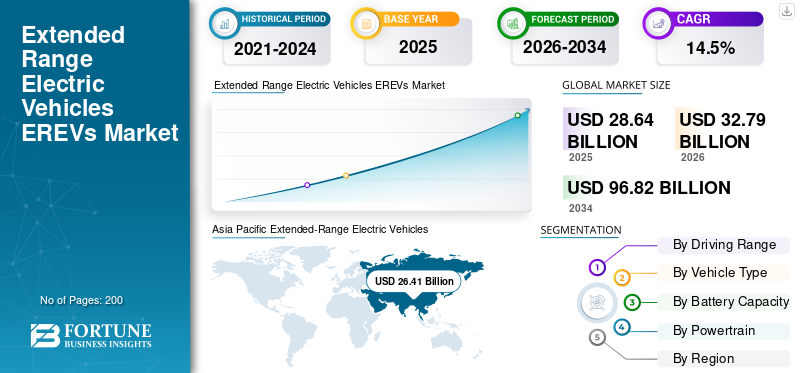
The global Extended-Range Electric Vehicles (EREVs) market size was valued at USD 28.64 billion in 2025 and is projected to grow from USD 32.79 billion in 2026 to USD 96.82 billion by 2034, exhibiting a CAGR of 14.5% during the forecast period. Asia Pacific dominated the extended-range electric vehicles (EREVs) market with a market share of 92.21% in 2025.
Extended-range electric vehicles (EREVs) are advanced electric drive vehicles combining battery electric vehicles with an internal combustion engine generator, enabling longer total range, improved efficiency, and reduced dependence on charging stations. Market growth is driven by rising consumer demand for EREV models, expanding charging infrastructure, advancements in battery packs and electric motors, increasing adoption of plug in hybrid electric vehicles, and demand for 500 miles driving range.
Major players in the market include BYD Company Ltd., Li Auto Inc., General Motors Company, Stellantis N.V., Nissan Motor Co., Ltd., and Scout Motors Inc., competing through advanced EREV models, intelligent electric drive technologies, AI-enabled energy management systems, high-capacity battery packs, plug in hybrids, and long-range extended range electric vehicle platforms.
Download Free sample to learn more about this report.
Extended Range Electric Vehicles EREVs Market Key Takeaways
 Global Market Size & Forecast
- 2025 Market Size: USD 28.64 billion
- 2026 Market Size: USD 32.79 billion
- 2034 Forecast Market Size: USD 96.82 billion
- CAGR: 14.5% from 2026–2034
 Market Share
- Asia Pacific dominated the market with a 92.21% share, valued at USD 26.41 billion in 2025.
- Passenger cars segment held the largest market share in 2025.
- Battery Electric Vehicle (BEV)-based EREV segment held the largest market share in 2025.
 Key Regional Highlights
North America
The market is the third-largest regional market, driven by long-range mobility demand and charging infrastructure.
Asia Pacific
The market reached USD 26.41 billion in 2025, driven by EV production and electrification policies.
Europe
The market is the second-largest regional market, supported by emission regulations and charging infrastructure.
U.S.
The market is projected to reach USD 0.34 billion by 2026, driven by full-size EREV adoption.
Japan
The market is projected to reach USD 1.91 billion by 2026, supported by electric drive technology investments.
Read More

EXTENDED-RANGE ELECTRIC VEHICLES (EREVS) MARKET TRENDS
Integration of AI-Enabled Energy Management Systems Emerges as Key Market Trend
The increasing integration of AI-enabled energy optimization technologies is becoming major market trend. Automakers are deploying intelligent software systems to optimize battery usage, electric motors efficiency, regenerative braking, and fuel consumption. Advanced predictive analytics improve vehicle performance by balancing electric drive operation with internal combustion engine support. Companies are also integrating connected vehicle platforms and smart diagnostics into EREV models. This trend supports improved total range, better battery durability, and enhanced user experience across passenger and commercial EREV segments.
- In December 2025, Marelli introduced its Intelligent Energy Management solution for hybrid and electric vehicles at CTI Europe 2025 in Berlin. The software-driven platform improves battery range, charging efficiency, thermal management, and vehicle performance while supporting software-defined vehicle architectures and accelerated EV development.
Increasing Development of High-Capacity Battery Platforms Shapes Industry Trends
Manufacturers are increasingly focusing on advanced battery packs and high-capacity systems to improve vehicle performance and driving range. New EREV platforms equipped with 92 kWh battery configurations and next-generation lithium-ion technologies are enabling extended driving capabilities exceeding 500 miles. Automakers, including Scout Motors and RAM are developing full size range electric vehicle EREV platforms such as the Ram 1500 Ramcharger to address growing market demand. These innovations are improving energy density, charging speed, and electric drive performance while supporting long-distance transportation requirements.
- In April 2026, Tata Motors delivered the first batch of Prima E.55S electric prime movers to BillionE Mobility. Equipped with a 450 kWh battery pack, the trucks offer an extended driving range of up to 350 km, supporting long-haul zero-emission freight transportation across India.
MARKET DYNAMICS
MARKET DRIVERS
Download Free sample to learn more about this report.
Rising Consumer Preference for Long-Range Electric Mobility Drives Market Expansion
Increasing consumer demand for extended range electric vehicle solutions is significantly supporting the global extended-range electric vehicles (EREVs) market growth. Buyers increasingly prefer EREV models that combine electric drive efficiency with backup internal combustion engine support, reducing range anxiety. Growing interest in plug in hybrids and plug in hybrid electric vehicles offering nearly 500 miles of total range is further accelerating adoption. Expanding urbanization, improving charging infrastructure, and demand for fuel-efficient mobility solutions are encouraging automakers to introduce full size EREVs with advanced battery packs and electric motors.
- In May 2026, Ferrari unveiled the Luce, its first fully electric 5-seater grand tourer featuring a 122 kWh battery pack and a driving range exceeding 530 km. The EV delivers over 1,050 hp, supporting Ferrari’s expansion into high-performance long-range electric mobility solutions.
Expanding Charging Infrastructure and Government Electrification Policies Accelerate Adoption
Rapid expansion of charging stations and supportive government policies promoting electrified transportation are driving the global market demand. Governments across Asia Pacific, Europe, and North America are introducing subsidies, tax incentives, and emission regulations encouraging the adoption of battery electric vehicles and range electric vehicle EREV technologies. Investments in public charging infrastructure and intelligent energy management systems are improving convenience for consumers. Additionally, automotive manufacturers are increasing production of extended-range electric vehicle platforms equipped with larger battery packs and improved electric drive systems.
- In May 2026, VinFast’s V-Green partnered with ChargeZone to launch a co-branded EV charging network in India. The collaboration began with a 60 kW DC fast-charging station in Gujarat and plans to deploy 100 additional charging stations within six months to support expanding electric vehicle adoption.
MARKET RESTRAINTS
High Manufacturing and Battery Costs Restrict Mass-Market Penetration
High production costs associated with advanced battery packs, dual powertrain integration, and electric drive technologies remain a major restraint for the market. Manufacturing EREVs requires complex integration of internal combustion engine systems, electric motors, intelligent control software, and high-capacity batteries, increasing overall vehicle costs. Fluctuating prices of lithium, nickel, cobalt, and rare earth materials also impact profitability. As a result, many EREV models remain positioned in premium or luxury categories, limiting affordability and slowing adoption in price-sensitive emerging markets.
MARKET OPPORTUNITIES
Growing Demand for Commercial Long-Range Electric Vehicles Creates Significant Opportunities
Rising electrification of logistics, public transportation, and commercial fleets is creating strong opportunities in the market. Fleet operators increasingly prefer extended range electric vehicle platforms capable of long-distance transportation without dependence solely on charging stations. Commercial EREVs provide improved operational flexibility, reduced fuel costs, and lower emissions compared to conventional internal combustion engine vehicles. Growing e-commerce activity and government decarbonization initiatives are encouraging adoption of plug in hybrids and advanced electric drive commercial vehicles equipped with larger battery packs and intelligent fleet management systems.
- In September 2025, Volvo Buses launched the Volvo BZR Electric coach chassis featuring battery capacity up to 720 kWh and a driving range of up to 700 km. The platform supports long-distance electric transportation with fewer charging stops and enhanced operational flexibility for interregional routes.
MARKET CHALLENGES
Complex Powertrain Integration and Battery Optimization Remain Major Industry Challenges
Integrating advanced electric drive systems with internal combustion engine technologies while maintaining efficiency, reliability, and cost competitiveness remains a major challenge for the market. Manufacturers must optimize battery packs, thermal management systems, software controls, and electric motors to deliver seamless performance and extended total range. Ensuring battery durability, reducing charging time, and maintaining vehicle affordability further complicate development. Additionally, balancing regulatory compliance with evolving emission standards and consumer performance expectations continues to challenge automakers globally.
Segmentation Analysis
By Driving Range
Expanding Long-Distance Mobility Preference Boosts 500–1000 km Segment Demand
Based on driving range, the market is segmented into below 500 km, 500–1000 km, and above 1000 km.
The 500-1000 km segment dominates the market due to strong consumer demand for practical long-range electric mobility solutions, balancing efficiency and convenience. These EREV models provide sufficient total range for intercity transportation while reducing dependence on charging stations. Increasing adoption of plug in hybrids, improving charging infrastructure, and advancements in battery packs and electric drive systems are further supporting segment growth. Automakers are increasingly launching full size extended range electric vehicle platforms within this range category to address growing mainstream consumer demand.
- In May 2026, Tata Motors announced the upcoming launch of the Sierra EV in India with an expected driving range of nearly 500 km. The premium electric SUV will feature fast-charging support, advanced connected technologies, and multiple battery pack options targeting long-distance electric mobility demand.
The above 1000 km segment is projected to grow at a CAGR of 20.0% during the forecast period. Increasing development of high-capacity battery packs, advanced electric motors, and premium long-range EREV models is accelerating adoption. Rising demand for commercial and luxury extended-range electric vehicle platforms further supports rapid segment expansion globally.
To know how our report can help streamline your business, Speak to Analyst
By Vehicle Type
Rising Consumer Adoption and Expanding EREV Launches Sustain Passenger Cars Segment Growth
Based on vehicle type, the market is segmented into passenger cars and commercial vehicles.
The passenger cars segment holds the largest global extended-range electric vehicles (EREVs) market share due to rising consumer demand for long-range, fuel-efficient, and low-emission mobility solutions. Increasing adoption of plug-in hybrid electric vehicles and premium EREV models equipped with advanced battery packs, electric motors, and intelligent electric drive systems is supporting segment expansion. Automakers are actively launching passenger-focused extended range electric vehicle platforms offering improved total range, enhanced comfort, and reduced dependence on charging infrastructure, particularly across Asia Pacific, Europe, and North America.
- In May 2026, VinFast unveiled the new-generation VF8 electric SUV featuring a 60.13 kWh battery pack and a claimed driving range of 500 km. The updated model delivers higher power output, enhanced onboard technologies, and improved electric drive performance for global electric mobility markets.
The commercial vehicles segment is projected to grow at a CAGR of 37.1% during the forecast period. Rising electrification of logistics, delivery fleets, and public transportation is accelerating the adoption of extended-range electric vehicle solutions. Increasing demand for long-distance transportation with lower operational costs and reduced charging downtime further supports segment growth.
By Battery Capacity
Increasing Balance between Affordability and Driving Range Boosts 40-80 kWh Segment
Based on battery capacity, the market is segmented into below 40 kWh, 40–80 kWh, and above 80 kWh.
The 40-80 kWh segment holds the largest share in the market due to its optimal balance between vehicle cost, driving efficiency, and practical total range. These battery packs are widely adopted across passenger EREV models and plug in hybrid electric vehicles, offering sufficient electric drive performance for daily and intercity transportation. Automakers increasingly prefer this capacity range as it supports improved energy efficiency, lower manufacturing costs, and reduced charging time while maintaining compatibility with expanding charging infrastructure and advanced electric motor technologies.
- In May 2026, Xiaomi revealed plans for its upcoming Kunlun full-size EREV SUV under the new Skynomad brand. The three-row vehicle is expected to feature a 70 kWh battery pack and deliver an electric driving range exceeding 400 km, targeting growing demand for long-range and extended-range electric vehicles in China.
The above 80 kWh segment is projected to grow at a CAGR of 22.0% during the forecast period. Rising demand for premium full-size extended range electric vehicle platforms, longer driving capabilities exceeding 500 miles, and high-performance commercial EREVs is accelerating the adoption of larger battery packs and advanced energy management systems globally.
By Powertrain
Advancements in Pure Electric Drive Technologies Accelerate Battery Electric Vehicle BEV-based EREV Segment Growth
Based on powertrain, the market is segmented into battery electric vehicle (BEV)-based EREV and hybrid electric vehicle (HEV)-based EREV.
The Battery Electric Vehicle (BEV)-based EREV segment dominates the market and is also the fastest-growing segment due to rising demand for high-efficiency electric drive platforms with lower emissions and extended total range. These systems primarily operate using a battery electric vehicle architecture while utilizing an internal combustion engine as a supplementary range extender. Increasing investments in advanced battery packs, fast-charging infrastructure, AI-enabled energy management systems, and long-range EREV models are accelerating adoption. Automakers are increasingly introducing premium and full-size BEV-based extended range electric vehicle platforms to address growing consumer demand for sustainable long-distance mobility solutions.
- In May 2026, Hyundai’s Ioniq V entered regulatory filings in China featuring both BEV and EREV powertrains built on the E-GMP platform. The sedan supports 800V fast charging, advanced electric drive technologies, and AI-enabled systems as part of Hyundai’s China-focused electrified mobility strategy.
The Hybrid Electric Vehicle (HEV)-based EREV segment is projected to grow at a CAGR of 10.1% during the forecast period. Growing adoption of plug-in hybrids and cost-efficient electrified mobility platforms is supporting demand. These systems offer improved fuel economy, reduced charging dependency, and practical transition solutions for regions with limited charging stations.
Extended-Range Electric Vehicles (EREVs) Market Regional Outlook
By geography, the market is categorized into Europe, North America, Asia Pacific, South America, and the Middle East & Africa.
Asia Pacific
Asia Pacific Extended-Range Electric Vehicles (EREVs) Market Size, 2025 (USD Billion)
To get more information on the regional analysis of this market, Download Free sample
Asia Pacific holds the largest share in the global extended-range electric vehicles (EREVs) market due to strong electric vehicle production, rising consumer demand, and aggressive government electrification policies across China, Japan, and South Korea. Major automakers are heavily investing in EREV models, advanced battery packs, and charging infrastructure development. Increasing adoption of plug-in hybrid electric vehicles, expanding urban mobility needs, and strong manufacturing capabilities are further supporting regional market growth. China remains the primary growth engine driven by rising sales of long-range electric drive vehicles.
- In April 2026, Hyundai’s Santa Fe EREV was spotted testing ahead of its expected 2027 launch. The extended-range electric SUV is expected to deliver a combined driving range exceeding 600 miles (960 km), combining electric drive performance with a gasoline-powered range extender system.
China Extended-Range Electric Vehicles (EREVs) Market
The Chinese market is estimated at around USD 26.84 billion in 2026, accounting for roughly 81.9% of the global market revenues. Strong domestic manufacturing, rising consumer demand, expanding charging infrastructure, and increasing adoption of advanced EREV models continue driving rapid market growth across passenger and commercial vehicle segments.
Japan Extended-Range Electric Vehicles (EREVs) Market
The Japanese market is estimated at around USD 1.91 billion in 2026, accounting for roughly 5.8% of the global market revenues. Increasing investments in electric drive technologies, battery packs, and intelligent energy management systems are supporting the gradual adoption of premium plug-in hybrid electric vehicles and long-range mobility solutions.
India Extended-Range Electric Vehicles (EREVs) Market
The Indian market is estimated at around USD 0.15 billion in 2026, accounting for roughly 0.5% of the global market revenues. Rapid urbanization, improving charging stations infrastructure, rising fuel prices, and supportive electrification policies are accelerating adoption, making India the fastest-growing regional market for EREVs.
Europe
Europe represents the second-largest market share in due to stringent emission regulations, increasing adoption of low-emission transportation, and strong investments in charging stations and battery electric vehicles Germany, France, and the U.K. are accelerating electrification through incentives and sustainability targets. Rising demand for premium full-size plug-in hybrids and extended range electric vehicle platforms is supporting market expansion. Automakers are increasingly introducing advanced electric drive systems and AI-enabled energy optimization technologies across the region.
- In May 2025, Volkswagen announced plans to introduce extended-range electric vehicles (EREVs) in Europe starting in 2026. The company aims to address slowing electric vehicle sales by offering EREV platforms with longer driving range, smaller battery capacity, and improved cost efficiency for European consumers.
Germany Extended-Range Electric Vehicles (EREVs) Market
The Germany market is estimated at around USD 0.53 billion in 2026, accounting for roughly 1.6% of the global market revenues. Strong automotive manufacturing capabilities, emission reduction targets, and increasing demand for premium electric drive vehicles are supporting steady market expansion across passenger mobility applications.
U.K. Extended-Range Electric Vehicles (EREVs) Market
The U.K. market is estimated at around USD 0.59 billion in 2026, accounting for roughly 1.8% of the global market revenues. Expanding charging infrastructure, rising adoption of plug-in hybrids, and government incentives supporting low-emission transportation are contributing to increasing consumer demand for extended range electric vehicle platforms.
North America
North America accounts for the third-largest share in the global market due to growing demand for long-range mobility solutions, expanding charging infrastructure, and rising investments in advanced electric drive technologies. Consumer preference for large SUVs, pickup trucks, and full size EREV models is supporting adoption across the U.S. and Canada. Automakers, including General Motors, Scout Motors, and RAM, are introducing innovative platforms equipped with high-capacity battery packs and extended total range capabilities for mainstream and commercial applications.
- In March 2026, Hyundai announced plans to launch 36 new or enhanced vehicles across North America by 2030, including EREV models. The expansion covers passenger cars, SUVs, trucks, and commercial vehicles powered by hybrid, electric, and EREV powertrain technologies.
U.S. Extended-Range Electric Vehicles (EREVs) Market
The U.S. market is estimated at around USD 0.34 billion in 2026, accounting for roughly 1.1% of global market revenues. Rising popularity of full size EREV models, expanding charging infrastructure, and increasing launches from companies including Scout Motors and RAM are supporting strong long-term market growth.
South America
South America is projected to grow at a CAGR of 49.9% during the forecast period. Rising fuel prices, increasing government focus on sustainable transportation, and gradual improvements in charging infrastructure are supporting the rapid adoption of plug-in hybrid electric vehicles and extended range electric vehicle platforms. Growing urbanization and increasing consumer awareness regarding fuel-efficient mobility solutions are also accelerating market demand. Expanding automotive investments and electrification initiatives across Brazil, Argentina, and Chile are further contributing to strong regional market growth.
- In December 2025, General Motors officially began electric vehicle production in Brazil with the Chevrolet Spark EUV at its Ceará plant. The company also confirmed plans to launch the Chevrolet Captiva EV in 2026, featuring a driving range of approximately 304 km for regional electric mobility markets.
Brazil Extended-Range Electric Vehicles (EREVs) Market
The Brazil market is estimated at around USD 0.14 billion in 2026, accounting for roughly 0.4% of global market revenues. Growth is supported by hybrid adoption, ethanol-compatible mobility transition, and rising interest in long-range electrified vehicles.
Middle East & Africa
The Middle East & Africa region witnesses a robust demand during the forecast period due to increasing investments in sustainable transportation projects, smart city initiatives, and renewable energy infrastructure which may gradually support future adoption of electric drive and plug-in hybrid electric vehicles across selected countries.
- In October 2025, VOYAH unveiled the Free premium EREV in the UAE. The luxury SUV combines pure electric driving for daily commuting with a gasoline-powered range extender for longer journeys, supporting sustainable mobility adoption across the Emirates.
UAE Extended-Range Electric Vehicles (EREVs) Market
The UAE market is estimated at around USD 0.09 billion in 2026, accounting for roughly 0.3% of global market revenues. Growth is driven by EV infrastructure expansion, premium vehicle demand, sustainability targets, and government-led clean mobility initiatives.
COMPETITIVE LANDSCAPE
Key Industry Players
Key Players are Investing in Advanced Electric Drive Technologies and Long-Range Platform Development to Strengthen Market Share
The global extended-range electric vehicles (EREVs) market is moderately consolidated, with major players competing through advanced electric drive systems, intelligent energy management technologies, and long-range EREV models. Key companies, including BYD Company Ltd., Li Auto Inc., General Motors Company, Stellantis N.V., Nissan Motor Co., Ltd., Scout Motors, and RAM, focus on improving battery packs, total range, charging efficiency, and software-enabled vehicle optimization. Companies are expanding production capabilities, forming battery technology partnerships, and investing in fast-charging infrastructure to strengthen market presence. Increasing launches of full-size plug-in hybrids and premium extended-range electric vehicle platforms continue to intensify competition globally.
- In August 2024, Dongfeng announced the launch of the eπ 007 EREV sedan with production commencing at its Wuhan plant. The vehicle offers a comprehensive driving range of up to 1,200 km, a 200 km pure electric range, and features a 28.39 kWh battery pack.
LIST OF KEY EXTENDED-RANGE ELECTRIC VEHICLES (EREVS) COMPANIES PROFILED IN REPORT
- BYD Company Ltd. (China)
- Li Auto Inc. (China)
- General Motors Company (U.S.)
- Stellantis N.V. (Netherlands)
- Nissan Motor Co., Ltd. (Japan)
- Scout Motors Inc. (U.S.)
- Ford Motor Company (U.S.)
- Zhejiang Geely Holding Group Co., Ltd. (China)
- Changan Automobile Co., Ltd. (China)
- SAIC Motor Corporation Limited (China)
- Great Wall Motor Company Limited (China)
- Dongfeng Motor Corporation (China)
- BMW AG (Germany)
- Mercedes-Benz Group AG (Germany)
- Volkswagen AG (Germany)
KEY INDUSTRY DEVELOPMENTS
- June 2026: BMW announced plans to introduce a range-extender version of the iX5, targeting growing demand for long-range electrified mobility. The upcoming extended-range electric vehicle is expected to combine advanced electric drive performance with reduced charging dependency for premium SUV consumers.
- May 2026: SK On announced plans to mass produce South Korea’s first EREV batteries, targeting rising demand for extended range electric vehicle platforms. The company aims to strengthen electric drive technology capabilities and support next-generation plug in hybrid and long-range mobility solutions globally.
- April 2026: Nissan introduced the NX8 SUV featuring an extended-range electric vehicle EREV system and a claimed driving range of up to 1,450 km. The model entered testing in Brazil as Nissan strengthened its electrified SUV strategy against growing competition from Chinese automakers.
- March 2026: Renault announced that its next-generation EV platform, RGEV Medium 2.0, will support EREV technology. The platform will underpin future Scenic and Rafale models, enabling longer driving range and improved electrified mobility options for European consumers.
- December 2025: Ford unveiled the next-generation F-150 Lightning EREV featuring electric motors and a generator-backed driving range exceeding 700 miles. The electric pickup is designed for long-distance towing, heavy-duty applications, and extended electric mobility without frequent charging stops.
- October 2024: CATL launched the Freevoy Super Hybrid Battery, designed for EREVs and plug-in hybrid electric vehicles. The battery delivers a pure electric range exceeding 400 km and supports 4C superfast charging, providing over 280 km of range within 10 minutes of charging.
Request for Customization to gain extensive market insights.
Report Scope & Segmentation
| ATTRIBUTE | DETAILS |
| Study Period | 2021-2034 |
| Base Year | 2025 |
| Estimated Year | 2026 |
| Forecast Period | 2026-2034 |
| Historical Period | 2021-2024 |
| Growth Rate | CAGR of 14.5% from 2026-2034 |
| Unit | Value (USD billion) |
| Segmentation | By Driving Range, By Battery Capacity, By Powertrain, By Vehicle Type, and By Region |
| By Driving Range |
|
| By Vehicle Type |
|
| By Battery Capacity |
|
| By Powertrain |
|
| By Region |
|
Frequently Asked Questions
Fortune Business Insights says that the global market value stood at USD 28.64 billion in 2025 and is projected to reach USD 96.82 billion by 2034.
In 2025, the Asia Pacific’s market value stood at USD 26.41 billion.
The market is expected to exhibit a CAGR of 14.5% during the forecast period of 2026-2034.
The passenger cars segment leads the market by vehicle type.
Rising consumer preference for long-range electric mobility drives market expansion.
Top players in the global market include BYD Company Ltd., Li Auto Inc., General Motors Company, Stellantis N.V., Nissan Motor Co., Ltd., and Scout Motors Inc.
Asia Pacific holds the largest share of the market.



- 2021-2034
- 2025
- 2021-2024
- 200
-
(Offer valid till 30th Sep 2026)
Get 30-60 hrs Free Customization
Expand Regional and Country Coverage, Segments Analysis, Company Profiles, Competitive Benchmarking, and End-user Insights.




















Related Reports
-
US +1 833 909 2966 ( Toll Free )
-
Get In Touch With Us