External Ventricular Drain Market Size, Share & Industry Analysis, By Patient Type (Adult and Pediatric), By Application (Traumatic Brain Injury, Subarachnoid Hemorrhage, Intracerebral Hemorrhage, Brain Tumors, and Others), By End-user (Hospitals, Specialty Clinics, and Others), and Regional Forecast, 2026-2034
 Download Free Sample
External Ventricular Drain Market Size and Future Outlook
 Listen to Audio Version
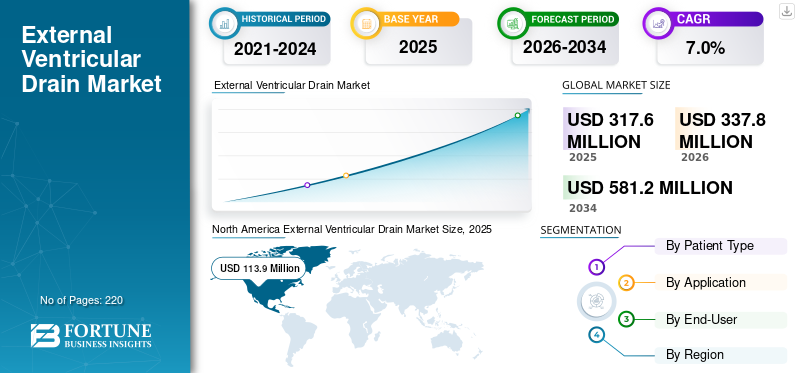
The global external ventricular drain market size was valued at USD 317.6 million in 2025. The market is projected to grow from USD 337.8 million in 2026 to USD 581.2 million by 2034, exhibiting a CAGR of 7.0% during the forecast period. North America dominated the external ventricular drain market with a market share of 35.86% in 2025.
An External Ventricular Drain (EVD) is a temporary neurosurgical drainage system used to remove cerebrospinal fluid (CSF) from brain ventricles and monitor intracranial pressure in critical conditions such as hydrocephalus, traumatic brain injury, subarachnoid hemorrhage, intraventricular hemorrhage, and brain tumors. The market growth is attributed to rising emergency neurosurgical procedures, increasing stroke and trauma burden, and higher demand for real-time intracranial pressure management in neuro-ICUs. In addition, EVDs remain a standard lifesaving intervention in acute brain injury care. Recent innovations are focused on reducing catheter blockage, infection, and drainage management errors.
- For instance, in 2025, Anuncia Medical received FDA Breakthrough Device Designation for ReFlow EVD, designed to restore and maintain CSF flow through a noninvasive flushing mechanism.
Leading companies in the market include Integra LifeSciences Corporation, Medtronic plc, Natus Medical Incorporated, Sophysa, and Spiegelberg GmbH & Co. KG. They emphasize creating different advanced technologies to provide better products with enhanced precision and efficacy.
Download Free sample to learn more about this report.
External Ventricular Drain Market Key Takeaways
 Global Market Size & Forecast
- 2025 Market Size: USD 317.6 million
- 2026 Market Size: USD 337.8 million
- 2034 Forecast Market Size: USD 581.2 million
- CAGR: 7.0% from 2026–2034
 Market Share
- North America dominated the external ventricular drain market with a 35.86% share in 2025.
- The adult segment accounted for the largest market share in 2025.
- The subarachnoid hemorrhage segment held 34.1% of the market share in 2025.
 Key Regional Highlights
North America
North America led the market with USD 113.9 million in 2025, supported by strong demand for emergency neurosurgical interventions.
Europe
Europe is projected to reach USD 101.0 million in 2026, driven by expanding neurocritical care adoption.
Asia Pacific was valued at USD 134.05 million in 2025 and is projected to grow at the fastest 8.48% CAGR through 2034.
Asia Pacific is expected to reach USD 76.6 million in 2026, making it the third-largest regional market.
U.S.
The market is estimated at USD 94.3 million in 2026, accounting for approximately 27.9% of global sales.
Japan
The market is estimated at USD 13.5 million in 2026, representing around 4.0% of global revenues.
Read More

EXTERNAL VENTRICULAR DRAIN MARKET TRENDS
Shift Toward Active Fluid Management Technologies is a Key Market Trend
The market is witnessing a shift from traditional passive drainage systems toward active and integrated CSF management technologies. Traditional EVDs mainly drain CSF and require manual monitoring, while newer systems aim to combine controlled drainage, irrigation, pressure monitoring, and data connectivity. The market is witnessing a rising preference for automation, closed systems, and connected neurocritical care technologies.
- For instance, in December 2022, IRRAS received U.S. FDA 510(k) clearance for its next-generation IRRAflow control unit, enabling enhanced workflow and communication with bedside monitors.
MARKET DYNAMICS
MARKET DRIVERS
Download Free sample to learn more about this report.
Rising Burden of Acute Neurological Conditions to Accelerate Market Growth
The growing incidence of traumatic brain injury, intracranial hemorrhage, hydrocephalus, and stroke is driving demand for external ventricular drains. EVDs are widely used in emergency neurosurgery to relieve elevated intracranial pressure and drain excess CSF. In addition, the device is particularly important in neurocritical care, where rapid pressure control can reduce secondary brain injury. Also, increasing hospital admissions for road accidents, aneurysmal bleeding, and hemorrhagic stroke are expanding procedure volumes, implicitly impacting the global external ventricular drain market growth.
MARKET RESTRAINTS
Infection and Catheter-Related Complications to Deter Market Growth
Infection risk remains a major restraint for the market. Since EVDs create a direct pathway into the ventricular system, patients are exposed to complications such as ventriculitis, catheter blockage, hemorrhage, malposition, and accidental dislodgement. In addition, these complications can increase ICU stay, antibiotic use, repeat procedures, and overall treatment cost. Conventional EVDs also require careful handling, frequent monitoring, and strict infection-control protocols. The invasive nature of the procedure makes hospitals cautious, especially in settings with limited neurosurgical expertise. These safety concerns continue to limit broader adoption in lower-resource healthcare facilities.
MARKET OPPORTUNITIES
Development of Anti-Occlusion and Smart Drainage Systems to Offer Lucrative Market Growth Opportunities
Significant growth opportunities exist in the development of next-generation external ventricular drain systems that address the major limitations associated with conventional EVDs, including catheter occlusion, infection risk, inaccurate drainage control, and high clinical monitoring requirements. Manufacturers are increasingly focusing on innovations such as active fluid exchange systems, antimicrobial catheters, integrated intracranial pressure monitoring, automated drainage regulation, and digital connectivity with hospital monitoring platforms. These technologies have the potential to improve patient outcomes while reducing ICU workload and catheter-related complications.
MARKET CHALLENGES
Need for Skilled Neurosurgical Handling to Pose a Critical Challenge to Market Growth
The market faces challenges due to the need for highly skilled neurosurgical placement and continuous ICU-level management. Incorrect catheter positioning, drainage-level errors, blockage, and infection can directly affect patient outcomes. Moreover, EVD placement is often performed in emergency conditions, where procedure accuracy and rapid decision-making are critical. Hospitals also require trained nurses and neurocritical care teams to manage drainage height, ICP monitoring, CSF sampling, and infection prevention. In addition, these operational requirements restrict adoption in smaller hospitals and emerging markets. As a result, training, protocol standardization, and post-placement monitoring remain key challenges for wider market penetration.
Segmentation Analysis
By Patient Type
Increased Prevalence of Neurological Conditions and Strokes in Adults Boosted Segment Growth
Based on the patient type, the market is divided into adult and pediatric.
The adult segment accounted for the largest external ventricular drain market share in 2025. The segment growth is attributed to the higher incidence of stroke, traumatic brain injury, subarachnoid hemorrhage, intracerebral hemorrhage, and adult-onset hydrocephalus. In addition, adults are more frequently exposed to road accidents, aneurysmal rupture, hypertension-related brain bleeding, and age-related neurological complications, creating a strong demand for emergency CSF drainage.
- For instance, according to data published by NCBI in August 2022, an estimated 18.2% of the U.S. population suffers from traumatic brain injury.
The pediatric segment is anticipated to rise with a CAGR of 6.7% over the forecast period.
To know how our report can help streamline your business, Speak to Analyst
By Application
Higher Adoption of EVD for Subarachnoid Hemorrhage Due to Substantial Benefits Fueled Segment Growth
Based on application, the market is segmented into traumatic brain injury, subarachnoid hemorrhage, intracerebral hemorrhage, brain tumors, and others.
In 2025, the subarachnoid hemorrhage segment dominated and held 34.1% market share. Subarachnoid hemorrhage accounts for a significant share of EVD usage as the condition often leads to acute hydrocephalus, elevated intracranial pressure, and impaired CSF circulation. Moreover, EVD placement is frequently required to drain CSF, monitor pressure, and stabilize patients during the acute phase of aneurysmal bleeding. These patients are generally treated in specialized stroke and neurocritical care units, where EVDs are part of standard emergency management.
The intracerebral hemorrhage segment is expected to register a CAGR of 7.4% during the forecast period.
By End-User
Hospitals Led Market Due to Availability of Superior Infrastructure
Based on end-user, the market is segmented into hospitals, specialty clinics, and others.
In 2025, hospitals held the highest market share, as EVD placement requires neurosurgeons, operating rooms or emergency procedure areas, imaging support, intensive care monitoring, and infection-control infrastructure. Most cases involving traumatic brain injury, hydrocephalus, subarachnoid hemorrhage, and intraventricular hemorrhage are managed in tertiary hospitals and trauma centers. Furthermore, the segment is set to hold 92.3% share in 2026.
The specialty clinics segment is projected to grow at a CAGR of 9.0% during the forecast period.
External Ventricular Drain Market Regional Outlook
By geography, the market is categorized into Europe, North America, Asia Pacific, Latin America, and the Middle East & Africa.
North America
North America External Ventricular Drain Market Size, 2025 (USD Million)
To get more information on the regional analysis of this market, Download Free sample
North America held the dominant share in 2024, valued at USD 107.5 million, and also maintained the leading share in 2025, with USD 113.9 million. The market in North America is expected to increase due to the high incidence of traumatic brain injuries, intracranial hemorrhage, hydrocephalus, and aneurysmal subarachnoid hemorrhage requiring emergency neurosurgical intervention.
U.S. External Ventricular Drain Market
Based on North America’s strong contribution and the U.S. dominance within the region, the U.S. market can be analytically approximated at around USD 94.3 million in 2026, accounting for roughly 27.9% of global sales.
Europe
Europe is projected to record a growth rate of 6.5% in the coming years, which is the second highest among all regions, and reach a valuation of USD 101.0 million in 2026. The region is estimated to witness considerable market growth due to increasing focus on improving neurocritical care outcomes and rising adoption of evidence-based intracranial pressure management protocols.
U.K. External Ventricular Drain Market
The U.K. market in 2026 is estimated at around USD 14.9 million, representing roughly 4.4% of global revenues.
Germany External Ventricular Drain Market
Germany’s market is projected to reach approximately USD 18.5 million in 2026, equivalent to around 5.5% of global sales.
Asia Pacific
Asia Pacific is estimated to reach USD 76.6 million in 2026 and secure the position of the third-largest region in the market.
Japan External Ventricular Drain Market
The Japanese market in 2026 is estimated at around USD 13.5 million, accounting for roughly 4.0% of global revenues.
China External Ventricular Drain Market
China’s market is projected to reach USD 25.7 million in 2026, representing roughly 7.6% of global sales.
India External Ventricular Drain Market
The Indian market in 2026 is estimated at around USD 17.2 million, accounting for roughly 5.1% of global revenues.
Latin America and Middle East & Africa
The Latin America and Middle East & Africa regions are expected to witness moderate growth during the forecast period. The Latin America market is set to reach a valuation of USD 21.4 million in 2026. Market growth in Latin America is driven by increasing healthcare investments, improving access to neurosurgical procedures, and the rising incidence of traumatic brain injuries and cerebrovascular diseases.
In the Middle East & Africa, the GCC is set to reach a value of USD 17.9 million in 2026. Market growth in the Middle East & Africa is attributed to the growing demand for advanced critical care services.
South Africa External Ventricular Drain Market
The South African market is projected to reach around USD 2.8 million in 2026, representing roughly 0.82% of global revenues.
COMPETITIVE LANDSCAPE
Key Industry Players
Rise in Product Introductions by Top Companies to Boost Market Revenue
The global external ventricular drain market holds a semi-consolidated market structure, constituting prominent players such as Integra LifeSciences Corporation, Medtronic plc, Natus Medical Incorporated, Sophysa, and Spiegelberg GmbH & Co. KG. Numerous strategic activities, including distribution collaborations and implementation of new programs, drive the significant global market share of these companies.
- For instance, in January 2022, Integra LifeSciences reported positive clinical and economic evidence for its External Ventricular Drainage systems, demonstrating their potential to enhance cerebrospinal fluid management and improve neurocritical care outcomes.
Desu Medical, KoçMedical, Silmag, and Suzhou New District Mingji Polymer Medical Equipment Co., Ltd. are other prominent players in the market. They are set to prioritize collaborations to increase their global market share in the coming years.
LIST OF KEY EXTERNAL VENTRICULAR DRAIN COMPANIES PROFILED
- Integra LifeSciences Corporation (U.S.)
- Medtronic plc (Ireland)
- Natus Medical Incorporated (U.S.)
- Sophysa (France)
- Spiegelberg GmbH & Co. KG (Germany)
- Desu Medical (Türkiye)
- KoçMedical (Türkiye)
- Silmag (Argentina)
- Suzhou New District Mingji Polymer Medical Equipment Co., Ltd. (China)
- Yushin Medical Co., Ltd. (South Korea)
KEY INDUSTRY DEVELOPMENTS
- June 2026: CereVasc raised USD 85 million in Series C financing from investors, including Johnson & Johnson Innovation and Medtronic to support its pivotal STRIDE trial and future commercialization of the eShunt System, a minimally invasive cerebrospinal fluid (CSF) diversion technology.
- May 2026: Zeta Surgical received FDA clearance for its AI-powered Zeta Navigation System, along with the Zeta Stylet and Zeta Bolt instruments, enabling real-time image-guided support for external ventricular drain placement, shunt procedures, and hydrocephalus management.
- January 2026: BrainSpace received FDA clearance for Intellidrop, an automated cerebrospinal fluid drainage and intracranial pressure monitoring system.
- June 2025: Researchers from the Institute for Basic Science (IBS) demonstrated that non-invasive mechanical stimulation of cervical lymphatic vessels significantly enhanced cerebrospinal fluid (CSF) drainage and brain waste clearance in preclinical models.
- July 2023: Anuncia Medical commercially launched the second-generation ReFlow Mini Flusher across leading U.S. neurosurgical centers for the treatment of hydrocephalus.
REPORT COVERAGE
The global external ventricular drain market analysis includes a comprehensive study of the market size & forecast by all the market segments included in the report. It includes details on the market dynamics and market trends expected to drive the market over the forecast period. It provides information on key aspects, including an overview of technological advancements, the regulatory environment, and product launches. Additionally, it details partnerships, mergers & acquisitions, as well as key industry developments and investments by key regions. The global market research report also provides a detailed competitive landscape with information on the market share and profiles of key operating players.
Request for Customization to gain extensive market insights.
Report Scope & Segmentation
| ATTRIBUTE | DETAILS |
| Study Period | 2021-2034 |
| Base Year | 2025 |
| Estimated Year | 2026 |
| Forecast Period | 2026-2034 |
| Historical Period | 2021-2024 |
| Growth Rate | CAGR of 7.0% from 2026 to 2034 |
| Unit | Value (USD Million) |
| Segmentation | By Patient Type, Application, End-User, and Region |
| By Patient Type |
|
| By Application |
|
| By End-User |
|
| By Region |
|
Frequently Asked Questions
According to Fortune Business Insights, the global market value stood at USD 317.6 million in 2025 and is projected to reach USD 581.2 million by 2034.
In 2025, the market value in North America stood at USD 113.9 million.
The market is expected to exhibit a CAGR of 7.0% during the forecast period of 2026-2034.
By patient type, the adult segment led the market.
The rising burden of acute neurological conditions is driving market expansion.
Integra LifeSciences Corporation, Medtronic plc, Natus Medical Incorporated, Sophysa, and Spiegelberg GmbH & Co. KG are the major players in the market.
North America dominated the market in 2025.



- 2021-2034
- 2025
- 2021-2024
- 220
Get 30-60 hrs Free Customization
Expand Regional and Country Coverage, Segments Analysis, Company Profiles, Competitive Benchmarking, and End-user Insights.













.webp)






Related Reports
-
US +1 833 909 2966 ( Toll Free )
-
Get In Touch With Us