Antimicrobial Catheters Market Size, Share & Industry Analysis By Product Type (Central Venous Catheters, Urinary Catheters, Intermittent Catheters, and Others), By Material (Silicone, Polyurethane, Latex and Others), By Coating Type (Silver-based, Antibiotic-based and Others), By End User (Hospitals & ASCs, Specialty Clinics, Homecare Settings, and Others), and Regional Forecast, 2026-2034
 Download Free Sample
Antimicrobial Catheters Market Size and Future Outlook
 Listen to Audio Version
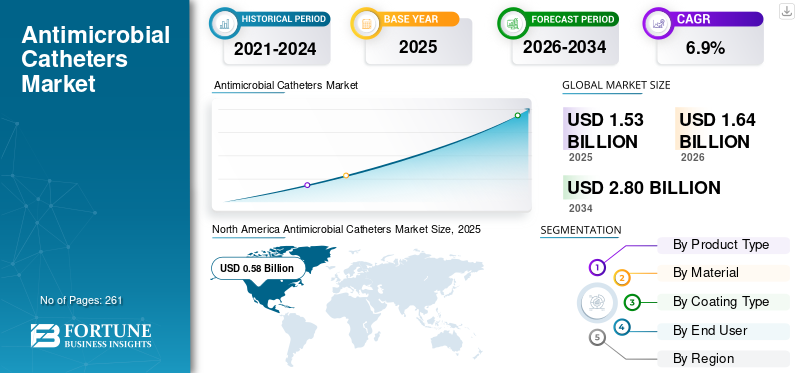
The antimicrobial catheters market size was valued at USD 1.53 billion in 2025 and is projected to grow from USD 1.64 billion in 2026 to USD 2.80 billion by 2034, exhibiting a CAGR of 6.9% during the forecast period. North America dominated the antimicrobial catheters market with a market share of 37.90% in 2025.
Antimicrobial catheters are medical tubes infused with antimicrobial agents, including chlorhexidine, antibiotics, and others, used to prevent bacterial colonization and reduce Catheter-Associated Infections (CAUTIs). The increasing prevalence of catheter-associated infections, rising number of surgical procedures, and growing healthcare spending are resulting in increased adoption rate of these devices in the market. Additionally, a growing antimicrobial resistance burden in healthcare settings, is further increasing the demand for infection prevention devices, thereby boosting market growth.
- For instance, according to 2020 data published by the National Center for Biotechnology Information (NCBI), there were approximately 40 to 50 million surgical procedures in the U.S.
Furthermore, the adoption of technological advancements in these devices among key companies, such as Cardinal Health and Teleflex Incorporated, are further contributing to the market expansion.
Download Free sample to learn more about this report.
ANTIMICROBIAL CATHETERS MARKET KEY TAKEAWAYS
 Global Market Size & Forecast
- 2025 Market Size: USD 1.53 billion
- 2026 Market Size: USD 1.64 billion
- 2034 Forecast Market Size: USD 2.80 billion
- CAGR: 6.90% from 2026–2034
 Market Share
- North America dominated the antimicrobial catheters market with a market share of 37.90% in 2025.
- The intermittent catheters segment is expected to grow at a CAGR of 7.6% over the forecast period.
- The polyurethane segment is set to grow with a rate of 7.2% over the forecast period.
 Key Regional Highlights
North America
North America held the leading position with a value of USD 0.58 billion in 2025, driven by high surgical volumes and infection prevention focus.
Europe
Europe is witnessing growth due to increasing surgical procedures and adoption of advanced antimicrobial devices.
Asia Pacific
Asia Pacific is projected to grow with rising healthcare infrastructure and increasing specialty clinics.
U.S.
U.S. market is estimated at around USD 0.53 billion in 2026, supported by demand for advanced catheter technologies.
Japan
Japan market is estimated at around USD 0.09 billion in 2026, driven by infection control initiatives and advanced healthcare adoption.
Read More

Antimicrobial Catheters Market Trends
Technological Advancements in Devices is Emerging Market Trend
The advancements in antimicrobial catheter devices are emerging as a key trend in the global market. Companies are increasingly focusing on the development of catheters with advanced coatings, including chlorhexidine-silver sulfadiazine, silver-based, antibiotic-infused, and non-leaching antimicrobial coatings to minimize bacterial adhesion and biofilm formation on catheter surfaces.
Furthermore, healthcare settings are emphasizing infection prevention techniques, antimicrobial stewardship, and the reduction of hospital-acquired infections, resulting in growing demand for catheters and catheter-lock technologies. These can offer longer-lasting protection, reduce infection risk, and enhance clinical outcomes in high-risk patients, such as dialysis, ICU, and long-term catheter users.
- In November 2023, CorMedix Inc., a biopharmaceutical company focused on developing and commercializing therapeutic products for the prevention and treatment of life-threatening diseases and conditions, received FDA approval for DefenCath (taurolidine and heparin) Catheter Lock Solution (CLS). This aims to reduce the incidence of Catheter-Related Bloodstream Infections (CRBSIs) for adult patients with kidney failure receiving chronic hemodialysis through a Central Venous Catheter (CVC).
Other Prominent Trends
- Growth in minimally invasive procedures to fuel the product demand
Market Dynamics
Market Drivers
Download Free sample to learn more about this report.
Increasing Number of Surgical Procedures to Drive Market Growth
The growing prevalence of chronic conditions such as cancer, cardiovascular disorders, among others, is resulting in a growing demand for fluid administration, hemodialysis, and parenteral nutrition among the patient population. This is subsequently fueling the demand for central venous catheters, dialysis catheters, and urinary catheters in the market.
- For instance, according to 2022 statistics published by the American Cancer Society (ACS), approximately 20.0 million cancer cases were estimated globally.
This, coupled with rising healthcare expenditure, expansion of healthcare infrastructure, and increasing incidence of hospital-acquired infections, is propelling the antimicrobial catheters market growth. Additionally, the growing focus of key companies on introducing R&D activities to launch innovative devices, are anticipated to support market development.
Market Restraints
High Cost Associated with the Devices Hinders Market Growth
The high cost associated with this equipment limits its adoption rate, especially in emerging countries, including Mexico, Brazil, and others. Additionally, the adoption of standard catheters and reliance on sterile insertion techniques, infection-control bundles, and catheter-care protocols amongst healthcare settings with constrained procurement budgets is further limiting market growth. Lack of reimbursement policies are also likely to hinder the adoption of these devices.
- For instance, according to the data published by the JAMA Network, the cost of the silver-coated catheter is around USD 9.40.
Market Opportunities
Expansion of Healthcare Facilities in Emerging Regions Offers Potential Market Growth Opportunity
There is an increasing expansion of healthcare facilities in emerging countries, including China, Mexico, and others. The increasing number of surgeries, growing healthcare spending, and rising number of ambulatory surgical centers and acute care settings are consequently contributing to growing adoption of these devices in healthcare settings.
Additionally, surging preference for ambulatory surgical centers for surgical procedures owing to their benefits, such as shorter patient stays, lower procedural costs, faster turnaround times, and a reduced risk of hospital-acquired infections, is further boosting the market growth.
- According to 2025 data published by Definitive Healthcare, there are about 10,000 active Ambulatory Surgical Centers (ASCs) in the U.S.
Market Challenges
Limited Healthcare Access in Developing Nations Limits Market Growth
Limited availability of technologically advanced devices, healthcare expenditure, risk of antimicrobial resistance, and stringent regulatory approval processes for these catheters, especially in emerging countries, are limiting market expansion. Additionally, a inadequate number of hospitals and clinics and specialist surgeons results in delayed surgical procedures among the patient population, especially in developing nations, including India, China, among others.
- For instance, according to 2023 statistics published by the World Bank Group (WBG), about 4.5 billion people lack full access to essential health services globally.
SEGMENTATION ANALYSIS
By Product Type
Increasing Prevalence for Central Line-Associated Bloodstream Infection (CLABSI) Led to Central Venous Catheters Segment Dominance
Based on the product type, the market is classified into central venous catheters, urinary catheters, intermittent catheters, and others.
To know how our report can help streamline your business, Speak to Analyst
The central venous catheters segment held the largest revenue share in 2025. The growth is due to increasing prevalence of CLABSI among the patient population, resulting in an increasing demand for advanced central venous catheters globally. This, along with growing focus of key companies on launching innovative devices, is further anticipated to contribute to the segment growth.
- For instance, according to 2020 statistics published by the Agency for Healthcare Research and Quality (AHRQ), the average rate of CLABSI is 5.3 per 1,000 catheter days among the patient population.
The intermittent catheters segment is expected to grow at a CAGR of 7.6% over the forecast period.
By Material
Increasing Adoption of Catheters Leds to Dominance of Silicone Segment
Based on material, the market segments are silicone, polyurethane, latex, and others.
The silicone segment dominated the global market in 2025 with a share of 37.7%. This growth is due to growing number of surgical procedures, resulting in a growing demand for catheters, further leading to rising demand for novel silicone and contributing to the segmental growth in the market.
- For instance, according to 2025 statistics published by the Centers for Disease Control & Prevention (CDC), about 15-25% of hospitalized patients receive urinary catheters during their hospital stay.
The polyurethane segment is set to grow with a rate of 7.2% over the forecast period.
By Coating Type
Growing Benefits of Silver-based Led to Segment Dominance
Based on coating type, the market is segmented into silver-based, antibiotic-based, and others.
The silver-based segment dominated the market and accounted for a share of 43.2% in 2025. This growth is due to increasing prevalence of catheter-based infections and benefits associated with silver-based devices, such as cost-effectiveness, inhibition of biofilm formation, and others, thereby contributing to the segment growth.
- For instance, according to the 2024 article published by Springer, it was reported that silver-alloy catheters reduce the likelihood of developing urinary tract infection among the patient population.
The antibiotic-based segment is probable to growth with a rate of 7.3% during the forecast period.
By End-user
Increasing Number of Hospitals & ASCs Led to the Segmental Dominance
Based on end user, the market is bifurcated into hospitals & ASCs, specialty clinics, homecare settings, and others.
The hospitals & ASCs segment held the largest antimicrobial catheters market share in 2025. The increasing prevalence of CAUTIs, growing number of surgeries, rising number of healthcare settings, including hospital and long term care settings, are some of the crucial factors contributing to the segment growth. Furthermore, the segment is set to hold a 69.5% share in 2026.
- For instance, according to 2023 data published by the National Bureau of Statistics of China (NBSC), there were about 39,000 hospitals in China.
In addition, specialty clinics’ end users are projected to grow at a 7.3% CAGR during the forecast period.
Antimicrobial Catheters Market Regional Outlook
Based on region, the market has been studied across North America, Europe, Asia Pacific, Latin America, and Middle East & Africa.
North America
North America Antimicrobial Catheters Market Size, 2025 (USD Billion)
To get more information on the regional analysis of this market, Download Free sample
The North America market held the dominant share in 2024, valued at USD 0.55 billion, and also took the leading share in 2025 with USD 0.58 billion. The growing prevalence of catheter based infections, rising surgical volumes, and increasing number of product introductions, and demand for antimicrobial urinary catheters, contribute to the regional market growth.
- For instance, according to 2024 statistics published by the Centers for Disease Control & Prevention (CDC), about 1 in 20 adults aged 20 and older has coronary artery disease (CAD).
U.S. Antimicrobial Catheters Market
Based on North America’s strong contribution, the U.S. market can be analytically approximated at around USD 0.53 billion in 2026, accounting for roughly 32.5% of global sales.
Europe
Europe is projected to record a growth rate of 5.2% in the coming years, which is the second highest among all regions, and reach a valuation of USD 0.44 billion by 2026. The increasing number of surgical procedures and growing adoption of novel devices are expected to support the market growth.
U.K. Antimicrobial Catheters Market
The U.K. market in 2026 is estimated at around USD 0.07 billion, representing roughly 4.4% of global revenues.
Germany Antimicrobial Catheters Market
Germany market is projected to reach approximately USD 0.08 billion in 2026, equivalent to around 5.0% of global sales.
Asia Pacific
Asia Pacific is estimated to reach USD 0.43 billion in 2026 and secure the position of the third-largest region in the market. The growth in surgical procedures, increasing number of specialty clinics, and developed healthcare settings in the region are likely to support market growth.
Japan Antimicrobial Catheters Market
The Japan market in 2026 is estimated at around USD 0.09 billion, accounting for roughly 5.8% of global revenues. Japan has historically reported a relatively high prevalence of catheter based infections, coupled with a strong focus on novel device launches.
China Antimicrobial Catheters Market
China’s market is projected to be one of the largest worldwide, with 2026 revenues estimated at around USD 0.14 billion, representing roughly 8.4% of global sales.
India Antimicrobial Catheters Market
The India market size in 2026 is estimated at around USD 0.07 billion, accounting for roughly 4.3% of global revenues.
Latin America and Middle East & Africa
The Latin America and Middle East & Africa regions are expected to witness moderate growth in the market during the forecast period. The Latin America market is set to reach a valuation of USD 0.08 billion in 2026. The growth is due to the increasing healthcare expenditure and rising regulatory focus on reducing hospital acquired infections. The Middle East & Africa region is also expected to grow due to growing acquisitions and mergers among other companies in the market. In the Middle East & Africa, the GCC is set to reach a value of USD 0.03 billion in 2026.
South Africa Antimicrobial Catheters Market
The South Africa market is projected to reach around USD 0.01 billion in 2026, representing roughly 0.7% of global revenues.
Competitive Landscape
Key Industry Players
Increasing Number of Research Studies to Support Increased Market Competition
A robust & diversified antimicrobial catheters portfolio, along with a strong geographic presence, is one of the key factor contributing to the dominance of these companies in the market. Cardinal Health and Teleflex Incorporated are major companies in the market. Furthermore, the growing focus of prominent companies on publishing study findings for antimicrobial catheters is likely to strengthen their presence.
- For instance, in June 2025, Teleflex Incorporated, a global provider of medical technologies, announced findings from a new multinational study reporting the efficacy of Arrow Chlorhexidine-Impregnated Central Venous Catheters (CVCs). This helped the company to increase its brand presence.
Other key players are also growing in the market, primarily due to their increasing emphasis on acquisitions.
List of Key Antimicrobial Catheters Companies Profiled
- Cook Medical (U.S.)
- Braun SE (Germany)
- BACTIGUARD AB (Sweden)
- Vygon (France)
- Kimal (U.K.)
- Sterimed Group (India)
- AVNS (U.S.)
- Spectrum Vascular (U.S.)
- Cardinal Health (U.S.)
- Teleflex Incorporated (U.S.)
KEY INDUSTRY DEVELOPMENTS
- May 2026: Spectrum Vascular announced a symposium on advances in antimicrobial CVC technology with a key focus on Spectrum II, a next generation catheter developed to help reduce CLABSI in high-risk patients. This helped the company to increase its brand presence.
- November 2024:Teleflex Incorporated launched its new Pressure Injectable Arrowg+ard Blue Plus MSB Procedure Kit in Europe and Middle East & Africa.
- July 2024: Teleflex Incorporated, a global provider of medical technologies, announced the establishment of the Teleflex Center for Antimicrobial Protection (TCAP) as a strategic branch of its Vascular Access business to reduce the spread of infections caused by multidrug-resistant organisms.
- April 2024: Vygon announced that its umbilical neonatal catheter, which incorporates AgION technology, is being used by around 60 NHS trusts.
- January 2024: Teleflex Incorporated announced it has been awarded a contract by Vizient, Inc., the provider-driven healthcare performance improvement company in the U.S. Through this agreement, Vizient provider-customers will gain access to increased savings and pre-negotiated terms on Teleflex’s vascular access products.
- December 2023: BD collaborated with Bactiguard AB to become the exclusive global license partner (excluding China) for Bactiguard-coated Foley catheters.
- March 2021: Bactiguard AB published a large, randomized, controlled multicenter study in India with 1,000 patients included, which shows that urinary catheters with Bactiguard’s coating for infection prevention reduce the risk of catheter-associated urinary tract infections (CAUTI) by 69% compared to standard catheters.
REPORT COVERAGE
The report provides a detailed global antimicrobial catheters market analysis and focuses on key aspects such as leading companies and market segmentation, including product type, material, coating type, and end user. Besides this, the global report offers insights into the market growth trends and highlights key industry developments. In addition to the aforementioned factors, the report encompasses several factors that have contributed to the growth and advancement of the market over recent years.
Request for Customization to gain extensive market insights.
Report Scope & Segmentation
| ATTRIBUTE | DETAILS |
| Study Period | 2021-2034 |
| Base Year | 2025 |
| Estimated Year | 2026 |
| Forecast Period | 2026-2034 |
| Historical Period | 2021-2024 |
| Growth Rate | CAGR of 6.9% from 2026-2034 |
| Unit | Value (USD Billion) |
| Segmentation | By Product Type, Material, Coating Type, End User, and Region |
| By Product Type |
|
| By Material |
|
| By Coating Type |
|
| By End User |
|
| By Region |
|
Frequently Asked Questions
Fortune Business Insights says that the global market size was USD 1.53 billion in 2025 and is projected to reach USD 2.80 billion by 2034.
In 2025, the North America regional market value stood at USD 0.58 billion.
Growing at a CAGR of 6.9%, the market will exhibit steady growth over the forecast period (2026-2034).
By product type, central venous catheters segment is the leading segment in the market.
The introduction of novel antimicrobial catheters is one of the major factors driving the market growth.
Cardinal Health and Teleflex Incorporated are the major players in the market.
North America dominated the market share.
The growing prevalence of chronic conditions and the increasing number of surgical procedures boost adoption of these products.



- 2021-2034
- 2025
- 2021-2024
- 261
Get 30-60 hrs Free Customization
Expand Regional and Country Coverage, Segments Analysis, Company Profiles, Competitive Benchmarking, and End-user Insights.













.webp)






Related Reports
-
US +1 833 909 2966 ( Toll Free )
-
Get In Touch With Us