Faux Leather Market Size, Share & Industry Analysis, By Type (PU (Polyurethane), PVC (Polyvinyl Chloride), and Bio-based), By Application (Footwear, Automotive, Furniture, and Others), and Regional Forecast, 2026-2034
 Download Free Sample
(Offer valid till 30th Sep 2026)

Faux Leather Market Size and Future Outlook
 Listen to Audio Version
The global faux leather market size was valued at USD 37.59 billion in 2025. The market is projected to grow from USD 39.09 billion in 2026 to USD 70.54 billion by 2034, exhibiting a CAGR of 7.66% during the forecast period. North America dominated the global faux leather market with a market share of 32.19% in 2025.
Faux leather is made of artificial materials that replicate the appearance and texture of real leather. Synthetic materials used in the production of such artificial leather are polyurethane (PU), Polyvinyl chloride, and others. Advancements in the development of materials that are used in the production of faux leather-based products and rising demand for renewable and recycled technology-based artificial leathers is creating newer market growth prospects. In 2024, Dow Inc. developed POE-based artificial leather formula for the production of automotive seats. The leather offers color stability and soft feel when used in production of automotive seats.
The global market is characterized by the key players operating in the market, including BASF SE, Responsive Industries Ltd., Konrad Hornschuch AG, Taiwan PU Corporation, and Bridge Synthetic Leather Co. Ltd.
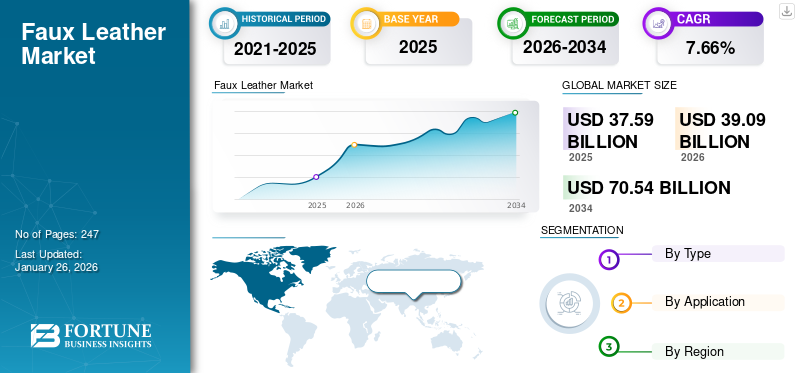
Download Free sample to learn more about this report.
Faux Leather Market Key Takeaways
 Global Market Size & Forecast
- 2025 Market Size: USD 37.59 billion
- 2026 Market Size: USD 39.09 billion
- 2034 Forecast Market Size: USD 70.54 billion
- CAGR: 7.66% from 2026–2034
 Market Share
- North America dominated the faux leather market with a 32.19% share in 2025.
- PU segment held the largest share with 64.54% in 2026.
- Footwear segment led the market with a 27.24% share in 2026.
 Key Regional Highlights
North America
North America reached USD 12.1 billion in 2025, accounting for 32.19% of global market share.
Asia Pacific
Asia Pacific generated USD 10.03 billion in 2025, representing 26.67% of global revenue.
Europe
Europe recorded USD 11.26 billion in 2025, capturing 29.95% of the worldwide market.
U.S.
Market was valued at USD 10.26 billion in 2026, driven by rising adoption across automotive, fashion, and upholstery sectors.
Japan
Market is projected to reach USD 0.89 billion by 2026, supported by growing demand for sustainable artificial leather products.
Read More

MARKET DYNAMICS
MARKET DRIVERS:
Increasing Preference for Sustainable and Animal-friendly Leather Alternatives to Drive Market Growth
Increasing consumer preference for the goods made of sustainability-made, animal-friendly alternatives to traditional leather materials is driving global faux leather market growth. In addition, consistent manufacturers’ efforts of the development of recycled and bio-based alternatives to the traditional leather are positively contributing to the product demand globally. Besides, governmental regulations regarding the sales of traditional leather-based goods is positively contributing to the development of faux leather-based products, favoring the global market growth. According to the “Animal Welfare in Fashion 2023” report published by FOUR PAWS, an animal welfare organization, around 50% of evaluated fashion brands disclosed their use of animal-derived materials, and only 9% of brands reported that 50% or more of their animal-derived materials were certified for animal welfare or recycled standards.
MARKET RESTRAINTS:
Fluctuating Raw Material Prices to Impact Production Costs, Restraining Market Growth
Fluctuating prices of raw materials used in faux leathers incur additional procurement costs of the company, posing challenges to the key players’ business profitability growth. In addition, fluctuations in the petroleum and crude oil prices negatively impact the product demand across price-sensitive geographical markets, restraining global market growth.
MARKET OPPORTUNITIES:
Expanding Automotive Industry Requiring Faux Leather for Custom Vehicle Interiors to Create Newer Growth Opportunities
Imitation leather is increasingly used in automotive designs due to the cost-effectiveness and durability of such materials. These materials better withstand UV exposure, water, and stains. Increasing automotive industries’ adoption of faux leathers in the production of vehicle interiors including seats, covers, curtains, and others is creating newer market growth opportunities. In addition, expanding automotive industry and rising car owners’ preference for the custom vehicle interior services including the extensive usage of imitation leather is favoring market growth across many countries.
FAUX LEATHER MARKET TRENDS:
Rising Demand for Sustainable Leather Goods to Strengthen Market Growth
Download Free sample to learn more about this report.
Rising demand for sustainably-made leather goods and increasing eco-consciousness positively contributes to the production of cruelty-free and environmentally-friendly goods, accelerating the global market growth. In addition, increasing manufacturing industries’ adoption of sustainability measures involving the procurement and usage of vegan materials for the production of vegan leather is favoring the faux leather industry revenue growth.
- For instance, in December 2023, NUPELLE, an eco-friendly vegan leather manufacturing company, launched a sustainable vegan leather product, ‘Panex’. This product is made of pineapple and other design materials.
MARKET CHALLENGES:
Imitation Leather Recycling Challenges to Pose Challenges to Companies Generate Business Profitability
Recycling synthetic leather involves complex tasks including material composition, mechanical separation of materials, and others. These tasks incur additional operational costs to the manufacturing companies, posing challenges for them to generate business profitability. In addition, uncertain and tedious procurement & materials disposition costs are negatively impacting the key players’ business profitability and production efficiencies.
Segmentation Analysis
By Type
Durability and Affordability Feature of PU (Polyurethane) Boost Segment’s Evolution
On the basis of type, the market is segmented into PU (Polyurethane), PVC (Polyvinyl Chloride), and bio-based.
The PU segment exhibited a leading global faux leather market share of 64.54% in 2026. The segment is projected to grow at a fastest rate of 6.89% during 2026-2034. Polyurethane-based goods are sold at cheaper prices compared to the goods made of counterpart materials. In addition, such goods deliver better performance compared to traditional leather-based goods. The segment’s leading share is attributed to the high demand for the affordable and durable polyurethane materials for the production of imitation leather goods.
PVC segment is mainly driven by consistent manufacturers’ production of Polyvinyl Chloride-based goods of a wide range of textures, colors, and finishes. In addition, increasing demand for aesthetically-designed, modern imitation leather-based coverings and other products is driving the segmental revenue growth.
To know how our report can help streamline your business, Speak to Analyst
By Application
Long-lasting Performance Provided by Vegan Leather Intensifies Segment’s Enlargement
Based on application, the worldwide market is divided into footwear, automotive, furniture, and others. Footwear segment exhibited a leading global market share of 27.24% in 2026. Its leading share is due to the significant usage of faux leather material as a main component in the production of footwear. In addition, rising food manufacturers’ preference for the usage of vegan-based leather materials to produce sustainable goods is favoring segmental revenue growth.
The Others segment covers the analysis on various applications including sporting goods, clothing & apparel, electronics, marine, hospitality & healthcare, etc. The others segment is slated to grow at a fastest rate of 7.07% during the forecast period of 2026-2034. The segment’s fastest growth is attributed to the increasing number of industries replacing the usage of genuine leather materials with imitation leather for better product performance.
Faux Leather Market Regional Outlook
Based on region, the global market of faux leather is divided into Asia Pacific, North America, Europe, South America, and the Middle East & Africa.
North America
North America Faux Leather Market Share, 2025 (USD Billion)
To get more information on the regional analysis of this market, Download Free sample
North America recorded a market size of USD 12.1 billion in 2025, capturing 32.19% of the global market share, and is projected to reach USD 12.48 billion in 2026. The region’s market was estimated to reach USD 12.48 billion and exhibit a leading global market share of 32.19% in 2026. The region’s leading share is attributed to the high American and Canadian consumer awareness about the usage of the goods made of animal-friendly materials including faux leather. Consistent American industries development of new goods made of artificial leather and technological advancements in the development of such goods is positively contributing to the market growth in the region.
The U.S. market was valued at USD 10.26 billion in 2026. Rising adoption of online shopping of the synthetic leather goods and increasing synthetic leather manufacturers’ collaboration with automotive, upholstery, fashion and other production industries offering customized solutions is favoring the market revenue growth in the U.S.
To know how our report can help streamline your business, Speak to Analyst
Asia Pacific
The Asia Pacific market generated USD 10.03 billion in 2025, representing 26.67% of the global market landscape, and is expected to reach USD 10.6 billion in 2026. Rapid urbanization, changing lifestyles, and increasing awareness regarding the environmental impact of animal-derived leather goods in Asian countries have contributed to a change in consumer preferences toward fashionable products, driving artificial leather-based fashion goods demand across Asia. According to the United Nations Department of Statistics, in January 2023, the number of people living in the cities are expected to increase up to 55% of the overall Asia Pacific regional geography by 2030. Furthermore, rising fashion-conscious youngsters’ demand for the stylish handbags, shoes, and accessories made of artificial leather is accelerating market growth in the region. The robust production facilities of synthetic leather also positively contribute to the Asia Pacific synthetic leather market expansion. The Japan market is projected to reach USD 0.89 billion by 2026, the China market is projected to reach USD 3.63 billion by 2026, and the India market is projected to reach USD 3.23 billion by 2026.
Europe
In 2025, Europe represented USD 11.26 billion, accounting for 29.95% of the worldwide market, and is projected to grow to USD 11.78 billion in 2026. Expanding retail infrastructural facilities including supermarkets and e-commerce platforms selling artificial leather items is driving the market growth in Europe. In addition, stricter governmental regulations about the sale of genuine leather-based goods increases the supply rate of sustainable leather items, positively contributing to the market expansion across many European countries. The UK market is projected to reach USD 1.58 billion by 2026, while the Germany market is projected to reach USD 2.07 billion by 2026.
South America
In 2025, the South America market stood at USD 2.64 billion, representing 7.02% of global demand, and is projected to grow to USD 2.69 billion in 2026. Advancements in the development of artificial leather and consistent manufacturers’ investments in the R&D of faux material-based goods to improve quality, durability, and sustainability of the products is mainly driving South American market growth. The South America market in 2025 is set to record USD 2.64 billion as its valuation.
Middle East & Africa
Middle East & Africa accounted for USD 1.57 billion in 2025, representing 4.17% of the global market share, and is projected to reach USD 1.54 billion in 2026. Evolving automotive, furniture, and fashion goods manufacturing processes-related sectors in the Saudi Arabia and UAE is mainly driving the market revenue growth in the Middle East region. Furthermore, the growing urbanization rate and rising demand for the sustainably-made fashion goods is favoring market revenue growth across the African region. In the Middle East & Africa synthetic leather market, the UAE is set to attain the market value of USD 0.31 billion in 2025.
COMPETITIVE LANDSCAPE
Key Industry Players
Technological Development in Vegan Leather Production to Amplify Market Growth
The global market is characterized by leading players including BASF SE, Responsive Industries Ltd., Konrad Hornschuch AG, Taiwan PU Corporation, and Bridge Synthetic Leather Co. Ltd. They develop innovative technology-based vegan leather to further support the production of sustainable products. Furthermore, they use 3D printing, embossing, and surface treatment procedures for the creation of artificial leather of realistic grain patterns. These initiatives help key players maintain their global market position.
LIST OF KEY FAUX LEATHER COMPANIES PROFILED:
- Anli (Vietnam) Material Technology Company Limited (Vietnam)
- BASF (Germany)
- Adams Plastics (U.S.)
- Konrad Hornschuch AG (Germany)
- Penche Faux Leather (Turkey)
- Bridge Synthetic Leather Co., Ltd. (China)
- Hantron Plastic Products Co., Ltd. (China)
- Responsive Industries Ltd. (India)
- Supreme Creations Ltd. (India)
- ISA Industrial Ltd. (China)
- Antilotex Flock Italia S.r.l. (Italy)
- Giriraj Coated Fab PVT. LTD. (India)
- WENZHOU DONGSHANG INTERNATIONAL TRADE CO., LTD. (China)
- Taiwan PU Corporation (China)
- McLaren Leather (China)
- San Fang Chemical Industry Co., Ltd. (Taiwan)
- Teijin Limited (Japan)
KEY INDUSTRY DEVELOPMENTS:
- June 2025: Hydefy (a Chicago startup) is developing a fungus-based leather alternative (material “Fy”), avoiding both animal and petroleum inputs. They recently launched a product collaboration with Stella McCartney for a purse made with their material.
- March 2025: Mayur Uniquoters Ltd., one of the world’s largest synthetic leather manufacturers, reported an installed capacity of 48.6 million linear meters (PVC) and 5 million linear meters (PU) annually, while investing in eco-friendly coating lines to meet sustainability and export-market demand (particularly the U.S. and EU).
- September 2024: Volkswagen partnered with Revoltech GmbH to pilot LOVR, a hemp-based artificial leather, for future vehicle interiors. This material is bio-based, fully recyclable, and petroleum-free, aligning with automakers’ de-carbonization and vegan-material strategies.
- July 2024: BASF SE launched Haptex 4.0, a polyurethane solution designed for synthetic leather that is 100% recyclable. The formulation enables coated fabrics and PET fabric to be recycled together without needing to peel apart layers, which addresses a key challenge in faux leather recycling.
- October 2022: Balenciaga, a luxury fashion house, in collaboration with biomaterials companies developed a coat made from Ephea, a mycelium-based leather alternative, signaling high-fashion adoption of next-gen faux leather.
REPORT COVERAGE
The global faux leather market analysis provides an in-depth study of market insights, size, and forecast by all the market segments included in the report. In addition, the report on the market outlooks market dynamics and market trends expected to drive the market in the forecast period. It offers information on the technological advancements, new product launches, key industry developments, and details on partnerships, mergers & acquisitions. The market research report also encompasses a detailed competitive landscape with information on the market share and profiles of key operating players.
Request for Customization to gain extensive market insights.
Report Scope & Segmentation
| ATTRIBUTE | DETAILS |
| Study Period | 2021-2034 |
| Base Year | 2025 |
| Forecast Period | 2026-2034 |
| Historical Period | 2021-2024 |
| Growth Rate | CAGR of 7.66% from 2026 to 2034 |
| Unit | Value (USD Billion) |
| Segmentation |
By Type
By Application
|
|
By Region North America (By Type, Application, and Country)
Europe (By Type, Application, and Country)
Asia Pacific (By Type, Application, and Country)
South America (By Type, Application, and Country)
Middle East & Africa (By Type, Application, and Country)
|
Frequently Asked Questions
Fortune Business Insights says that the global market size was worth USD 70.54 billion by 2034.
Fortune Business Insights says that the global market value stood at USD 37.59 billion in 2025.
The global market will exhibit a CAGR of 7.66% during the forecast period.
By type, the PU (Polyurethane) segment is predicted to dominate the market during the forecast period.
Rising concerns about animal cruelty in the fashion and textile industries are likely to drive the product demand.
BASF SE, Responsive Industries Ltd., Konrad Hornschuch AG, Taiwan PU Corporation, and Bridge Synthetic Leather Co., Ltd. are some of the leading players globally.
North America dominated the global market in 2025.



- 2021-2034
- 2025
- 2021-2024
- 247
-
(Offer valid till 30th Sep 2026)
Get 30-60 hrs Free Customization
Expand Regional and Country Coverage, Segments Analysis, Company Profiles, Competitive Benchmarking, and End-user Insights.



















Related Reports
-
US +1 833 909 2966 ( Toll Free )
-
Get In Touch With Us