Fava Beans Market Size, Share & Industry Analysis, By Product Type (Whole Fava Beans {Dried, Frozen, and Canned}, Split Fava Beans {Hulled Split Beans and Dehulled Split Beans}, Fava Bean Flour, and Others), By Nature (Conventional and Organic), By Application (Food & Beverage, Nutraceuticals, Cosmetics & Personal Care, Animal Feed, and Others), and Regional Forecast, 2026-2034
 Download Free Sample
(Offer valid till 15th Oct 2026)

KEY MARKET INSIGHTS
 Listen to Audio Version
The global fava beans market size was valued at USD 3.33 billion in 2025. The market is projected to grow from USD 3.49 billion in 2026 to USD 5.21 billion by 2034, exhibiting a CAGR of 5.13% during the forecast period. Europe dominated the fava beans market with a market share of 37.54% in 2025.
Fava beans, commonly referred to as broad beans, are flat, large legumes native to Southwest Asia and North Africa. Typically, these edible seeds are pale green, although numerous varieties exist in violet, black, and brown colors. Nutritionally, it is a rich source of folate, manganese, iron, potassium, and phosphorus. Moreover, it offers low saturated fat and has a low glycemic index. These nutrients help boost the immune system, digestive health, and blood sugar regulation. With respect to application, these legumes are widely utilized in the beverage and food sector to produce gluten-free snacks and plant-based goods. Additionally, its extracts are used in cosmetics and the animal feed sector. Geographically, Europe and Asia Pacific are the key consumers.
Companies such as Roquette Freres, BENEO Corporation, and Bunge are key players in this market. New product launches are a pivotal strategy adopted by key market players to improve their position.
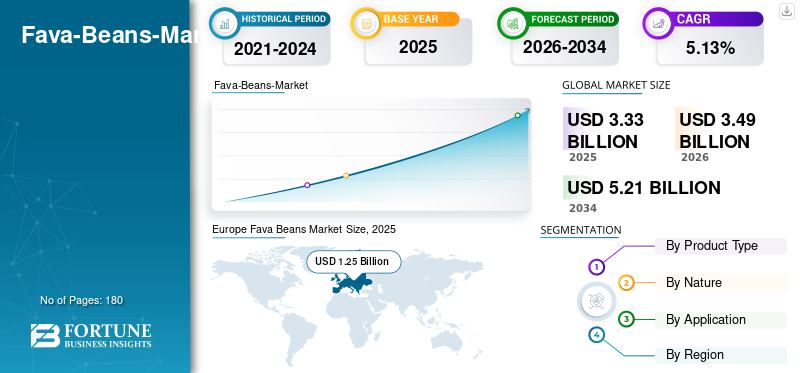
Download Free sample to learn more about this report.
Fava Beans Market Takeaways
 Global Market Size & Forecast
- 2025 Market Size: USD 3.33 billion
- 2026 Market Size: USD 3.49 billion
- 2034 Forecast Market Size: USD 5.21 billion
- CAGR: 5.13% from 2026–2034
 Market Share
- Europe dominated the fava beans market with a 37.54% share in 2025.
- Fava bean flour is projected to grow at a CAGR of 7.86% during the forecast period.
- The cosmetics & personal care segment is expected to expand at a CAGR of 11.99% during the forecast period.
 Key Regional Highlights
North America
North America recorded USD 0.51 billion in 2025, supported by growing consumer interest in plant-based and high-protein food ingredients.
Europe
Europe led the market with USD 1.25 billion in 2025 and is expected to maintain steady growth, supported by strong consumption of traditional fava bean products.
Asia Pacific
Asia Pacific reached USD 0.88 billion in 2025, driven by rising demand for plant-based proteins and increasing health awareness across emerging economies.
U.S.
The U.S. market was valued at approximately USD 0.35 billion in 2025, accounting for around 10.49% of global sales, driven by rising demand for plant-based foods.
Japan
Japan's fava beans market was valued at approximately USD 0.15 billion in 2025, supported by increasing adoption of nutritious, plant-based ingredients in food applications.
Read More

FAVA BEANS MARKET TRENDS
Increasing Use of Fava Bean Ingredients in Skincare Formulations is the Current Trend
The global market is witnessing a gradual yet evolving trend toward the use of fava-based components in beauty products, majorly fueled by the shift toward clean beauty/sustainable products. Extracts from beans are used in skincare items such as lotions/creams owing to their emulsifying and foaming properties. These ingredients are also used in hair care masks and conditioners, which improve thickness and reduce hair loss. Moreover, it is incorporated in eye masks to strengthen skin elasticity. Additionally, fava bean powder is being explored for use in lipsticks, as it offers a moisturizing effect and enhances smoothness. Along with this, its anti-aging properties help minimize acne concerns. Witnessing these advantages, global cosmetic producers are focusing on using fava-bean ingredients in beauty care products.
Download Free sample to learn more about this report.
MARKET DYNAMICS
MARKET DRIVERS
Expansion of Gluten-Free/Specialty Diet Products Drives Fava Flour Use
The flourishing specialty or gluten-free items sector is a remarkable driver in the global market, as fava bean based ingredients are highly used in products targeting health conscious and gluten-intolerant individuals. Unlike wheat-based products, broad bean-based products are gluten-free and offer both functional advantages (structure formation/water absorption) and protein enrichment in pasta and savory snack applications. Additionally, it is a rich source of amino acids, fiber, and micronutrients (folate, iron, and zinc). Moreover, the natural sugar and protein content of bean flour enhance crust formation and browning during the baking process. Recognizing these advantages, the gluten-free producers in the global space are trying to reformulate their portfolio and expand their product range beyond corn and tapioca flour.
MARKET RESTRAINTS
Presence of Anti-Nutritional Compounds and Rising Allergen Concerns Hinders Its Consumption
One of the pivotal restraints in the global industry is the presence of anti-nutritional components. Such beans contain particular anti-nutritional compounds, especially convicine and vicine, along with phytic acid and tannins. These components can have a negative impact on nutrient absorption and cause various psychological reactions in some sensitive individuals. The common issue faced by consumers is favism, a hemolytic reaction triggered by glucose-6-phosphate dehydrogenase (G6PD) deficiency upon ingestion of such beans. However, G6PD is known to affect a minimal percentage of the population; its incidence is higher in various parts of the Mediterranean and Middle East & Africa region, which are among the major consumers. Moreover, from a food production standpoint, the presence of covincine and vincine compounds needs careful processing, particularly when producing protein isolates and flour. Soaking, heat treatment, and dehulling can minimize anti-nutritional components, but they also fuel complexity and costs. As a result, the aforementioned factors hinder the global fava beans market share.
MARKET OPPORTUNITY
Adoption of Advanced Technologies in Beans Sector Opens Growth Possibilities
The usage of modern technologies in the beans industry creates several growth opportunities in the global market. To improve product uniformity and processing efficiency, the producers are adopting precision splitting and dehulling techniques. Innovations in wet and dry fractionation technologies are also gaining traction in the market, as they substantially enhance the extraction of fava bean isolates and concentrates. This upgradation strengthens the plant-centric protein segment by improving the utilization of such beans in non-dairy and meat products. Moreover, advanced texturization technologies are being adopted by food manufacturers to produce textured fava-based protein components. Besides this, enzymatic and fermentation treatments are also used by businesses to boost flavor profiles and strengthen digestibility.
Segmentation Analysis
By Product Type
Whole Fava Beans Dominated Market Due to Their Minimal Processing
Based on the product type, the market is distributed into whole fava beans, split fava beans, fava bean flour, and others.
The whole fava beans lead the global market in 2025. Compared to flour and other derivatives, whole beans undergo minimal processing, retaining their nutritional integrity and natural structure. The unprocessed beans offer a high fiber content and other micronutrients, and have a longer shelf life than flour. Moreover, it has reduced the risk of functional degradation as they are minimally exposed to oxidation and protein denaturation. Additionally, whole beans are widely utilized in traditional cuisines (salads and stews) across the Middle East and Mediterranean region. As a result, the aforementioned factors are responsible for boosting global fava beans market growth.
Fava bean flour is projected to grow at a high CAGR of 7.86% over the forecast period.
By Nature
Conventional Category Led Market Due to Its Cost-Effectiveness
Depending on the nature, the market is bifurcated into organic and conventional.
In 2025, the conventional category led the global industry. Conventional beans are primarily produced using crop protection inputs and synthetic fertilizers, which improve production efficiency. These beans require minimal traceability systems and certifications, unlike organic items, which are associated with high compliance costs. Additionally, it has lower retail price sensitivity, which appeals to budget-conscious consumers. Moreover, conventional farming allows effective disease and pest management via agrochemicals. Besides this, less complexed supply chains for conventional beans further minimize the risk of certification-centric disruptions. Thus, such factors bolster the segment’s potential.
The organic segment is projected to grow at a CAGR of 7.19% over the forecast period.
By Application
Food & Beverage Leads Industry Owing to High Usage of Beans in Culinary Applications
Based on application, the market is segmented into food & beverage, nutraceuticals, cosmetics & personal care, animal feed, and others.
Food & beverage dominated the global industry in 2025. In the food sector, this bean is widely used in the preparation of traditional African and Middle Eastern cuisine and is used in larger volumes than in the nutraceuticals and cosmetics sector. Moreover, the rising trend of plant-based protein is boosting demand for fava bean, especially in the formulation of plant-based products. Additionally, the extracts of such beans, which are used in the cosmetics industry, are expensive as compared to whole fava beans utilized in food products, further adding to the growth.
The cosmetics & personal care segment is anticipated to grow at a high CAGR of 11.99% over the forecast period.
To know how our report can help streamline your business, Speak to Analyst
Fava Beans Market Regional Outlook
By region, the market is categorized into Europe, North America, Asia Pacific, South America, and the Middle East & Africa.
Europe
Europe Fava Beans Market Size, 2025 (USD Billion)
To get more information on the regional analysis of this market, Download Free sample
Europe dominates the market and reached a valuation of USD 1.25 billion by 2025, recording a growth rate of 5.10% in the coming years. The rising number of health conscious consumers (vegetarians and vegans) and the increasing demand in the processed foods sector are propelling the region’s potential.
Germany Fava Beans Market
The Germany market size in 2025 was valued at around USD 0.31 billion, representing roughly 9.42% of the global revenues.
U.K. Fava Beans Market
The U.K. market value reached approximately USD 0.17 billion in 2025, equivalent to around 5.07% of the global market sales.
Asia Pacific
Asia Pacific market size reached USD 0.88 billion in 2025 and holds the second position. The surging demand for plant based proteins and the improved awareness of the health benefits of high protein content are key factors boosting the region’s potential. In the region, India and China both reached USD 0.18 billion and USD 0.31 billion, respectively, in 2025.
India Fava Beans Market
The India market in 2025 valued at around USD 0.18 billion, accounting for roughly 5.48% of the global market revenues. The growing health consciousness and rising prevalence of celiac disease are driving factors in the market.
China Fava Beans Market
China's market is projected to be one of the largest worldwide, with revenues estimated at around USD 0.31 billion in 2025, representing roughly 9.33% of the global market sales.
Japan Fava Beans Market
The Japan market in 2025 valued at around USD 0.15 billion, accounting for approximately 4.40% of the global market revenues.
North America
The North America market reached a valuation of USD 0.51 billion in 2025 in the global market and secured the third position. The market in North America is expected to grow due to the expansion of the meat alternatives sector and the growing demand for plant based foods. Moreover, product innovation and technological advancements improve regional growth.
U.S. Fava Beans Market
Based on North America’s strong contribution and the U.S. dominance within the region, the U.S. market analytically approximated at around USD 0.35 billion in 2025, accounting for roughly 10.49% of global sales.
South America and the Middle East & Africa
South America and the Middle East & Africa regions are expected to witness moderate growth in this market space during the forecast period. The South America market reached a valuation of USD 0.27 billion in 2025. The rising health consciousness and robust distribution channels are expected to drive regional growth. The Middle East and Africa market reached a valuation of USD 0.41 billion in 2025.
South Africa Fava Beans Market
The South Africa market reached around USD 0.18 billion in 2025, representing roughly 5.40% of global revenues.
COMPETITIVE LANDSCAPE
Key Industry Players
New Product Introductions Support Companies in Strengthening Market Position
The market is highly fragmented, with strong competition among companies operating in this segment. Within this landscape, leading firms are mainly focusing on new product launches as their core strategy. Through this approach, they aim to meet growing consumer demand and strengthen their brand image.
LIST OF KEY FAVA BEANS COMPANIES PROFILED:
- Roquette Freres (France)
- BENEO Corporation (Germany)
- Bunge (U.S.)
- AGT Food and Ingredients Inc. (Canada)
- Unigrain Pty Ltd (Australia)
- Burcon NutraScience Corporation (Canada)
- Nuttee Bean Co., (U.S.)
- United Pulse Trading (UPT) (Netherlands)
- NORDIC Grain Oy (Finland)
- The Scoular Company (U.S.)
KEY INDUSTRY DEVELOPMENTS
- September 2025: Maia Farms, a Canada-based mushroom-based ingredients firm, Protein Industries Canada, a Canadian plant-based food company, and Phytokana Ingredients, a food processing enterprise in Canada, partnered on a USD 23.50 million (approx.) project to convert fava beans into sustainable and nutritious components for plant-centric foods.
- August 2025: Burcon NutraScience Corporation, a Canadian plant-based ingredients producer, introduced a premium quality fava bean protein isolate, “FavaPro,” which offers more than 90% protein. This component is designed for use in the Canadian baked snacks and dairy alternatives sector.
- June 2025: Nuttee Bean Co., a U.S.-based high-protein snacks firm, launched a new brand, “Favalicious,” through which it offers fava bean-based pasta for the U.S. foodservice and retail markets.
- May 2024: Roquette Frères, a French ingredient manufacturer, revealed its first-ever fava bean protein isolate across the North America and European markets. This ingredient is intended for use in dairy and meat alternatives.
- February 2023: BENEO Corporation, a German functional ingredients enterprise, expanded its portfolio of animal nutrition by adding starch-rice flour and faba bean protein concentrate, which are non-GMO in nature.
REPORT COVERAGE
The global fava beans industry analysis provides an in-depth study of the market size & forecast by all the market segments included in the report. The market forecast includes details on the market dynamics and global market trends expected to drive the market during the forecast period. Further, the global market analysis offers information on the technological advancements, new product launches, key industry developments, and details on partnerships, mergers & acquisitions. The market forecast also encompasses a detailed competitive landscape with information on the market segmentation, market share, and profiles of key operating players.
Request for Customization to gain extensive market insights.
Report Scope & Segmentation
| ATTRIBUTE | DETAILS |
| Study Period | 2021-2034 |
| Base Year | 2025 |
| Forecast Period | 2026-2034 |
| Historical Period | 2021-2024 |
| Growth Rate | CAGR of 5.13% from 2026-2034 |
| Unit | Value (USD Billion) |
| Segmentation | By Product Type, Nature, Application, and Region |
| By Product Type |
|
| By Nature |
|
| By Application |
|
| By Region |
North America (By Product Type, Nature, Application, and Country)
Europe (By Product Type, Nature, Application, and Country)
Asia Pacific (By Product Type, Nature, Application, and Country)
South America (By Product Type, Nature, Application, and Country)
Middle East and Africa (By Product Type, Nature, Application, and Country)
|
Frequently Asked Questions
Fortune Business Insights says that the global market value stood at USD 3.33 billion in 2025 and is projected to reach USD 5.21 billion by 2034.
In 2025, the market value stood at USD 1.25 billion.
The market is expected to exhibit a CAGR of 5.13% during the global market forecast period.
By nature, the conventional segment led the global market in 2025.
The expansion of gluten-free/specialty diet products drives fava flour use.
Roquette Freres, BENEO Corporation, and Bunge are among the key players in the market.
Europe held the largest market share in 2025.
The increasing use of fava bean ingredients in skincare formulations is the current trend.



- 2021-2034
- 2025
- 2021-2024
- 180
-
(Offer valid till 15th Oct 2026)
Get 30-60 hrs Free Customization
Expand Regional and Country Coverage, Segments Analysis, Company Profiles, Competitive Benchmarking, and End-user Insights.




















Related Reports
-
US +1 833 909 2966 ( Toll Free )
-
Get In Touch With Us