Global Feed Antioxidants Market Size, Share & Industry Analysis, By Type (Synthetic Antioxidants {Butylated Hydroxyanisole (BHA), Butylated Hydroxytoluene (BHT), Ethoxyquin Propyl Gallate, TBHQ (Tertiary-Butylhydroquinone)} and Natural Antioxidants {Tocopherols (Vitamin E), Ascorbic Acid (Vitamin C), Carotenoids, Plant Extracts, Citric Acid & Other Organic Acids}), By Form (Dry / Powder Form and Liquid Form), By Function (Feed Preservation, Nutritional Antioxidants, Color & Flavor Stabilization and Shelf-life Extension), By Animal, and Regional Forecast, 2026-2034
 Download Free Sample
(Offer valid till 15th Oct 2026)

KEY MARKET INSIGHTS
 Listen to Audio Version
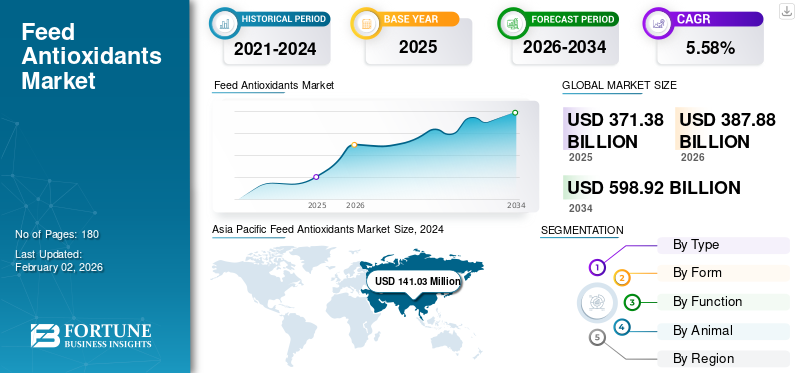
The global feed antioxidants market size was valued at USD 371.38 billion in 2025. The market is projected to grow from USD 387.88 billion in 2026 to USD 598.92 billion by 2034, exhibiting a CAGR of 5.58% during the forecast period. Asia Pacific dominated the feed antioxidants market with a market share of 41.35% in 2025.
Feed antioxidants are additive substances that are mixed with animal feed products. These products help to prevent oxidation of feed ingredients and help to protect animal health by reducing oxidative stress. The rising demand for animal feed products in Asia and South America has significantly boosted the demand for nutritionally balanced animal feed formulations in the market.
Companies such as BASF SE, Cargill Incorporated, Kemin Industries, Inc. are some of the key players operating in this market. Companies are launching new product lines with improved efficacy in the market.
Download Free sample to learn more about this report.
Feed Antioxidants Market Key Takeaways
 Market Size & Forecast
- 2025 Market Size: USD 371.38 billion
- 2026 Market Size: USD 387.88 billion
- 2034 Forecast Market Size: USD 598.92 billion
- CAGR: 5.58% from 2026–2034
 Market Share
- Asia Pacific dominated the feed antioxidants market with a 41.35% share in 2025.
- The synthetic segment is projected to account for 62.09% of the market share in 2026.
- The feed preservation segment is expected to hold 53.12% of the global market share in 2026.
 Key Regional Highlights
Asia Pacific
Asia Pacific generated USD 153.56 billion in revenue in 2025 and is projected to reach USD 160.90 billion in 2026.
North America
North America captured 19.98% of global revenue in 2025 and is projected to reach USD 77.23 billion in 2026.
Europe
Europe accounted for 23.23% of the global market in 2025 and is expected to reach USD 90.00 billion in 2026.
U.S.
The U.S. feed antioxidants market is projected to reach USD 62.64 billion by 2026.
Japan
Japan’s feed antioxidants market is projected to reach USD 8.97 billion by 2026.
Read More

MARKET DYNAMICS
MARKET DRIVERS
Rising Global Demand for Animal Protein Supports Market Growth
Population growth and urbanization are key factors driving the demand and consumption of protein-rich food products, such as meat, milk, eggs, and fish, among consumers. As per the Food and Agriculture Organization (FAO), global demand for meat products is expected to increase by over 14% by 2030 compared to 2020. This growing demand for protein directly influences the demand for compound feed, as feed is the primary input for livestock production. Therefore, the demand for animal feed products is expected to continue to increase in the future as well. Rising global food production is driving higher demand for feed antioxidants as livestock producers seek to maintain feed quality and animal performance throughout intensive farming cycles.
MARKET RESTRAINTS
Disease Outbreaks and Stringent Feed Related Regulatory Guidelines to Impede Market Growth
In recent years, there have been regular outbreaks of Avian influenza, African swine fever (ASF), and foot-and-mouth disease, which negatively impact the livestock populations. Such outbreaks lead to a decline in demand for feed products, resulting in a reduction in demand for feed in the affected regions. Moreover, the tight supply of feed in the market, stringent regulations related to additive approval, and residue limit regulations in key markets such as Europe, the U.S., and Japan, impact product launches, which in turn hinder global feed antioxidants market growth. Furthermore, volatility in the prices of key raw materials, such as petrochemical derivatives and natural plant extracts, continues to influence the overall cost structure of feed antioxidants.
MARKET OPPORTUNITIES
Product Innovation in Compound Feed and Premix Production Creates Opportunity to Expand Sales
There is an increasing use of vitamin/mineral premixes, fats, and oils in animal feed products. As these ingredients help to raise oxidation risk, they create a structural demand for antioxidants in every formulation. This, in turn, helps to create the need to develop customized antioxidant systems for manufacturing fat-rich poultry feeds, aquaculture lipid stabilization, and also to manufacture vitamin/mineral premixes for animal feed products. Therefore, such expansion in the applications necessitates the need to develop different antioxidant solubility and synergistic blends for the market, creating growth opportunities for the manufacturers.
FEED ANTIOXIDANTS MARKET TRENDS
Technological Innovation in Delivery Systems of Animal Feed is Key Trend Influencing Market
In recent years, there has been advancement in the development of microencapsulation, nanoemulsion, and controlled-release antioxidants that helps to improve product stability and heat resistance during feed pelleting. The use of microencapsulated Vitamin E and lipid-protected natural extracts in manufacturing different animal feed formulations is expanding rapidly. Use of advanced technology helps to differentiate products based on increased efficacy and shelf life, creating a product line that is technology-driven.
Download Free sample to learn more about this report.
Segmentation Analysis
By Type
Synthetic Segment Accounts for Major Market Share as it is Economical
The market is divided by type into synthetic and natural antioxidants. Synthetic oxidants are further segmented into butylated hydroxyanisole (BHA), butylated hydroxytoluene (BHT), ethoxyquin, propyl gallate, TBHQ (Tertiary-Butylhydroquinone). Natural antioxidants are further segmented into tocopherols (Vitamin E), ascorbic acid (Vitamin C), carotenoids, plant extracts, citric acid & other organic acids.
The synthetic segment is anticipated to hold a dominant market share of 62.09% in 2026. These products are chemically pure, and deliver a standardized and uniform impact in preventing oxidation. Moreover, synthetic antioxidants are far less expensive to produce than natural extract making it suitable for cost conscious consumers.
The natural segment is expected to grow at a CAGR of 4.89% over the forecast period. Regulatory restriction on the use of chemical products is one of the major factors which is supporting the market’s growth.
By Form
Dry/powder accounted for Major Market Share Due to Uniform Mixture and Cost Effectiveness
The market is segmented by form into Dry / Powder Form and Liquid Form.
The Dry/powder form segment is anticipated to hold a dominant market share of 72.34% in 2026. They are easy to mix and can be easily blended to develop uniform mixtures of animal feed without impacting the physical and chemical properties of feed products. This form is highly concentrated, which allows precise dosing and helps reduce transportation costs.
Liquid form is another major segment which is expected to grow by 4.98% during the forecast period. This form of product is suitable for stabilizing feed oils, animal fats, and premix lipids prior to blending them into compound feed.
By Function
Feed Preservation Accounted for Major Market Share Due Effectiveness in Enhancing Shelf Life
The market is segmented by function into feed preservation, nutritional antioxidants, color & flavor stabilization, and shelf-life extension.
The Feed preservation segment is expected to account for 53.12% of the market in 2026. As feeds are made of several vitamins and minerals the use of such products help to prevent oxidation and maintain product stability and increase shelf life.
The Nutritional Antioxidants segment is another major segment which is expected to grow by 5.24% during the forecast period. Nutritional antioxidants help to strengthen immune cell function and improve animals’ ability to fight infections and recover from stress.
By Animal
To know how our report can help streamline your business, Speak to Analyst
Strong Popularity of Poultry Contributed to Higher Share of this Segment
The market is segmented by animal into poultry, swine, ruminants, aquaculture, and others.
The Poultry segment will account for 44.46% market share in 2026 and holds a major share in the animal feed antioxidants market. Antioxidants are essential for animal health and welfare and poultry meat is one of the largest consumed meat in the world. It is an affordable source of protein and it is cheaper to produce compared to other animals.
Swine is another major category with a CAGR of 5.09% during the forecast period. Many cultures in Asia pacific which are the leading consumer of animal meat prefer to consume swine. This includes China, Japan, South Korea and others who grow swine for consumption leading to high consumption of feed products for swine animals.
Feed Antioxidants Market Regional Outlook
By geography, the market is categorized into Europe, North America, Asia Pacific, South America, and the Middle East & Africa.
ASIA PACIFIC
Asia Pacific Feed Antioxidants Market Size, 2025 (USD Million)
To get more information on the regional analysis of this market, Download Free sample
Asia Pacific accounted for USD 153.56 billion in 2025, representing 41.35% of the global market share, and is projected to reach USD 160.9 billion in 2026. The market in the Asia Pacific is estimated to reach USD 153.56 million in 2025. Feed manufacturers in Asia are enhancing the oxidative stability of their products, and they are collaborating with international companies to develop high-quality formulations for the market. Countries such as China, India, Japan, and others are some of the largest aquaculture farmers in the region, and they are increasingly adopting high-quality antioxidant-rich feed products in their farms. In this region, China and Japan are estimated to reach USD 85.37 million and USD 8.21 million, each, in 2025. The Japan market is valued at USD 8.97 billion by 2026, the China market is valued at USD 89.7 billion by 2026, and the India market is valued at USD 14.6 billion by 2026.
EUROPE
Europe contributed 23.23% to the global market in 2025, with a valuation of USD 86.28 billion, and is projected to reach USD 90 billion in 2026. Europe has established one of the world’s most rigorous feed additive regulations that is enforced by the European Food Safety Authority (EFSA) and EU Feed Additives Regulation (EC No. 1831/2003). It has banned the use of Ethoxyquin, BHA/BHT and other synthetic compounds. Therefore, feed manufacturers have to include regulatory body-approved, high-quality antioxidant systems to comply with safety standards in the region. During the forecast period, the European region is projected to record a growth rate of 4.94%. Backed by these factors, countries such as Germany are expected to record valuations of USD 13.82 million, France USD 10.96 million, and the U.K. USD 9.58 million in 2025. The UK market is valued at USD 10.07 billion by 2026, while the Germany market is valued at USD 14.52 billion by 2026.
NORTH AMERICA
The North America market generated USD 74.19 billion in 2025, representing 19.98% of the global market landscape, and is expected to reach USD 77.23 billion in 2026.
Modern livestock farmers are heavily influenced by diets that have high-energy formulations, are rich in polyunsaturated fatty acids (PUFA), oils, and fat-soluble vitamins. Large-scale, high-output farms require compound feeds that have high oil and vitamin content. Such compounds are highly prone to oxidation, and the use of these products helps preserve fat quality, prevent rancidity, and maintain nutrient stability, thereby enabling bulk storage and transport over long distances. In 2025, the U.S. market is estimated to reach USD 60.08 million. The U.S. is one of the largest meat producers and exporters of poultry, beef, and swine. The U.S. market is valued at USD 62.64 billion by 2026.
SOUTH AMERICA & MIDDLE EAST & AFRICA
In 2025, Middle East & Africa held 9.34% of the global market, reaching a valuation of USD 34.69 billion, and is projected to grow to USD 36.07 billion in 2026. Over the forecast period, South America will witness a high growth in this market. Research associations in Brazil and Argentina are using antioxidants as a key to improving energy density and vitamin stability in animal feed products. Middle East countries are experiencing a steady increase in meat, milk, and egg consumption, which is expected to drive up demand for compound feed products.
Latin America
Latin America contributed approximately USD 22.66 billion to the global market in 2025, accounting for 6.10% share, and is expected to reach USD 23.68 billion in 2026.
COMPETITIVE LANDSCAPE
Key Industry Players
Product Innovation and Technological Innovation are Key Strategies Used to Increase Sales
The market exhibits a consolidated structure with key market players such as BASF SE, Cargill Incorporated, Kemin Industries, Inc. operating in the market. Product innovation is one of the major strategies where it develops natural antioxidants (tocopherols, plant extracts) to meet “clean label” demand. Technology/format innovation is another major category where manufacturers are innovating and developing better delivery systems (micro-encapsulation, liquid forms, blends) to improve antioxidant efficacy.
LIST OF KEY FEED ANTIOXIDANTS COMPANIES PROFILED
- BASF SE (Germany)
- Kemin Industries, Inc. (U.S.)
- Royal DSM N.V. (Netherlands)
- Cargill, Incorporated (U.S.)
- Alltech, Inc. (U.S.)
- DuPont de Nemours, Inc. (U.S.)
- Oxiris Chemicals (Spain)
- Synergia Life Sciences (India)
- Ab Vista Ltd. (U.K.)
- MIAVIT Stefan Niemeyer GmbH (Germany)
KEY INDUSTRY DEVELOPMENTS
- September 2025 – Brenntag Specialties Animal Nutrition and BTSA presented their feed antioxidants product portfolio in a conference in Sweden. This organic antioxidant solution is suitable for pet food, rendering and feed applications.
- August 2025 – Ecolex Animal Nutrition improved its online presence by launching a new, user-friendly website. This website is mainly aimed to improve the sales of products in the market.
- March 2025: Feedworks USA one of the leading distributors of specialty feed ingredients named Elife and included it in its product lineup for monogastric and ruminant diets. It is a 100% natural blend of multiple EU-sourced polyphenols.
- September 2024: Syensqo introduced a new range of antioxidants named Riza in the market. The product is suitable for a wide range of applications which includes food, and animal feed as well.
- July 2021: Natural antioxidant manufacturer AstaReal launched antioxidant rich pet food ingredient NOVASTA in the market. It is suitable for all kinds of animal feed including pets, aquaculture, and others.
Request for Customization to gain extensive market insights.
Report Scope & Segmentation
| ATTRIBUTE | DETAILS |
| Study Period | 2021-2034 |
| Base Year | 2025 |
| Forecast Period | 2026-2034 |
| Historical Period | 2021-2024 |
| Growth Rate | CAGR of 5.58% from 2026-2034 |
| Unit | Value (USD Million) |
| Segmentation |
By Type · Synthetic Antioxidants o Butylated Hydroxyanisole (BHA) o Butylated Hydroxytoluene (BHT) o Ethoxyquin o Propyl Gallate o TBHQ (Tertiary-Butylhydroquinone) · Natural Antioxidants o Tocopherols (Vitamin E) o Ascorbic Acid (Vitamin C) o Carotenoids o Plant Extracts (Rosemary, Green Tea, etc.) o Citric Acid & Other Organic Acids By Form · Dry / Powder Form · Liquid Form By Function · Feed Preservation · Nutritional Antioxidants · Color & Flavor Stabilization · Shelf-life Extension By Animal · Poultry · Swine · Ruminants · Aquaculture · Others By Region North America (By Type, Form, Function, Animal and Country)
Europe (By Type, Form, Function, Animal and Country)
Asia Pacific (By Type, Form, Function, Animal and Country)
South America (By Type, Form, Function, Animal and Country)
Middle East and Africa (By Type, Form, Function, Animal and Country)
· Rest of the Middle East & Africa (By Form) |
Frequently Asked Questions
Fortune Business Insights says that the global market value stood at USD 371.38 million in 2025 and is projected to reach USD 598.92 million by 2034.
In 2025, the market value stood at USD 153.56 million.
The market is expected to exhibit a CAGR of 5.58% during the forecast period of 2026-2034.
By type, the synthetic type segment led the global market in 2025.
Rising global demand for animal protein supports the market growth.
BASF SE, Cargill Incorporated, Kemin Industries, Inc. are a few of the players in the feed antioxidants market.
Asia Pacific held the largest market share in 2025.
Technological innovation in delivery systems of animal feed is the key trend influencing the market.



- 2021-2034
- 2025
- 2021-2024
- 180
-
(Offer valid till 15th Oct 2026)
Get 30-60 hrs Free Customization
Expand Regional and Country Coverage, Segments Analysis, Company Profiles, Competitive Benchmarking, and End-user Insights.














Related Reports
-
US +1 833 909 2966 ( Toll Free )
-
Get In Touch With Us