Flex-Fuel Vehicle Market Size, Share & Industry Analysis, By Vehicle Type (Hatchbacks & Sedans, SUVs, LCVs, and HCVs), By Propulsion Architecture (Flex-Fuel Internal Combustion Engine (ICE) Vehicles and Flex-Fuel Hybrid Electric Vehicles (HEVs/PHEVs)), By Fuel Blend Compatibility (E10-E20 Compatible Vehicles, E21-E50 Compatible Vehicles, and E51 & Above Compatible Vehicles), By Engine Displacement (Below 1.5L, 1.5L-2.5L, and Above 2.5L), and Regional Forecast, 2026-2034
 Download Free Sample
(Offer valid till 15th Aug 2026)
Flex-fuel Vehicle Market Size and Future Outlook
 Listen to Audio Version
The global flex-fuel vehicle market size was valued at USD 77.7 million in 2025. The market is projected to grow from USD 82.7 million in 2026 to USD 137.1 million by 2034, exhibiting a CAGR of 6.5% during the forecast period. South America dominated the flex fuel vehicle market with a market share of 83.65% in 2025.
A flex-fuel vehicle is a vehicle equipped with modified internal combustion engines capable of operating on gasoline, ethanol blends such as E85, or other renewable fuels, offering greater fuel flexibility and energy diversification. Market growth is driven by blending mandates, rising ethanol consumption, increasing adoption of ethanol in transportation fuels, supportive renewable fuel standards, volatile crude oil prices, expanding ethanol production, and the focus on reducing greenhouse gas emissions.
Major players in the market include Ford Motor Company, General Motors Company, Stellantis N.V., Volkswagen AG, Toyota Motor Corporation, Nissan Motor Co., Ltd., Honda Motor Co., Ltd., Hyundai Motor Company, and Renault Group, competing through advanced flex-fuel engine technologies, E85-compatible vehicle development, fuel-efficiency improvements, strategic biofuel partnerships, and compliance with evolving renewable fuel and emissions regulations.
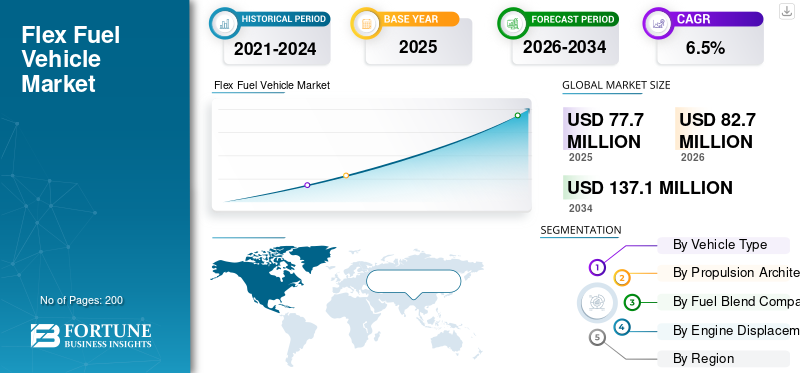
Download Free sample to learn more about this report.
Flex Fuel Vehicle Market Key Takeaways
 Global Market Size & Forecast
- 2025 Market Size: USD 77.7 million
- 2026 Market Size: USD 82.7 million
- 2034 Forecast Market Size: USD 137.1 million
- CAGR: 6.5% from 2026-2034
 Market Share
- South America dominated the flex-fuel vehicle market with an 83.65% share in 2025.
- The flex-fuel hybrid electric vehicles (HEVs/PHEVs) segment is projected to grow at the highest CAGR of 14.4% during the forecast period.
- The below 1.5L segment is projected to expand at a CAGR of 6.3% during the forecast period.
 Key Regional Highlights
North America
North America was the second-largest regional market in 2025.
Asia Pacific
Asia Pacific is projected to register the fastest growth at a CAGR of 10.1% during the forecast period.
Europe
Europe was the third-largest regional market in 2025.
U.S.
The U.S. market is estimated to reach USD 9.98 million in 2026.
Japan
The Japan market is estimated to reach USD 0.09 million in 2026.
Read More

FLEX-FUEL VEHICLE MARKET TRENDS
Expansion of Advanced E85-Compatible Vehicle Platforms Enhances Consumer Acceptance
Automotive manufacturers are increasingly introducing advanced E85-compatible vehicle platforms with improved fuel management systems, engine calibration technologies, and performance capabilities. Modern flex-fuel vehicles can seamlessly switch between gasoline and ethanol blends while maintaining operational efficiency. This trend is improving consumer confidence and expanding vehicle availability across multiple segments. Enhanced compatibility with higher ethanol blends is also supporting greater ethanol demand and strengthening the integration of renewable fuels into mainstream transportation systems, particularly in regions with established biofuel ecosystems.
- For instance, in October 2025, Suzuki showcased the Fronx Flex Fuel Vehicle concept at the Japan Mobility Show 2025, engineered to operate on E85 fuel.
Strategic Partnerships across Ethanol Value Chain Strengthen Market Development
Automakers, ethanol producers, fuel distributors, and government agencies are increasingly forming strategic partnerships to support flex-fuel adoption. These collaborations focus on expanding fuel infrastructure, improving fuel availability, and promoting consumer awareness. Joint investments are helping accelerate ethanol production capacity and strengthen supply chains. Industry participants are also working together on research and development initiatives to improve vehicle efficiency and fuel performance. Such ecosystem-wide cooperation is becoming an important market trend that supports sustainable long-term industry development.
- For instance, in May 2024, GM-certified 2025 FFVs can use gasoline, E85, or any blend, signaling renewed OEM interest in flex-fuel vehicles.
MARKET DYNAMICS
MARKET DRIVERS
Download Free sample to learn more about this report.
Rising Ethanol Blending Mandates and Renewable Fuel Policies Accelerate Vehicle Adoption
Government-led blending mandates and renewable fuel standards are encouraging the use of higher ethanol blends across transportation fuels. Countries, including Brazil, India, and the U.S., are increasing ethanol blending targets to strengthen energy security and reduce dependence on fossil fuels. These regulatory initiatives are encouraging automakers to expand flex-fuel vehicle portfolios and invest in compatible engine technologies. As ethanol infrastructure expands and policy support remains strong, consumers and fleet operators are increasingly adopting flexible fuel vehicle solutions.
- For instance, in June 2026, India waived excise duty on E22, E25, E27, and E30 fuels, supporting higher ethanol blending and future flex-fuel vehicle adoption.
Growing Focus on Reducing Greenhouse Gas Emissions Supports Market Expansion
The transportation sector is under increasing pressure to lower carbon emissions and support climate goals. Flex-fuel vehicles offer a practical pathway for reducing greenhouse gas emissions by utilizing renewable fuels such as ethanol. Governments, fleet operators, and consumers are increasingly considering lower-carbon transportation alternatives that can leverage existing fueling infrastructure. Compared with complete vehicle electrification, flex-fuel technology provides a relatively cost-effective transition option, supporting broader adoption across passenger and commercial vehicle categories while contributing to sustainability objectives. This is expected to boost the flex-fuel vehicle market growth over the forecast period.
- For instance, as per U.S. Bioenergy Statistics Data, 2026, ethanol remains a major U.S. transport biofuel, supporting long-term renewable-fuel demand.
MARKET RESTRAINTS
Limited Rural Charging Infrastructure Restricts Market Expansion
The availability of charging infrastructure remains a significant barrier to widespread deployment of flex-fuel vehicles, particularly in remote and rural farming regions. Many farms lack adequate electrical capacity or charging facilities required to support large-scale electric equipment operations. Long charging times compared to conventional refueling can also create operational challenges during peak agricultural seasons. While infrastructure investments are gradually increasing, limitations in charging accessibility and grid connectivity continue to slow adoption rates among farmers considering a transition to electric machinery.
- For instance, in June 2026, as highlighted in NITI Aayog’s report, India may delay higher ethanol mandates as E20-compatible vehicles can face 1-2% fuel-efficiency losses, raising consumer acceptance concerns.
MARKET OPPORTUNITIES
Emerging Ethanol Programs in Asia Pacific Create New Growth Potential
Several countries across Asia Pacific are implementing ambitious ethanol blending programs to reduce fuel imports and improve environmental performance. Expanding ethanol infrastructure and favorable policy frameworks are creating significant opportunities for automakers to introduce flex-fuel vehicle models. Growing vehicle ownership, increasing fuel consumption, and supportive government initiatives are strengthening market attractiveness. As ethanol availability improves across emerging economies, manufacturers can capitalize on new customer segments and expand regional market presence while supporting national renewable energy objectives.
- For instance, in June 2026, The Economic Times mentioned that India launched E85 dispensing with a USD 0.21 per liter discount, creating new demand potential for high-ethanol compatible vehicles.
Commercial Fleet Conversion Initiatives Generate Untapped Revenue Streams
Commercial transportation operators are increasingly exploring alternative fuel solutions to manage fuel expenses and meet sustainability targets. Flex-fuel vehicles offer fleet owners the flexibility to utilize different fuel blends based on availability and economics. Logistics providers, public transportation agencies, and corporate fleets are evaluating ethanol-powered vehicle deployments as part of broader environmental strategies. Growing fleet conversion programs create opportunities for vehicle manufacturers, fuel suppliers, and infrastructure developers to expand their offerings and establish long-term partnerships within the commercial transportation sector.
- For instance, in August 2024, Toyota India said electrified FFVs can combine ethanol engines with hybrid systems, improving efficiency and supporting scalable clean mobility.
MARKET CHALLENGES
Inconsistent Ethanol Supply Infrastructure Creates Operational Uncertainty
Despite growing adoption, ethanol fueling infrastructure remains unevenly distributed across many regions. Limited availability of high-ethanol blends can reduce consumer confidence and restrict vehicle utilization. Supply chain disruptions, regional variations in ethanol production, and differences in fuel distribution networks may create operational challenges for vehicle owners and fleet operators. Ensuring consistent fuel availability requires coordinated investments across production, storage, transportation, and retail fueling systems. Addressing these infrastructure gaps remains a key challenge for achieving broader market penetration.
Segmentation Analysis
By Propulsion Architecture
Established Ethanol-Compatible Vehicle Base Boosted Flex-Fuel Internal Combustion Engine (ICE) Vehicle Demand
Based on propulsion architecture, the market is segmented into flex-fuel internal combustion engine (ICE) vehicles and flex-fuel hybrid electric vehicles (HEVs/PHEVs).
The flex-fuel internal combustion engine (ICE) vehicles segment dominated the market in 2025. The segment benefits from a large installed base of ethanol-compatible vehicles, widespread fuel availability, and strong consumer familiarity with conventional powertrain technologies. Automakers continue to expand flex-fuel offerings across passenger and commercial vehicle categories due to lower production costs and easier integration with existing manufacturing platforms. Supportive blending mandates, rising ethanol consumption, and expanding renewable fuel programs further strengthen adoption. The ability to utilize multiple fuel blends without major infrastructure changes continues to sustain demand across major markets.
The flex-fuel hybrid electric vehicles (HEVs/PHEVs) segment is the fastest-growing segment and is projected to expand at a CAGR of 14.4% during the forecast period. Growth is driven by increasing demand for fuel-efficient mobility solutions that combine ethanol compatibility with electrified propulsion. Stricter emission regulations, technological advancements, and growing investments in low-carbon transportation are accelerating adoption across developed and emerging markets.
- For instance, in August 2024, Toyota highlighted FFV-SHEV technology, where electric powertrains offset ethanol’s lower energy density, supporting flex-fuel hybrid vehicle
By Engine Displacement
1.5L-2.5L Segment Led Due to Broad Consumer Acceptance and Vehicle Availability
Based on engine displacement, the market is segmented into below 1.5L, 1.5L-2.5L, and above 2.5L.
The 1.5L-2.5L segment dominated the flex-fuel vehicle market share in 2025. The segment benefits from its widespread adoption across passenger cars, light commercial vehicles, and fleet transportation applications. This engine category offers an optimal balance between fuel efficiency, vehicle performance, and ethanol compatibility, making it highly suitable for flex-fuel applications. Automakers increasingly utilize this displacement range for mass-market models due to regulatory compliance requirements and consumer preference for practical, cost-effective vehicles. Expanding ethanol blending programs and growing adoption of renewable fuels continue to support demand across both developed and emerging automotive markets.
The below 1.5L segment is the second-largest segment and is projected to expand at a CAGR of 6.3% during the forecast period. Growth is supported by rising demand for compact vehicles, improving fuel economy standards, and increasing adoption of flex-fuel technology in urban transportation. Manufacturers are focusing on smaller, ethanol-compatible engines to meet affordability and emission reduction objectives.
- For instance, Fuel Economy (U.S. Department of Energy) lists 2025 Chevrolet Trax and Trailblazer FFVs with 1.2L engines, supporting compact displacement adoption.
By Fuel Blend Compatibility
Strong Ethanol Infrastructure and Regulatory Fostered E51 & Above Compatible Vehicles Segment Growth
Based on fuel blend compatibility, the market is segmented into E10-E20 compatible vehicles, E21-E50 compatible vehicles, and E51 & above compatible vehicles.
The E51 & above compatible vehicles segment dominated the market in 2025. The segment benefits from strong adoption in countries with well-established ethanol ecosystems, particularly where high-blend ethanol fuels are widely available. These vehicles are specifically designed to maximize the use of renewable fuels, supporting national energy security and emissions reduction goals. Government-backed blending mandates, expanding ethanol production capacity, and increasing consumer acceptance of higher ethanol blends continue to strengthen demand. Automakers are also expanding E85-compatible product portfolios to capitalize on growing ethanol demand and evolving fuel diversification strategies.
- For instance, in June 2025, the Ministry of Road Transport and Highways, India, highlighted that the government is preparing testing norms for E85-E100 vehicles, enabling OEMs to produce cars compatible with up to 100% ethanol.
The E21-E50 compatible vehicles segment is the second-largest segment and is projected to expand at a CAGR of 5.3% during the forecast period. Growth is supported by the gradual expansion of mid-level ethanol blending programs, increasing fuel flexibility requirements, and rising investments in transportation fuels that balance infrastructure readiness with environmental objectives.
By Vehicle Type
To know how our report can help streamline your business, Speak to Analyst
Hatchbacks & Sedans Segment Dominated Due to Extensive Consumer Adoption and High Production Volumes
Based on vehicle type, the market is segmented into hatchbacks & sedans, SUVs, LCVs, and HCVs.
The hatchbacks & sedans segment dominated the market in 2025. The segment benefits from its large global vehicle population and widespread use across personal transportation applications. These vehicles represent the primary target category for flex-fuel technology due to their affordability, high production volumes, and broad consumer acceptance. Automakers continue integrating ethanol-compatible powertrains into mass-market passenger vehicles to comply with renewable fuel policies and emission reduction goals. Growing ethanol consumption, expanding fuel ethanol market infrastructure, and increasing adoption of ethanol across major automotive markets continue to reinforce demand for this segment.
The SUVs segment is the fastest-growing segment and is projected to expand at a CAGR of 7.7% during the forecast period. Growth is driven by rising consumer preference for larger vehicles, expanding flex-fuel SUV model availability, and increasing demand for versatile transportation solutions. Manufacturers are introducing ethanol-compatible SUV platforms to address changing consumer lifestyles while supporting renewable fuel adoption initiatives.
- For instance, Fuel Economy (U.S. Department of Energy) lists 2025 Chevrolet Trax, Buick Envista, Trailblazer, Silverado, and GMC Sierra FFVs, covering cars, SUVs, and pickups.
Flex-fuel Vehicle Market Regional Outlook
By geography, the market is categorized into Europe, North America, Asia Pacific, South America, and the Middle East & Africa.
South America
South America Flex-fuel Vehicle Market Size, 2025 (USD Million)
To get more information on the regional analysis of this market, Download Free sample
South America dominated the market in 2025. The region benefits from a highly developed ethanol ecosystem, extensive flex-fuel vehicle penetration, and long-standing government support for biofuel adoption. Brazil remains the primary growth engine due to its mature fuel ethanol market, widespread availability of high-ethanol blends, and strong consumer acceptance of flex-fuel technologies. Continuous investments in ethanol production, favorable blending mandates, and established fueling infrastructure support sustained market expansion. The region's leadership in renewable fuels continues to strengthen demand across passenger and commercial vehicle segments.
Brazil Flex-fuel Vehicle Market
The Brazil market in 2026 is estimated at around USD 65.27 million, accounting for roughly 78.9% of global revenues. As the dominant market globally, growth is sustained by mature ethanol infrastructure, widespread flex-fuel vehicle adoption, strong ethanol consumption, favorable blending mandates, and long-standing biofuel industry leadership.
North America
North America was the second-largest market in 2025 and continues to demonstrate stable growth driven by expanding renewable fuel standards and increasing ethanol demand. The U.S. remains the key contributor due to its significant ethanol production capacity, extensive agricultural feedstock availability, and growing E85 infrastructure. Automakers are increasingly offering ethanol-compatible vehicle models to comply with sustainability objectives and diversify fuel options. Rising interest in reducing greenhouse gas emissions and enhancing energy security supports market development.
- For instance, Fuel Economy (U.S. Department of Energy) shows 2025 U.S. FFV availability led by GM models, including Silverado, Sierra, Trax, Trailblazer, Envista, and Encore GX.
U.S. Flex-fuel Vehicle Market
The U.S. market in 2026 is estimated at around USD 9.98 million, accounting for roughly 12.1% of global revenues. Growth is driven by strong ethanol production capacity, established renewable fuel standards, extensive E85 infrastructure, and continued demand for flexible transportation fuel options across consumer and fleet sectors.
Europe
Europe was the third-largest market in 2025. Growth is supported by the region's strong focus on carbon reduction, renewable energy adoption, and transportation decarbonization strategies. Several countries are encouraging the use of alternative fuels through supportive regulatory frameworks and sustainability initiatives. While electric vehicles remain a major priority, flex-fuel technologies provide an additional pathway for lowering transportation emissions. Increasing investments in renewable fuels and growing interest in diversified mobility solutions contribute to market expansion. The region is projected to grow at a CAGR of 3.5% during the forecast period.
Germany Flex-fuel Vehicle Market
The Germany market in 2026 is estimated at around USD 0.15 million, accounting for roughly 0.2% of global revenues. Growth is supported by sustainability objectives, increasing interest in renewable fuels, emission reduction initiatives, and continued development of alternative transportation solutions alongside conventional mobility technologies.
U.K. Flex-fuel Vehicle Market
The U.K. market in 2026 is estimated at around USD 0.12 million, accounting for roughly 0.2% of global revenues. Market expansion is supported by renewable fuel adoption programs, carbon reduction targets, evolving fuel regulations, and growing focus on diversified pathways toward sustainable transportation systems.
Asia Pacific
Asia Pacific is the fastest-growing region in the market with a CAGR of 10.1% over the forecast period. Countries such as India, China, and Thailand are actively promoting ethanol blending programs to reduce fuel imports and strengthen domestic energy security. Government initiatives supporting ethanol consumption, expanding fuel distribution networks, and increasing the adoption of ethanol-compatible vehicles are accelerating growth. Rising vehicle ownership and growing awareness of renewable fuels further support market expansion. Continuous policy support and investments in biofuel infrastructure position the region as a major future growth hub for flex-fuel vehicles.
China Flex-fuel Vehicle Market
The China market in 2026 is estimated at around USD 0.16 million, accounting for roughly 0.2% of global revenues. Growth is supported by increasing renewable fuel investments, pilot ethanol blending initiatives, expanding domestic vehicle production, and long-term efforts to diversify transportation fuels and reduce emissions.
Japan Flex-fuel Vehicle Market
The Japan market in 2026 is estimated at around USD 0.09 million, accounting for roughly 0.1% of global revenues. As the second-largest market in Asia Pacific, growth is driven by interest in low-carbon mobility solutions, advanced automotive technologies, and gradual evaluation of alternative renewable fuel pathways.
India Flex-fuel Vehicle Market
The India market in 2026 is estimated at around USD 0.27 million, accounting for roughly 0.3% of global revenues. Market expansion is fueled by aggressive ethanol blending mandates, rising ethanol production, supportive government policies, and increasing automaker investments in ethanol-compatible vehicles.
Middle East & Africa
The Middle East & Africa region held the least market share in 2025. Market growth is primarily supported by the gradual diversification of transportation fuel sources and the emerging interest in sustainable mobility solutions. Several countries are exploring biofuel policies and renewable energy initiatives to reduce dependence on conventional fuels and improve environmental performance. However, limited ethanol infrastructure and relatively lower adoption of flex-fuel technologies currently constrain wider market penetration. Ongoing investments in transportation modernization and renewable fuel development are expected to create incremental growth opportunities across selected markets in the region.
COMPETITIVE LANDSCAPE
Key Industry Players
Ethanol Ecosystem Development and Vehicle Technology Innovation Define Competitive Landscape
The market is moderately consolidated, with major players such as Ford Motor Company, General Motors Company, Stellantis N.V., Volkswagen AG, Toyota Motor Corporation, Honda Motor Co., Ltd., and Nissan Motor Co., Ltd. competing through flex-fuel engine advancements, ethanol-compatible vehicle portfolios, and regional product expansion. To strengthen their competitive edge, manufacturers are investing in advanced fuel management technologies, improving compatibility with higher ethanol blends, and aligning vehicle development with renewable fuel standards. Strategic partnerships with ethanol producers, localized manufacturing, and expansion into emerging biofuel markets support long-term growth. In 2025, several automakers accelerated launches of advanced E85-compatible models to capitalize on growing ethanol demand and evolving blending mandates worldwide.
- For instance, in March 2024, Stellantis announced a USD 6.41 billion South America investment for 2025-2030, supporting 40 new products, Bio-Hybrid technologies, decarbonization, BEV production, and regional growth.
LIST OF KEY FLEX-FUEL VEHICLE COMPANIES PROFILED
- Ford Motor Company (U.S.)
- General Motors Company (U.S.)
- Stellantis N.V. (Netherlands)
- Volkswagen AG (Germany)
- Toyota Motor Corporation (Japan)
- Honda Motor Co., Ltd. (Japan)
- Nissan Motor Co., Ltd. (Japan)
- Hyundai Motor Company (South Korea)
- Kia Corporation (South Korea)
- Renault S.A. (France)
- Mitsubishi Motors Corporation (Japan)
- Suzuki Motor Corporation (Japan)
- Tata Motors Limited (India)
- Mahindra & Mahindra Limited (India)
- Great Wall Motor Company Limited (China)
KEY INDUSTRY DEVELOPMENTS
- June 2026: The Indian government announced plans to expand E85 fuel availability to nearly 5,000 retail fuel stations by 2027, significantly increasing access to high-ethanol fuel nationwide. The initiative supports the country’s ethanol-blending strategy and aims to accelerate the adoption of flex-fuel vehicles capable of operating on up to 85% ethanol. The expansion is expected to strengthen domestic biofuel consumption, reduce petroleum imports, and support India’s energy security and emissions-reduction objectives.
- June 2026: Hero MotoCorp launched Splendor+ Flex Fuel and HF Deluxe Flex Fuel motorcycles compatible with up to E85 ethanol blends.
- June 2026: India launched E85 fuel in Delhi, with rollout planned through state-run oil marketing companies to support flex-fuel mobility.
- March 2026: Volkswagen revealed that its upcoming Tukan SUV will become the company’s first flex-fuel hybrid vehicle developed specifically for the Brazilian market. The model combines hybrid-electric technology with Brazil’s established ethanol-fuel infrastructure, allowing operation on gasoline and ethanol blends. The launch reflects Volkswagen’s strategy to leverage biofuels alongside electrification, targeting lower emissions while utilizing Brazil’s mature flex-fuel ecosystem and strong consumer acceptance of ethanol-powered vehicles.
- February 2026: Stellantis began a new Bio-Hybrid phase with a Pernambuco-built 48V mild-hybrid flex model planned for launch.
- October 2025: BYD launched a biofuel-compatible plug-in hybrid system after development by over 100 Chinese and Brazilian engineers.
- January 2025: Tata Motors showcased flex-fuel technologies among over 50 exhibits at Bharat Mobility Global Expo 2025.
REPORT COVERAGE
The global flex-fuel vehicle market analysis provides an in-depth study of the market size & forecast by all the market segments included in the market report. It includes details on the market dynamics and trends expected to drive the market over the forecast period. It offers information on technological advancements, new product launches, key automotive industry developments, and details on partnerships, mergers, and acquisitions. The market report scope also encompasses a detailed competitive landscape with information on the market share and profiles of key operating players.
Request for Customization to gain extensive market insights.
Report Scope & Segmentation
| ATTRIBUTE | DETAILS |
| Study Period | 2021-2034 |
| Base Year | 2025 |
| Estimated Year | 2026 |
| Forecast Period | 2026-2034 |
| Historical Period | 2021-2024 |
| Growth Rate | CAGR of 6.5% from 2026 to 2034 |
| Unit |
Value (USD Million) Volume (Thousand Units) |
| Segmentation | By Vehicle Type, By Propulsion Architecture, By Fuel Blend Compatibility, By Engine Displacement, and By Region |
| By Vehicle Type |
|
| By Propulsion Architecture |
|
| By Fuel Blend Compatibility |
|
| By Engine Displacement |
|
| By Region |
|
Frequently Asked Questions
Fortune Business Insights says that the global market value stood at USD 77.7 million in 2025 and is projected to reach USD 137.1 million by 2034.
In 2025, the South America market value stood at USD 65.0 million.
The market is expected to exhibit a CAGR of 6.5% during the forecast period of 2026-2034.
The hatchbacks & sedans segment led the market by vehicle type.
Rising ethanol blending mandates & renewable fuel policies and growing focus on reducing greenhouse gas emissions support market expansion.
Major players in the market include Ford Motor Company, General Motors Company, Stellantis N.V., Volkswagen AG, Toyota Motor Corporation, Honda Motor Co., Ltd., and Nissan Motor Co., Ltd.
South America held the largest market share in 2025.



- 2021-2034
- 2025
- 2021-2024
- 200
-
(Offer valid till 15th Aug 2026)
Get 30-60 hrs Free Customization
Expand Regional and Country Coverage, Segments Analysis, Company Profiles, Competitive Benchmarking, and End-user Insights.




















Related Reports
-
US +1 833 909 2966 ( Toll Free )
-
Get In Touch With Us