Flexible Perovskite Solar Cell Market Size, Share, & Industry Analysis, By Structure (Planar Perovskite Solar Cells and Mesoporous Perovskite Solar Cells), By Method (Solution Method, Vapor-Deposition Method, and Vapor-Assisted Solution Method), By End User (BIPV, Power Station, Transportation and Mobility, Consumer Electronics, and Others), and Regional Forecast, 2026-2034
 Download Free Sample
KEY MARKET INSIGHTS
 Listen to Audio Version
The global flexible perovskite solar cell market size was valued at USD 94.2 million in 2025. The market is projected to be worth USD 145.36 million in 2026 and reach USD 1,076.13 million by 2034, exhibiting a CAGR of 28.43% during the forecast period. Asia Pacific dominated the flexible perovskite solar cell market with a share of 40.81% in 2025.
Flexible perovskite solar cells provide high solar energy conversion efficiency with a light, flexible design. Such flexibility allows for their integration into various applications, including wearable devices, Building Integrated Photovoltaics (BIPV), curved surfaces, portable power sources, and transportation sectors, creating new opportunities beyond conventional rigid perovskite solar cells. Perovskite solar cells are manufactured at a small fraction of the cost of conventional silicon-based solar panels using solution processing methods such as spin coating. Recent developments in material science and process technology make it possible to reduce costs further while introducing scalable roll-to-roll fabrication techniques.
Saule Technologies, Fab Solar, and ART PV India are key players in the flexible perovskite solar cell industry. Saule Technologies is a Polish firm that leads the way in inkjet-printed flexible, light, ultrathin perovskite photovoltaic modules on polymer films. They have already commercialized products such as electronic price tags based on their flexible perovskite cells.
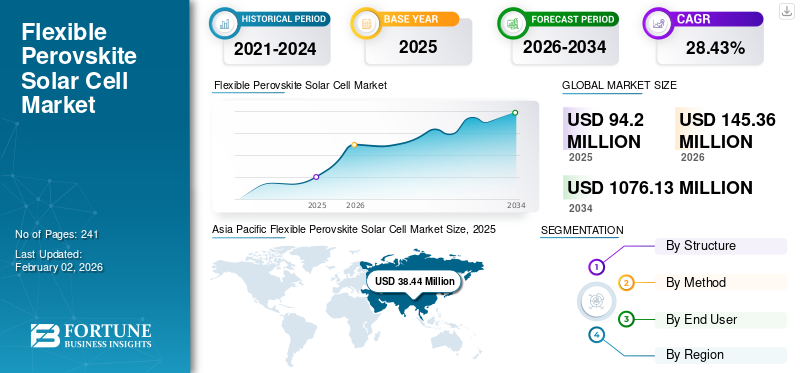
Download Free sample to learn more about this report.
Flexible Perovskite Solar Cell Market Key Takeaways
 Global Market Size & Forecast
- 2025 Market Size: USD 94.2 million
- 2026 Market Size: USD 145.36 million
- 2034 Forecast Market Size: USD 1,076.13 million
- CAGR: 28.43% from 2026-2034
 Market Share
- Asia Pacific dominated the flexible perovskite solar cell market with a 40.81% share in 2025.
- Planar perovskite solar cells were the leading segment in the market.
- The vapor-deposition method was the dominant manufacturing segment.
 Key Regional Highlights
Asia Pacific
Asia Pacific accounted for USD 38.44 million in 2025 and is projected to reach USD 61.45 million in 2026.
Europe
Europe accounted for USD 37.99 million in 2025 and is projected to reach USD 59.78 million in 2026.
North America
North America accounted for USD 16.23 million in 2025 and is projected to reach USD 22.26 million in 2026.
U.S.
Growing adoption in wearable electronics is supporting demand for flexible perovskite solar cells.
Latin America
Latin America accounted for USD 0.86 million in 2025 and is projected to reach USD 1.05 million in 2026.
Read More

MARKET DYNAMICS
MARKET DRIVERS
Growing Demand for Lightweight and Flexible Solar Solutions to Drive Market Growth
Perovskite solar panels have the great benefits of easy installation and conformability to irregular or curved surfaces, along with being adaptable to a wide range of applications such as consumer products, transportation, off-grid, and building integrated photovoltaics. Flexible and lightweight solar cells are being widely applied in electric vehicles, boats, aerospace, portable devices, and remote or off-grid locations where rigid panels are not feasible. Their potential to be integrated into smart grids and IoT devices further increases their market potential. This is expected to boost the flexible perovskite solar cell market growth in the coming years.
MARKET RESTRAINTS
Stability and Durability Issues to Hinder Market Growth
Flexible perovskite solar cells (F-PSCs) are mechanically weak and thus low in flexibility, which is a requirement for guaranteeing long-term durability and performance. Due to this drawback, they tend to crack and delaminate upon bending or stress. Perovskite materials are environmentally sensitive to humidity, temperature, and light exposure. These conditions lead to degradation over time, impacting the long-term stability of the cells. The intrinsic instability of perovskite materials, resulting from weak interactions such as van der Waals forces and hydrogen bonds, is responsible for their vulnerability to degradation.
MARKET OPPORTUNITIES
Growing Technological Advancements to Boost Market Expansion
Studies have concentrated on creating flexible substrates such as plastics, metals, fibers, etc., and transparent conductors with high conductivity and mechanical stability. Such advancements are necessary to realize high efficiency, performance, and device flexibility and break bottlenecks, including lower transmittance and brittle transparent conducting oxides.
Flexible perovskite solar cells are compatible with roll-to-roll and solution-based fabrication procedures, allowing for large-area, low-cost, and high-throughput manufacturing. Scalability is a key for commercialization and integration into a broad range of applications, comprising wearable electronics and building integrated photovoltaics.
FLEXIBLE PEROVSKITE SOLAR CELL MARKET TRENDS
Growing Product Usage in BIPV is Expected to Surge Market Growth
Growing product usage in building integrated photovoltaics is expected to boost the adoption of flexible perovskite solar cells significantly. Their lightweight, bendable, and semi-transparent nature makes them ideal for seamless integration into windows, facades, roofs, and other structural surfaces without compromising aesthetics. As global demand for zero-energy buildings and sustainable urban infrastructure rises, the application of FPSCs in BIPV will emerge as one of the major trends in the market.
Download Free sample to learn more about this report.
SEGMENTATION ANALYSIS
By Structure
Planar Perovskite Solar Cells Lead Market Due to Their Simple and Layer-by-Layer Design
By structure, the market is bifurcated into planar perovskite solar cells and mesoporous perovskite solar cells.
Planar perovskite solar cells are the dominating segment in the market. Planar cells are preferred for their flexible use due to their simple, layer-by-layer design, which allows for simpler fabrication on flexible substrates, facilitating high-throughput manufacturing techniques such as roll-to-roll and slot-die coating. This simplicity in structure, coupled with innovations in material stability and efficiency, has driven planar architecture's fast-tracking and market leadership in flexible form.
By Method
Reliable and Promising Technology Leads Vapor-Deposition Method Segment Growth
By method, the market is segregated into solution method, vapor-deposition method, and vapor-assisted solution method.
The vapor-deposition method is the dominating segment. A significant shift is taking place in the direction of vapor-based deposition by commercial producers and startups toward perovskite solar cells, facilitated by its capacity to deliver uniform, uniform films that contain fewer defects than solution processes.
By End User
Decreasing Emissions from Building Sector Propels Installation of Perovskite Solar Cells in BIPV
By end user, the market is categorized into BIPV, power station, transportation and mobility, consumer electronics, and others.
BIPV is a dominant and leading application segment of the flexible perovskite solar cell market. Several industry analyses validate that BIPV, where solar cells are integrated directly into building components such as facades, rooftops, and windows, has become the leading application for flexible perovskite solar technologies.
FLEXIBLE PEROVSKITE SOLAR CELL MARKET REGIONAL OUTLOOK
The market has been analyzed geographically over five primary regions: North America, Europe, Asia Pacific, Latin America, and the Middle East & Africa.
Asia Pacific
Asia Pacific Flexible Perovskite Solar Cell Market Size, 2025 (USD Million)
To get more information on the regional analysis of this market, Download Free sample
The Asia Pacific market was valued at USD 38.44 million in 2025, capturing 40.81% of global revenue, and is estimated to reach USD 61.45 million in 2026. Asia Pacific dominates the flexible perovskite solar cell market share due to the growing demand for renewable energy. Compared to conventional silicon-based solar cells, perovskite cells provide greater efficiency and reduced manufacturing expenses. Asia Pacific dominated the global market in 2025, with a market size of USD 38.44 million.This makes them appealing for widespread implementation in the Asia Pacific area, where the energy demand is swiftly rising due to industrial growth and urban development in nations such as China, India, Japan, and South Korea.
North America
North America contributed 17.23% to the global market in 2025, with a valuation of USD 16.23 million, and is projected to reach USD 22.26 million in 2026. Market growth in North America is backed by ongoing innovations that enhance perovskite cells' efficiency, stability, scalability, and long-term performance. Partnerships between academic institutions and manufacturers additionally propel advancements, setting North America up to swiftly embrace flexible perovskite solar technology once mass production is realized. The robust manufacturing infrastructure and significant domestic demand create a perfect setting for developing industry standards in flexible perovskite solar cells.
U.S.
In the U.S., the flexible perovskite solar cell has gained significant popularity in wearable electronics and building integrated photovoltaics, owing to its superior performance in low and variable light conditions. Also, these cells have broader spectral absorption, and they are known for their flexibility, relatively low cost, and lightweight nature. In addition, their portability and ability to be integrated into various form factors make them suitable for charging portable devices and powering remote sensors.
Europe
Europe accounted for USD 37.99 million in 2025, representing 40.33% of the global market share, and is projected to reach USD 59.78 million in 2026. Europe benefits from a strong R&D atmosphere featuring prominent institutions and partnerships to boost the utilization of renewable energy sources. This ecosystem speeds up innovation in material science, device engineering, and scalable manufacturing methods, enhancing efficiency and stability and reducing production expenses. The capability to create flexible perovskite solar films through scalable methods such as roll-to-roll printing lowers expenses and aids in large-scale manufacturing, enabling wider commercial applications across various uses.
Latin America
In 2025, the Latin America market stood at USD 0.86 million, representing 0.91% of global demand, and is projected to grow to USD 1.05 million in 2026. Latin America, especially nations such as Brazil and Chile, possesses plentiful solar power resources and is progressively dedicated to renewable energy goals. These countries channel investments into research and development to customize perovskite technology for regional circumstances, aiding the area's shift to sustainable energy. Numerous Latin American nations have implemented policies and incentives to encourage the use of renewable energy. Global organizations and development agencies also offer financial support for green energy initiatives, further enhancing investment in perovskite solar technology.
Middle East & Africa
The market in Middle East & Africa reached USD 0.68 million in 2025, representing 0.72% of total market revenue, and is projected to reach USD 0.81 million in 2026. Recent progress consists of creating stable, flexible tandem solar cells that integrate perovskite with materials such as CIGS, improving efficiency and longevity on flexible substrates. Nations such as Saudi Arabia, UAE, South Africa, and Egypt represent significant markets in the Middle East & Africa, actively investigating perovskite solar technologies to broaden energy sources and aid sustainability objectives.
COMPETITIVE LANDSCAPE
KEY INDUSTRY PLAYERS
Introduction of Innovative and More Effective Flexible Perovskite Solar Cells to Boost Company’s Market Presence
Saule Technologies is a prominent Polish firm innovating inkjet-printed, ultra-thin, and adaptable perovskite solar cells manufactured on slim foils. Its technology allows for lightweight, flexible, and tailored solar modules with remarkable efficiencies, such as a record 31% power conversion efficiency for flexible indoor perovskite solar cells. In April 2020, Saule received USD 4.97 million for Printed Flexible Perovskite Solar Modules for IoT Gadgets. The Internet of Things (IoT) represents the expansion of the Internet beyond just computers and smartphones to a wider range of devices that collect, produce, and transmit information interchangeably.
List of Key Flexible Perovskite Solar Cell Companies Profiled
- Saule Technologies (Poland)
- Fab Solar (U.S.)
- Mellow Energy (China)
- Active Surfaces (U.S.)
- Verde Technologies (U.S.)
- Ascent Solar Technologies (U.S.)
- ART-PV India (India)
- Microquanta Semiconductor (China)
- Swift Solar Inc. (U.S.)
- GCL Perovskite (China)
KEY INDUSTRY DEVELOPMENTS
- In March 2025, Ascent Solar Technologies, a manufacturer of lightweight and flexible thin-film photovoltaic (PV) panels, obtained a new request to modify the design of its space solar products.
- In February 2025, A consortium from Japan announced the evaluation of the durability and effectiveness of lightweight, flexible perovskite solar modules at Osanbashi Pier, Yokohama City, in conditions characterized by wind and salt air. This outdoor testing is a component of a broader research collaboration focused on perovskite solar technology that spans three years.
- In January 2025, A Chinese startup, Mellow Energy, introduced adaptable perovskite photovoltaic modules boasting 15.6% efficiency. Mellow Energy asserts that its ML-Flex panel is the largest flexible perovskite solar module globally.
- In December 2024, H. I. S. Co., Ltd., collaborated with Saule Technologies and Lawson, Inc., a major chain of grocery stores located in Japan, to initiate a pilot program at “Green Lawson” in Tokyo. This project will evaluate the implementation of film-based perovskite solar cells, an innovative energy solution, inside the store setting.
- In August 2023, Italian researchers created a flexible indoor perovskite solar cell that boasts an efficiency of 32.5%. Their design incorporates a PET substrate and a tetrabutylammonium bromide layer placed over the perovskite absorber.
REPORT COVERAGE
The report provides a detailed analysis of the market. It focuses on key aspects such as leading companies, product/service process, competitive landscape, and the leading source of the flexible perovskite solar cell. Besides, the report offers insights into the market trends and highlights key industry developments. In addition to the factors above, the report encompasses several factors that contributed to the market's growth in recent years.
Request for Customization to gain extensive market insights.
Report Scope & Segmentation
|
ATTRIBUTE |
DETAILS |
|
Study Period |
2021-2034 |
|
Base Year |
2025 |
|
Estimated Year |
2026 |
|
Forecast Period |
2026-2034 |
|
Historical Period |
2021-2024 |
|
Growth Rate |
CAGR of 28.43% from 2026 to 2034 |
|
Unit |
Value (USD Million) |
|
Segmentation |
By Structure
|
|
By Method
|
|
|
By End User
|
|
|
By Region
|
Frequently Asked Questions
As per the Fortune Business Insights study, the market size was USD 94.2 million in 2025.
In 2025, the Asia Pacific market value stood at USD 38.44 million.
The market is expected to exhibit a CAGR of 28.43% during the forecast period of 2026-2034.
By end user, the BIPV segment leads the market.
Increasing demand for lightweight and flexible solar solutions to drive market growth.
Saule Technologies, Fab Solar, and Mellow Energy are the key players in the market.
Asia Pacific holds the largest market share.



- 2021-2034
- 2025
- 2021-2024
- 241
Get 30-60 hrs Free Customization
Expand Regional and Country Coverage, Segments Analysis, Company Profiles, Competitive Benchmarking, and End-user Insights.



















-
US +1 833 909 2966 ( Toll Free )
-
Get In Touch With Us