Fluorescent In Situ Hybridization Probe Market Size, Share & Industry Analysis, By Technology (Flow FISH, Q FISH), By Type (DNA, RNA), By Application, By End-use (Research, Clinical use), and Regional Forecast, 2026-2034
 Download Free Sample
Fluorescent In Situ Hybridization Probe Market Overview
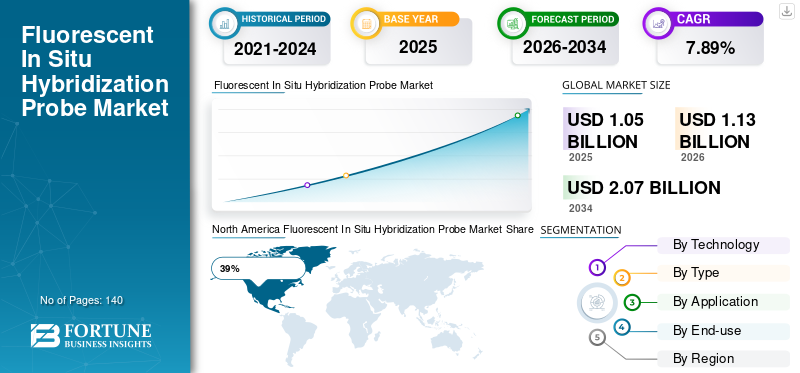
The global fluorescent in situ hybridization probe market size was valued at USD 1.05 billion in 2025. The market is projected to grow from USD 1.13 billion in 2026 to USD 2.07 billion by 2034, exhibiting a CAGR of 7.89% during the forecast period.

The fluorescent in situ hybridization probe market is expanding steadily due to increasing demand for molecular diagnostics, cancer detection, and genetic disorder analysis. Fluorescent in situ hybridization probes are widely used for chromosome mapping, gene amplification studies, and biomarker identification in clinical laboratories and research institutions. fluorescent in situ hybridization probe market trends indicate rising adoption of precision medicine and personalized oncology testing across healthcare systems. Advancements in fluorescence imaging technologies and automated hybridization platforms are improving diagnostic accuracy and laboratory efficiency. Growing use of cytogenetic testing in prenatal diagnostics and infectious disease identification is also contributing significantly to market expansion worldwide.
The USA fluorescent in situ hybridization probe market is witnessing strong development due to advanced genomic research infrastructure and increasing utilization of molecular diagnostic techniques in oncology. Hospitals, pathology laboratories, and biotechnology companies are increasingly adopting FISH-based testing methods for cancer biomarker analysis and chromosomal abnormality detection. fluorescent in situ hybridization probe market analysis in the United States highlights growing investment in precision medicine, companion diagnostics, and targeted cancer therapies. Expanding clinical applications of fluorescence-based testing and rising prevalence of genetic disorders are accelerating market demand. Strong research funding and continuous innovation in diagnostic technologies further support market growth across the country.
Download Free sample to learn more about this report.
Fluorescent In Situ Hybridization Probe Market Key Takeaways
 Global Market Size & Forecast
- 2025 Market Size: USD 1.05 Billion
- 2026 Market Size: USD 1.13 Billion
- 2034 Forecast Market Size: USD 2.07 Billion
- CAGR: 7.89% from 2026-2034
 Market Share
- The market in North America dominated with a revenue share of 39% in 2025.
- Flow FISH dominated with approximately 58% market share.
- DNA applications dominated with approximately 67% market share.
 Key Regional Highlights
North America
North America dominated the market with a 39% share in 2025, supported by advanced molecular diagnostics and genomic research.
Europe
Europe accounted for 27% of the market, driven by growing adoption of molecular cytogenetics and personalized medicine.
Asia-Pacific
Asia-Pacific held a 25% market share, supported by expanding healthcare infrastructure and genomic research activities.
U.S.
The U.S. market is supported by increasing demand for precision oncology, molecular diagnostics, and advanced FISH technologies.
Japan
Japan accounted for 18% of the Asia-Pacific market, supported by growing genomic research and molecular diagnostic applications.
Read More

fluorescent in situ hybridization probe market Latest Trends
The fluorescent in situ hybridization probe market is experiencing rapid technological advancement with increasing integration of automated imaging systems and multiplex fluorescence platforms. One of the major fluorescent in situ hybridization probe market trends is the growing use of AI-assisted microscopy and digital pathology solutions for faster interpretation of fluorescence signals. Laboratories are increasingly implementing automated hybridization workflows to improve testing accuracy and reduce manual processing time.
Download Free sample to learn more about this report.
Another significant trend in the fluorescent in situ hybridization probe market Research Report is the expansion of RNA-targeted FISH assays for infectious disease detection and gene expression analysis. The demand for highly specific probes capable of detecting rare chromosomal abnormalities and low-expression biomarkers is increasing substantially. Manufacturers are developing advanced fluorescent labeling chemistries that improve signal intensity and test reproducibility. fluorescent in situ hybridization probe market Insights also indicate increasing adoption of companion diagnostics in oncology treatment planning. Rising clinical emphasis on early disease diagnosis and precision healthcare solutions continues to strengthen global market demand.
fluorescent in situ hybridization probe market Dynamics
DRIVER
Increasing Adoption of Molecular Diagnostics and Precision Medicine
The rising use of molecular diagnostics and precision medicine is a major factor driving fluorescent in situ hybridization probe market growth. Healthcare providers are increasingly utilizing FISH-based testing methods to identify genetic abnormalities, chromosomal rearrangements, and cancer biomarkers with high specificity. fluorescent in situ hybridization probe market report findings indicate strong demand for advanced cytogenetic testing in oncology, prenatal diagnostics, and hematological disorder analysis.
The growing prevalence of cancer and genetic diseases is accelerating adoption of fluorescence-based diagnostic technologies across hospitals and diagnostic laboratories. FISH probes enable rapid and accurate detection of chromosomal mutations, supporting personalized treatment planning and targeted therapy selection. fluorescent in situ hybridization probe market forecast studies highlight increasing use of automated fluorescence imaging systems and digital pathology platforms that improve laboratory efficiency. Expanding investment in genomic research and precision healthcare infrastructure continues to strengthen market development globally.
RESTRAINT
High Testing Costs and Complex Laboratory Procedures
The fluorescent in situ hybridization probe market faces restraints associated with high testing costs and technical complexity of laboratory procedures. Advanced fluorescence imaging systems, automated analyzers, and specialized probe kits require substantial investment, limiting accessibility for smaller diagnostic laboratories. Fluorescent In Situ Hybridization Probe Industry Analysis indicates that skilled laboratory professionals are required for probe preparation, hybridization, and result interpretation, increasing operational costs.
Another major restraint involves lengthy sample preparation procedures and complex fluorescence signal analysis. Inconsistent fluorescence intensity and probe hybridization variability may affect diagnostic reliability in certain cases. Regulatory compliance requirements and validation standards for molecular diagnostic testing further increase product development complexity. Limited reimbursement coverage in some healthcare systems may also reduce adoption of advanced FISH testing procedures, particularly in developing regions.
OPPORTUNITY
Expansion of Companion Diagnostics and Personalized Oncology
The increasing adoption of companion diagnostics and targeted oncology therapies presents strong opportunities for the fluorescent in situ hybridization probe market Outlook. Healthcare providers are increasingly utilizing FISH probes to identify predictive biomarkers that support personalized cancer treatment decisions. fluorescent in situ hybridization probe market opportunities are expanding with rising demand for genomic profiling and precision oncology testing.
Biotechnology companies and diagnostic manufacturers are investing heavily in advanced probe development for detection of rare mutations and gene amplifications. Growing integration of molecular diagnostics into routine clinical workflows is accelerating commercialization opportunities. fluorescent in situ hybridization probe market Insights indicate rising collaboration between pharmaceutical companies and diagnostic developers to create companion diagnostic solutions linked to targeted therapies. Emerging healthcare markets with expanding genomic medicine infrastructure are also expected to generate substantial long-term growth opportunities.
CHALLENGE
Standardization Issues and Diagnostic Interpretation Complexity
One of the major challenges in the fluorescent in situ hybridization probe market is maintaining testing standardization and interpretation accuracy across laboratories. Variability in sample preparation, probe hybridization quality, and fluorescence imaging can influence diagnostic consistency. fluorescent in situ hybridization probe market Research Report findings highlight the need for standardized testing protocols and quality assurance systems to improve clinical reliability.
Healthcare institutions also face challenges associated with high dependence on trained cytogenetic specialists for result interpretation. Complex fluorescence patterns and overlapping signals can create diagnostic uncertainty in certain cases. Manufacturers must continuously invest in software automation, image analysis tools, and advanced probe chemistry to reduce variability and improve efficiency. Competitive pressure within the molecular diagnostics industry further intensifies the need for innovation and clinical validation.
fluorescent in situ hybridization probe market Segmentation
By Technology
Flow FISH accounts for approximately 58% of the fluorescent in situ hybridization probe market share due to its high-throughput analysis capability and growing use in telomere length assessment and hematological research. This technique combines flow cytometry with fluorescence hybridization, enabling rapid quantification of genetic markers within large cell populations. fluorescent in situ hybridization probe market trends indicate increasing adoption of Flow FISH in oncology research and immunology testing applications. Clinical laboratories prefer Flow FISH because it provides precise cellular analysis while reducing processing time compared to traditional cytogenetic methods. The technique is widely used in leukemia diagnostics, immune deficiency studies, and stem cell research. fluorescent in situ hybridization probe market analysis highlights rising investment in automated flow cytometry systems integrated with fluorescence imaging capabilities.
Q FISH represents nearly 42% of the fluorescent in situ hybridization probe market size due to its ability to measure telomere length and chromosomal abnormalities with high quantitative precision. Quantitative fluorescence in situ hybridization is increasingly used in aging research, oncology studies, and genomic instability analysis. Fluorescent In Situ Hybridization Probe Industry Report findings indicate growing demand for Q FISH technologies in advanced genetic research laboratories. Researchers utilize Q FISH techniques to analyze chromosome integrity, DNA damage, and disease progression markers in cancer patients. Technological advancements in fluorescence microscopy and image analysis software are improving testing sensitivity and reproducibility.
To know how our report can help streamline your business, Speak to Analyst
By Type
DNA applications account for approximately 67% of the fluorescent in situ hybridization probe market share because DNA-targeted probes are extensively used in chromosomal abnormality detection, prenatal diagnostics, and cancer cytogenetics. fluorescent in situ hybridization probe market report findings indicate strong adoption of DNA FISH testing in breast cancer, leukemia, and lymphoma diagnosis. Healthcare providers rely on DNA-targeted probes for identification of chromosomal translocations, deletions, and gene amplifications that support treatment planning and disease monitoring. Automated imaging technologies and advanced fluorescence labeling systems are improving DNA probe sensitivity and diagnostic efficiency. fluorescent in situ hybridization probe market growth is further supported by increasing genomic research activities and rising demand for personalized oncology testing solutions.
RNA applications represent nearly 33% of the fluorescent in situ hybridization probe market size because RNA-targeted assays are increasingly utilized for infectious disease diagnostics and gene expression analysis. RNA FISH techniques enable visualization of transcriptional activity and cellular gene expression patterns with high specificity. fluorescent in situ hybridization probe market Insights indicate rising adoption of RNA probes in virology research and molecular pathology laboratories. Researchers and healthcare providers increasingly use RNA FISH assays to identify infectious pathogens, evaluate therapeutic response, and study tumor microenvironments. Technological innovation in multiplex fluorescence imaging and probe chemistry is improving RNA detection sensitivity.
By Application
DNA applications account for a dominant share in the fluorescent in situ hybridization probe market because DNA-targeted probes are extensively used for chromosomal abnormality detection, cancer diagnostics, and prenatal genetic screening. fluorescent in situ hybridization probe market report findings indicate strong demand for DNA FISH technologies in leukemia, lymphoma, breast cancer, and hereditary disease analysis. Clinical laboratories increasingly utilize DNA probes to identify gene amplifications, deletions, and chromosomal translocations that support accurate disease diagnosis and treatment planning. Healthcare providers prefer DNA-targeted fluorescence assays due to their high specificity, rapid turnaround time, and compatibility with automated pathology systems.
Technological advancements in fluorescence labeling chemistry and digital imaging platforms are improving signal clarity and diagnostic efficiency. fluorescent in situ hybridization probe market trends also highlight increasing adoption of DNA FISH testing in precision oncology and companion diagnostic applications. Rising genomic research activities and expanding molecular pathology infrastructure continue to support segment growth globally. Biotechnology companies are developing highly sensitive DNA probes capable of detecting rare mutations and complex chromosomal abnormalities, further strengthening the role of DNA applications in molecular diagnostics and personalized medicine.
By End-use
The research segment holds a significant share in the fluorescent in situ hybridization probe market due to rising genomic research activities and increasing use of molecular cytogenetics in biotechnology and academic laboratories. Research institutions are heavily utilizing fluorescence in situ hybridization probes for chromosome mapping, gene amplification studies, biomarker identification, and transcriptomics analysis. fluorescent in situ hybridization probe market trends indicate increasing adoption of advanced fluorescence imaging systems in cancer biology, neuroscience, and infectious disease research applications. Biotechnology companies and universities are investing in high-sensitivity FISH probes capable of detecting rare genetic abnormalities and cellular mutations with improved precision. The growing focus on personalized medicine and biomarker discovery is accelerating demand for RNA and DNA targeted fluorescence assays across research laboratories.
The clinical use segment represents a major portion of the fluorescent in situ hybridization probe market because hospitals, pathology laboratories, and diagnostic centers increasingly rely on fluorescence hybridization technologies for disease diagnosis and treatment planning. Clinical applications of FISH probes are expanding rapidly in oncology, prenatal diagnostics, hematology, and infectious disease testing. fluorescent in situ hybridization probe market Insights indicate growing utilization of molecular diagnostic tools for detecting chromosomal abnormalities, gene rearrangements, and cancer biomarkers with high diagnostic accuracy. Healthcare providers are increasingly implementing automated fluorescence imaging systems and digital pathology platforms to improve laboratory efficiency and reduce diagnostic turnaround time.
fluorescent in situ hybridization probe market Regional Outlook
North America Fluorescent In Situ Hybridization Probe Market Share, 2026 (%)
To get more information on the regional analysis of this market, Download Free sample
North America
North America accounts for approximately 39% of the fluorescent in situ hybridization probe market share due to advanced genomic research infrastructure and strong adoption of molecular diagnostic technologies. The region benefits from increasing investment in precision oncology, companion diagnostics, and genetic testing programs. fluorescent in situ hybridization probe market Research Report findings indicate growing demand for automated fluorescence imaging systems across pathology laboratories and research institutions. The United States remains the leading contributor within the region because of strong healthcare spending, extensive biotechnology research, and rapid implementation of genomic medicine initiatives.
Healthcare providers in North America are increasingly integrating FISH-based diagnostics into routine cancer screening and biomarker analysis workflows. Strong biotechnology innovation and pharmaceutical research activities continue to support market expansion. Rising prevalence of cancer and genetic disorders further contributes to increasing demand for fluorescence hybridization probes across the region. Academic institutions and private laboratories are also investing in advanced cytogenetic testing platforms to improve diagnostic precision and laboratory efficiency. Canada is witnessing increasing adoption of molecular pathology technologies supported by government healthcare modernization programs.
Europe
Europe holds nearly 29% of the fluorescent in situ hybridization probe market share supported by growing genomic medicine initiatives and strong adoption of molecular pathology techniques. European healthcare systems are emphasizing precision diagnostics and personalized treatment planning, increasing demand for advanced fluorescence-based testing technologies. fluorescent in situ hybridization probe market analysis highlights rising investment in cytogenetic laboratories and automated diagnostic systems throughout the region. Countries across Europe are strengthening genomic research programs and expanding access to molecular diagnostic services for oncology and rare disease detection.
Manufacturers in Europe are focusing on high-sensitivity fluorescence probes and multiplex imaging technologies designed for oncology and prenatal testing applications. Expansion of academic genomics research and biotechnology partnerships continues to strengthen regional market development. Increased awareness regarding early disease detection and personalized healthcare solutions is further supporting market growth. Government support for precision medicine initiatives and healthcare digitization is encouraging hospitals and laboratories to adopt advanced fluorescence hybridization technologies. Research collaborations between universities, biotechnology firms, and pharmaceutical companies are accelerating innovation in molecular diagnostics. Increasing prevalence of cancer and hereditary disorders is also contributing to rising demand for fluorescence in situ hybridization testing across European healthcare systems.
Germany fluorescent in situ hybridization probe market
Germany contributes approximately 32% of the European fluorescent in situ hybridization probe market due to strong biomedical research capabilities and advanced molecular diagnostics infrastructure. fluorescent in situ hybridization probe market trends in Germany indicate increasing adoption of fluorescence-based genomic testing in oncology and rare disease diagnostics. The country benefits from a highly developed healthcare system and strong collaboration between academic institutions and biotechnology companies focused on genomic medicine innovation.
German research institutions and hospitals are investing heavily in automated pathology systems, digital imaging platforms, and advanced cytogenetic technologies. Rising focus on precision medicine and biomarker-driven therapies is accelerating demand for high-performance fluorescence probes. The country’s strong biotechnology ecosystem and increasing genomic research funding continue to strengthen market competitiveness within Europe. Diagnostic laboratories are increasingly implementing automated fluorescence imaging systems to improve testing efficiency and reduce turnaround times. Germany is also witnessing rising demand for companion diagnostics linked to targeted cancer therapies. Government initiatives supporting healthcare innovation and molecular diagnostics research are encouraging adoption of advanced fluorescence hybridization technologies.
United Kingdom Fluorescent in Situ Hybridization Probe Market
The United Kingdom accounts for approximately 24% of the European fluorescent in situ hybridization probe market driven by increasing demand for molecular diagnostics and genomic testing services. fluorescent in situ hybridization probe market Insights indicate growing use of fluorescence-based pathology systems in cancer screening and infectious disease analysis. The country’s healthcare system is increasingly emphasizing precision medicine and personalized treatment approaches supported by genomic testing technologies.
Healthcare providers in the United Kingdom are expanding adoption of precision diagnostic technologies to improve treatment selection and disease monitoring. Research organizations are also investing in RNA-targeted fluorescence assays and digital pathology automation. Rising prevalence of cancer and expanding genomic medicine programs continue to support long-term market growth across the country. Universities and biotechnology companies are collaborating on advanced molecular diagnostics research aimed at improving early disease detection and biomarker identification. Increasing investment in healthcare digitization and laboratory automation is enhancing diagnostic efficiency and clinical accuracy. The National Health Service is also supporting broader implementation of genomic testing initiatives for oncology and rare disease management.
Asia-Pacific
Asia-Pacific represents approximately 25% of the fluorescent in situ hybridization probe market share due to increasing healthcare modernization and rising investment in molecular diagnostics infrastructure. Expanding genomic research activities and growing awareness regarding early disease diagnosis are supporting strong market demand throughout the region. fluorescent in situ hybridization probe market Outlook assessments indicate significant growth potential in emerging biotechnology and precision medicine markets. Countries across Asia-Pacific are rapidly improving healthcare infrastructure and expanding access to advanced molecular diagnostic technologies.
Manufacturers are expanding production capabilities and laboratory partnerships across Asia-Pacific healthcare systems. Increasing use of fluorescence-based testing in oncology, infectious disease diagnostics, and prenatal screening continues to strengthen market penetration. Government support for genomic research and healthcare technology innovation further contributes to regional market expansion. Rising prevalence of cancer and hereditary disorders is encouraging hospitals and diagnostic laboratories to adopt advanced fluorescence hybridization systems. Biotechnology companies are investing heavily in automated imaging technologies and high-sensitivity fluorescence probes tailored for regional healthcare needs. Academic institutions are also increasing research activities focused on genomic medicine and biomarker discovery. Growing healthcare expenditure and expanding precision medicine initiatives are expected to create substantial opportunities for market growth across Asia-Pacific during the forecast period.
Japan Fluorescent in Situ Hybridization Probe Market
Japan contributes approximately 18% of the Asia-Pacific fluorescent in situ hybridization probe market because of advanced biomedical research infrastructure and strong adoption of genomic medicine technologies. fluorescent in situ hybridization probe market forecast studies indicate increasing use of fluorescence-based diagnostics in oncology, neurology, and aging-related disease research. Japan’s healthcare sector is highly focused on technological innovation and precision diagnostics, supporting widespread adoption of advanced molecular testing systems.
Japanese healthcare providers are emphasizing precision diagnostics and personalized treatment strategies supported by molecular pathology technologies. Research laboratories are investing in high-resolution fluorescence imaging systems and automated cytogenetic workflows. The country’s strong biotechnology innovation ecosystem continues to support development of advanced fluorescence hybridization products and testing solutions. Pharmaceutical companies and academic institutions are collaborating on genomic research projects aimed at improving cancer diagnostics and targeted therapy selection. Increasing demand for early disease detection and personalized healthcare services is accelerating implementation of fluorescence-based testing methods. Government support for healthcare modernization and biotechnology innovation is further strengthening market growth.
China Fluorescent in Situ Hybridization Probe Market
China accounts for approximately 6% of the Asia-Pacific fluorescent in situ hybridization probe market due to expanding genomic research infrastructure and rising adoption of molecular diagnostic technologies. fluorescent in situ hybridization probe market growth in China is supported by increasing cancer prevalence and strong investment in precision healthcare systems. The country is rapidly modernizing healthcare facilities and expanding access to advanced genomic testing services across urban and regional hospitals.
Hospitals and biotechnology companies are rapidly implementing fluorescence-based diagnostic platforms for oncology and infectious disease testing. Domestic manufacturers are expanding production of advanced probe kits and automated imaging systems tailored to regional laboratory needs. Government healthcare modernization initiatives and growing biotechnology investments continue to strengthen market expansion across the country. China is also witnessing increasing collaboration between research institutions and pharmaceutical companies focused on biomarker discovery and personalized medicine development. Rising awareness regarding early disease diagnosis and genetic testing is encouraging broader adoption of fluorescence hybridization technologies. Expansion of molecular pathology laboratories and improvements in healthcare infrastructure are supporting long-term market growth.
Rest of World
The Rest of World region accounts for approximately 9% of the fluorescent in situ hybridization probe market share supported by improving molecular diagnostics infrastructure and increasing awareness regarding genomic medicine. Healthcare providers in Latin America, the Middle East, and Africa are gradually adopting fluorescence hybridization technologies for cancer diagnostics and prenatal testing. Growing healthcare investments and rising focus on early disease detection are contributing to increasing demand for molecular diagnostic solutions across these developing regions.
International diagnostic manufacturers are expanding distribution partnerships and laboratory collaborations across developing healthcare markets. Although affordability challenges and limited specialist availability remain constraints, increasing investment in healthcare modernization and precision diagnostics is expected to support future market growth throughout these regions. Governments and private healthcare organizations are working to improve access to advanced diagnostic technologies and strengthen laboratory capabilities. Rising prevalence of cancer, infectious diseases, and genetic disorders is encouraging adoption of fluorescence-based testing methods in hospitals and research centers. Educational initiatives and training programs are also helping improve awareness regarding molecular pathology and genomic medicine applications.
List of Top Fluorescent In Situ Hybridization Probe Companies
- Thermo Fisher Scientific
- PerkinElmer
- BioDot
- Horizon Diagnostics
- Agilent Technologies
- Abnova Corporation
- LGC Biosearch Technologies
- Genemed
Top Two Companies by market share
- Thermo Fisher Scientific Inc. – 21%
- Agilent Technologies, Inc. – 16%
Investment Analysis and Opportunities
The fluorescent in situ hybridization probe market is attracting strong investment from biotechnology firms, molecular diagnostics manufacturers, and genomic research organizations. Increasing demand for precision medicine, companion diagnostics, and targeted oncology testing is encouraging expansion of advanced fluorescence imaging and probe production capabilities. fluorescent in situ hybridization probe market opportunities are particularly strong in AI-assisted pathology systems, automated cytogenetic workflows, and multiplex fluorescence technologies.
Diagnostic manufacturers are investing heavily in high-sensitivity fluorescence probes and digital imaging platforms that improve laboratory efficiency and clinical reliability. Emerging healthcare markets are also witnessing increasing investment in genomic medicine infrastructure and molecular testing laboratories. fluorescent in situ hybridization probe market Insights indicate rising strategic collaborations between pharmaceutical companies and diagnostic developers to create biomarker-based companion diagnostics. Expansion of precision oncology and personalized medicine programs continues to support long-term investment growth.
New Product Development
New product development in the fluorescent in situ hybridization probe market is focused on improving probe specificity, fluorescence intensity, and automation compatibility. Manufacturers are introducing advanced multiplex fluorescence probes capable of detecting multiple genetic abnormalities simultaneously. fluorescent in situ hybridization probe market trends indicate increasing demand for AI-integrated digital pathology systems and automated fluorescence imaging platforms.
Companies are also investing in RNA-targeted probes and high-resolution imaging technologies designed for transcriptomic analysis and infectious disease diagnostics. Innovations in fluorescence labeling chemistry and image analysis software are improving signal clarity and diagnostic reproducibility. fluorescent in situ hybridization probe market Research Report findings indicate rising development of customizable probe panels tailored for precision oncology applications. Increasing focus on personalized medicine and biomarker-driven diagnostics continues to accelerate product innovation across the industry.
Five Recent Developments (2023-2025)
- Thermo Fisher Scientific Inc. expanded fluorescence probe manufacturing capabilities for oncology diagnostics applications.
- Agilent Technologies introduced advanced automated fluorescence imaging systems for molecular pathology laboratories.
- PerkinElmer enhanced multiplex fluorescence assay technologies for genomic research and biomarker analysis.
- Horizon Diagnostics expanded companion diagnostic development programs focused on precision oncology testing.
- LGC Biosearch Technologies introduced high-sensitivity RNA fluorescence probe solutions for transcriptomics research.
Report Coverage
The fluorescent in situ hybridization probe market report provides comprehensive analysis of molecular diagnostics trends, technological advancements, competitive landscape, and genomic medicine developments across global healthcare industries. The report evaluates major technology categories including Flow FISH and Q FISH along with detailed application analysis covering DNA and RNA diagnostics. Fluorescent In Situ Hybridization Probe Industry Report findings include assessment of fluorescence imaging systems, probe innovation, automation technologies, and precision medicine applications influencing market expansion.
Request for Customization to gain extensive market insights.
The study also covers regional healthcare infrastructure trends, biotechnology investment activities, and molecular diagnostics adoption patterns shaping competitive dynamics. fluorescent in situ hybridization probe market analysis includes evaluation of digital pathology platforms, AI-assisted imaging technologies, and companion diagnostic development strategies. Country-level insights provide detailed understanding of laboratory demand, genomic research activities, and healthcare modernization trends. The report further examines product pipelines, regulatory considerations, and strategic partnerships impacting the future evolution of the fluorescence hybridization industry.
Frequently Asked Questions
Fortune Business Insights says that the global Fluorescent In Situ Hybridization Probe Market value stood at USD 1.05 billion in 2025 and is projected to reach USD 2.07 billion by 2034.
The market is expected to exhibit a CAGR of 7.89% during the forecast period of 2026-2034.
The DNA segment dominated with approximately 67% market share, driven by extensive use in chromosomal abnormality detection, cancer diagnostics, and prenatal genetic screening.
Key players include Thermo Fisher Scientific, PerkinElmer, BioDot, Horizon Diagnostics, Agilent Technologies, and Abnova Corporation.
Major trends include increasing adoption of AI-assisted microscopy and digital pathology and expansion of RNA-targeted FISH assays. North America led the market with a 39% share.



- 2021-2034
- 2025
- 2021-2024
- 140
-

(Offer valid till 30th Sep 2026)
Get 30-60 hrs Free Customization
Expand Regional and Country Coverage, Segments Analysis, Company Profiles, Competitive Benchmarking, and End-user Insights.













.webp)






-
US +1 833 909 2966 ( Toll Free )
-
Get In Touch With Us