Food Contract Manufacturing Market Size, Share & Industry Analysis, By Type (Snacks, Bakery & Confectionery, Ready Meals / Prepared Foods, Dairy & Dairy Alternatives, Processed Meat, Poultry & Seafood, Sauces, Dressings & Condiments, Frozen Foods, and Beverages), By Service Type (Full-Service Contract Manufacturing, Co-Manufacturing, Private Label Manufacturing, and Co-Packing), By End User (Branded Food Companies, Private Label/Retailers, and Foodservice Companies), and Regional Forecast, 2026-2034
 Download Free Sample
(Offer valid till 15th Oct 2026)

Food Contract Manufacturing Market Size and Future Outlook
 Listen to Audio Version
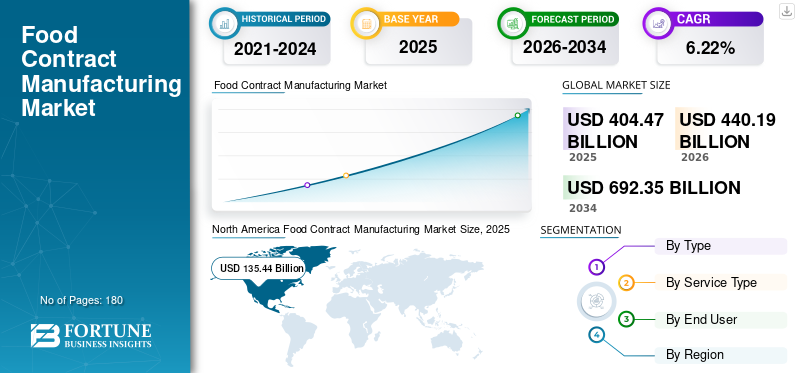
The global food contract manufacturing market size was valued at USD 404.47 billion in 2025. The market is projected to grow from USD 440.19 billion in 2026 to USD 692.35 billion by 2034, growing at a CAGR of 6.22% during the forecast period. North America dominated the food contract manufacturing market with a market share of 33.49% in 2025.
Food contract manufacturing is the outsourcing of food production to third-party manufacturers that produce food products on behalf of brand owners. These manufacturers handle formulation, processing, packaging, and other functions, allowing companies to focus on branding, marketing, and distribution. It is widely used across categories such as packaged foods, beverages, nutraceuticals, and private-label products. The market is growing rapidly due to food companies trying to economize and scale up. The rise of e-commerce and the adoption of new technologies with the growing need for specialized products, such as clean-label or gluten-free options, are also boosting market growth.
Companies such as Fibro Foods Private Limited, TreeHouse Foods, Inc, OSI Group, and others are some of the key players operating in this market. Increasing partnership between food companies is the key strategy which is boosting product sales and supporting the growth of the market.
Download Free sample to learn more about this report.
Food Contract Manufacturing Market Takeaways
 Global Market Size & Forecast
- 2025 Market Size: USD 404.47 billion
- 2026 Market Size: USD 440.19 billion
- 2034 Forecast Market Size: USD 692.35 billion
- CAGR: 6.22% from 2026–2034
 Market Share
- North America dominated the food contract manufacturing market with a market share of 33.49% in 2025.
- The beverages segment held the largest food contract manufacturing market share in 2025.
- The co-manufacturing segment accounted for the largest market share in 2025.
 Key Regional Highlights
North America
The market in North America reached a valuation of USD 135.44 billion in 2025.
Europe
The European market reached a valuation of USD 122.38 billion in 2025.
Asia Pacific
The Asia Pacific market was valued at USD 94.17 billion in 2025 and is growing rapidly due to rapid industrialization, urbanization, and growth of the food service and food processing market in the region.
U.S.
In 2025, the U.S. market reached USD 113.18 billion.
Japan
The Japan market in 2025 reached a valuation of around USD 11.96 billion, accounting for roughly 2.96% of global market revenues.
Read More

FOOD CONTRACT MANUFACTURING MARKET TRENDS
Shift Toward Clean-Label and Health-Oriented Products Reshape Market Competition
There is a stronger focus on clean-label and health-oriented products. As a result, contract manufacturers are using more natural ingredients and making their processes more transparent. Another trend is the shift toward more sustainable, eco-friendly production capabilities. This includes cutting waste, improving energy efficiency, and sourcing materials responsibly. Manufacturers are adding smart technologies to improve traceability, monitor quality, and optimize supply chains. Customization and flexibility in production are now more valued. Brands want unique products and quicker ways to respond to consumer demand. There is also more demand for service providers who can manage end to end operations from formulation and production to packaging and logistics in one place.
MARKET DYNAMICS
MARKET DRIVERS
Download Free sample to learn more about this report.
Rising Demand for Cost Efficiency and Smoother Operations Accelerates Adoption of Products
Food brands are turning to contract manufacturing to cut costs and run their operations more efficiently. Many companies now prefer asset-light models to avoid the high costs of building and maintaining their own production facilities. This shift lets them focus on what they do best, such as branding, marketing, and distribution. At the same time, more retailers and online platforms want private-label products, which means companies are relying even more on contract manufacturers. Quick changes in products, especially in ready-to-eat meals, functional foods, and drinks, mean companies need flexible manufacturing options. Moreover, as the food supply chain becomes more global and cross-border trade increases, companies are teaming up with regional manufacturers, accelerating market growth.
MARKET RESTRAINTS
Quality Control Risks and Regulatory Complexity Limit the Market Expansion
Although the market has strong growth potential, it also faces challenges, particularly in quality control and regulatory compliance. Food safety standards are strict in several countries, and maintaining consistent product quality can be challenging while working with third-party manufacturers. As poor quality can hurt a brand’s reputation, companies are often careful about outsourcing. Relying on contract manufacturers also mean less control over production, risks to intellectual property, and possible confidentiality issues. Changes in raw material prices and supply chain problems can also impact production schedules and costs and negatively impact the food contract manufacturing market growth.
MARKET OPPORTUNITIES
Growing Need for Specialized and Flexible Food Production Creates New Expansion Potential
As more consumers choose clean-label, organic, gluten-free, and plant-based foods, brands are working with contract manufacturers who have specialized knowledge in these areas. New technologies such as automation, digital supply chain tools, and improved packaging are helping contract manufacturers work more efficiently and improve product quality. The growth of e-commerce and direct-to-consumer brands also means there is a greater need for flexible, small-batch production. Strategic partnerships, mergers, and acquisitions are helping companies expand their capacity and reach new markets. All these factors make contract manufacturing an important driver of innovation and growth in the global food industry.
Segmentation Analysis
By Type
High Volume Production and Standardized Processes Drive Dominance of Beverage Segment
The market is segmented by type into snacks, bakery & confectionery, ready meals / prepared foods, dairy & dairy alternatives, processed meat, poultry & seafood, sauces, dressings & condiments, frozen foods, and beverages.
The beverages segment held the largest food contract manufacturing market share in 2025, since they are produced in high volumes, have frequent new product launches, and use standardized manufacturing processes. The beverage industry, which includes soft drinks, functional beverages, juices, and bottled water, depends on contract manufacturers for large-scale production, packaging, and quick scaling. As more people seek health-focused drinks, such as plant-based and nutraceutical beverages, companies are outsourcing more to specialized manufacturers.
The bakery and confectionery products holds the second-largest market share, and is expected to grow at a CAGR of 6.48% during the forecast period. Bakery and confectionery products are also in demand for outsourced production, especially for items such as cakes, cookies, and chocolates. Contract manufacturers help private labels grow and encourage new product development in this area. However, compared to beverages, bakery products typically have more complex recipes, shorter shelf lives, and less standardized processes. These factors can make large-scale outsourcing more difficult.
By Service Type
Shared Operational Control and Production Flexibility Drive the Leadership of Co-Manufacturing Services
Based on service type, the market is segmented into full-service contract manufacturing, co-manufacturing, private label manufacturing, and co-packing.
Co-manufacturing segment accounted for the largest market share in 2025 as it uses a collaborative and flexible production model. In this setup, brand owners and manufacturers collaborate on tasks such as formulation, sourcing, and production. This model lets companies keep some control over product quality and intellectual property, while also benefiting from their partners’ manufacturing skills and facilities.
Private label manufacturing makes up the second-largest share of the market is expected to grow at a CAGR of 6.26% during the forecast period. Private-label manufacturing mainly happens when retailers offer their own branded products. This segment is growing as more people seek affordable options, but it is still largely limited to retailer-led strategies and certain product types.
On the other hand, co-manufacturing serves a wider range of clients, including startups and large brands, giving it a larger market share.
To know how our report can help streamline your business, Speak to Analyst
By End User
Large-Scale Production Requirements and Broad Product Portfolios Drive Higher Outsourcing by Branded Food Companies
The market is segmented, by end user into branded food companies, private label/retailers, and foodservice companies.
The branded food companies segment led the global market in 2025 since they need to produce at a large scale, offer many products, and constantly innovate. They often outsource manufacturing to work more efficiently, spend less on equipment, and bring new products to market faster. Expanding into new markets and needing consistent quality in different regions also leads these companies to rely on skilled contract manufacturers, which helps them remain competitive.
Private-label retailers are another major segment that has a CAGR of 6.15% during the forecast period. Private-label retailers are gaining popularity because store brands offer more affordable options than branded products. More retailers are working with contract manufacturers to create their own exclusive product lines. However, private-label retailers still have a smaller market share because they operate only within certain retail networks. In contrast, branded companies reach wider markets and produce larger volumes.
Food Contract Manufacturing Market Regional Outlook
By region, the market is categorized into Europe, North America, Asia Pacific, South America, and the Middle East & Africa.
Asia Pacific
North America Food Contract Manufacturing Market Size, 2025 (USD Billion)
To get more information on the regional analysis of this market, Download Free sample
The Asia Pacific market was valued at USD 94.17 billion in 2025. Asia Pacific is growing rapidly as due to rapid industrialization, urbanization and growth of thee food service and food processing market in the region. China, India, and Japan play a major role, as more people in these countries are seeking packaged, ready-to-eat foods. Lower production costs in the region attract global brands to outsource their manufacturing. At the same time, more local food startups and the growth of online shopping are driving demand even higher.
India Food Contract Manufacturing Market
The India market in 2025 was valued around USD 14.10 billion, accounting for roughly 3.49% of global market revenues.
China Food Contract Manufacturing Market
China’s market in 2025 was valued around USD 28.34 billion, representing roughly 7.01% of global market share. China’s ability to produce at scale, keep costs low, and improve technology makes it a top choice for outsourcing. The rise of e-commerce and private-label products is also boosting demand for contract manufacturing services.
Japan Food Contract Manufacturing Market
The Japan market in 2025 reached a valuation of around USD 11.96 billion, accounting for roughly 2.96% of global market revenues.
North America
The market in North America reached a valuation of USD 135.44 billion in 2025. North America leads the market due to its strong food processing industry and high demand for private-label products. The U.S. is the leading market as large food brands outsource production to save costs and boost efficiency. As more people want clean-label, organic, and functional foods, companies are partnering with specialized contract manufacturers.
New technologies and strict regulations also influence how the market develops.
U.S. Food Contract Manufacturing Market
In 2025, the U.S. market reached USD 113.18 billion. The U.S. leads the North American market because of its advanced food industry and a strong push to outsource for greater efficiency and faster time-to-market. More food brands now turn to contract manufacturers for innovation, new product development, and the ability to scale up production. Growing interest in private-label brands, clean-label products, and functional foods is increasing the need for specialized manufacturing. Strict regulations and new technology also play a critical role in shaping competition in the industry.
Europe
The European market reached a valuation of USD 122.38 billion in 2025. Europe’s food market is growing steadily, due to strong demand for private-label and premium products. Retailers in countries such as Germany, the U.K, and France are relying more on contract manufacturers. Strict food safety rules and sustainability standards are shaping how food is produced. At the same time, more people want organic and clean-label foods, so manufacturers are finding new ways to make products and be open about where ingredients come from.
Germany Food Contract Manufacturing Market
The market in Germany in 2025 reached around USD 25.42 billion, representing roughly 6.28% of global market revenues. Germany is an important European market with a strong food processing industry and a high demand for quality, sustainable products. Both established brands and retailers that sell private-label products often use contract manufacturing.
U.K. Food Contract Manufacturing Market
The U.K. market reached approximately USD 20.69 billion in 2025, equivalent to around 5.12% of global market sales.
South America and Middle East & Africa
Over the forecast period, South America is expected to experience significant growth in this market. The South America market in 2025 recorded USD 28.37 billion. South America is experiencing moderate growth, driven by expanding food processing industries and growing urban populations. Brazil and Argentina are key markets, supported by growing demand for packaged and private-label foods. Cost advantages and availability of raw materials support contract manufacturing activities. However, economic instability and regulatory challenges may impact consistent market growth. Middle East & Africa region reached a valuation of USD 24.13 billion in 2025. The market in the Middle East and Africa is seeing steady growth as more people want processed and packaged foods. The UAE and Saudi Arabia are leading the way because people have more money to spend, and the retail sector is strong. Since the region relies heavily on imports, there are strong opportunities for contract manufacturers. In Africa, slow but steady industrialization and urbanization are helping the market grow, but limited infrastructure is still a challenge.
UAE Food Contract Manufacturing Market
UAE market is set to grow at a CAGR of 4.55% during the forecast period. The UAE market continues to grow, driven by its reliance on imported food and a strong retail and foodservice industry. More companies are turning to contract manufacturing to build local production and lower supply chain risks. Rising demand for premium, halal-certified, and convenient foods is also increasing the need for specialized contract manufacturing.
COMPETITIVE LANDSCAPE
Key Industry Players
Rising Demand for End-to-End and Flexible Manufacturing Solutions Intensifies Competition Among Market Players
The food contract manufacturing services market includes global manufacturers, regional specialists, and niche companies that provide customized solutions. This makes the market highly fragmented and major companies compete based on their production capacity, technology, quality standards, and service offerings. Companies often form partnerships, merge, or acquire others to grow their presence in new regions and offer more services. Investing in automation, digital tracking, and advanced processing technology is now a major way for companies to stand out. As more people want clean-label, organic, and specialty foods, competition is increasing. Manufacturers are responding by creating new, high-value, customized products.
LIST OF FOOD CONTRACT MANUFACTURING COMPANIES PROFILED IN REPORT
- Fibro Foods Private Limited (India)
- TreeHouse Foods, Inc (U.S.)
- OSI Group (U.S.)
- Jabil Inc. (U.S.)
- BRF S.A. (Brazil)
- Fuji Oil Holdings Inc. (Japan)
- 2 Sisters Food Group (U.K.)
- SK Food Group (U.S.)
- Pacmoore Products Inc. (U.S.)
- De Banketgroep B.V. (Netherlands)
KEY INDUSTRY DEVELOPMENTS
- February 2026: Stern-Wywiol Group has changed the name of its US teams to SternMaid America. For more than ten years, SternMaid has provided contract manufacturing services in America, including blending, tolling, and packaging dry ingredients.
- March 2025: Arla Foods Ingredients has entered into a contract manufacturing agreement with Valley Queen to better meet the rising demand for protein-enriched dairy products in the US.
- January 2025: Flexible Solutions International (FSI) recently signed a major contract with a US company to provide food-grade manufacturing services. The contract will last five years and can automatically renew for up to five additional five-year periods unless either party gives 180 days' notice before the end of a term.
- July 2023: Annapurna Swadisht, a fast-moving consumer goods company based in eastern India, has signed an exclusive contract manufacturing agreement with Gopal Food Products. The new facility can produce 1,000 metric tons of biscuits, 60 metric tons of namkeen, and 150 metric tons of snacks each month.
- January 2023: SK Food Group, a leading custom food manufacturer in North America, is excited to share plans for a new 525,000-square-foot production facility in U.S.
REPORT COVERAGE
The global food contract manufacturing market research provides an in-depth study of market size & forecast by all the market segments included in the report. The market analysis includes details on the market dynamics and trends expected to drive the market during the forecast period. It offers information on the technological advancements, new product launches, key industry developments, and details on partnerships, mergers & acquisitions. The market forecast also encompasses detailed competitive landscape with information on the market segmentation, market share and profiles of key operating players.
Request for Customization to gain extensive market insights.
Report Scope & Segmentation
| ATTRIBUTE | DETAILS |
| Study Period | 2021-2034 |
| Base Year | 2025 |
| Estimated Year | 2026 |
| Forecast Period | 2026-2034 |
| Historical Period | 2021-2024 |
| Growth Rate | CAGR of 6.22% from 2026-2034 |
| Unit | Value (USD Billion) |
| Segmentation | By Type, By Service Type, By End User, and Region |
| By Type |
|
| By Service Type |
|
| By End User |
|
| By Region |
|
Frequently Asked Questions
Fortune Business Insights says that the global market value stood at USD 404.47 billion in 2025 and is projected to reach USD 692.35 billion by 2034.
In 2025, the Asia Pacific’s market value stood at USD 135.44 billion.
The market is expected to exhibit a CAGR of 6.22% during the forecast period.
By end user, branded food companies segment led the global market in 2025.
Rising demand for cost efficiency and faster market entry accelerates adoption of food contract manufacturing.
Fibro Foods Private Limited, TreeHouse Foods, Inc., and OSI Group are a few of the players in the global market.
North America held the largest market share in 2025.
Shift toward clean-label, sustainable, and end-to-end manufacturing services reshapes market competition.



- 2021-2034
- 2025
- 2021-2024
- 180
-
(Offer valid till 15th Oct 2026)
Get 30-60 hrs Free Customization
Expand Regional and Country Coverage, Segments Analysis, Company Profiles, Competitive Benchmarking, and End-user Insights.



















-
US +1 833 909 2966 ( Toll Free )
-
Get In Touch With Us