Food Traceability Market Size, Share & Industry Analysis, By Type (Hardware {Barcode Scanner, RFID System, GPS Tracker, and Others}, Software {ERP System, SCM System, WMS System, LIMS System, QMS System, and Others), By Application (Fruits and Vegetables, Dairy Products, Fish, Meat, and Seafood, Beverages, Bakery and Confectionery, and Others), and Regional Forecast, 2026-2034
 Download Free Sample
(Offer valid till 15th Oct 2026)

Food Traceability Market Future Outlook
 Listen to Audio Version
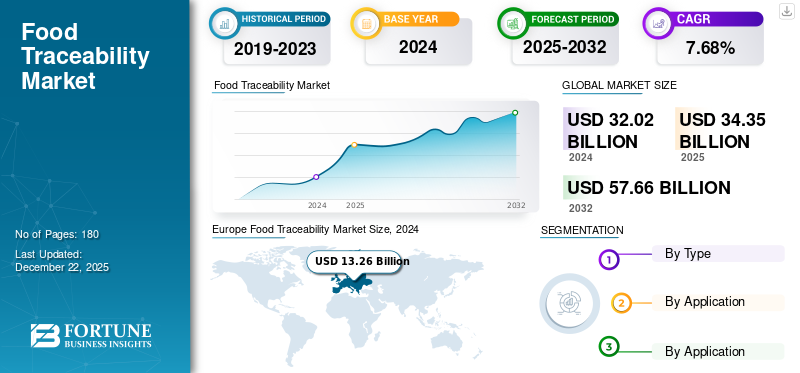
The global food traceability market size was valued at USD 34.35 billion in 2025. The market is projected to grow from USD 36.88 billion in 2026 to USD 67.44 billion by 2034, exhibiting a CAGR of 7.84% during the forecast period. Europe dominated the food traceability market with a market share of 41.43% in 2025.
Food traceability refers to the systems that track the flow of a food ingredient and product through the food supply chain, ranging from production to consumption. The main role of this system is to track the safety and quality of food and create transparency across food manufacturing facilities. Globally, Europe and North America are considered substantial users of systems. Some common examples of this system include RFID tags, barcode scanning, and others. Along with food safety, this system usage reduces food fraud/recalls, verifies authenticity, and strengthens operational efficiency. The surging consumer awareness regarding transparency and increasing government regulations drive the global market growth.
SGS SA, Honeywell International Inc., and Zebra Technologies Corp. are some of the few prominent players operating in the market.
Download Free sample to learn more about this report.
Food Traceability Market Key Takeaways
 Market Size & Forecast
- 2025 Market Size: USD 34.35 Billion
- 2026 Market Size: USD 36.88 Billion
- 2034 Forecast Market Size: USD 67.44 Billion
- CAGR: 7.84% from 2026–2034
 Market Share
- Europe dominated the food traceability market with a 41.43% share in 2025.
- The software segment is projected to account for 26.33% of the global market in 2026.
- The fish, meat, and seafood segment is expected to hold a 29.42% market share in 2026.
 Key Regional Highlights
Europe
Europe led the global market with USD 14.23 billion in 2025 and is projected to reach USD 15.29 billion in 2026.
North America
North America accounted for USD 12.40 billion in 2025 and is expected to grow to USD 13.38 billion in 2026.
Asia Pacific
Asia Pacific generated USD 6.25 billion in 2025 and is projected to reach USD 6.66 billion in 2026.
U.S.
The food traceability market is projected to reach USD 11.08 billion in 2026.
Japan
The market is forecast to attain USD 1.91 billion by 2026
Read More

MARKET DYNAMICS
Market Drivers
Increasing Prevalence of Foodborne Illness Boosts Market Growth
The surging incidences of foodborne illness are the pivotal aspect boosting market growth. Foodborne diseases caused by spoiled food are a critical public health concern affecting thousands of individuals globally. When contaminated food results in illness, a traceability system allows for faster identification of the spoiled food and the source, preventing the spread of contamination. Beyond immediate responses, these systems also offer data for potential vulnerabilities and identifying patterns in the supply chain. As a result, the aforementioned factors drive the global food traceability market growth.
Stringent Food Safety Regulatory Frameworks Facilitate Industry's Growth
The robust food safety regulations are another main driver stimulating the market's growth trajectory. In today's era, most consumers are increasingly seeking transparency about the safety and origin of finished products. Food safety regulations mandated by the European Union and the FDA require traceability across the supply chain, particularly from farm to table, to fulfill such consumer demands. As a result, such stringent regulations for food safety strengthen the industry’s growing momentum.
Market Restraints
High Implementation Cost of System and Inconsistent Supplier Transparency Obstruct Industry's Growth
One of the pivotal hurdles faced by food operators is the high cost of implementation of the system. Food traceability systems are highly expensive, owing to the initial cost of implementing the system, including software, hardware, maintenance, and data analysis costs. Moreover, few systems use advanced/modern technologies such as blockchain and RFID, which are associated with high costs. Along with this, international trade and complex supply chains drive the overall price. Thus, such high implementation prices impede its utilization rate.
Inconsistent supplier transparency is also a serious issue in the global marketplace. In some scenarios, some suppliers lack transparency regarding processing and sourcing. As a result, the aforementioned factors hamper the food traceability industry's growth.
Market Opportunities
Smart Labeling and Packaging Creates Growth Opportunities
The demand for smart packaging and labeling is growing faster, reflecting individual interest in the traceability sector. Integrating advanced technologies such as RFID tags and QR codes in food packaging facilitates accountability, transparency, and consumer trust in the supply chain. Such labels offer consumers detailed information about the end product, including ingredients, allergen warnings, and origin. Moreover, smart packaging can easily monitor humidity and temperature, minimizing contamination. Also, digital twin technology and artificial intelligence can be used to optimize supply chains and easily predict potential challenges. Additionally, incorporating security features prevents the risk of counterfeiting and assures the target group receives authentic products.
FOOD TRACEABILITY MARKET TRENDS
Rising Inclination Toward Transparency is a Prominent Trend
The surging inclination toward transparency of food products is a substantial and growing trend in the global industry. Modern consumers are increasingly becoming more health-conscious and are looking for information regarding production, origin, and ingredients. This inclination leads to a higher emphasis on food transparency across the supply chain. Moreover, this trend is intensified by the escalated number of foodborne outbreaks, necessitating consumers to make informed decisions. Also, food fraud is a growing concern, which further fuels the importance of systems to ensure safe food produce.
Download Free sample to learn more about this report.
Impact of Tariffs
In the initial days of April 2025, Donald Trump, the U.S. President, announced the news of imposing tariffs on imported products. Likewise, for food commodities, this tariff can impact the prices of traceability systems owing to the spike in hardware components. The increased cost of such components can lead to higher prices, especially for software firms. Although the tariff act is on hold for a few months, it is still expected to affect the market considerably.
SEGMENTATION ANALYSIS
By Type
Software Segment Led Market Owing to Its Enhanced Traceability
Depending on the type, the market is segmented into hardware and software.
The software segment dominated the market and captured the highest share in 2024. Such systems enable faster identification and real-time visibility into the supply chain and improve operational efficiency. Moreover, software helps food businesses meet regulatory compliance set by the governments of different countries. Additionally, traceability software can reduce financial losses and build customer confidence. The software segment is expected to lead the market, contributing 26.33% globally in 2026.
The hardware segment secured the second position in the global market and is projected to grow at the same pace in the future. The increasing demand for transparency and escalated awareness of food safety will propel the segment's growth.
By Application
To know how our report can help streamline your business, Speak to Analyst
Increasing Need to Prevent Food Recalls Propels Fish, Meat, and Seafood Segment Growth
Based on application, the market is distributed into fruits and vegetables, dairy products, fish, meat, and seafood, beverages, bakery and confectionery, and others.
The fish, meat, and seafood segment leads the market and holds the highest CAGR. The traceability systems are highly utilized in this category to prevent food recalls and assist in tracking information about fishing vessels, aquaculture, and farms. Moreover, such systems can help in combating illegal fishing and help in building a company's reputation by utilizing systems. Compared to other food categories, seafood and meat are highly susceptible to pathogen infection, which drives the adoption rate of systems. The fish, meat and seafood segment will account for 29.42% market share in 2026.
The others segment ranked second in the market and is projected to maintain the same pace in the coming term. The improved awareness of food safety and increasing usage of systems by producers can support the global market share.
Food Traceability Market Regional Outlook
Based on region, the market is segmented into North America, Europe, Asia Pacific, South America, and the Middle East & Africa.
Europe
Europe Food Traceability Market Size, 2025 (USD Billion)
To get more information on the regional analysis of this market, Download Free sample
The Europe region captured 41.43% of the global market in 2025, generating USD 14.23 billion in revenue, and is projected to reach USD 15.29 billion in 2026. Europe dominates the market and holds the largest food traceability market share. The regional growth is backed by mandatory regulations and a rising inclination toward transparency. Today, more than half of Europeans are concerned about the quality control and ethical production practices of finished products. To lead a healthy lifestyle, individuals are willing to pay extra for items with robust traceability systems, especially in the fish and meat sector. Moreover, the rising emphasis on Environmental, Social, and Governance (ESG) criteria further increases regional growth. Among all European countries, Germany led the regional industry, and its growth is attributed to technological advancement in systems and a surging focus on sustainability. The UK market is expected to reach USD 2.78 billion by 2026, while the Germany market is anticipated to account for USD 3.76 billion by 2026.
North America
In 2025, the North America market stood at USD 12.4 billion, representing 36.09% of global demand, and is projected to grow to USD 13.38 billion in 2026. North America, the second-leading and fastest-growing region, benefits from the augmented cases of foodborne illnesses and technological advancements in systems. Such cases of foodborne outbreaks highlight the need for traceability systems and boost their adoption among food companies. Likewise, Europe, the North American region aim at food safety, which is attained via the U.S. Food Safety Modernization Act (FSMA). This act necessitates that manufacturers/businesses implement tracking systems throughout their supply chain. The U.S. led the market in this region, owing to smart packaging trends and growing demand for sustainably sourced products. The U.S. market is valued at USD 11.08 billion by 2026.
Asia Pacific
Asia Pacific maintained a strong presence in the global market, reaching USD 6.25 billion in 2025, accounting for 18.19% share, and is expected to reach USD 6.66 billion in 2026. Asia Pacific is the third most prominent region in the global market, owing to improved health consciousness awareness and an enhanced willingness to pay for premium items. Compared to developed regions, Asia Pacific is progressing and is expected to soar faster in the coming years. The rising number of system players and enhanced collaboration of retailers with traceability system firms strengthen market growth. Moreover, the South American Government proposes initiatives to ensure food safety, which helps to maintain the individual’s health. The Japan market is forecast to attain USD 1.91 billion by 2026, the China market is set to reach USD 2.69 billion by 2026, and the India market is expected to achieve USD 0.47 billion by 2026.
South America
South America is at its nascent stage and is projected to maintain the same growth trajectory in the coming years. The growing disposable income and rising focus on food safety are escalating the region's growing potential.
Middle East & Africa
The Middle East & Africa market accounted for USD 0.56 billion in 2025, representing 1.64% of the global industry, and is expected to reach USD 0.59 billion in 2026. The Middle East & Africa region is developing, and its growth is attributed to surging demand for ethically produced food items and growing meat production, which requires traceability systems to maintain quality.
Latin America
In 2025, Latin America represented USD 0.91 billion, accounting for 2.64% of the worldwide market, and is projected to grow to USD 0.96 billion in 2026.
COMPETITIVE LANDSCAPE
Key Industry Players
Main Players in Market are Aiming at Product Launches to Enhance Revenue Generation
Active players in the global market include SGS SA, C.H. Robinson, Honeywell International Inc., and Trustwell. All the firms are concentrating on launching new systems that can aid in creating superior-quality food products. Moreover, companies aim for collaborations that further bolster their brand's reputation.
List of Key Food Traceability Companies Profiled
- C.H. Robinson (U.S.)
- SGS SA (Switzerland)
- Bar Code Integrators, Inc. (U.S.)
- Zebra Technologies (U.S.)
- Trustwell (U.S.)
- Honeywell International Inc. (U.S.)
- Cognex Corporation (U.S.)
- Merit-Trax Technologies (Canada)
- Carlisle Technology (Canada)
- Covectra (U.S.)
KEY INDUSTRY DEVELOPMENTS
- March 2025: SGS SA, a Swiss multinational enterprise, introduced its latest FSMA 204 food solutions, which combine the TRAKKEY digital traceability platform and FSMA 204 training and audits. This system aids in minimizing recalls and improving outbreak investigations across Switzerland.
- May 2022: OPTEL Group, a Canadian leader in supply chain traceability solutions, revealed the launch of Optchain, a suite of modular intelligent supply chains for the beverage & food industry. This chain has been particularly designed to address the traceability needs of all supply chain stakeholders to adhere to the Food and Drug Administration's critical update of the Food Safety Modernization Act.
- March 2022: Chipotle Mexican Grill, an American fast-casual restaurant chain, unveiled the news of implementing radio frequency identification tags (RFID) across its supply chain. This technology has proven beneficial, especially for managing limited-edition offers, such as Chicken El Pastor.
- September 2021: Nestle S.A., a food conglomerate in Switzerland, and Carrefour, a retailer in France, announced using IBM's, a technology company in the U.S., food trust blockchain platform to track baby milk items, especially organic products.
- April 2020: Nestle S.A., a prominent food company in Switzerland, expanded the utilization of IBM's, an American technology enterprise, blockchain technology platform to a coffee brand. Via the blockchain-recorded data, consumers can easily track the origin of their coffee.
REPORT COVERAGE
The market industry report analyzes the market in depth and highlights crucial aspects such as global market trends, market dynamics, prominent companies, and applications. Besides this, the market statistics report also provides insights into the global food traceability market and highlights significant industry developments.
Request for Customization to gain extensive market insights.
Report Scope & Segmentation
|
ATTRIBUTE |
DETAILS |
|
Study Period |
2021-2034 |
|
Base Year |
2025 |
|
Estimated Year |
2026 |
|
Forecast Period |
2026-2034 |
|
Historical Period |
2021-2024 |
|
Unit |
Value (USD Billion) |
|
Growth Rate |
CAGR of 7.84% from 2026 to 2034 |
|
Segmentation |
By Type
|
|
By Application
|
|
|
By Region
|
Frequently Asked Questions
Fortune Business Insights says that the market was valued at USD 34.35 billion in 2025.
The market is expected to grow at a CAGR of 7.84% during the forecast period (2026-2034).
By type, the software segment led the market.
The increasing prevalence of foodborne illness and stringent food safety regulations boost the market's growth.
SGS SA, Trustwell, and Honeywell International Inc. are a few of the major players in the market.
Europe holds the highest market share of 41.43% in 2025.
Smart labeling and packaging create growth opportunities.



- 2021-2034
- 2025
- 2021-2024
- 180
-
(Offer valid till 15th Oct 2026)
Get 30-60 hrs Free Customization
Expand Regional and Country Coverage, Segments Analysis, Company Profiles, Competitive Benchmarking, and End-user Insights.



















-
US +1 833 909 2966 ( Toll Free )
-
Get In Touch With Us