Smart Packaging Market Size, Share & Industry Analysis, By Technology Type (Modified Atmosphere Packaging (MAP), Active Packaging, and Intelligent Packaging), By Application (Food & Beverages, Personal Care & Cosmetics, Pharmaceuticals, Electronics, E-commerce, and Others), and Regional Forecast, 2026-2034
 Download Free Sample
(Offer valid till 30th Sep 2026)

KEY MARKET INSIGHTS
 Listen to Audio Version
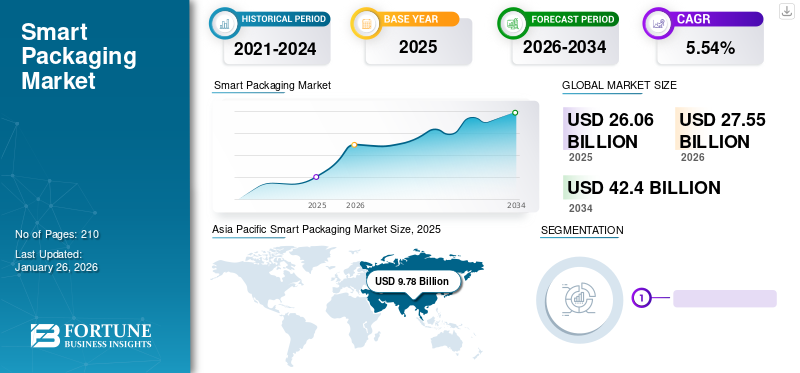
The global smart packaging market size was valued at USD 26.06 billion in 2025. The market growth is projected to be USD 27.55 billion in 2026 to USD 42.40 billion by 2034, exhibiting a CAGR of 5.54% during the forecast period. Asia Pacific dominated the smart packaging market with a market share of 37.52% in 2025. Moreover, the smart packaging market in the U.S. is projected to grow significantly, reaching an estimated value of USD 10.70 billion by 2034, driven by the rapid advancement in Internet of Things technologies.
Smart packaging refers to packaging systems that incorporate technologies such as RFID (radio-frequency identification), NFC (near field communication), QR codes, sensors, and other components such as modified atmosphere packaging (MAP) to provide additional features beyond traditional packaging. Temperature-sensitive labels and indicators can be integrated into the packaging to monitor and communicate the conditions in which a product is stored and transported.
The primary goal of the solution is to provide consumers, retailers, and manufacturers with added value beyond the basic containment and protection of products. One significant driver behind the growth of the market share is the increasing consumer demand for more information about products, including their origin, authenticity, and usage. Another aspect of the solution is its ability to enhance supply chain management.
The notable effect of the COVID-19 pandemic on the market is the increased emphasis on safety and hygiene. Smart packaging technologies, such as antimicrobial coatings and tamper-evident features, gained prominence as they could address these concerns by enhancing the safety and integrity of packaged goods. These factors helped the market recover from the initial setback.
Download Free sample to learn more about this report.
SMART PACKAGING MARKET KEY TAKEAWAYS
 Global Market Size & Forecast
- 2025 Market Size: USD 26.06 billion
- 2026 Market Size: USD 27.55 billion
- 2034 Forecast Market Size: USD 42.40 billion
- CAGR: 5.54% from 2026–2034
 Market Share
- Asia Pacific dominated the smart packaging market with a market share of 37.52% in 2025.
- The modified atmosphere packaging (MAP) segment is expected to account for 48.03% of the market in 2026.
- The food & beverages segment is expected to hold a 35.03% share in 2025.
 Key Regional Highlights
North America
In 2025, North America represented USD 7.21 billion, accounting for 27.66% of the worldwide market, and is projected to grow to USD 7.63 billion in 2026.
Europe
The Europe market generated USD 6.07 billion in 2025, representing 23.30% of the global market landscape, and is expected to reach USD 6.37 billion in 2026.
Asia Pacific
Asia Pacific contributed 37.52% to the global market in 2025, with a valuation of USD 9.78 billion, and is projected to reach USD 10.45 billion in 2026.
U.S.
The U.S. market is valued at USD 6.82 billion by 2026.
Japan
The Japan market is valued at USD 2.3 billion by 2026.
Read More

Smart Packaging Market Trends
Enhanced Product Traceability and Authentication Offered by Smart Packaging is Emerging as a Key Trend
There has been a growing emphasis on enhancing product traceability and authentication within the packaging market. This trend has been driven by increased consumer awareness regarding the origin and authenticity of products, especially in industries such as pharmaceuticals, food, and luxury goods. Technologies such as RFID, NFC, and QR codes play a pivotal role in enabling product traceability. RFID, in particular, allows for real-time tracking of products throughout the supply chain, offering precise information on the location and movement of goods.
NFC and QR codes provide consumers with easy access to detailed product information, allowing them to verify the authenticity of the item. The integration of smart packaging technologies makes it significantly more difficult for counterfeiters to replicate products, as each item can be uniquely identified and verified. These factors are expected to contribute to the smart packaging market growth over the forthcoming years. Asia Pacific witnessed a growth from USD 9.78 Billion in 2025 to USD 10.45 Billion in 2026.
Download Free sample to learn more about this report.
Smart Packaging Market Growth Factors
Growing Focus on Sustainability and Environmental Concerns in Packaging to Fuel the Market Growth
The increasing emphasis on sustainability and environmental consciousness is proving to be a major driver propelling the market growth. Smart packaging technologies contribute to sustainability by enabling more efficient use of resources and reducing environmental footprint. For instance, sensors embedded in packaging can monitor the freshness of perishable goods, preventing unnecessary waste by providing consumers with accurate information about product shelf life. In addition, smart packaging facilitates better recycling practices by offering detailed information about the materials used, aiding in the separation of recyclable components.
In response to the global push for eco-friendly practices, businesses are increasingly incorporating smart solutions into their sustainability initiatives. Such exclusive characteristics of smart packaging technologies are boosting the market growth.
Advancements in Internet of Things (IoT) Technologies to Drive the Market Growth
The rapid advancements in Internet of Things (IoT) technologies play a crucial role in driving the market growth. IoT technologies, such as sensors, RFID, and connectivity solutions, enable packaging to become intelligent and interactive. These technologies empower packaging to capture and transmit real-time data, transforming traditional packaging into a dynamic and responsive component of the supply chain.
The seamless integration of the solution with IoT technologies not only addresses current business challenges but also opens up for new possibilities for innovation and optimization in various industries. The vision of creating an active and intelligent supply chain through smart solutions aligns with the broader trend of Industry 4.0, where digital technologies are transforming traditional manufacturing and logistics processes. Due to these reasons, the market is expected to witness further growth during the forecast period.
RESTRAINING FACTORS
High Cost and Data Security and Privacy Concerns May Hamper the Market Growth
One of the primary restraining factors of the smart packaging market growth is the cost associated with implementing smart technologies into packaging solutions. The integration of digital or active elements can significantly increase the overall production cost of packaging, posing a financial barrier for some businesses, especially small and medium-sized enterprises. The initial investment in technology, software development, and infrastructure required for the solution can be substantial.
In addition, the rapid evolution of digital technologies demands continuous updates and upgrades, further adding to the technological complexity and maintenance costs. Moreover, the increasing connectivity of the solution to the internet and other networks raises concerns about data security and privacy. Ensuring the security of sensitive data, especially in industries where confidentiality is vital, such as healthcare and pharmaceuticals, is critical to maintaining trust among consumers and businesses.
Smart Packaging Market Segmentation Analysis
By Technology Type Analysis
Modified Atmosphere Packaging (MAP) Segment Dominates Due to the Distinct Benefits
The market is categorized by technology type into modified atmosphere packaging (MAP), intelligent packaging, and active packaging.
The modified atmosphere packaging (MAP) segment is expected to account for 48.03% of the market in 2026 in the smart packaging market worldwide and the segment is forecasted to multiply during the forecast period.
The primary reason for the dominance of the segment is its effectiveness in extending the shelf life of perishable products. By adjusting the levels of oxygen, carbon dioxide, and nitrogen within the packaging, MAP creates an environment that slows down the deterioration of food, reducing the need for preservatives. This is crucial for items such as fresh produce, meat, and seafood, where maintaining optimal conditions during transportation and storage is essential to prevent spoilage and ensure that consumers receive products in their best condition. While initially associated with the food industry, MAP has found applications in various sectors, including pharmaceuticals. These factors make them suitable for diverse market segments, boosting their demand worldwide.
By Application Analysis
To know how our report can help streamline your business, Speak to Analyst
Food & Beverages Segment Dominates Owing to Integration of RFID Tags
Based on application, the market is classified into personal care & cosmetics, food & beverages, pharmaceuticals, electronics, e-commerce, and others.
The food and beverage segment dominates the market. With the growing emphasis on food safety and transparency, the industry has embraced smart packaging solutions to provide consumers with real-time access to product information, sourcing details, and nutritional content.
- The food & beverages segment is expected to hold a 35.03% share in 2025.
Brands are integrating QR codes and RFID tags to enable consumers to track the product's journey from farm to consumer, ensuring transparency and authenticity. By incorporating technologies that enable traceability, authentication, and tamper-evident features, brands can ensure compliance with food safety regulations and quality standards, making the food & beverages segment acquire a larger market share.
REGIONAL INSIGHTS
The market is analyzed across North America, Europe, the Asia Pacific, Latin America, and the Middle East & Africa.
Asia Pacific Smart Packaging Market Size, 2025 (USD Billion)
To get more information on the regional analysis of this market, Download Free sample
Asia Pacific
Asia Pacific contributed 37.52% to the global market in 2025, with a valuation of USD 9.78 billion, and is projected to reach USD 10.45 billion in 2026. The Asia Pacific holds the largest share and is the dominating region in the market. Countries such as China and Japan have been at the forefront of implementing innovative packaging solutions, both for food safety and supply chain optimization. The healthcare industry in the region has also shown interest in the solution for ensuring product integrity. The Japan market is valued at USD 2.3 billion by 2026, the China market is valued at USD 3.41 billion by 2026, and the India market is valued at USD 2.03 billion by 2026.
North America
In 2025, North America represented USD 7.21 billion, accounting for 27.66% of the worldwide market, and is projected to grow to USD 7.63 billion in 2026. North America is the second dominating region in the market. The technological advancements, consumer demand, and the presence of significant key players have led to rapid market growth in the North American region. The U.S. market is valued at USD 6.82 billion by 2026.
Europe
The Europe market generated USD 6.07 billion in 2025, representing 23.30% of the global market landscape, and is expected to reach USD 6.37 billion in 2026. Europe, after North America, is also one of the dominating regions and is expected to attain substantial growth over the coming years. The regulatory rules by the European authorities against counterfeiting of goods, especially for pharmaceuticals, promote the use of QR codes and RFIDs for packaging, contributing to regional growth. The UK market is valued at USD 1.12 billion by 2026, while the Germany market is valued at USD 1.49 billion by 2026.
Latin America
The market in Latin America reached USD 2.08 billion in 2025, representing 7.97% of total market revenue, and is projected to reach USD 2.15 billion in 2026. Latin America region is expected to experience promising growth over the projected period due to the rising demand for affordable technologies for product visibility and consumer interaction.
Middle East & Africa
The Middle East & Africa market was valued at USD 0.92 billion in 2025, capturing 3.54% of global revenue, and is estimated to reach USD 0.95 billion in 2026. The Middle East & Africa industry is estimated to attain a moderate growth rate during the forecast period due to the increasing demand for smart packaging solutions that ensure product traceability. However, market growth in this region may be influenced by factors such as economic stability and infrastructure development.
List of Key Companies in Smart Packaging Market
Key Participants in the Market Witnessing Significant Growth Opportunities
The global market is highly fragmented and competitive. Regarding market share, the few major players dominate the market by offering innovative packaging in the packaging industry. These major players in the market are constantly focusing on expanding their customer base across the regions and innovation.
Major players in the market include International Paper Company, Smurfit Kappa Group plc, 3M Company, Amcor Plc, Constantia Flexibles, and others. Numerous other players operating in the industry are focused on delivering advanced packaging solutions.
List of Key Companies Profiled:
- International Paper Company (U.S.)
- Smurfit Kappa Group plc (U.S.)
- 3M Company (U.S.)
- Amcor Plc (Switzerland)
- Constantia Flexibles (Austria)
- Avery Dennison Corporation (U.S.)
- R.R. Donnelley & Sons Company (U.S.)
- Stora Enso Oyj (Finland)
- Filtration Group (U.S.)
- Sealed Air (U.S.)
- Air Products and Chemicals, Inc. (U.S.)
- Zebra Technologies Corporation (U.S.)
- EMCO Packaging Systems Ltd. (U.K.)
- Amerplast Ltd. (Finland)
- DuPont (U.S.)
KEY INDUSTRY DEVELOPMENTS:
- November 2023 – Smurfit Kappa launched its new SupplySmart digital solution, which helps businesses intelligently adapt their packaging to increase efficiency and reduce emissions across their supply chains.
- September 2023 – Bastille Parfums, a French company specializing in sustainable and natural fragrances, partnered with Avery Dennison to combine Avery Dennison’s RFID (radio frequency identification) sensor technology to track and trace tagged products across Bastille’s entire supply chain, improve inventory management and mitigate counterfeit products.
- July 2023 – International Paper developed an innovative technology (OHMEGA®) to interact with consumers through packaging. OHMEGA® delivers advertisements, sweepstakes, coupons and more to consumers by using a unique code printed in conductive ink on the package.
- April 2022 – Sealed Air announced the introduction of prismiq™, which is a digital packaging brand with a portfolio of solutions for design services, digital printing, and smart packaging.
- May 2021 – BASF joined the Digital Watermark Initiative “HolyGrail 2.0” for smart packaging recycling. The initiative aims to increase plastic recycling rates by adding imperceptible digital watermarks to product packaging.
REPORT COVERAGE
Request for Customization to gain extensive market insights.
The report provides a detailed market analysis and focuses on key aspects such as prominent players, competitive landscape, product/service types, market segmentation, Porter's five forces analysis, and leading applications of the product. Besides this, it offers insights into the market trends and highlights key industry developments. In addition to the above factors, the report encompasses several factors that have contributed to the market's growth in recent years.
Report Scope & Segmentation
|
ATTRIBUTE |
DETAILS |
|
Study Period |
2021-2034 |
|
Base Year |
2025 |
|
Estimated Year |
2026 |
|
Forecast Period |
2026-2034 |
|
Historical Period |
2021-2024 |
|
Growth Rate |
CAGR of 5.54% from 2026 to 2034 |
|
Unit |
Value (USD Billion) |
|
Segmentation |
By Technology Type
|
|
By Application
|
|
|
By Region
|
Frequently Asked Questions
According to Fortune Business Insights, the global smart packaging market size was valued at USD 26.06 billion in 2025. It is projected to grow from USD 27.55 billion in 2026 to USD 42.40 billion by 2034, exhibiting a CAGR of 5.54% during the forecast period.
The market is projected to grow at a compound annual growth rate CAGR of 5.54% during the forecast period.
The smart packaging market is driven by factors such as the advancement of Internet of Things (IoT) technologies, rising demand for product traceability and authentication, and increasing consumer awareness regarding product origin and safety. Sustainability concerns and efforts to reduce food waste are also key contributors.
Asia Pacific dominated the smart packaging market in 2024 with a market share of 37.52%, driven by rapid adoption of innovative packaging in China, Japan, and India. North America and Europe are also witnessing strong growth due to technology integration and regulatory mandates.
One major trend is the integration of RFID, NFC, and QR codes for enhanced product authentication and real-time tracking. Another key trend is the development of antimicrobial coatings and tamper-evident features in response to growing safety and hygiene concerns post-COVID-19.
Modified Atmosphere Packaging (MAP) holds the largest market share due to its ability to extend shelf life and reduce spoilage of perishable goods. Its use is prevalent in the food, pharmaceutical, and electronics sectors.
The food & beverages industry is the leading adopter of smart packaging, leveraging RFID tags and QR codes to provide traceability, freshness monitoring, and consumer engagement. The pharmaceutical and personal care sectors also show strong uptake.
The primary restraints include the high cost of implementation, especially for small businesses, and data privacy and cybersecurity concerns associated with connected packaging systems. Constant technology upgrades also pose a financial and operational challenge.
Key companies in the global smart packaging market include International Paper Company, Smurfit Kappa Group plc, 3M Company, Amcor Plc, Avery Dennison, Sealed Air, and Zebra Technologies, among others. These players focus on innovation, sustainability, and expanding global reach.


- 2021-2034
- 2025
- 2021-2024
- 210
-
(Offer valid till 30th Sep 2026)
Get 30-60 hrs Free Customization
Expand Regional and Country Coverage, Segments Analysis, Company Profiles, Competitive Benchmarking, and End-user Insights.



Related Reports
-
US +1 833 909 2966 ( Toll Free )
-
Get In Touch With Us