Footrest Market, Share & Industry Analysis, By Product Type (Adjustable, Fixed, Rocking, and Others), By Material (Plastic, Foam, Metal, and Others), By Application (Office/Corporate Use, Home Office/Residential Use, and Others), By Price Range (Economy, Mid-Range, and Others) By Distribution Channel (Online Retail and Offline Retail), and Regional Forecast, 2026-2034
 Download Free Sample
(Offer valid till 31st Oct 2026)

Footrest Market Size and Future Outlook
 Listen to Audio Version
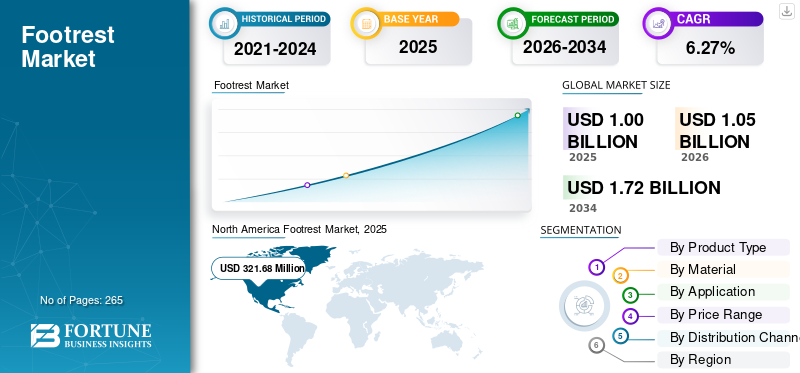
The global footrest market was valued at USD 1,004.30 million in 2025. The market is projected to grow from USD 1,058.43 million in 2026 to USD 1,721.57 million by 2034, exhibiting a CAGR of 6.27% during the forecast period. North America dominated the footrest market with a market share of 32.93% in 2025.
The global footrest market is growing at a considerable rate, driven by the growing desk job culture, sedentary lifestyles, rising awareness of ergonomic health, and the rise in home office environments globally. Working professionals are gradually investing in ergonomic accessories such as flexible seating solutions and adjustable memory foam footrests, as extended work sittings can lead to poor posture, backache, and circulation concerns. Corporate offices are also undertaking and complying with ergonomic workplace standards to enhance employee health and work productivity. Moreover, the expansion of digital channels has boosted product accessibility and price competitiveness. Unique product price ranges, material innovation, and movable formats are further accelerating market expansion across commercial and residential applications globally.
- For instance, according to the U.S. Bureau of Labor Statistics (BLS), in the first quarter of 2024, an estimated 35.5 million people in the country worked at home or teleworked for pay, representing 22.9% of all employed professionals during the same period.
A few of the leading players in the market include Fellowes, Inc., Humanscale, 3M Company, Kensington, and ErgoFoam. These prominent players constantly focus on ergonomic features such as sustainable materials, memory foam padding, and adjustable height. Moreover, product distribution via digital platforms and direct-to-consumer channels is emphasized, enabling brands to gain broader consumer reach, stronger brand visibility, and competitive pricing.
Download Free sample to learn more about this report.
FOOTREST MARKET Key Takeaways
 Market Size & Forecast
- 2025 Market Size: USD 1,004.30 million
- 2026 Market Size: USD 1,058.43 million
- 2034 Forecast Market Size: USD 1,721.57 million
- CAGR: 6.27% from 2026–2034
 Market Share
- North America dominated the footrest market with a market share of 32.93% in 2025.
- The other segment (wood, mesh, fabric, and composite materials) is expected to witness the fastest growth, registering a CAGR of 6.41% during the forecast period.
- The premium segment is projected to grow at the fastest CAGR of 7.74% through 2034.
 Key Regional Highlights
North America
North America is projected to grow at a CAGR of 5.73% over the coming years, with the highest market share among all regions, and to reach a valuation of USD 321.68 million in 2025.
Europe
Europe held the third-largest share in 2025, valued at USD 277.11 million and accounting for 27.59% of the global market, supported by growing adoption of hybrid work models and rising demand for ergonomic office accessories.
Asia Pacific
Asia Pacific was valued at USD 298.79 million in 2025 and is anticipated to expand at the fastest regional CAGR of 7.49% during the forecast period.
U.S.
The U.S. market reached USD 259.22 million in 2025, contributing approximately 25.81% of global market revenue, driven by strong demand for workplace ergonomics solutions.
Japan
The Japanese market was valued at USD 49.76 million in 2025, supported by increasing adoption of compact ergonomic products, home-office setups, and workplace wellness initiatives.
Read More

FOOTREST MARKET TRENDS
Growing Demand for Ergonomic Home Office Setups to Lead Product Innovation
The swift rise in the work-from-home population has increased demand for posture-supportive, comfortable workspace accessories. As working professionals spend longer hours at their desks, health concerns regarding back pain and poor posture are increasing. This transition is driving higher demand for memory foam, adjustable, and multifunctional footrests. As a result, market players are launching portable, compact, and ergonomically advanced products to improve productivity and enhance comfort.
MARKET DYNAMICS
MARKET DRIVERS
Download Free sample to learn more about this report.
Growing Awareness of Workplace Ergonomics Accelerating Market Expansion
Growing awareness of the health risks of prolonged sitting, including poor blood circulation, lower back pain, and musculoskeletal disorders, is significantly driving demand for ergonomic accessories such as footrests. Organizations are actively investing in ergonomic solutions to improve employee productivity and work efficiency, reduce absenteeism, and enhance comfort. Concurrently, professionals working from home are also emphasizing products that help them maintain proper posture to create a healthier working environment. Thus, growing focus on physical well-being is directly contributing to rising adoption rates and contributing to the global footrest market growth.
MARKET RESTRAINTS
Availability of Low-Cost Substitutes to Limit Premium Product Adoption
The extensive availability of cheaper, low-cost alternatives, including small tables, stools, and other improvised foot supports, as well as generic products, hampers the growth of standard footrest products. Budget-conscious consumers typically prefer economical alternatives to spending on ergonomic, advanced versions. Consequently, market players experience pricing pressure, lower profit margins, and slower adoption of high-value, feature-rich footrest products in emerging markets.
MARKET OPPORTUNITIES
Expansion of Remote Work Culture to Create an Untapped Consumer Segment
The steady rise in hybrid and remote work culture globally is generating significant growth opportunities for manufacturers. As more working professionals establish permanent home office setups, demand for ergonomic work-related accessories grows. More and more consumers are investing in posture-enhancing accessories that enhance comfort, work efficiency, and productivity. This transition has enabled manufacturers to capture a broader residential consumer segment through affordable, innovative, and highly marketed ergonomic footrest solutions.
MARKET CHALLENGES
Intense Price Competition is Hampering the Profit Margins of the Product
There are many unorganized local players in the footrest market offering low-priced products, which creates an intense price war. Since consumers tend to incline towards affordability over brand value and product differentiation, established players are forced to lower prices or offer discounts to maintain market share. This constant pricing pressure influences overall profit margins and restricts market players' ability to invest aggressively in product innovation, premium, eco-friendly materials, and large-scale marketing initiatives.
Segmentation Analysis
By Product Type
Rising Demand for Customizable Ergonomic Comfort to Drive Dominance of Adjustable Footrests
Based on product type, the market is segmented into adjustable, fixed, rocking, and others.
The adjustable segment led market growth due to its widespread adoption. The segment’s dominance is driven by growing consumer preference for ergonomic flexibility, as adjustable models let users adjust their height and tilt to suit their comfort needs. As more people work from home, they are spending on customizable solutions to reduce strain and avoid posture-related concerns during prolonged sitting. Moreover, corporate offices prioritize employee health and productivity, thereby investing in adjustable ergonomic accessories.
The other segment is anticipated to rise at the second-fastest CAGR of 7.67% over the forecast period.
To know how our report can help streamline your business, Speak to Analyst
By Material
Superior Comfort and Pressure Relief to Lead the Growth of Foam-Based Products
Based on material, the market is segmented into plastic, foam, metal, and others.
In 2025, the foam segment dominated the global footrest market share. This segment's dominance was attributed to its excellent cushioning, which helps reduce foot fatigue and improve blood circulation during prolonged sitting. As knowledge and awareness of ergonomic health increase, working professionals are opting for foam-based footrests for enhanced comfort in home and office environments. Moreover, foam material is affordable, lightweight, and widely available through online retailers. These advantages together place foam footrests as the dominant segment.
The other segment, including wood, mesh, fabric, and composite materials, is projected to grow at the fastest CAGR of 6.41% over the forecast period.
By Price Range
Balanced Affordability and Features to Lead Mid-Range Segment Growth
Based on the price range, the market is divided into economy, mid-range, and premium.
The mid-range segment dominated market growth, as this price range strikes an optimal balance between ergonomic features such as memory foam cushioning, adjustable height, and durable build quality, along with consumer affordability. Also, corporate bulk purchases often fall within this price category due to limited budget allotment. Consequently, the mid-range segment holds the highest market share compared to economy and premium offerings.
The premium segment is anticipated to rise at the fastest CAGR of 7.74% over the forecast period.
By Application
Expansion of Remote Work Culture Increasing Demand for Home Office Ergonomic Solutions
Based on the application, the market is segmented into office/corporate use, home office/residential use, and others.
The home office/residential use segment is anticipated to witness a dominating market share over the forecast period. With the rise in remote work, professionals are spending most of their working hours sitting at a desk. This, in turn, has led to increased demand for ergonomic accessories, such as footrests, in the residential home office segment. Furthermore, rising awareness of musculoskeletal health and circulation problems supports adoption in home environments.
The other segment, encompassing commercial spaces, gaming, and educational institutions, is projected to grow at a CAGR of 6.25% over the forecast period.
By Distribution Channel
In-Store Purchasing and Strong Institutional Procurement to Drive Offline Retail Dominance
Based on distribution channels, the market is segmented into online retail and offline retail.
The offline retail segment dominated the global market. This high market share was driven by bulk purchases by educational institutions, corporate offices, and commercial facilities through distributors and specialty office supply stores. Typically, firms prefer physical verification of product quality, durability, and ergonomic standards before making large-scale purchases. In addition, traditional retail stores continue to hold a higher market share in developing regions where online channel adoption is still growing. Moreover, direct consumer support and instant product availability further reinforce offline sales.
In addition, the online retail segment is projected to grow at the second-fastest CAGR of 6.90% during the forecast period.
Footrest Market Regional Outlook
By region, the market is categorized into Europe, North America, Asia Pacific, South America, and the Middle East & Africa.
North America
North America Footrest Market, 2025 (USD Million)
To get more information on the regional analysis of this market, Download Free sample
North America has emerged as a key region. It is projected to grow at a CAGR of 5.73% over the coming years, with the highest market share among all regions, and to reach a valuation of USD 321.68 million in 2025. The regional market growth is driven by ergonomic workplace standards across home and corporate office environments. Employers in the region emphasize the importance of ergonomic accessories to improve employee work comfort and productivity. Moreover, hybrid or remote work models have compelled professionals to enhance home office setups with posture-improving accessories.
U.S Footrest Market
Given North America’s strong contribution and the U.S. dominance in the region, the U.S. market reached USD 259.22 million in 2025, accounting for roughly 25.81% of global market sales.
Europe
Europe held the third-largest share in 2025, valued at USD 277.11 million and accounting for 27.59% of the global market. The increasing adoption of hybrid and remote work cultures, strict workplace ergonomics standards, growing consumer awareness of the importance of posture-related health, and ever-rising demand for sustainable, high-quality office accessories drive market growth in Europe.
U.K Footrest Market
The U.K. market in 2025 reached USD 47.52 million, representing roughly 4.73% of global market revenues.
Germany Footrest Market
Germany’s market reached USD 60.52 million in 2025, equivalent to around 6.03% of global market sales.
Asia Pacific
The Asia Pacific market is growing at a CAGR of 7.49% and reached USD 298.79 million in 2025. In the region, India and China both reached USD 77.88 million and USD 96.67 million, respectively, in 2025.
Japan Footrest Market
The Japanese market in 2025 was valued at USD 49.76 million, accounting for roughly 5.21% of global market revenues. Increasing demand for space-efficient, compact, and ergonomic accessories in office setups, extended working shifts, growing home-office adoption, and a strong workplace wellness culture across corporate and residential sectors are driving growth in the regional footrest market.
China Footrest Market
China’s market in 2025 was valued at USD 96.67 million in revenues, representing roughly 9.63% of global market sales.
India Footrest Market
The Indian market in 2025 was valued at USD 77.88 million, accounting for roughly 7.75% of global market revenues.
South America and the Middle East & Africa
The South America and Middle East & Africa regions are expected to witness moderate growth in this market space during the forecast period. The South America market reached USD 65.03 million in 2025. Expanding e-commerce penetration, rising corporate office development, and growing awareness regarding the importance of ergonomic work accessories drive regional market growth. In the Middle East & Africa, the UAE reached USD 7.90 million in 2025.
South Africa Footrest Market
The South African market reached USD 6.79 million in 2025, representing roughly 0.68% of global market revenues.
COMPETITIVE LANDSCAPE
Key Industry Players
Competitive Pricing and Product Innovation Increases Competition Amongst Players
Brand differentiation through product innovation, ergonomic feature enhancements, and a broader distribution network are the two major factors driving competition in the global footrest market. As consumers transition towards adjustable, comfort-driven ergonomic workplace accessories, market players are emphasizing the introduction of multiple product features, including sustainable materials, Price Range aesthetics, and certified ergonomic standards, to attract buyers. Brands are also strengthening their distribution channels by broadening their presence across online marketplaces and global retail networks to capture a broader consumer base.
LIST OF KEY FOOTREST COMPANIES PROFILED
- Fellowes, Inc. (U.S.)
- Humanscale Corporation (U.S.)
- 3M Company (U.S.)
- ACCO Brands Corporation (Kensington) (U.S.)
- ErgoFoam (U.S.)
- Safco Products Company (U.S.)
- Kokuyo Co., Ltd. (Japan)
- Herman Miller, Inc. (MillerKnoll) (U.S.)
- VARIDESK (Vari) (U.S.)
- Mount-It! (MI Products Inc.) (U.S.)
KEY INDUSTRY DEVELOPMENTS
- February 2025: ErgoFoam strengthened its direct-to-consumer strategy by launching a memory foam footrest with upgraded density support and washable covers. This was supported by online marketing campaigns to garner the growing home office segment.
- January 2025: Kensington (ACCO Brands) expanded its ergonomic product category by unveiling a re-priced footrest model. This model is made from recyclable materials and features height-adjustable settings, focusing on both comfort and sustainability.
- July 2024: Humanscale Corporation upgrades its ergonomic workspace collection by branding its premium footrest solution as part of integrated office wellness packages aimed at corporate clients adopting sustainable, employee-centric workplace Pricing.
- March 2024: Fellowes, Inc. expanded its ergonomic accessories portfolio by launching an enhanced line of height-adjustable footrests. This newly launched Price Range includes improved anti-slip surfaces and enhanced tilt-lock mechanisms, targeting hybrid workers seeking personalized comfort solutions.
REPORT COVERAGE
The global footrest market analysis includes a comprehensive study of the market & forecast by all the market segments included in the report. This qualitative and quantitative report includes details on the market dynamics and market trends expected to drive the market over the forecast period. It provides information on key aspects, including technological advancements, pipeline candidates, the regulatory environment, and product launches. Additionally, it details partnerships, mergers & acquisitions, and key industry developments, as well as their prevalence by key regions. The global market research report also provides a detailed competitive landscape, including market share and profiles of key players.
Request for Customization to gain extensive market insights.
Report Scope & Segmentation
| ATTRIBUTE | DETAILS |
| Study Period | 2021-2034 |
| Base Year | 2025 |
| Estimated Year | 2026 |
| Forecast Period | 2026-2034 |
| Historical Period | 2021-2024 |
| Growth Rate | CAGR of 6.27% from 2026-2034 |
| Unit | Value (USD Million) |
| Segmentation | By Product Type, Material, Application, Price Range, Distribution Channel, and Region |
| By Product Type |
|
| By Material |
|
| By Application |
|
| By Price Range |
|
| By Distribution Channel |
|
| By Region |
|
Frequently Asked Questions
According to Fortune Business Insights, the global market value stood at USD 1,004.30 million in 2025 and is projected to reach USD 1,721.57 million by 2034.
In 2025, the market value stood at USD 321.68 million.
The market is expected to grow at a CAGR of 6.27% over the forecast period.
By product type, the adjustable segment leads the market.
The growing desk job culture, sedentary lifestyles, growing awareness of ergonomic health, and the rise in home office environments globally are driving market growth.
Fellowes, Inc., Humanscale, 3M Company, Kensington, and ErgoFoam are the major players in the global market.
North America dominated the market in 2025.



- 2021-2034
- 2025
- 2021-2024
- 265
-
(Offer valid till 31st Oct 2026)
Get 30-60 hrs Free Customization
Expand Regional and Country Coverage, Segments Analysis, Company Profiles, Competitive Benchmarking, and End-user Insights.



















Related Reports
-
US +1 833 909 2966 ( Toll Free )
-
Get In Touch With Us