Friction Stir Welding Market Size, Share & Industry Analysis, By Welding Type (Spot Friction Stir Welding (Spot FSW), Linear Friction Stir Welding, Refill Friction Stir Spot Welding (RFSSW), Bobbin Tool Friction Stir Welding, and Others), By Material (Aluminum Alloys, Magnesium Alloys, Copper Alloys, Titanium Alloys, and Others), By End-use Industry (Automotive & Electric Vehicles, Aerospace & Defense, Rail & Transportation, Shipbuilding & Marine, and Others), By Type (Machines & Systems and Tooling & Consumables), and Regional Forecast, 2026–2034
 Download Free Sample
Friction Stir Welding Market Size and Future Outlook
 Listen to Audio Version
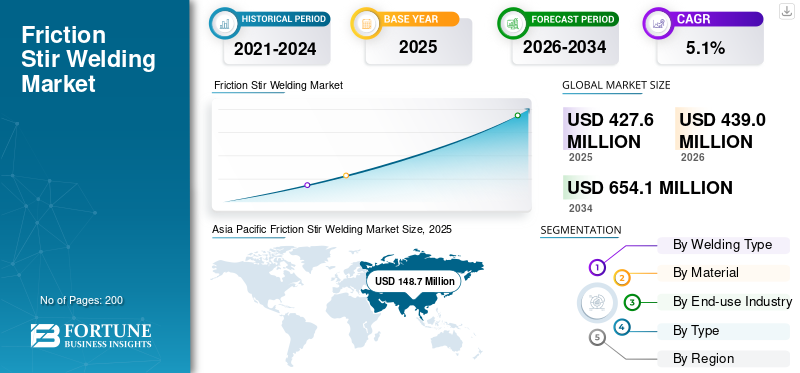
The friction stir welding market size was valued at USD 427.6 million in 2025 and is projected to grow from USD 439.0 million in 2026 to USD 654.1 million by 2034, exhibiting a CAGR of 5.1% during the forecast period. Asia Pacific dominated the friction stir welding market with a market share of 34.78% in 2025.
Friction Stir Welding (FSW) is emerging as a prominent solid-state welding method, providing high weld strength, enhanced mechanical properties, reduced distortion, enhanced fatigue life, and better fit with lightweight materials such as aluminum and magnesium alloys. The market is steadily expanding as FSW technology gains popularity in automotive, aerospace, shipbuilding, railway, and heavy engineering sectors. Key drivers include the growing demand for lightweight structures, expanded use of advanced joining techniques among electric vehicles and aerospace parts, and the need for defect-free welds in critical industrial facilities. Also, a focus on energy-saving manufacturing, cost saving, reducing material waste, and improving joint quality continues to boost FSW adoption throughout various industries.
FSW helps to improve weld quality when compared with conventional fusion welding methods. It uses a rotating non-consumable tool to generate frictional heat and plasticize the material without melting it, thereby making it appropriate for applications requiring high-strength, defect-free joining of aluminum, magnesium, copper, and other lightweight alloys. While friction stir welding may have restrictions in terms of tool wear, equipment cost, and suitability for sophisticated designs, it considerably reduces welding defects, distortion, porosity, and residual stresses when compared to traditional welding methods.
Major companies in the market include KUKA AG, Mazak MegaStir, Grenzebach Maschinenbau GmbH, STIRTEC GmbH, and MTI Welding. They are progressively adopting advanced FSW systems, robotic welding platforms, and automated joining technologies to improve production efficiency and strengthen their competitiveness in the market. In the long run, rising demand for lightweight structures, increasing use of aluminum-intensive components, and higher adoption of automated solid-state welding technologies will drive growth in the broader solid-state welding market.
Download Free sample to learn more about this report.
FRICTION STIR WELDING MARKET KEY TAKEAWAYS
 Global Market Size & Forecast
- 2025 Market Size: USD 427.6 million
- 2026 Market Size: USD 439.0 million
- 2034 Forecast Market Size: USD 654.1 million
- CAGR: 5.1% from 2026–2034
 Market Share
- Asia Pacific dominated the friction stir welding market with a market share of 34.78% in 2025.
- Growing investment in FSW equipment segment is anticipated to rise with a CAGR of 4.5% over the forecast period.
- The automotive & electric vehicles segment is expected to grow at a CAGR of 7.1% over the forecast period.
 Key Regional Highlights
North America
North America is projected to reach USD 112.6 million in 2026, supported by aerospace, defense, and EV battery applications.
Europe
Europe is estimated to reach USD 129.5 million in 2026, fueled by EV battery tray production, rail manufacturing, and aerospace components.
Asia Pacific
Asia Pacific led the global market with a valuation of USD 148.7 million in 2025, driven by strong automotive, EV battery, shipbuilding, and electronics manufacturing.
U.S.
U.S. friction stir welding market is estimated at USD 86.1 million in 2026.
Japan
Japan friction stir welding market is estimated at USD 28.6 million in 2026, accounting for approximately 6.5% of global revenues.
Read More

FRICTION STIR WELDING MARKET TRENDS
Growing Adoption of FSW in EV Battery Trays and Lightweight Aluminum Structures is a Key Market Trend
The market is encountering growing demand for high-tech solid-state welding technologies as automotive manufacturers and EV component suppliers increase the use of aluminum-intensive structures to reduce vehicle weight and improve battery output. Conventional fusion welding processes frequently create issues such as distortion, porosity, cracking, and reduced joint strength when used on lightweight aluminum components. Friction stir welding offers a reliable solution for joining EV battery trays, cooling plates, battery enclosures, and lightweight structural components without melting the base material. The process delivers high-strength, low-defect, and leak-tight joints, making it appropriate for high-volume electric vehicle production and advanced mobility applications. As EV production expands globally and manufacturers focus on lightweight, safety, and thermal management, the adoption of friction stir welding is expected to increase across automotive and transportation manufacturing.
- For instance, in July 2025, KUKA received an order from a major U.S. automotive manufacturer for 12 robotic friction stir welding cells for e-mobility production. The FSW cells, equipped with KUKA KR FORTEC robots, will be integrated into electric vehicle production lines to weld battery cases and connect cooling water jackets to battery cases, supporting the growing use of friction stir welding in EV battery enclosure and thermal management applications.
MARKET DYNAMICS
MARKET DRIVERS
Download Free sample to learn more about this report.
Increasing Use of Automated FSW Systems in Automotive Manufacturing is Driving Market Growth
Automakers are gradually introducing automated friction stir welding technologies across the automotive industry and high-volume vehicle manufacturing to improve weld consistency, production efficiency, and joint quality. As electric vehicles and lightweight mobility platforms require sturdy aluminum joints, battery structures, and thermal management components, manufacturers are shifting toward robotic and gantry-based FSW systems. The method is becoming increasingly important as it enables reliable, low-defect welding of aluminum components without filler materials and with less distortion than standard fusion welding. Due to this, FSW is appropriate for battery trays, cooling plates, battery cases, and lightweight structural elements where joint strength and dimensional precision are crucial. Manufacturers are growing their FSW production facilities for automotive applications to accommodate this change. This is expected to boost the friction stir welding market growth in the coming years.
- For instance, Grenzebach strengthened its friction stir welding growth plan and supported the broader adoption of FSW in automobile manufacture in June 2025 when it obtained a significant order worth USD 9.13 million and a retrofit project worth USD 2.28 million from the automotive sector.
MARKET RESTRAINTS
High Capital Cost and Process Integration Complexity are Limiting Wider Adoption
The high initial cost may act as a constraint on the adoption of FSW systems, particularly among small and medium-scale manufacturers. FSW machines require rigid machine structures, high axial force capability, precision motion control, specialized tooling, robust clamping fixtures, and skilled process integration, making them more expensive than conventional arc welding or resistance welding systems. Moreover, the process often requires customized tool design, workpiece support, parameter optimization, and application-specific automation depending on material type, thickness, and joint geometry. Therefore, adoption may remain limited in cost-sensitive and low-volume fabrication applications unless the end-use requires high-strength, low-distortion, and leak-tight joints, such as EV battery trays, aerospace structures, rail panels, marine components, and advanced aluminum assemblies.
MARKET OPPORTUNITIES
Increasing Use of FSW in Aerospace, Defense, and Space Applications is Creating Significant Growth Opportunities
Growing use of advanced aluminum structures in aerospace industries, defense, and space applications is likely to provide strong growth potential for the market. Aircraft structures, launch vehicle fuel tanks, defense components, satellite structures, and high-strength aerospace assemblies require reliable joining methods that can deliver strong, lightweight, and low-defect welds. FSW is well-suited for these applications as it joins materials in the solid state, reducing issues such as porosity, hot cracking, distortion, and weld defects that are commonly associated with conventional fusion welding, along with increasing demand for dissimilar metal welding in advanced aerospace and transportation applications. The market is also benefiting from the adoption of advanced alloy fabrication techniques for lightweight structural manufacturing.
Segmentation Analysis
By Welding Type
Linear Friction Stir Welding Segment Led Market Due to Its High Adoption in Long Weld Applications
Based on the welding type, the market is divided into spot friction stir welding (Spot FSW), linear friction stir welding, refill friction stir spot welding (RFSSW), bobbin tool friction stir welding, and others.
In 2025, the linear friction stir welding segment accounted for the highest market share due to its extensive use in long continuous weld applications across automotive, aerospace, rail, marine, and industrial manufacturing. The segment dominates as manufacturers increasingly require strong, defect-free, and low-distortion welds for large aluminum panels, EV battery trays, railcar bodies, shipbuilding structures, and aerospace components. Linear FSW is highly preferred as it provides consistent weld quality over long joint lengths without melting the base material. Its suitability for structural applications and high-strength aluminum joining makes it one of the most commercially adopted FSW processes. The segment is anticipated to rise with a CAGR of 4.4% over the forecast period.
The refill friction stir spot welding segment is anticipated to rise at the fastest pace over the forecast period. The segment is rising in prominence due to its increasing use in automotive and EV sheet-joining applications, where clean joints, reduced keyhole formation, and improved surface finish are required.
To know how our report can help streamline your business, Speak to Analyst
By Material
Aluminum Alloys Segment Dominated Due to Its High Usage in Lightweight Structural Applications
Based on the material, the market is divided into aluminum alloys, magnesium alloys, copper alloys, titanium alloys, and others.
In 2025, the aluminum alloys segment accounted for the highest friction stir welding market share due to its widespread usage in lightweight structures throughout automotive, electric vehicles, aerospace, rail, marine, and industrial applications. The segment dominates as FSW is especially suitable for aluminum joining, offering strong weld strength, reduced distortion, and lower defect formation compared with conventional fusion welding. Aluminum alloys are widely used in EV battery enclosures, cooling plates, aircraft panels, railcar bodies, and marine structures, where lightweight and joint reliability are critical. The growing focus on fuel efficiency, vehicle electrification, and structural weight reduction continues to support the adoption of FSW for aluminum components. The segment is anticipated to rise with a CAGR of 4.4% over the forecast period.
The copper alloys segment is anticipated to rise at the fastest pace over the forecast period. Copper alloys are increasingly adopted due to increasing use in EV battery systems, busbars, cooling plates, electrical connectors, and thermal management components.
By End-use Industry
Automotive & Electric Vehicles Segment Led Due to Rapid FSW Adoption in Battery Trays and Lightweight Structures
Based on the end-use industry, the market is divided into automotive & electric vehicles, aerospace & defense, rail & transportation, shipbuilding & marine, and others.
The automotive & electric vehicles segment accounted for the highest market share due to the growing adoption of FSW in battery trays, battery enclosures, cooling plates, lightweight aluminum body structures, and chassis components. The segment dominates as electric vehicle manufacturers require strong, leak-tight, and low-distortion joints to improve battery safety, vehicle efficiency, and structural performance. FSW is highly preferred in automotive and EV applications as it joins aluminum components without melting the base material, reducing defects such as porosity, cracking, and distortion compared to conventional fusion welding. Its ability to deliver consistent weld quality in high-volume production makes it suitable for advanced EV platforms and lightweight vehicle manufacturing. The segment is expected to grow at a CAGR of 7.1% over the forecast period.
The shipbuilding & marine segment is anticipated to rise at the fastest pace over the forecast period. Shipbuilding & marine is increasing in popularity due to the increasing use of FSW in lightweight aluminum marine panels, naval structures, ship decks, and large welded assemblies, particularly as shipbuilders focus on stronger, low-distortion joining technologies for high-performance vessels.
By Type
Machines & Systems Segment Commanded Market Due to High Capital Investments in FSW Equipment
Based on type, the market is divided into machines & systems and tooling & consumables.
In 2025, the machines & systems segment accounted for the highest market share due to the capital-intensive nature of FSW technology. FSW requires specialized gantry machines, robotic welding cells, CNC-controlled systems, and customized automated production lines capable of delivering high axial force, precise tool movement, and stable process control. The segment dominates as end-use industries such as automotive & electric vehicles, rail, shipbuilding, and the aerospace industries increasingly require reliable joining systems for aluminum structures, battery trays, cooling plates, rail panels, and aerospace components. The high value of FSW equipment compared to consumables makes machines & systems the leading revenue contributor in the market. Growing investment in FSW equipment is supporting wider adoption across automotive and aerospace manufacturing. The segment is anticipated to rise with a CAGR of 4.5% over the forecast period.
The tooling & consumables segment is anticipated to rise at the fastest pace over the forecast period. The segment is expected to grow as the installed base of FSW machines expands, increasing recurring demand for tools, pins, PCBN tools, holders, fixtures, and replacement wear parts.
Friction Stir Welding Market Regional Outlook
By geography, the market is categorized into Europe, North America, Asia Pacific, South America, and the Middle East & Africa.
Asia Pacific
Asia Pacific Friction Stir Welding Market Size, 2025 (USD Million)
To get more information on the regional analysis of this market, Download Free sample
Asia Pacific held the dominant position in the market in 2024 and continued to lead in 2025, with a market valuation of USD 148.7 million. The region’s dominance is driven by the presence of large automotive, EV battery, shipbuilding, electronics, rail, and industrial manufacturing bases in China, Japan, South Korea, and India. Growing adoption of FSW for EV battery trays, cooling plates, aluminum structures, rail panels, and marine components is expected to support strong regional growth.
Japan Friction Stir Welding Market
The Japanese market in 2026 is estimated at around USD 28.6 million, accounting for roughly 6.5% of global revenues.
China Friction Stir Welding Market
The Chinese market in 2026 is estimated at around USD 69.9 million, accounting for roughly 15.9% of global revenues.
India Friction Stir Welding Market
The Indian market in 2026 is estimated at around USD 12.6 million, accounting for roughly 2.9% of global revenues.
North America
North America’s market is projected to reach USD 112.6 million in 2026. North America has a large share due to the strong adoption of friction stir welding across aerospace & defense, space applications, EV battery systems, and advanced aluminum joining. The region benefits from the presence of established FSW technology providers and strong demand for high-strength, low-distortion welding in aerospace structures, battery trays, cooling plates, and lightweight transportation components.
U.S. Friction Stir Welding Market
The U.S. market in 2026 is estimated at around USD 86.1 million. The U.S. remains the largest contributor to the North America market, supported by strong demand from aerospace, EV manufacturing, and advanced industrial production.
Europe
The European market in 2026 is estimated at around USD 129.5 million. Europe demonstrates steady growth supported by strong EV battery tray production, rail manufacturing, aerospace components, and the presence of major FSW equipment and automation companies. The region has a mature FSW ecosystem, particularly across Germany, France, the U.K., Italy, and Austria, where advanced welding automation and aluminum-intensive manufacturing are well established.
U.K. Friction Stir Welding Market
The U.K. market in 2026 is estimated at around USD 16.3 million, representing roughly 3.7% of global revenues.
Germany Friction Stir Welding Market
Germany’s market is projected to reach USD 44.6 million in 2026, equivalent to around 10.2% of global sales.
South America and Middle East & Africa
South America and the Middle East & Africa are anticipated to experience moderate growth in this market over the forecast period. South America is projected to reach a market value of USD 16.7 million in 2026. South America is expected to witness gradual growth during the forecast period, as automotive manufacturers, aerospace suppliers, industrial fabricators, and marine sector participants increasingly evaluate advanced joining technologies for aluminum and lightweight structures. Meanwhile, the Middle East & Africa market is expected to attain a value of USD 25.2 million in 2026. The Middle East & Africa region is projected to grow steadily, supported by industrial diversification, defense localization, rail and metro projects, shipbuilding, energy infrastructure, and advanced manufacturing investments, particularly across GCC countries and South Africa.
GCC Friction Stir Welding Market
The GCC market is projected to reach around USD 13.7 million in 2026, representing roughly 3.1% of global revenues.
COMPETITIVE LANDSCAPE
Key Industry Players
Leading Companies Focus on Robotic FSW Systems and EV Battery Welding Applications to Strengthen Their Market Positions
The friction stir welding industry exhibits moderate consolidation as leading companies focus on producing advanced FSW machines, robotic welding cells, gantry systems, CNC-based FSW platforms, and high-performance tooling solutions. Major players such as Mazak MegaStir, KUKA AG, Grenzebach, MTI Welding, PAR Systems, and Stirweld are strengthening their market visibility through EV battery tray welding systems, aerospace and defense applications, advanced aluminum joining, and automated production-line integration. Competition is increasing with growing demand for robotic FSW cells, PCBN tooling, turnkey welding systems, and application-specific solutions for automotive & electric vehicles, aerospace, rail, shipbuilding, and industrial manufacturing as the market moves toward high-strength, low-distortion, and defect-free solid-state welding technologies. Several companies are also expanding into friction stir processing (FSP) for surface modification and material enhancement applications.
LIST OF KEY FRICTION STIR WELDING COMPANIES PROFILED
- Mazak MegaStir (U.S.)
- KUKA AG (Germany)
- MTI Welding (U.S.)
- Grenzebach Maschinenbau GmbH (Germany)
- STIRTEC GmbH (Austria)
- FOOKE GmbH (Germany)
- PAR Systems (U.S.)
- Bond Technologies (U.S.)
- Stirweld (France)
- Komatsu NTC Ltd. (Japan)
KEY INDUSTRY DEVELOPMENTS
- June 2026: Bond Technologies announced that it is engineering a large-scale friction stir welding system for NASA’s next-generation launch vehicle structures, supporting fabrication of rocket bodies, propellant tanks, and other large-scale flight hardware.
- February 2026: Grenzebach established Grenzebach Friction Stir Welding GmbH as an independent company within the Group to strengthen its FSW growth field, improve customer focus, and accelerate development of friction stir welding solutions.
- January 2026: PAR Systems highlighted that its I-STIR friction stir welding technology supports NASA’s Artemis II mission by enabling strong, lightweight structural hardware for the SLS launch vehicle and Orion spacecraft.
- November 2024: Komatsu NTC announced that it would take over and succeed the friction stir welding business from Hitachi Power Solutions, integrating FSW joining technology with its machine tool capabilities to develop new production and engineering solutions.
- August 2023: Bond Technologies launched its PM2 high-volume production friction stir welding machine, designed for manufacturers seeking compact, high-throughput FSW capability for small to medium aluminum alloy parts.
REPORT COVERAGE
The friction stir welding market analysis includes a comprehensive study of the market size & forecast by all the market segments included in the report. It includes details on the market dynamics and market trends expected to drive the market over the forecast period. It provides information on key aspects, including an overview of technological advancements, pipeline candidates, the regulatory environment, and product launches. Additionally, it details partnerships, mergers & acquisitions, as well as key industry developments and prevalence by key regions. The global market research report also provides a detailed competitive landscape with information on the market share and profiles of key operating players.
Request for Customization to gain extensive market insights.
Report Scope & Segmentation
| ATTRIBUTE | DETAILS |
| Study Period | 2021-2034 |
| Base Year | 2025 |
| Estimated Year | 2026 |
| Forecast Period | 2026-2034 |
| Historical Period | 2021-2024 |
| Growth Rate | CAGR of 5.1% from 2026 to 2034 |
| Unit | Value (USD Million) |
| Segmentation | By Welding Type, By Material, By End-use Industry, By Type, and Region |
| By Welding Type |
|
| By Material |
|
| By End-use Industry |
|
| By Type |
|
| By Region |
|
Frequently Asked Questions
According to Fortune Business Insights, the global market value stood at USD 427.6 million in 2025 and is projected to reach USD 654.1 million by 2034.
In 2025, the market in Asia Pacific was valued at USD 148.7 million.
The market is expected to exhibit a CAGR of 5.1% during the forecast period of 2026-2034.
By type, the machines & systems segment led the market.
Increasing use of automated FSW systems in automotive manufacturing is driving market growth.
Mazak MegaStir, KUKA AG, Grenzebach, MTI Welding, PAR Systems, and Stirweld are the major players in the global market.
Asia Pacific dominated the market in 2025.



- 2021-2034
- 2025
- 2021-2024
- 200
Get 30-60 hrs Free Customization
Expand Regional and Country Coverage, Segments Analysis, Company Profiles, Competitive Benchmarking, and End-user Insights.















Related Reports
-
US +1 833 909 2966 ( Toll Free )
-
Get In Touch With Us