Functional Cosmetics Market Size, Share & Industry Analysis, By Product (Skin Whitening/Brightening, Anti-Aging/Wrinkle Care, UV Protection/Sun Care, Anti-Acne / Blemish Control, Moisturizing/Hydration Functional Products, Hair Growth/Anti-Hair Loss/Scalp Care, Multi-Functional Cosmetics, and Others), By Active Ingredient Type (Vitamins & Derivatives, Peptides & Proteins, Botanical & Herbal Extracts, Sunscreen Agents, Hydration & Barrier Agents, Exfoliating & Renewing, and Specialized/Niche Actives), By Distribution Channel, and Regional Forecast, 2026-2034
 Download Free Sample
(Offer valid till 15th Oct 2026)

Functional Cosmetics Market Size and Future Outlook
 Listen to Audio Version
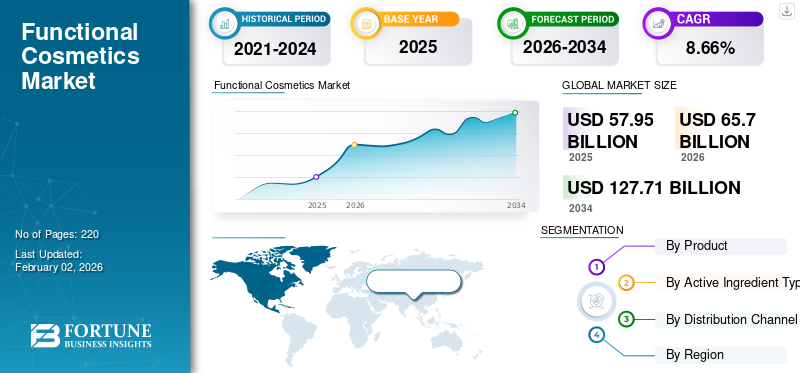
The global functional cosmetics market size was valued at USD 57.95 billion in 2025 and is projected to grow from USD 65.70 billion in 2026 to USD 127.71 billion by 2034, exhibiting a CAGR of 8.66% during the forecast period. Asia Pacific dominated the functional cosmetics market with a market share of 40.68% in 2025.
The market is characterized by strong growth as consumers increasingly seek products that combine cosmetic enhancement with scientifically validated skin health benefits. Manufacturers are innovating with multifunctional ingredients, clean formulations, and advanced delivery technologies to meet demands for efficacy, sustainability, and product transparency. Functional cosmetics now go beyond aesthetics to address needs such as anti aging, sun protection, hydration, and skin barrier support appealing to consumers seeking holistic, results-driven skincare solutions.
L’Oréal S.A., Estée Lauder Companies, Inc., Beiersdorf AG, Shiseido Co. Ltd., and The Procter & Gamble Company are the leading players operating in the global market. These players focus on launching innovative active ingredient formulation-based products to build their product portfolio and maintain market position.
Download Free sample to learn more about this report.
Functional Cosmetics Market Key Takeaways
 Global Market Size & Forecast
- 2025 Market Size: USD 57.95 billion
- 2026 Market Size: USD 65.70 billion
- 2034 Forecast Market Size: USD 127.71 billion
- CAGR: 8.66% from 2026–2034
 Market Share
- Asia Pacific dominated the functional cosmetics market with a 40.68% share in 2025.
- The anti-aging/wrinkle care segment is projected to account for 25.06% of the market in 2026.
- The vitamins & derivatives segment is expected to hold 22.89% of the market in 2026.
 Key Regional Highlights
Asia Pacific
Valued at USD 23.57 billion in 2025 with a 40.68% market share and is projected to reach USD 27.25 billion in 2026.
North America
Reached USD 12.62 billion in 2025 and is expected to grow at a 9.35% CAGR.
Europe
Accounted for USD 11.52 billion in 2025, representing 19.89% of the global market.
U.S
Functional cosmetics market is projected to reach USD 11.05 billion by 2026.
Japan
Functional cosmetics market is projected to reach USD 4.59 billion by 2026.
Read More

MARKET DYNAMICS
MARKET DRIVERS:
Consistent Advancements in Nano-encapsulation Technology to Produce Functional Cosmetics to Drive Market Growth
Technological advances including nano-encapsulation encapsulate active cosmetic ingredients within tiny carriers, enabling deeper and more precise skin penetration. This enhances ingredient stability by protecting them from degradation and ensures controlled, targeted delivery, leading to improved efficacy and longer-lasting benefits. Consumers experience quicker absorption, reduced irritation, and noticeable skin improvements due to this advanced ingredient delivery system, which increases the product demand and drives the global functional cosmetics market growth. In October 2024, KCI, a cosmetic and personal care material supplier, developed a new skin delivery technology, EncapguardTM’, encapsulating active ingredients that are beneficial for anti-ageing, improved skin elasticity, and reduced pigmentation.
MARKET RESTRAINTS:
High Development Costs of Ingredients Used in Products to Restrain Market Growth
High development costs in functional cosmetics arise primarily from the use of expensive active ingredients such as peptides, antioxidants, and botanical extracts that demand careful sourcing and quality assurance. Additionally, advanced technologies such as nano-encapsulation and microemulsion systems require significant investment in research, testing, and specialized manufacturing processes, which collectively raise production expenses. These factors often lead to higher product prices, making functional cosmetics less accessible to price-sensitive consumers and limiting widespread adoption.
MARKET OPPORTUNITIES:
Growing Number of Consumers Prioritizing Plant-based Cosmetics to Favor Market Growth
Rising consumer interest in clean, plant-based, and sustainable ingredients is pushing brands to formulate eco-friendly cosmetics that prioritize ingredient transparency and ethical sourcing. This shift is driven by growing awareness of the environmental impact of synthetic chemicals, along with a preference for safer, natural alternatives that align with wellness and ethical values. Brands are innovating with biodegradable packaging and cruelty-free certifications to meet evolving consumers’ demand for sustainability and authenticity, positively contributing to the market growth.
FUNCTIONAL COSMETICS MARKET TRENDS:
Gaining Popularity of Multi-functional Cosmetics to Augment Market Growth
Multifunctional skincare products are increasingly popular because they combine several benefits, such as hydration, anti-aging, and sun protection, into a single formulation. This trend meets consumer demand for effective and convenient solutions that simplify routines while ensuring comprehensive skin care. By integrating multiple active ingredients, these products save time and cost while delivering enhanced results, making skincare more efficient and manageable for busy lifestyles.
MARKET CHALLENGES:
Regulatory Complexity Related to Products’ Ingredient Safety and Environmental Claims to Challenge Brands’ Business Expansion
- Regulatory complexity in the cosmetic industry is driven by constantly evolving global standards on ingredient safety, labeling, environmental claims, and product categorization. Brands face increasing demands for detailed safety documentation, adverse event reporting, and compliance with diverse regional rules. This creates higher operational costs, requires rigorous record-keeping, and often delays product launches as companies adjust to new regulations and ensure market access. These aspects challenge key players in their portfolio building and business expansion activities.
Download Free sample to learn more about this report.
Segmentation Analysis
By Product
High Demand for Anti-aging Skincare Products Led Anti-aging/Wrinkle care Segment to Hold a leading Market Share
Based on product, the market is segregated into skin whitening/brightening, anti-aging/wrinkle care, UV protection/sun care, anti-acne/blemish control, moisturizing/hydration functional products, hair growth/anti-hair loss/scalp care, multi-functional cosmetics, and others.
The Anti-aging/wrinkle care segment is projected exhibited a leading global functional cosmetics market with a share of 25.06% in 2026. The Anti-aging/wrinkle care segment remains a key focus in functional cosmetics due to increasing consumer desire to combat visible signs of aging, including wrinkles and loss of skin elasticity. Consumers are drawn to scientifically validated products that offer noticeable results through ingredients such as peptides, retinol, and antioxidants. This segment benefits from ongoing innovation, premiumization, and growing awareness of preventive skincare, with rising demand from both older populations and younger consumers seeking early intervention.
To know how our report can help streamline your business, Speak to Analyst
The multi-functional cosmetics segment is anticipated with growing at a CAGR of 12.96% during the forecast period of 2026-2034. The fastest growing segment within multi-functional cosmetics is centered on products that combine hydration, anti-aging, and sun protection benefits. Consumers increasingly favor these all-in-one solutions for their convenience and efficiency, addressing multiple skin concerns in a single application. Innovation in ingredients such as peptides, ceramides, and plant-based stem cells, along with advanced delivery technologies, supports the development of these multifunctional formulas. This segment benefits from the growing demand for personalized and preventive skincare, aided by digital beauty platforms and strong consumer focus on science-backed efficacy.
By Active Ingredient Type
Strong Antioxidant Benefits of Vitamin-based Functional Cosmetics Led Vitamins & Derivatives Segment to Dominate Market
Based on active ingredient type, the market is categorized into vitamins & derivatives, peptides & proteins, botanical & herbal extracts, sunscreen agents, hydration & barrier agents, exfoliating & renewing, and specialized/niche actives.
The vitamins & derivatives segment is anticipated to hold a leading global market with a share of 22.89% in 2026. The vitamins & derivatives segment dominates the market due to their strong antioxidant, anti-aging, and skin-brightening benefits. Key vitamins such as Vitamin C and Vitamin E derivatives promote collagen synthesis and protect against oxidative damage, making them highly effective and popular. Consumer preference for scientifically backed, natural ingredients and ongoing innovations in stabilizing these vitamins further drive their widespread use and market growth.
The specialized/niche actives segment slated is projected to grow at the fastest rate of 11.40% during the forecast period of 2026-2034. The fastest-growing specialized/niche actives segment is driven by demand for highly targeted, clinically validated ingredients such as chrono-peptides, plant-based circadian extracts, and melatonin boosters. These actives focus on advanced skin functions such as night repair, regeneration, and circadian rhythm alignment. Growth is fueled by rising consumer preference for personalized, evidence-based skincare supported by dermatologist endorsements and digital personalization tools.
By Distribution Channel
Exponential Growth of Online Channels Segment is Due to Significant Adoption of Online Shopping Globally
Based on distribution channel, the market is segmented into specialty stores, supermarkets/hypermarkets, online/e-commerce, department stores, and others.
The specialty stores segment is exhibited a leading global market share of 33.40% in 2024. The specialty stores segment dominates the cosmetics distribution market due to its focused product range, personalized shopping experience, and expert customer service. These stores cater specifically to beauty consumers, offering opportunities for product discovery, in-store testing, and access to trending and premium brands. Their ability to create engaging environments and leverage social media communities appeals strongly to younger consumers, driving loyalty and sustained growth in this segment.
The online channels segment is slated to grow at a fastest CAGR of 11.04% during the forecast period of 2026-2034. The fastest-growing online channel in cosmetics is social commerce, where brands leverage social media platforms for direct consumer engagement and sales. This channel benefits from influencer marketing, interactive content, and personalized shopping experiences that build trust and drive quick purchase decisions. The real-time interaction and product discovery enabled by social platforms make social commerce a key driver of market growth.
Functional Cosmetics Market Regional Outlook
By geography, the market is categorized into North America, Europe, Asia Pacific, South America, and Middle East & Africa.
ASIA PACIFIC
The Asia Pacific region held the dominant share in 2025, valued at USD 23.57 billion, representing 40.68% of total market revenue and also projected to took the leading share in 2026 with USD 27.25 billion. The region’s market is projected to grow at a fastest rate of 40.68% during 2026-2034. The Asia Pacific market is characterized by rising disposable incomes and increasing consumer focus on personal grooming and premium cosmetics. The region’s market growth is also driven by demand for products that address diverse climatic and environmental factors. Growth is also fueled by the popularity of regional beauty trends including K-beauty and J-beauty, the rise of men's grooming, and expanding e-commerce and digital engagement. The Japan functional cosmetics market is projected to reach USD 4.59 billion by 2026, and the India functional cosmetics market is projected to reach USD 2.83 billion by 2026.
The Chinese market within the global functional cosmetics market size is anticipated to reached USD 12.42 billion in 2026. The Chinese market is rapidly evolving with increasing consumer demand for multifunctional, performance-driven skincare products. Brands leverage scientific innovation and digital platforms to offer personalized, clean, and sustainable formulations. Rising consumer awareness and preference for effective, natural ingredients are driving growth and market diversification.
NORTH AMERICA
During the forecast period, the market in the North America region is projected to grow at a CAGR of 9.35% from 2025-2032, which is the second highest among all the regions, and reach a valuation of USD 12.62 billion in 2025. The North America market is driven by consumer demand for premium, science-backed skincare that offers both aesthetic and health benefits. The region benefits from strong R&D, technological innovation, and robust distribution channels, including a growing e-commerce presence. Consumers increasingly prefer multifunctional, clean beauty products that align with wellness and sustainability trends. The U.S. functional cosmetics market is projected to reach USD 11.05 billion by 2026.
EUROPE
In 2025, Europe held 19.89% of the global market, reaching a valuation of USD 11.52 billion, and is projected to grow to USD 12.93 billion in 2026. The European functional cosmetics market holds a third significant share, driven by strong consumer preference for clean, sustainable, and multifunctional beauty products. Emphasis on natural ingredients, anti-aging solutions, and personalized skincare benefits, combined with technological innovation and a wellness-oriented mindset, fuels market expansion across countries including Germany and France. The UK functional cosmetics market is projected to reach USD 2.11 billion by 2026, while the Germany functional cosmetics market is projected to reach USD 2.65 billion by 2026.
SOUTH AMERICA
South America recorded a market size of USD 4.48 billion in 2025, capturing 7.74% of the global market share, and is projected to reach USD 4.92 billion in 2026. The South American functional cosmetics market is growing steadily, fueled by rising disposable incomes, increasing consumer focus on skincare benefits, and expanding digital engagement. Natural and sustainable beauty formulations are gaining traction, supported by strong local brands and distribution networks, especially in Brazil and Argentina.
MIDDLE EAST & AFRICA
In 2025, the Middle East & Africa market stood at USD 5.75 billion, representing 9.92% of global demand, and is projected to grow to USD 6.36 billion in 2026. The Middle East and Africa functional cosmetics market is experiencing steady growth, driven by rising skincare awareness, urbanization, and demand for climate-adapted, premium products. Increasing digital adoption and influencer-driven social commerce are accelerating market penetration, especially in the GCC countries and South Africa. In the Middle East & Africa, South Africa is set to attain the market value of USD 1.38 billion in 2025.
COMPETITIVE LANDSCAPE
Key Industry Players:
Consistent Portfolio Building and Partnership Efforts to Help Key Players Maintain their Leading Market Position.
L’Oréal S.A., Estée Lauder Companies, Inc., Beiersdorf AG, Shiseido Co. Ltd., and The Procter & Gamble Company are the leading players operating in the global market. L’Oréal S.A. is the largest global player in the functional cosmetics space, driving innovation with investments in advanced skin science, digital personalization, and sustainability to retain its dominant portfolio and brand influence. The Estée Lauder Companies, Inc. is renowned for its science-driven, prestige skincare and functional beauty offerings, leveraging high R&D and strategic partnerships to lead in efficacy-focused segments.
Beiersdorf AG, the company behind brands such as NIVEA, stands out for its dermatological credibility and consumer trust, with a strong focus on skin barrier and sensitive skin solutions that blend natural and clinical approaches. Shiseido Co. Ltd. excels through Japanese innovation and a distinct emphasis on functional, science-backed ingredients, establishing itself as a technology leader in anti-aging and brightening cosmetics. The Procter & Gamble Company is a global force in everyday functional skincare, utilizing extensive scale, data-driven consumer insights, and innovation to deliver multifunctional beauty and personal care products across mass and premium tiers.
LIST OF KEY FUNCTIONAL COSMETICS COMPANIES PROFILED:
- L’Oréal S.A. (France)
- Estée Lauder Companies, Inc. (U.S.)
- Beiersdorf AG (Germany)
- Shiseido Co. Ltd. (Japan)
- The Procter & Gamble Company (U.S.)
- Unilever Plc. (U.K.)
- Kao Corporation (Japan)
- Pechoin (China)
- Amorepacific Group (South Korea)
- PROYA Cosmetics Co., Ltd. (China)
KEY INDUSTRY DEVELOPMENTS:
- September 2025: KKR, a global investment firm, completed the acquisition of Samhwa Co., Ltd., a South Korean cosmetics packaging company, to strengthen its capabilities in the development and manufacturing of packaging for functional, high-end cosmetics.
- August 2024: L’Oréal S.A. acquired a 10% stake in Galderma, a dermatology brand, to leverage its innovation capabilities and produce functional skincare products.
- February 2024: Advent International, a global private equity investor, acquired Skala Cosméticos to broaden its presence in the functional hair care products and masks.
- August 2023: L’Oréal S.A. acquired AESOP, offering skin, hair, and body care formulations to strengthen its innovation capabilities and build a brand portfolio globally.
- August 2023: Elf Beauty invested USD 355 million to acquire Naturium, a provider of science-backed clean skincare and bodycare line of products, to double its presence in the functional skincare products industry.
REPORT COVERAGE
The global market analysis provides an in-depth study of market insights, size, and forecast by all the market segments included in the report. It includes details on the market dynamics and market trends expected to drive the market during the forecast period. It offers information on the technological advancements, new product launches, key industry developments, and details on partnerships, mergers & acquisitions. The market research report also encompasses a detailed competitive landscape with information on the market share and profiles of key operating players.
Request for Customization to gain extensive market insights.
Report Scope & Segmentation
| ATTRIBUTE | DETAILS |
| Study Period | 2021-2034 |
| Base Year | 2025 |
| Estimated Year |
2026 |
| Forecast Period | 2026-2034 |
| Historical Period | 2021-2024 |
| Growth Rate | CAGR of 8.66% from 2026-2034 |
| Unit | Value (USD Billion) |
| Segmentation | By Product, Active Ingredient Type, Distribution Channel, and Region |
| By Product |
|
| By Active Ingredient Type |
|
| By Distribution Channel |
|
| By Region |
|
Frequently Asked Questions
Fortune Business Insights says that the global market value stood at USD 65.70 Billion in 2026 and is projected to reach USD 127.71 Billion by 2034.
In 2025, the market value stood at USD 23.57 billion.
The market is expected to exhibit a CAGR of 8.66% during the forecast period of 2026-2034.
The anti-aging/wrinkle care segment led the market by Product.
The consistent advancements in nano-encapsulation technology to produce functional cosmetics are driving the global market.
L’Oréal S.A., Estée Lauder Companies, Inc., Beiersdorf AG, Shiseido Co. Ltd., and The Procter & Gamble Company are some of the prominent players in the market.
Asia Pacific dominated the market in 2025.
The growing number of consumers prioritizing plant-based functional skincare products is expected to favor the product adoption rate.



- 2021-2034
- 2025
- 2021-2024
- 220
-
(Offer valid till 15th Oct 2026)
Get 30-60 hrs Free Customization
Expand Regional and Country Coverage, Segments Analysis, Company Profiles, Competitive Benchmarking, and End-user Insights.













Related Reports
-
US +1 833 909 2966 ( Toll Free )
-
Get In Touch With Us