Functional Safety Market Size, Share & Industry Analysis, By Device (Safety Switches, Safety Sensors), By System (Emergency Shutdown Systems, Distributed Control Systems), By Industry (Oil & Gas, Power Generation), and Regional Forecast, 2026-2034
 Download Free Sample
Functional Safety Market Overview
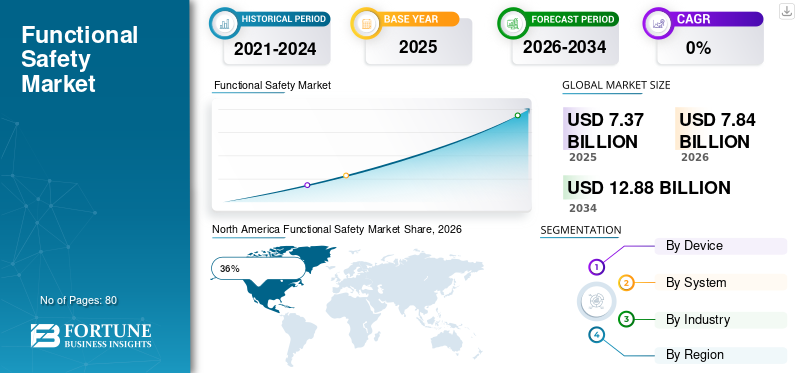
The global functional safety market size was valued at USD 7.37 billion in 2025. The market is projected to grow from USD 7.84 billion in 2026 to USD 12.88 billion by 2034, exhibiting a CAGR of 6.4% during the forecast period.

The functional safety market is expanding steadily due to increasing implementation of industrial automation systems, stringent workplace safety regulations, and rising deployment of intelligent manufacturing technologies across critical industries. Functional safety systems are widely used in oil & gas, power generation, chemicals, pharmaceuticals, mining, and automotive manufacturing to minimize operational risks and prevent hazardous failures. Industrial facilities are integrating programmable safety controllers, emergency shutdown systems, safety sensors, and advanced monitoring technologies to improve operational reliability and workforce protection. functional safety market analysis indicates strong enterprise demand for compliance-based automation infrastructure integrated with predictive diagnostics and real-time monitoring. Growing adoption of Industry 4.0 and connected industrial systems continues to strengthen functional safety market growth worldwide.
The USA functional safety market remains one of the most technologically advanced regional markets due to extensive industrial automation deployment and strict occupational safety standards. More than 73% of large manufacturing and energy facilities in the United States utilize integrated functional safety systems for operational protection and process reliability. Oil & gas companies are increasingly implementing emergency shutdown systems and safety instrumented systems to minimize operational disruptions. Smart manufacturing initiatives and rising investments in digital industrial infrastructure are accelerating demand for advanced safety sensors and intelligent safety controllers. functional safety market research report findings indicate growing enterprise investment in cybersecurity-integrated safety systems, industrial analytics, and real-time hazard monitoring solutions across manufacturing, chemical processing, and power generation sectors.
Download Free sample to learn more about this report.
Functional Safety Market Key Takeaways
 Global Market Size & Forecast
- 2025 Market Size: USD 7.37 Billion
- 2026 Market Size: USD 7.84 Billion
- 2034 Forecast Market Size: USD 12.88 Billion
- CAGR: 6.4% from 2026–2034
 Market Share
- North America dominated with a revenue share of 36% in 2025.
- Safety switches held the largest device share at approximately 56%.
- Emergency shutdown systems accounted for nearly 58% of the system segment.
 Key Regional Highlights
North America
North America led the market with a 36% share in 2025.
Europe
Europe accounted for 31% of the global market, supported by stringent safety regulations.
Asia-Pacific
Asia-Pacific held approximately 25% of the market, driven by industrial automation growth.
U.S.
The U.S. remains a major market, supported by industrial automation and strict workplace safety requirements.
Japan
Japan accounted for 27% of the Asia-Pacific market, driven by advanced manufacturing and automation adoption.
Read More

functional safety market Latest Trends
The functional safety market trends highlight increasing adoption of smart safety technologies integrated with industrial automation and digital monitoring platforms. Manufacturing facilities are deploying intelligent safety controllers and AI-enabled monitoring systems to improve predictive maintenance and reduce operational downtime. Approximately 67% of industrial enterprises are integrating functional safety solutions with industrial IoT infrastructure to improve real-time hazard detection and automated process management. Edge computing and cloud-based diagnostics are becoming increasingly important for monitoring safety-critical industrial assets across large production environments.
Another major trend shaping the functional safety market outlook is the expansion of safety-certified robotics and autonomous industrial systems. Automotive manufacturers and electronics facilities are integrating collaborative robots equipped with safety sensors and emergency stop technologies to improve worker safety and operational efficiency. Functional Safety Industry analysis also indicates rising demand for SIL-certified systems capable of supporting high-risk industrial operations. Energy and utilities sectors are implementing intelligent safety monitoring systems to improve infrastructure reliability and minimize equipment failures. Cloud-enabled predictive diagnostics, digital twins, and AI-driven fault detection are transforming industrial safety operations. The functional safety market forecast further reflects strong enterprise focus on cybersecurity-integrated safety architecture designed to protect connected industrial systems from operational disruptions and cyber vulnerabilities.
Download Free sample to learn more about this report.
functional safety market dynamics
DRIVER
Increasing Industrial Automation and Strict Safety Compliance Requirements
Industrial sectors are rapidly deploying automated systems and connected operational technologies, significantly increasing demand for advanced functional safety infrastructure. More than 71% of large-scale industrial facilities have implemented automated production systems requiring integrated safety monitoring and emergency response mechanisms. Oil & gas, chemical processing, power generation, and automotive industries are particularly focused on safety compliance due to hazardous operational environments and stringent regulatory standards. functional safety market growth is strongly supported by rising deployment of safety instrumented systems, emergency shutdown systems, and intelligent process monitoring solutions. Enterprises are investing in predictive safety analytics and automated fault detection technologies to reduce workplace incidents and improve operational continuity. Industry 4.0 adoption and increasing deployment of connected manufacturing ecosystems continue to accelerate functional safety market opportunities across global industrial sectors.
RESTRAINT
High Installation and Maintenance Complexity of Safety Systems
The functional safety market faces restraints related to the complexity associated with installation, configuration, and maintenance of advanced industrial safety infrastructure. Functional safety systems require extensive compliance testing, operational certification, and skilled engineering support, increasing deployment costs for industrial enterprises. Approximately 48% of medium-sized industrial organizations report operational challenges related to integrating functional safety technologies with legacy automation systems. Safety-certified equipment and specialized software infrastructure often involve lengthy implementation cycles and significant workforce training requirements. Industrial sectors operating with outdated infrastructure face compatibility issues while upgrading to modern safety ecosystems. functional safety market analysis also indicates that smaller enterprises often delay adoption due to high system validation costs, limited technical expertise, and ongoing maintenance expenditures associated with safety-critical industrial operations.
OPPORTUNIT
Expansion of Smart Factories and Connected Industrial Ecosystems
The expansion of smart manufacturing and intelligent industrial infrastructure presents strong growth opportunities for the functional safety market. More than 64% of newly established manufacturing facilities are integrating automated safety systems with connected production infrastructure. Smart factories require continuous monitoring of robotic systems, automated conveyors, programmable logic controllers, and connected operational equipment to minimize workplace hazards and operational disruptions. functional safety market insights indicate increasing adoption of AI-driven safety analytics capable of predicting equipment failures and identifying abnormal operational behavior in real time. Growing investments in industrial IoT and edge-enabled automation are creating substantial opportunities for safety-certified sensors, controllers, and shutdown systems. Energy-efficient industrial operations and sustainability-focused manufacturing initiatives are also driving enterprise demand for advanced safety monitoring solutions integrated with predictive operational intelligence.
CHALLENGE
Shortage of Skilled Workforce and Integration Expertise
One of the major challenges affecting the functional safety market outlook is the shortage of highly skilled professionals capable of managing safety-critical industrial systems. Functional safety deployment requires expertise in industrial automation, cybersecurity, compliance engineering, and operational risk assessment. Approximately 52% of industrial enterprises report difficulties in recruiting engineers trained in safety-certified automation technologies and SIL-compliant infrastructure management. Integration of modern safety systems with legacy industrial equipment further increases technical complexity across manufacturing and energy sectors. Rapid technological advancement in AI-enabled automation and connected industrial systems also creates continuous workforce training requirements. functional safety market research report findings indicate that enterprises are increasingly investing in managed industrial safety services and third-party compliance consulting to address operational knowledge gaps and implementation challenges.
functional safety market segmentation
By Device
Safety switches account for approximately 56% of the functional safety market share due to their extensive use in industrial machinery protection, emergency stop systems, and hazardous equipment isolation applications. Manufacturing plants, automotive assembly lines, and power generation facilities rely heavily on safety switches to prevent accidental equipment activation and protect operational personnel. More than 69% of industrial robotic systems utilize safety-certified switch technologies integrated with automated process control infrastructure. functional safety market trends indicate increasing demand for compact and intelligent safety switches capable of supporting high-speed industrial automation environments.
Safety sensors represent nearly 44% of the functional safety market size due to growing deployment of intelligent monitoring systems and automated industrial operations. These sensors are widely used for motion detection, machine guarding, temperature monitoring, pressure sensing, and hazardous environment detection across industrial facilities. Approximately 63% of smart manufacturing environments utilize AI-integrated safety sensor networks for predictive operational monitoring and workforce protection. Functional Safety Industry report findings indicate rising adoption of laser scanners, vision-based sensors, and contactless monitoring technologies in automotive and electronics manufacturing sectors.
To know how our report can help streamline your business, Speak to Analyst
By System
Emergency shutdown systems account for nearly 58% of the functional safety market share because of their critical role in preventing industrial accidents and minimizing operational disruptions across hazardous environments. Oil & gas refineries, offshore drilling facilities, chemical processing plants, and power generation stations rely heavily on emergency shutdown systems to automatically isolate dangerous operations during abnormal conditions. More than 74% of high-risk industrial facilities utilize automated emergency shutdown infrastructure integrated with programmable safety controllers and intelligent monitoring systems.
Distributed control systems hold approximately 42% market share within the functional safety market due to rising deployment of centralized industrial automation and process management infrastructure. Manufacturing and energy facilities are increasingly integrating distributed control systems with functional safety architecture to improve operational continuity and hazard detection capabilities. Approximately 61% of industrial enterprises use distributed control systems combined with intelligent analytics for process optimization and automated safety monitoring. functional safety market opportunities are expanding due to increasing demand for cloud-enabled industrial control infrastructure and real-time operational visibility.
By Industry
The oil & gas sector contributes approximately 37% of the functional safety market size due to high operational risk levels and strict industrial safety regulations. Refineries, offshore drilling platforms, LNG facilities, and pipeline infrastructure require advanced safety systems to minimize hazards and ensure continuous operations. More than 76% of oil & gas facilities globally utilize safety instrumented systems and emergency shutdown technologies integrated with predictive monitoring infrastructure. functional safety market analysis indicates rising adoption of intelligent gas detection systems, automated fire suppression technologies.
Power generation applications account for nearly 29% of the functional safety market growth due to increasing deployment of automated monitoring systems and intelligent operational protection technologies. Thermal power plants, nuclear facilities, renewable energy infrastructure, and grid management systems require advanced safety controls to prevent operational failures and ensure energy reliability. Approximately 68% of modern power generation facilities utilize distributed safety monitoring systems integrated with predictive diagnostics and automated shutdown capabilities. functional safety market insights indicate growing investment in intelligent turbine monitoring, grid protection .
functional safety market regional outlook
North America
North America Functional Safety Market Share, 2025 (%)
To get more information on the regional analysis of this market, Download Free sample
North America accounts for nearly 36% of the global functional safety market share due to extensive industrial automation adoption and strict workplace safety regulations across hazardous industries. The region has strong deployment across oil & gas, chemicals, pharmaceuticals, automotive manufacturing, and power generation sectors. Industrial facilities are increasingly implementing safety instrumented systems, emergency shutdown technologies, and intelligent hazard monitoring infrastructure to improve operational continuity and workforce protection. functional safety market trends in North America indicate rising demand for AI-enabled predictive safety analytics and cloud-connected industrial monitoring systems. Manufacturing companies are integrating safety-certified robotics and automated shutdown infrastructure into smart factory environments. Energy companies are deploying advanced pipeline monitoring and real-time operational protection technologies. Cybersecurity integration within industrial safety architecture is becoming increasingly important because of connected operational technologies. Enterprises are also investing in edge-enabled industrial monitoring systems for process optimization and hazard prevention.
Europe
Europe holds approximately 31% of the global functional safety market size due to advanced industrial engineering capabilities and widespread implementation of Industry 4.0 technologies. Germany, France, Italy, and Nordic countries are major contributors to regional market expansion because of strong manufacturing infrastructure and industrial digitalization initiatives. Automotive, chemical processing, and renewable energy industries are leading adopters of safety-certified automation technologies and intelligent monitoring systems. functional safety market analysis indicates increasing investment in predictive maintenance systems, distributed control infrastructure, and AI-driven operational safety technologies. European enterprises are rapidly integrating emergency shutdown systems and industrial safety analytics into connected manufacturing ecosystems. Renewable energy modernization projects are also supporting demand for advanced industrial protection technologies. Cloud-based operational monitoring platforms are becoming increasingly common across large industrial facilities.
Germany functional safety market
Germany contributes nearly 34% of the European functional safety market share due to its advanced manufacturing ecosystem and strong smart factory deployment. Automotive manufacturers and industrial engineering companies are implementing intelligent robotics safety systems and automated process monitoring technologies to improve operational efficiency and workforce safety. Industrial facilities are integrating connected safety controllers and emergency shutdown systems into highly automated production environments. functional safety market opportunities are expanding because enterprises are investing heavily in predictive maintenance technologies, digital twin systems, and AI-driven industrial analytics platforms. Smart factory deployment continues to accelerate demand for safety-certified automation technologies across automotive and heavy engineering sectors. Germany’s focus on operational precision and industrial reliability supports strong implementation of intelligent hazard management systems. Industrial enterprises are also deploying cloud-connected safety monitoring infrastructure and edge-enabled operational analytics.
United Kingdom functional safety market
The United Kingdom accounts for approximately 21% of the European functional safety market due to increasing investments in industrial automation and energy infrastructure modernization. Oil & gas companies, pharmaceutical manufacturers, and industrial processing facilities are implementing advanced safety systems to improve compliance management and operational reliability. functional safety market forecast indicates growing demand for AI-driven process monitoring systems and cybersecurity-enabled industrial protection technologies. Smart manufacturing initiatives are accelerating deployment of safety-certified robotics and intelligent operational monitoring infrastructure across production facilities. Renewable energy expansion projects are also increasing demand for distributed safety control systems and automated hazard detection technologies. Enterprises are adopting cloud-connected industrial safety platforms to improve operational visibility and remote monitoring efficiency. functional safety market trends in the United Kingdom reflect increasing enterprise focus on digital industrial transformation and connected process safety management.
Asia-Pacific
Asia-Pacific captures approximately 25% of the global functional safety market growth due to rapid industrialization, smart manufacturing expansion, and increasing deployment of connected automation infrastructure. China, Japan, South Korea, and India are investing significantly in industrial robotics, intelligent monitoring systems, and automated hazard management technologies. Automotive, electronics, chemicals, and power generation sectors are major contributors to regional market demand. functional safety market research report findings indicate rising enterprise adoption of emergency shutdown systems and distributed control infrastructure across large industrial environments. Governments are supporting industrial digitalization and smart factory development initiatives to improve manufacturing productivity and operational reliability. AI-enabled predictive maintenance systems and cloud-connected monitoring platforms are becoming increasingly common in industrial operations. The region is also witnessing strong growth in industrial IoT deployment and edge-based operational analytics. functional safety market outlook remains highly favorable because of expanding industrial automation investments and increasing regulatory focus on workplace safety across Asia-Pacific economies.
Japan functional safety market
Japan contributes approximately 27% of the Asia-Pacific functional safety market share due to strong industrial robotics deployment and advanced manufacturing automation capabilities. Automotive and electronics industries are integrating intelligent safety-certified robotics and connected process monitoring systems into production environments. functional safety market analysis indicates growing enterprise investment in predictive maintenance systems and AI-enabled industrial monitoring infrastructure. Smart factory deployment and precision manufacturing requirements continue to drive adoption of safety-certified automation systems across industrial sectors. Japanese enterprises are increasingly implementing cloud-based operational analytics integrated with connected safety architecture. Industrial robotics manufacturers are developing intelligent collaborative robotic systems equipped with adaptive hazard detection technologies. Energy infrastructure modernization projects are supporting additional demand for distributed safety control systems and operational monitoring technologies. functional safety market trends in Japan indicate strong future opportunities related to connected manufacturing and intelligent industrial automation deployment.
China functional safety market
China accounts for nearly 18% of the Asia-Pacific functional safety market size due to rapid industrial expansion and government-supported smart manufacturing initiatives. Industrial facilities across automotive, electronics, heavy engineering, and chemical sectors are increasingly deploying safety-certified automation infrastructure and intelligent monitoring technologies. functional safety market insights indicate strong enterprise demand for AI-integrated operational monitoring and predictive maintenance infrastructure. Smart factory investments and industrial robotics deployment continue to accelerate adoption of emergency shutdown systems and distributed safety controls. China’s large-scale industrial digitalization strategy is creating significant demand for cloud-connected safety monitoring platforms and edge-enabled industrial analytics solutions. Manufacturing companies are prioritizing workforce safety and operational reliability through advanced automation technologies. Renewable energy and power infrastructure expansion are also contributing to increased deployment of industrial safety systems. functional safety market forecast remains highly positive due to continuous industrial modernization and connected automation growth across China.
Rest of World
The Rest of World region accounts for approximately 8% of the global functional safety market share due to increasing investments in industrial modernization and critical infrastructure development across Latin America, the Middle East, and Africa. Oil & gas industries in the Middle East are major adopters of emergency shutdown systems, intelligent gas detection technologies, and automated hazard management infrastructure. functional safety market opportunities are expanding because of growing investments in mining, manufacturing, and renewable energy infrastructure. Latin American industrial enterprises are implementing predictive maintenance systems and automated operational monitoring technologies to improve efficiency and minimize workplace incidents. African mining sectors are deploying intelligent safety sensors and automated process monitoring infrastructure for workforce protection. Cloud-connected industrial analytics and distributed control systems are becoming increasingly common across emerging industrial economies. functional safety market outlook in the Rest of World region remains positive due to ongoing industrial expansion and rising adoption of connected operational safety technologies.
List of Top Functional Safety Companies
- ABB Ltd.
- DEKRA Group
- Emerson Electric Co.
- Endress+Hauser Management AG
- General Electric Company
- HIMA Paul Hildebrandt GmbH
- Honeywell International Inc.
- Omron Corporation
- Rockwell Automation Inc.
- Schneider Electric SE
- Siemens AG
- Yokogawa Electric Corporation
- Modelwise
- Ascent Labs
Top Two Companies with Highest Market Share
- Siemens AG – 16%
- Honeywell International Inc. – 14%
Investment analysis and Opportunities
The functional safety market opportunities are expanding due to increasing industrial automation investments, modernization of aging industrial infrastructure, and rising compliance requirements across hazardous operational environments. Industrial enterprises are prioritizing investments in intelligent safety systems capable of reducing operational risks and minimizing downtime. More than 61% of manufacturing and energy companies increased spending on safety-certified automation infrastructure during the last two years. Smart factory deployment and connected industrial ecosystems are generating strong demand for AI-integrated safety monitoring and predictive operational analytics.
Oil & gas companies are investing heavily in automated emergency shutdown systems and intelligent hazard detection technologies to improve process reliability and environmental protection. Renewable energy expansion and modernization of thermal power plants are creating additional investment opportunities for safety-certified control infrastructure. functional safety market forecast indicates strong long-term demand for cybersecurity-integrated industrial safety systems designed to protect connected operational technologies from cyber threats and operational failures. Venture capital investments are also increasing in industrial AI analytics, digital twin technologies, and cloud-based predictive maintenance solutions supporting automated industrial safety management.
New Product Development
New product development in the functional safety market is focused heavily on AI-driven monitoring systems, intelligent safety controllers, predictive diagnostics, and cloud-connected industrial protection technologies. Companies are introducing next-generation safety-certified programmable logic controllers capable of supporting real-time operational analytics and automated fault detection across industrial environments. Approximately 64% of newly launched industrial safety products now include edge computing and industrial IoT integration capabilities.
Manufacturers are also developing advanced laser scanners, contactless safety sensors, and AI-powered machine vision systems for smart manufacturing applications. functional safety market trends indicate rising demand for cybersecurity-integrated safety architecture designed to protect industrial operational technologies from unauthorized access and cyber disruptions. Industrial robotics companies are launching collaborative robotic safety systems equipped with intelligent motion detection and adaptive hazard management capabilities. Cloud-based predictive maintenance solutions and digital twin-enabled monitoring platforms are also gaining significant traction across manufacturing and energy sectors. functional safety market insights further indicate increasing innovation in wireless industrial safety infrastructure and remote operational monitoring technologies supporting connected industrial ecosystems.
Five Recent Developments (2023-2025)
- In 2023, Siemens AG expanded its industrial safety automation portfolio with advanced AI-integrated monitoring systems.
- In 2023, Honeywell International Inc. introduced enhanced cybersecurity-enabled industrial safety infrastructure solutions for process industries.
- In 2024, Rockwell Automation Inc. launched upgraded predictive maintenance technologies integrated with safety-certified automation systems.
- In 2024, ABB Ltd. expanded smart factory safety monitoring solutions supporting connected manufacturing environments.
- In 2025, Yokogawa Electric Corporation introduced next-generation distributed control systems with real-time operational hazard analytics.
report Coverage of functional safety market
The functional safety market report provides detailed analysis of industrial safety technologies, automation infrastructure, enterprise adoption patterns, and operational risk management strategies across global industries. The report evaluates functional safety market segmentation by type, system, industry, and regional deployment trends. It includes comprehensive analysis of safety switches, safety sensors, emergency shutdown systems, distributed control systems, and safety-certified automation technologies used across manufacturing, oil & gas, chemicals, pharmaceuticals, automotive, and power generation sectors.
Request for Customization to gain extensive market insights.
The report further examines market drivers, restraints, opportunities, and challenges influencing enterprise investments in industrial operational protection systems. functional safety market research report coverage includes analysis of Industry 4.0 adoption, AI-enabled industrial analytics, cybersecurity-integrated safety architecture, and cloud-connected monitoring technologies. Regional evaluation covers North America, Europe, Asia-Pacific, and Rest of World markets with country-level insights for major industrial economies. Competitive landscape assessment includes company strategies, product innovation activities, industrial partnerships, and operational expansion initiatives.
Frequently Asked Questions
Fortune Business Insights says that the global market value stood at USD 7.37 billion in 2025 and is projected to reach USD 12.88 billion by 2034.
The market is expected to exhibit a CAGR of 6.4% during the forecast period of 2026-2034.
Safety switches were the leading device segment, accounting for approximately 56% of the market, due to their extensive use in machinery protection and emergency-stop systems.
Key players mentioned by Fortune Business Insights include Siemens AG, Honeywell International Inc., ABB Ltd., Emerson Electric Co., Schneider Electric SE, and Rockwell Automation Inc.
Major trends include the adoption of AI-enabled safety monitoring and industrial IoT integration, along with growing use of safety-certified robotics and autonomous systems. North America led the market with a 36% share in 2025.



- 2021-2034
- 2025
- 2021-2024
- 80
-

(Offer valid till 30th Sep 2026)
Get 30-60 hrs Free Customization
Expand Regional and Country Coverage, Segments Analysis, Company Profiles, Competitive Benchmarking, and End-user Insights.




















-
US +1 833 909 2966 ( Toll Free )
-
Get In Touch With Us