Fusion Biopsy Market Size, Share & Industry Analysis, By Product (Equipment and Consumables), By Procedure (Transrectal and Transperineal), By End-user (Hospitals, Diagnostic Centers, and Others), and Regional Forecast, 2026-2034
 Download Free Sample
Fusion Biopsy Market Size and Future Outlook
 Listen to Audio Version
The global fusion biopsy market size was valued at USD 793.5 million in 2025 and is projected to grow from USD 852.1 million in 2026 to USD 1,546.7 million by 2034, exhibiting a CAGR of 7.7% during the forecast period. North America dominated the global fusion biopsy market with a market share of 34.04% in 2025.
Fusion biopsy is a diagnostic procedure that combines MRI and ultrasound imaging to create a detailed, real-time 3D image of the prostate. This helps healthcare professionals to guide the biopsy needle precisely to targeted areas for tissue sampling. Market growth is attributed to increasing demand for accurate diagnosis of prostate cancer, for which fusion biopsy is mainly preferred due to its high precision.
The market is dominated by major players, including GE HealthCare, KOELIS, Koninklijke Philips N.V., BiopSee, and others. These players are involved in innovations and strategic initiatives to expand their market reach.
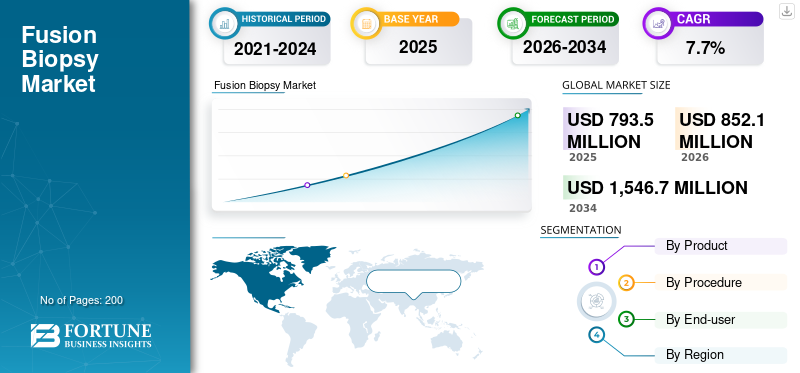
Download Free sample to learn more about this report.
Fusion Biopsy Market Key Takeaways
 Market Size & Forecast
- 2025 Market Size: USD 793.5 million
- 2026 Market Size: USD 852.1 million
- 2034 Forecast Market Size: USD 1,546.7 million
- CAGR: 7.7% from 2026–2034
 Market Share
- North America dominated the global fusion biopsy market with a market share of 34.04% in 2025.
- The transperineal segment is projected to expand at a CAGR of 7.9% during the forecast period.
- The diagnostic centers segment is projected to grow at a CAGR of 8.0% during the forecast period.
 Key Regional Highlights
North America
North America captured the dominant share in 2024, valued at USD 250.9 million, and continued to lead the market in 2025 with USD 270.1 million. Also increasing adoption of fusion biopsy systems across healthcare facilities.
Europe
Europe is poised to record a growth rate of 7.7%, the second-highest among all regions, and touch a valuation of USD 250.8 billion by 2026 & increasing demand for advanced diagnostic technologies.
Asia Pacific
The market in Asia Pacific is estimated to reach USD 223.2 million in 2026 and secure the position of the third-largest region in the market & rising awareness of early prostate cancer diagnosis.
U.S.
The U.S. fusion biopsy market is estimated to reach USD 261.6 million in 2026, supported by a well-established healthcare system and widespread utilization of advanced biopsy procedures.
Japan
Japan is expected to contribute significantly to Asia Pacific market growth, driven by increasing adoption of precision diagnostic technologies and a growing focus on early cancer detection.
Read More

MARKET DYNAMICS
MARKET DRIVERS
Rising Incidence of Prostate Cancer to Drive Market Growth
Over the past few years, there has been a significant surge in the incidence of prostate cancer, which has increased the demand for early, accurate, and minimally invasive diagnostic techniques such as the fusion biopsy.
- For instance, in September 2025, the Centers for Disease Control & Prevention (CDC) stated that 5.0% of prostate cancer cases occurred in men aged 45-54, 52.0% in those aged 55-69, and 43.0% in men aged 70 and above in the U.S. in 2022.
Fusion biopsy improves lesion localization and detection rates, which is further spurring its adoption of fusion biopsy systems among hospitals and healthcare facilities. Such a trend is anticipated to drive the global fusion biopsy market growth during the forecast period.
MARKET RESTRAINTS
High Capital Investment to Restrict Market Expansion
Advanced equipment, such as the MRI-ultrasound fusion systems, requires a high capital investment due to advanced imaging platforms, specialized software, and compatible ultrasound devices. This is hampering adoption among hospitals and diagnostic centers in resource-limited countries.
Moreover, several healthcare facilities in low-income countries are using less expensive options, such as TRUS (transrectal ultrasound) biopsy, which is limiting the pace of transition toward premium fusion biopsy technologies, hindering market expansion.
MARKET OPPORTUNITIES
Expansion in Emerging Markets to Offer Lucrative Growth Opportunities
Recently, there has been an expansion of healthcare infrastructure in emerging countries of the Asia Pacific and Latin America, creating significant demand for fusion biopsy systems in the healthcare facilities of these regions.
- For instance, according to data from the National Center for Biotechnology Information (NCBI) in May 2023, the Brazilian government announced plans to enhance healthcare infrastructure and expand access to healthcare services, especially in underserved areas.
Moreover, medical tourism in emerging countries such as Brazil, India, South Korea, and China is growing due to affordable diagnostic rates, which are expected to present lucrative opportunities for key players to expand their product offerings in these countries.
FUSION BIOPSY MARKET TRENDS
Increasing Adoption of AI-enhanced and Fully Automated Fusion Biopsy Platforms to Emerge as a Key Market Trend
Currently, there has been a significant surge in demand for AI-enhanced and fully automated fusion biopsy platforms, as AI algorithms are increasingly used for mpMRI analysis, PI-RADS scoring assistance, and lesion detection, significantly reducing variability in interpretation.
As a result, key players are integrating cloud platforms, automated reporting tools, and real-time 3D mapping to streamline workflow and improve accuracy. Additionally, they are collaborating to enhance the integration of such algorithms into fusion biopsy systems.
- For instance, in September 2024, KOELIS partnered with DeepHealth to integrate AI-powered prostate MRI interpretation into the KOELIS Trinity 3D ultrasound platform, streamlining prostate fusion biopsy and enhancing diagnostic accuracy.
MARKET CHALLENGES
Limited Availability of Trained Professionals to Challenge Market Growth
Radiologists and urologists are required to undergo specialized training to interpret multiparametric MRI (mpMRI) and perform targeted biopsies. Additionally, in regions with limited expertise, the interpretation of mpMRI varies significantly, resulting in inconsistent diagnostic performance.
Moreover, workflow integration between radiology and urology departments remains a challenge, causing delays and inefficiencies. Such issues are hindering the widespread clinical adoption of fusion biopsy, thereby challenging market growth.
Download Free sample to learn more about this report.
Segmentation Analysis
By Product
Increasing Introduction of Fusion Biopsy Equipment to Drive the Segmental Growth
Based on product, the market is classified into equipment and consumables.
To know how our report can help streamline your business, Speak to Analyst
The equipment segment accounted for the largest global fusion biopsy market share in 2025. The growth is attributed to the increasing installation of fusion biopsy equipment for prostate cancer detection in emerging countries. Additionally, the adoption of fully integrated equipment is currently higher in developed nations, further contributing to the segment’s share.
- For instance, Sir HN Reliance Foundation in Mumbai introduced AI-powered MR Fusion Prostate Biopsy equipment, which combines MRI with ultrasound for the precise early detection of prostate cancer, achieving 90.0% accuracy compared to 30.0-40.0% with conventional methods.
Additionally, the consumables segment is expected to grow at a CAGR of 7.8% during the forecast period.
By Procedure
Long-Standing Clinical Adoption Boosted the Transrectal Segment’s Growth
Based on procedure, the market is segmented into transrectal and transperineal.
The transrectal segment accounted for the largest share in 2025. The segment’s growth is attributed to long-standing clinical adoption, a well-established workflow, and the lower complexity of the transrectal procedure compared to the transperineal procedure. Furthermore, the segment is expected to hold a 74.8% share in 2026.
The transperineal segment is projected to grow at a CAGR of 7.9% during the forecast period.
By End-user
Higher Fusion Biopsy Procedures Performed in Hospital Settings Globally Drive the Segment Growth
Based on end-user, the market is segmented into hospitals, diagnostic centers, and others.
In 2025, the global market was dominated by hospitals in terms of end-user. Hospitals serve as the primary centers for prostate cancer diagnosis, offering advanced imaging infrastructure, including MRI, high-end ultrasound systems, and fusion biopsy platforms. These settings handle the highest patient volumes, which is further spurring the adoption of fusion biopsy systems. Furthermore, the segment is set to hold 54.4% share in 2026.
The diagnostic centers segment is projected to grow at a CAGR of 8.0% during the forecast period.
Fusion Biopsy Market Regional Outlook
By geography, the market is categorized into North America, Europe, Asia Pacific, Latin America, and the Middle East & Africa.
North America Fusion Biopsy Market Size, 2025
To get more information on the regional analysis of this market, Download Free sample
North America
North America captured the dominant share in 2024, valued at USD 250.9 million, and continued to lead the market in 2025 with USD 270.1 million. The growth is attributed to the increasing number of prostate biopsy procedures in the region, which is expected to fuel the demand for fusion biopsy systems, as most of the biopsies are being performed with fusion biopsy over traditional procedures. In 2026, the U.S. market is estimated to reach USD 261.6 million. The growth of the U.S. market is due to well-established healthcare infrastructure, contributing higher performance of fusion biopsy in the country.
- For instance, according to data from the National Center for Biotechnology Information (NCBI) as of June 2025, the use of MRI before prostate biopsy increased sharply over time, rising from 0.5% in 2007 to 2.1% in 2012, 16.4% in 2017, and 35.5% in 2022.
Europe & Asia Pacific
Europe and Asia Pacific are likely to experience notable growth during the study period. Europe is poised to record a growth rate of 7.7%, the second-highest among all regions, and touch a valuation of USD 250.8 billion by 2026. This growth is attributed to the presence of major players in countries such as Germany, the U.K., and France. In 2026, the U.K. is expected to record a valuation of USD 52.2 million, Germany USD 59.9 million, and France USD 44.9 million. The market in Asia Pacific is estimated to reach USD 223.2 million in 2026 and secure the position of the third-largest region in the market. Within the region, China and India are both estimated to reach USD 33.6 million and USD 66.6 million, respectively, in 2026.
Latin America and Middle East & Africa
In 2026, the Latin America is expected to witness modest growth and set to reach a valuation of USD 57.8 million. The growth is attributed to increasing awareness of prostate cancer diagnosis in the region. In the Middle East & Africa, the GCC is set to reach a value of USD 17.9 million by 2026.
COMPETITIVE LANDSCAPE
Key Industry Players:
Focus on Innovations and Strategic Initiatives to Strengthen the Position of Industry Participants
In 2025, major players such as GE HealthCare, KOELIS, and Koninklijke Philips N.V., accounted for the largest global fusion biopsy market share. The share is attributed to the focus of these players on innovations and other strategic initiatives, including partnerships, acquisitions, and collaborations.
Other prominent companies, such as BiopSee and Focal Healthcare, are focusing on increasing product supply to emerging countries, which is expected to help them gain a significant market share.
LIST OF KEY FUSION BIOPSY MARKET COMPANIES PROFILED:
- KOELIS (France)
- Koninklijke Philips N.V. (Netherlands)
- BiopSee (Germany)
- Focal Healthcare (Canada)
- GE HealthCare (U.S.)
- Exact Imaging (Canada)
- Biobot Surgical (Singapore)
- UC-Care Medical Systems (Israel)
- Eigen Health (U.S.)
KEY INDUSTRY DEVELOPMENTS
- January 2025: Biobot Surgical’s “Mona Lisa 2.0” robotic system received CE certification for prostate biopsy and ablation in Europe. The system supports precise targeting and flexibility in prostate biopsies and ablations.
- March 2024: GE HealthCare introduced “Prostate Volume Assist” (PVA), an AI-enabled software feature aimed at prostate imaging or biopsy workflows.
- April 2023: FUJIFILM Corporation launched the “ARIETTA 65 IntuitiveFusion” MRI-US fusion prostate biopsy system in partnership with MedCom GmbH/BiopSee software in Japan.
- February 2022: KOELIS introduced innovative products at the American Urological Association meeting, including ProMap-FT for focal cryoablation guidance, single-use transperineal biopsy grids (Perine Grids), and ProMap Lite MRI processing software, which enhances their Trinity MRI-US fusion platform.
- September 2022: FUJIFILM Corporation launched the Arietta 65 IntuitiveFusion, a compact ultrasound system with dedicated MRI-US fusion imaging for targeted prostate biopsies, enhancing cancer detection capabilities.
REPORT COVERAGE
The global fusion biopsy market encompasses a detailed analysis of the market, including all segments. It encompasses market dynamics, including market drivers, trends, opportunities, challenges, and restraints. The report also provides key insights, including new product launches and significant industry developments, such as partnerships, mergers, and acquisitions. Additionally, the report provides a detailed profile of key players operating in the market, along with an analysis of their market share.
Request for Customization to gain extensive market insights.
Report Scope & Segmentation
| ATTRIBUTE | DETAILS |
| Study Period | 2021-2034 |
| Base Year | 2025 |
| Forecast Period | 2026-2034 |
| Historical Period | 2021-2024 |
| Growth Rate | CAGR of 7.7% from 2026-2034 |
| Unit | Value (USD Million) |
| Segmentation |
By Product
By Procedure
By End-user
By Geography
|
Frequently Asked Questions
Fortune Business Insights says that the global market value stood at USD 793.5 million in 2025 and is projected to reach USD 1,546.7 million by 2034.
In 2025, the market value stood at USD 270.1 million.
The market is expected to exhibit a CAGR of 7.7% during the forecast period (2026-2034).
The equipment segment led the market by product.
The key factors driving the market are the increasing incidence of prostate cancer and the increasing demand for early diagnosis of such conditions.
GE HealthCare, KOELIS, and Koninklijke Philips N.V. are some of the prominent players in the market.
North America dominated the market in 2025.



- 2021-2034
- 2025
- 2021-2024
- 200
Get 30-60 hrs Free Customization
Expand Regional and Country Coverage, Segments Analysis, Company Profiles, Competitive Benchmarking, and End-user Insights.













.webp)






Related Reports
-
US +1 833 909 2966 ( Toll Free )
-
Get In Touch With Us