Generative AI Chatbot Market Size, Share & Industry Analysis, By Deployment (On-premise and Cloud), By Technology (Natural Language Processing, Machine Learning and Deep Learning, Automatic Speech Recognition, and Others), By Business Function (Sales & Marketing, Supply Chain & Operations, Finance & Accounting, Human Resource, and IT Service Management), By Industry (BFSI, IT & Telecom, Retail & e-Commerce, Healthcare, Government & Public Sector, Media & Entertainment, Education, and Others), and Regional Forecast, 2026-2034
 Download Free Sample
KEY MARKET INSIGHTS
 Listen to Audio Version
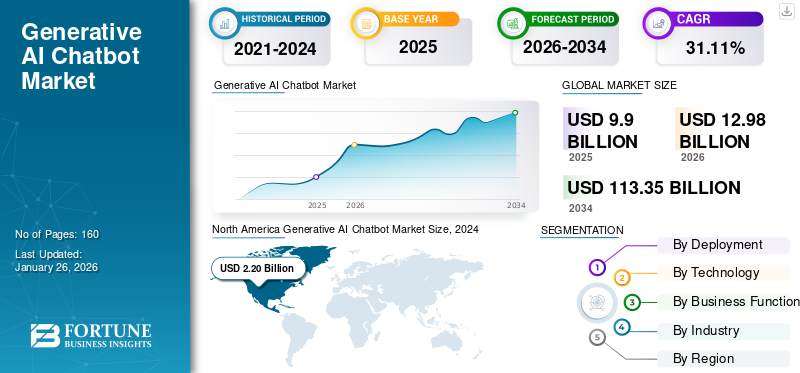
The global generative AI chatbot market size was valued at USD 9.9 billion in 2025 and is projected to grow from USD 12.98 billion in 2026 to USD 113.35 billion by 2034, exhibiting a CAGR of 31.11% during the forecast period. North America dominated the generative AI chatbot market with a share of 28.72% in 2024.
Download Free sample to learn more about this report.
Generative AI Chatbot Market KEY TAKEAWAYS
 Global Market Size & Forecast
- 2025 Market Size: USD 9.9 billion
- 2026 Market Size: USD 12.98 billion
- 2034 Forecast Market Size: USD 113.35 billion
- CAGR: 31.11% from 2026–2034
 Market Share
- North America dominated the generative AI chatbot market with a 28.72% share in 2024.
- Cloud segment is projected to dominate the market during the forecast period.
- Machine learning and deep learning segment dominated the market in 2024.
 Key Regional Highlights
Asia Pacific
Asia Pacific is expected to witness the fastest growth, driven by rapid digitalization and expanding e-commerce adoption.
North America
North America dominated the market, supported by strong AI investments and the presence of leading AI companies.
Europe
Europe is experiencing steady growth, driven by rising adoption of AI-powered customer service.
U.S.
U.S. is projected to witness significant growth, fueled by increasing enterprise adoption of generative AI chatbots.
Japan
Japan is witnessing growing adoption of generative AI, supported by digital transformation and AI innovation.
Read More

The demand for generative AI chatbots is rising sharply across industries due to their ability to deliver intelligent, human like conversational, automate complex customer interactions, and support a wide range of business functions from customer service to HR, healthcare, and finance.
As the digital world is constantly evolving, the adoption of generative chatbots is increasing to enhance customer satisfaction. The idea of providing customer services without human intervention is attracting companies to invest in chatbots, as it reshapes marketing tactics to help businesses streamline processes and manage customer interactions.
- According to a survey by Userlike, around 80% of respondents stated that they had interacted with a chatbot at some point.
- According to industry experts, 68% of users enjoy the speed at which chatbots answer them.
Key players in the market including OpenAI, Google, Microsoft, and Anthropic, among others are adopting multi-pronged growth strategies to scale product adoption, monetize capabilities, and solidify competitive advantage in the rapidly evolving AI landscape.
List of Top Generative AI Chatbots, April 2025
|
Generative AI Chatbot |
Description |
LLMs Used |
Estimated Quarterly User Growth |
|
ChatGPT (excluding Copilot) |
General Purpose AI Chatbot |
GPT-3.5, GPT-4 |
8% |
|
Google Gemini |
General Purpose AI Assistant |
Gemini |
5% |
|
Perplexity |
Accuracy-focused AI Search Engine |
Mistral 7B, Llama 2
|
10%
|
|
Microsoft Copilot |
General Purpose AI Assistant |
GPT-4 |
6% |
|
Deepseek |
General Purpose AI Search Engine |
DeepSeek V3 |
10% |
|
Claude AI |
Business focused AI Assistant |
Claude 3 |
14% |
|
Grok |
General Purpose AI Search Engine |
Grok 2, Grok 3 |
12% |
|
Brave Leo AI |
Privacy focused AI Assistant |
Mixtral 8x7B |
6% |
IMPACT OF RECIPROCAL TARIFF
The impact of the reciprocal tariff on the generative AI chatbot market is significant. Although the generative AI models are largely software based, they depend heavily on hardware, including GPUs, which are traded internationally. Therefore, the reciprocal tariff on hardware components will result in delays and increased costs for setting up chatbot infrastructure. This may also have potential opportunities. For instance, countries affected by tariffs may invest in homegrown AI startups.
GENERATIVE AI CHATBOT MARKET TRENDS
Popularity of Multimodal AI Chatbots to Drive Market Growth
Multimodal AI chatbots are built to understand and respond using more than just text. These bots can process voice inputs, analyze images, and extract key details from documents, making them much more adaptable for real-world business operations. These systems are backed by NLP, computer graphics, and imaging and voice recognition technologies, among others. Multimodal chatbots provide a more natural and intuitive user experience, making interactions feel more human-like and engaging.
Multimodal chatbots can be used to create new revenue streams, such as offering personalized product recommendations or virtual assistance services. Multimodal chatbots can be used to communicate with customers in multiple languages, expanding a business’s reach to new markets. These chatbots represent a significant advancement in AI technology. By combining multiple input modalities, they offer a more natural, engaging, and accessible user experience. Therefore, the popularity of multimodal AI chatbots is driving the generative AI chatbot market share.
MARKET DYNAMICS
MARKET DRIVERS
Growing Demand for Automation in Customer Service is Boosting Market Growth
The growing demand for automation in customer service is driving the market growth. As businesses focus on prioritizing efficiency, cost reduction, and seamless customer experience, the adoption of generative AI chatbots is increasing to automate routine and repetitive interactions.
The adoption of generative AI chatbot helps enterprises reduce wait times, provide customer support 24/7, and scale their customer service operations without a proportional increase in staffing cost. Moreover, chatbots handle thousands of conversations simultaneously, and this improves responsiveness and customer satisfaction. Additionally, it helps human agents focus on more complex and high-value tasks. The surge in investment is propelling the generative AI chatbot market growth. This funding is speeding up the development of advanced language models that drive intelligent chatbots, enabling them to provide human-like, context-sensitive interactions. Therefore, the growing demand for automation in customer service is expected to drive the market share.
MARKET RESTRAINTS
Addressing Ethical Consideration is Hindering Market Growth
Addressing or resolving ethical considerations is a major market development hurdle. During the content-generation process, AI can inadvertently produce inappropriate content. Strong content filtering mechanisms need to be designed to ensure offensive or harmful free content generation that follows ethical regulations and guidelines. Companies and developers must actively work to avert the continuation of biased information in the training data, which will help promote transparency, fairness, and accountability.
MARKET OPPORTUNITIES
Growing Popularity of AI-Powered Analytics to Create New Market Opportunities
AI-powered analytics is a transformative trend in the generative AI chatbots market, which enables businesses to unlock actionable insights from customer interactions. By analyzing vast amounts of data in real time, enterprises can identify patterns, predict behaviors, and deliver hyper-personalized responses. This capability drives efficiency, reduces costs, and improves customer satisfaction across industries such as retail, e-commerce, and healthcare. With the integration of CRM and ERP systems, AI powered chatbots provide a unified view of customer data, enhancing decision-making and operational workflows. Thereby, the growing popularity of AI-powered analytics is expected to create opportunities for players in the market.
SEGMENTATION ANALYSIS
By Deployment
Adoption of Cloud-based Generative AI Chatbot is Increasing Due to its Scalability
Based on deployment, the market is classified into on-premise and cloud.
Among these, cloud dominated the market and is estimated to grow with highest CAGR during the forecast period. Cloud-based generative AI chatbots offer significant benefits to organizations by providing highly scalable, intelligent, and cost-effective conversational interfaces without the need for heavy infrastructure investments. Moreover, cloud-based chatbots are easy to deploy and integrate into enterprise applications such as CRM, ERP, websites, mobile apps, and communication tools (Slack, Teams, WhatsApp). They are continuously updated with the latest model improvements, reducing the burden of maintenance and version management.
On-premise is estimated to grow at a steady rate during the forecast period. On-premise deployments give companies complete ownership of the infrastructure, data, and model behavior, making them especially valuable for highly regulated sectors such as banking, defense, government, and healthcare, where sensitive information must remain within internal networks.
By Technology
Machine Learning to Dominate Due to its Understanding of Human Interaction
Based on technology, the market is classified into natural language processing, machine learning and deep learning, automatic speech recognition, and others.
Among these, machine learning and deep learning dominated the market in 2024. These models enhance AI’s ability to understand and generate human qualities, such as conversation. As per OpenAI, GPT-3 has 175 billion parameters that help to generate coherent and contextually relevant text responses.
Automatic speech recognition is estimated to grow with the highest CAGR during the forecast period. Users prefer voice interactions, as it provides hands-free, and more immersive experience. According to industry experts, around 71% of users utilize voice assistants for their queries.
By Business Function
Adoption of Generative AI Chatbot in Sales & Marketing Drives Sales & Marketing Segment Growth
Based on business function, the market is segmented into sales & marketing, supply chain & operations, finance & accounting, human resource, and IT service management.
Among these, sales & marketing dominated the market in 2024. Generative AI chatbot plays a significant role in the sales & marketing field by helping enterprises analyze increased customer data, enabling them to create tailored marketing strategies and personalized product recommendations. This level of personalization, which was previously unattainable, is now possible due to conversational GenAI. As a result, a 30% increase in sales is anticipated by 2025.
Human resource is estimated to register the highest CAGR during the forecast period. As per industry experts, around 70% of organizations reported that automation of HR processes has led to significant cost reductions, especially in admin functions.
By Industry
Adoption of Generative AI Chatbot in Financial Institutions for Addressing Customer Concerns Drives BFSI Segment Growth
Based on industry, the market is segmented into BFSI, IT & telecom, retail & e-commerce, healthcare, government & public sector, media & entertainment, education, and others.
Among these, BFSI dominated the market in 2024. GenAI chatbots have redefined customer engagement for banks. They serve as proactive tools to address customer inquiries, guide them through complex processes, and even offer financial advice. This level of engagement fosters customer loyalty and trust in the banking institution.
Healthcare is estimated to register the highest CAGR during the forecast period. GenAI chatbot has emerged as an impressive tool for elevating personalized patient engagement and support and is becoming a valuable tool in healthcare, streamlining routine tasks and improving service quality.
GENERATIVE AI CHATBOT MARKET REGIONAL OUTLOOK
By geography, the market is categorized into North America, South America, Europe, the Middle East & Africa, and Asia Pacific.
North America
North America Generative AI Chatbot Market Size, 2025 (USD Billion)
To get more information on the regional analysis of this market, Download Free sample
North America dominates the market with the highest share, owing to the region’s leading role in AI research and development. The region has a major presence of generative AI chatbot companies that are developing cutting-edge generative AI models. Governments and private enterprises in North America are heavily investing in AI as a part of their broader digital transformation strategies. Funding initiatives, tax incentives, and AI research programs support the development and deployment of generative AI technologies across the public and private sectors.
Download Free sample to learn more about this report.
The U.S. is estimated to depict the fastest growth in coming years, owing to the integration of generative AI, which enhances the ability of chatbots to deliver more natural human interactions. As per industry experts, the number of U.S. banking customers using chatbots is estimated to reach 110 million by 2026, as financial institutions are increasingly adopting AI for customer service and transaction handling.
Asia Pacific
Asia Pacific is estimated to grow with the highest CAGR during the forecast period, owing to the increasing digitally connected population. The rapid expansion of the e-commerce industry in the region is majorly driving the demand for generative AI chatbots for efficient customer service. These chatbots enhance the shopping experience by providing real-time assistance, personalized recommendations, and streamlined transaction processes. This region is estimated to account for around 85% of global retail spending on chatbots.
Europe
Europe is expected to witness growth in the coming years as consumers in this region are increasingly attracted to AI-powered customer service. A 2024 survey by industry experts indicated that around 80% of Spanish consumers, 81% of Italians, and 79% of Irish shoppers are willing to communicate with generative AI chatbots for customer service needs.
Middle East & Africa
The Middle East & Africa is estimated to witness significant growth in coming years as governments in this region are actively investing in AI infrastructure. For instance, in May 2025, UAE entered into a partnership with OpenAI to build Stargate UAE, a massive AI data center in Abu Dhabi. This initiative includes providing ChatGPT Plus subscriptions to the entire UAE population.
South America
South America is likely to register a steady growth rate over the forecast period, owing to the increasing adoption of AI technologies among enterprises. Also, enterprises are actively investing in generative AI chatbots.
COMPETITIVE LANDSCAPE
KEY INDUSTRY PLAYERS
Continuous Development and Introduction of New Products by Key Companies Resulted in their Dominating Position
Major market players implement strategies such as partnerships, acquisitions, and mergers. The introduction of innovative solutions has helped companies penetrate the market and obtain a substantial market share. Moreover, to maintain an advantage over other market giants, firms are pouring heavy funds into R&D to design technologically advanced solutions. Acquisitions have also played an important role in helping market leaders deploy state-of-the-art AI models into their existing platforms.
Long Top of Companies Studied
- OpenAI (U.S.)
- Google (U.S.)
- Anthropic (U.S.)
- Microsoft (U.S.)
- Meta (U.S.)
- Amazon (U.S.)
- Salesforce (U.S.)
- Jasper (U.S.)
- Writesonic (U.S.)
- Kuki.ai (U.S.)
- Replika (U.S.)
- AI21 Labs (Israel)
- Avaamo (U.S.)
- Kore.ai (U.S.)
- Cognigy (Germany)
KEY INDUSTRY DEVELOPMENTS
- December 2024: Five9 launched a bi-directional presence feature for its Microsoft Teams integration, enabling Five9 agents and Team users to see each other’s real-time availability.
- November 2024: Cognigy launched Agentic AI into its Cognigy.AI platform to enhance customer service. By integrating with Cognigy’s conversational AI engine and Large Language Models (LLMs), Agentic AI enables orchestration across customer interactions.
- November 2024: Avaamo Launched AutoQA, which is a Gen-AI powered quality assurance solution that will help contact centers evaluate customer interactions. Auto QA evaluates customer interactions across all channels.
- September 2024: Kore.ai launched GALE (Generative AI and LLM Platform for Enterprises), a platform that helps enterprises build GenAI applications to enhance innovation and productivity and derive value from GenAI.
- March 2023: Salesforce announced the launch of Einstein GPT, Generative AI for CRM. It creates personalized content across every Salesforce cloud with generative AI, improving the overall customer experience.
REPORT COVERAGE
The report provides a detailed market analysis. It focuses on key points, such as leading companies, offerings, and applications. Besides this, it offers an understanding of the latest market trends and highlights key industry developments. In addition to the above-mentioned factors, the report contains several factors that have contributed to the growth of the market in recent years.
Request for Customization to gain extensive market insights.
REPORT SCOPE & SEGMENTATION
|
ATTRIBUTE |
DETAILS |
|
Study Period |
2021-2034 |
|
Base Year |
2025 |
|
Estimated Year |
2026 |
|
Forecast Period |
2026-2034 |
|
Historical Period |
2021-2024 |
|
Growth Rate |
CAGR of 31.11% from 2026 to 2034 |
|
Unit |
Value (USD Billion) |
|
Segmentation |
By Deployment
By Technology
By Business Function
By Industry
By Region
|
Frequently Asked Questions
The global generative AI chatbot market size was valued at USD 9.9 billion in 2025 and is projected to grow from USD 12.98 billion in 2026 to USD 113.35 billion by 2034, exhibiting a CAGR of 31.11% during the forecast period.
In 2025, the North American market value stood at USD 2.20 billion.
The market is expected to exhibit a CAGR of 31.11% during the forecast period of 2026-2034.
By technology, machine learning is the leading segment in the market.
Growing demand for automation in customer service is boosting the market growth.
Open AI, Google, Microsoft, Cognigy, Amazon, and Meta are the top players in the market.
North America dominated the market in 2025 by holding the largest share.
Healthcare is estimated to register the highest CAGR during the forecast period.



- 2021-2034
- 2025
- 2021-2024
- 160
Get 30-60 hrs Free Customization
Expand Regional and Country Coverage, Segments Analysis, Company Profiles, Competitive Benchmarking, and End-user Insights.




















Related Reports
-
US +1 833 909 2966 ( Toll Free )
-
Get In Touch With Us