Generative AI in Industrial Design Market Size, Share & Industry Analysis, By Deployment (Cloud & On-premises), By Enterprise Type (Large Enterprises & Small & Medium Enterprises (SMEs)), By Application (Design Concept Generation, CAD Modeling & Automation, Design Optimization, Simulation & Validation, Prototyping & Visualization, Product Customization & Others), By Industry (Automotive, Aerospace & Defense, Consumer Electronics, Industrial Machinery, Healthcare & Medical Devices, Architecture, Engineering & Construction, Furniture & Consumer Goods & Others), & Regional Forecast, 2026 – 2034
 Download Free Sample
GENERATIVE AI IN INDUSTRIAL DESIGN MARKET SIZE AND FUTURE OUTLOOK
 Listen to Audio Version
The generative AI in industrial design market size was valued at USD 1.08 billion in 2025. The market is projected to grow from USD 1.60 billion in 2026 to USD 13.73 billion by 2034, exhibiting a CAGR of 30.8% during the forecast period. North America dominated the generative AI in industrial design market with a market share of 38.88% in 2025.
The market comprises AI-enabled software solutions and associated services used to support the creation, automation, optimization, simulation, visualization, and customization of industrial product designs. The market covers cloud-based and on-premises deployment models adopted by large enterprises and small and medium enterprises. Key applications include design concept generation, CAD modeling and automation, design optimization, simulation and validation, prototyping and visualization, product customization, documentation, compliance checking, and material selection.
The market growth is driven by faster product development cycles, improved design efficiency, cost reduction, automation, and rising adoption across automotive, aerospace, electronics, machinery, healthcare, AEC, and consumer goods industries. Autodesk, Inc., Dassault Systèmes SE, Siemens AG, and Synopsys, Inc. are the top players in the market.
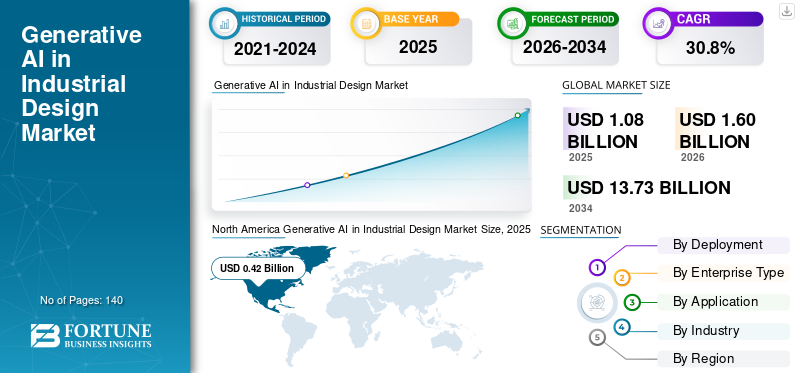
Download Free sample to learn more about this report.
GENERATIVE AI IN INDUSTRIAL DESIGN MARKET KEY TAKEAWAYS
 Global Market Size & Forecast
- 2025 Market Size: USD 1.08 billion
- 2026 Market Size: USD 1.60 billion
- 2034 Forecast Market Size: USD 13.73 billion
- CAGR: 30.8% from 2026–2034
 Market Share
- North America dominated the market with a 38.88% share in 2025.
- The Cloud segment held the largest market share in 2025.
- The Large Enterprises segment held the largest market share in 2025.
 Key Regional Highlights
North America
North America dominated the market in 2025, supported by strong adoption of AI-enabled CAD, simulation, cloud engineering, and design automation across automotive, aerospace, healthcare devices, and industrial machinery.
Europe
Europe held the second-largest share, driven by mature automotive, aerospace, machinery, industrial equipment, and AEC engineering ecosystems across Germany, France, the U.K., Italy, and the Nordics.
Asia Pacific
Asia Pacific projected to grow at the highest CAGR, supported by its large manufacturing base, expanding electronics and automotive industries, and rising digital engineering adoption across China, India, Japan, and South Korea.
U.S.
The market reached USD 0.35 billion in 2025, accounting for roughly 31.9% of global sales.
Japan
The market reached USD 0.05 billion in 2025, accounting for roughly 4.6% of global revenues.
Read More

GENERATIVE AI IN INDUSTRIAL DESIGN MARKET TRENDS
Integration of Generative AI into CAD, Simulation, and Design Automation Workflows to be a Significant Market Trend
Enterprises are increasingly embedding generative AI into CAD, simulation, and design automation platforms to improve the speed and accuracy of industrial design workflows. These solutions use AI systems and machine learning to support real-time design suggestions, automate repetitive tasks, and enable data-driven decision-making during concept development, CAD modeling, validation, and product customization. The trend is gaining traction as manufacturers seek AI-driven design optimization to improve product performance, reduce material usage, and accelerate design iterations. Cloud deployment further supports collaborative and scalable adoption across distributed engineering teams.
- In March 2025, Siemens completed the acquisition of Altair for approximately USD 10 billion to strengthen its AI powered industrial software and simulation portfolio.
MARKET DYNAMICS
MARKET DRIVERS
Download Free sample to learn more about this report.
Growing Need to Reduce Product Development Time and Design Costs to Drive Market Growth
Manufacturers and engineering firms are under increasing pressure to shorten product development cycles while maintaining design quality, performance, and cost efficiency. AI-enabled design tools and machine learning algorithms help automate repetitive tasks, enabling designers to generate multiple design alternatives, optimize product geometry, and validate designs earlier in the workflow. These AI systems support data-driven and AI-driven design optimization, reducing time spent on manual iterations, material selection, prototyping, and engineering reviews. Real-time collaboration through cloud-based platforms further improves coordination between design, simulation, and manufacturing teams across large enterprises and SMEs.
- In July 2025, Ansys launched Ansys 2025 R2 with AI capabilities across seven products to accelerate simulation, improve workflows, and shorten time-to-market.
|
Rank |
Market Drivers |
Overall Impact Rank |
Estimated Gross Market Growth Contribution (USD Billion) |
Impact 2026-2028 |
Impact 2029-2031 |
Impact 2032-2034 |
|
1 |
Rising adoption of AI-enabled CAD, simulation, and design automation tools is increasing demand for faster and more efficient industrial design workflows. |
High |
3.71 |
High |
High |
High |
|
2 |
Growing pressure to reduce product development time, manual design iterations, material wastage, and prototyping costs is accelerating generative AI adoption. |
High |
3.22 |
High |
High |
Medium |
|
3 |
Expansion of cloud-based design platforms is enabling scalable access to AI-driven design optimization, real-time collaboration, and advanced engineering tools. |
High |
2.69 |
High |
High |
High |
|
4 |
Increasing use of generative AI for product customization is supporting faster variant creation across automotive, electronics, healthcare devices, furniture, and consumer goods. |
Medium |
1.99 |
Medium |
High |
High |
|
5 |
Rising integration of machine learning and AI systems into CAD, CAE, PLM, and digital twin platforms is improving data-driven design decision-making. |
Medium |
1.77 |
Medium |
Medium |
High |
|
6 |
Others (adoption across AEC, industrial machinery, medical devices, and SME design teams) are creating additional growth opportunities for AI-enabled design solutions. |
Low |
1.46 |
Medium |
Medium |
Low |
|
|
Total Positive Growth Contribution |
|
14.84 |
|
|
|
MARKET RESTRAINTS
Data Security, IP Protection, and Design Reliability Concerns to Restrain Market Growth
Concerns around proprietary design data, intellectual property protection, model reliability, and output validation may restrain adoption. Industrial design workflows involve sensitive CAD files, product blueprints, material specifications, simulation data, and customer-specific engineering inputs, making companies cautious about using AI systems in cloud environments. Even when machine learning supports real-time recommendations and AI-driven design optimization, outputs must be verified for manufacturability, safety, compliance, and performance. These concerns can slow adoption, especially in aerospace and defense, automotive, healthcare devices, and regulated industrial sectors.
|
Rank |
Market Restraints |
Overall Impact Rank |
Estimated Reduction in Market Size (USD Billion) |
Impact 2026-2028 |
Impact 2029-2031 |
Impact 2032-2034 |
|
1 |
Data security and IP protection concerns may limit the use of cloud AI design tools for sensitive CAD and product data. |
High |
0.93 |
High |
High |
Medium |
|
2 |
Reliability and validation concerns may slow adoption as AI-generated designs require safety, compliance, and manufacturability checks. |
High |
0.75 |
High |
Medium |
Medium |
|
3 |
Integration challenges with CAD, CAE, PLM, and simulation systems may delay enterprise implementation. |
Medium |
0.57 |
High |
Medium |
Low |
|
4 |
Others (skill gaps, high software costs, limited SME awareness, and workflow resistance) may restrict adoption |
Low |
0.46 |
Medium |
Medium |
Low |
|
|
Total Negative Growth Impact |
|
2.71 |
|
|
|
MARKET OPPORTUNITIES
Rising Adoption of AI-enabled Design Tools among SMEs to Create Market Opportunities
Cloud-based generative AI platforms are creating opportunities among SMEs by lowering the need for heavy upfront investment in advanced design software and computing infrastructure. SMEs can use these tools to automate repetitive tasks, support faster concept development, and access data-driven design recommendations without building large in-house engineering technology teams. This is especially useful for product design firms, component manufacturers, AEC companies, furniture makers, and consumer goods brands that need faster design iterations and cost-efficient prototyping. As subscription-based access improves, SMEs are expected to adopt AI-enabled design tools more rapidly.
- In June 2026, PTC introduced a new AI platform, 12 AI agents, 10 integrations, and 100+ enhancements across CAD, PLM, ALM, and SLM solutions.
SEGMENTATION ANALYSIS
By Deployment
Cloud Segment Led Market Owing to Scalable AI Design Workflows
Based on deployment, the market is divided into cloud and on-premises.
In 2025, cloud segment held the largest market share as most generative AI design tools require scalable computing, faster collaboration, and easier integration with cloud-based CAD, simulation, and visualization workflows. It is also expected to grow at the maximum CAGR of 34.2% during the forecast period as SMEs and distributed design teams increasingly prefer subscription-based access without heavy infrastructure investment.
On-premises holds the second-largest market share as large enterprises in aerospace, defense, automotive, and regulated industries still prefer local control over sensitive CAD files, simulation data, and proprietary design IP. However, its growth is slower as cloud security, hybrid deployment, and enterprise SaaS adoption continue improving.
By Enterprise Type
Large Enterprises Segment Led Due to Stronger Capacity for AI Investment
Based on enterprise type, the market is segmented into large enterprises and small & medium enterprises (SMEs).
In 2025, large enterprises segment led the market share as they have higher budgets, mature CAD/PLM ecosystems, larger design teams, and stronger capacity to invest in AI-enabled design automation. These companies also adopt generative AI earlier to reduce engineering cycles, optimize complex products, and improve productivity across global design operations.
Small & Medium Enterprises (SMEs) segment is projected to grow at the highest CAGR of 34.6% during the forecast period as cloud-based tools are reducing entry barriers for advanced design, simulation, and product visualization capabilities. Subscription pricing, easier deployment, and AI-assisted workflows allow smaller firms to access capabilities that were earlier limited to large enterprises.
By Application
CAD Modeling & Automation Segment Led Owing to Core Design Usage
Based on application, the market is classified into design concept generation, CAD modeling & automation, design optimization, simulation & validation, prototyping & visualization, product customization, and others.
In 2025, CAD modeling & automation segment held the largest share of 26.9% in market as CAD is the core workflow in industrial design and product engineering. Generative AI is widely used to automate repetitive modeling tasks, accelerate drawing creation, improve design iterations, and support geometry development across manufacturing industries.
Product customization segment is projected to record maximum CAGR of 34.7% during the forecast period. The growth is supported by companies who are increasingly shifting toward customer-specific, variant-based, and personalized product design. Generative AI enables faster configuration, automated design changes, and scalable customization across consumer goods, medical devices, furniture, automotive components, and electronics.
By Industry
To know how our report can help streamline your business, Speak to Analyst
Automotive Segment Led Due to High Design Complexity
Based on industry, the market is segmented into automotive, aerospace & defense, consumer electronics, industrial machinery, healthcare & medical devices, architecture, engineering, & construction, furniture & consumer goods, and others.
In 2025, the automotive segment held the maximum share of 23.5% in the market. The segment includes high design complexity, large R&D spending, and strong use of CAD, CAE, simulation, and digital engineering tools. Generative AI supports lightweighting, EV component design, interior design, aerodynamic optimization, prototyping, and faster model development.
Healthcare & medical devices segment is expected to grow at the highest CAGR of 34.9% during the forecast period due to rising demand for patient-specific devices, implants, wearables, and ergonomic medical products. Generative AI helps improve design precision, customization, simulation-based validation, and faster development of complex healthcare products.
Generative AI in Industrial Design Market Regional Outlook
By geography, the market is categorized into North America, South America, Asia Pacific, Europe, and the Middle East & Africa.
North America
North America Generative AI in Industrial Design Market Size, 2025 (USD Billion)
To get more information on the regional analysis of this market, Download Free sample
North America holds the largest generative AI in industrial design market share due to strong adoption of AI-enabled CAD, simulation, cloud engineering, and design automation platforms across automotive, aerospace, healthcare devices, and industrial machinery. The region also benefits from the presence of leading software vendors, mature enterprise IT spending, advanced AI talent, and early commercialization of generative design tools, supporting faster enterprise-scale deployment across design workflows.
U.S. Generative AI in Industrial Design Market
The U.S. market was valued at USD 0.35 billion in 2025, accounting for roughly 31.9% of sales.
To know how our report can help streamline your business, Speak to Analyst
Europe
Europe holds the second-largest share due to its strong automotive, aerospace, machinery, industrial equipment, and AEC sectors. Germany, France, the U.K., Italy, and the Nordics have mature engineering ecosystems and established use of CAD, CAE, PLM, and simulation tools.
U.K. Generative AI in Industrial Design Market
The U.K. market was valued at USD 0.04 billion in 2025, accounting for roughly 4.0% of global revenues.
Germany Generative AI in Industrial Design Market
Germany’s market reached USD 0.08 million in 2025, equivalent to around 7.0% of global sales.
Asia Pacific
Asia Pacific is projected to grow at the highest CAGR during the forecast period due to its large manufacturing base, expanding electronics and automotive industries, and rising digital engineering adoption. China, India, Japan, South Korea, and ASEAN are increasing investments in automation, EVs, consumer electronics, and industrial machinery, creating strong demand for AI-enabled design tools to improve speed, cost, and product innovation.
Japan Generative AI in Industrial Design Market
The Japanese market was valued at USD 0.05 billion in 2025, accounting for roughly 4.6% of global revenues.
China Generative AI in Industrial Design Market
China’s market is projected to be one of the largest globally, with 2025 revenues valued at USD 0.09 billion, roughly 8.3% of global sales.
India Generative AI in Industrial Design Market
The Indian market was valued at USD 0.03 billion in 2025, accounting for roughly 3.2% of global revenues.
Middle East & Africa
The Middle East & Africa is expected to grow at the second-highest CAGR due to rising digital transformation initiatives, smart city projects, infrastructure development, and industrial diversification, particularly across GCC countries and Israel. Generative AI adoption is expected to increase in AEC, energy, infrastructure design, and advanced manufacturing as regional enterprises seek faster project design, better visualization, and improved engineering efficiency.
GCC Generative AI in Industrial Design Market
The GCC market reached USD 0.02 billion in 2025, accounting for roughly 2.1% of global revenues.
South America
South America holds a smaller share due to lower enterprise software spending, uneven digital maturity, and slower adoption of advanced CAD, simulation, and AI-enabled design platforms. Growth is mainly concentrated in Brazil and Argentina across automotive, industrial machinery, AEC, and product design. Currency volatility, budget constraints, and dependence on imported software also limit faster regional adoption.
Brazil Generative AI in Industrial Design Market
The Brazilian market was valued at USD 0.03 billion in 2025, accounting for roughly 2.6% of global revenues.
COMPETITIVE LANDSCAPE
Key Industry Players
Key Players Launch AI-enabled Design Solutions to Strengthen Market Positioning
Key players in the generative AI in industrial design market are strengthening their positions by launching AI-enabled design, CAD automation, simulation, and visualization solutions. Companies are integrating generative AI into CAD, CAE, PLM, and digital engineering platforms to support concept generation, geometry optimization, validation, prototyping, and customization. Strategic partnerships, acquisitions, cloud expansion, and AI driven product upgrades are helping vendors address rising demand across automotive, aerospace, electronics, industrial machinery, healthcare devices, AEC, and consumer goods industries.
LIST OF KEY GENERATIVE AI IN INDUSTRIAL DESIGN COMPANIES PROFILED IN REPORT
- Autodesk, Inc. (U.S.)
- Dassault Systèmes SE (France)
- Siemens AG (Germany)
- Synopsys, Inc. (U.S.)
- Cadence Design Systems, Inc. (U.S.)
- Hexagon AB (Sweden)
- PTC Inc. (U.S.)
- Bentley Systems, Incorporated (U.S.)
- NVIDIA Corporation (U.S.)
- The MathWorks, Inc. (U.S.)
KEY INDUSTRY DEVELOPMENTS
- April 2026: PTC launched Windchill AI Assistant within its PLM solution, helping users find, summarize, and analyze product lifecycle data through natural language interactions and faster access.
- October 2025: MathWorks launched MATLAB Copilot for MATLAB and Simulink Release 2025b, supporting coding, debugging, learning, and engineering development workflows for technical users and research teams.
- September 2025: Autodesk announced upcoming 3D generative AI foundation models for Autodesk Fusion and Autodesk Forma, supporting CAD workflows, early design exploration, and geometry generation for industrial applications.
- July 2025: Ansys launched Ansys 2025 R2 with Engineering Copilot, adding AI-driven assistance and AI+ capabilities across simulation and engineering software products.
- May 2025: Cadence launched Cerebrus AI Studio for advanced SoC design implementation, using agentic AI to support multi-block, multi-user design optimization and improve engineering productivity.
- March 2025: Siemens showcased an industrial AI foundation model for engineering workflows, designed to process 3D models, 2D drawings, industrial data, and technical specifications for faster decision-making.
- February 2025: Dassault Systèmes introduced 3D UNIV+RSES with generative AI technologies embedded into IPLM, supporting virtual twins, customer IP protection, and AI-enabled product development collaboration.
REPORT COVERAGE
The generative AI in industrial design market report provides an overview of market size, forecasts, and key segments across deployment, enterprise type, application, industry, and region. It examines market dynamics, emerging trends, technological advancements, and rising adoption of AI-enabled design, CAD automation, simulation, visualization, and product customization solutions. The report highlights major developments, including product launches, partnerships, mergers, acquisitions, and strategic initiatives by leading players. It also includes the competitive landscape, market share analysis, and profiles of top companies operating in the market.
Request for Customization to gain extensive market insights.
REPORT SCOPE & SEGMENTATION
| ATTRIBUTE | DETAILS |
| Study Period | 2021-2034 |
| Base Year | 2025 |
| Estimated Year | 2026 |
| Forecast Period | 2026-2034 |
| Historical Period | 2021-2024 |
| Growth Rate | CAGR of 30.8% from 2026-2034 |
| Unit | Value (USD Billion) |
| Segmentation | By Deployment, By Enterprise Type, By Application, By Industry, and By Region |
| By Deployment |
|
| By Enterprise Type |
|
| By Application |
|
| By Industry |
|
| By Region |
|
Frequently Asked Questions
Fortune Business Insights says that the global market value stood at USD 1.08 billion in 2025 and is projected to reach USD 13.73 billion by 2034.
In 2025, the North America’s market value stood at USD 0.42 billion.
The market is expected to grow at a CAGR of 30.8% over the forecast period.
By industry, the automotive segment led the market.
The market is driven by faster product development, AI-enabled CAD/simulation adoption, and lower design and prototyping costs.
Autodesk, Inc., Dassault Systèmes SE, Siemens AG, and Synopsys, Inc. are the top players in the market.
North America held the largest market share in 2025.
Product adoption is favored by CAD/PLM integration, cloud subscriptions, and improved trust in AI-generated computer aided design.



- 2021-2034
- 2025
- 2021-2024
- 140
Get 30-60 hrs Free Customization
Expand Regional and Country Coverage, Segments Analysis, Company Profiles, Competitive Benchmarking, and End-user Insights.




















Related Reports
-
US +1 833 909 2966 ( Toll Free )
-
Get In Touch With Us