Product Lifecycle Management (PLM) Market Size, Share & Industry Analysis, By Deployment (Cloud and On-Premises), By Enterprise Type (Small and Mid-Sized Enterprises (SMEs) and Large Enterprises), By Industry (Automotive, Aerospace and Defense, Manufacturing, Healthcare, Retail, and Others), and Regional Forecast, 2026-2034
 Download Free Sample
(Offer valid till 30th Sep 2026)

Product Lifecycle Management Market Size and Future Outlook
 Listen to Audio Version
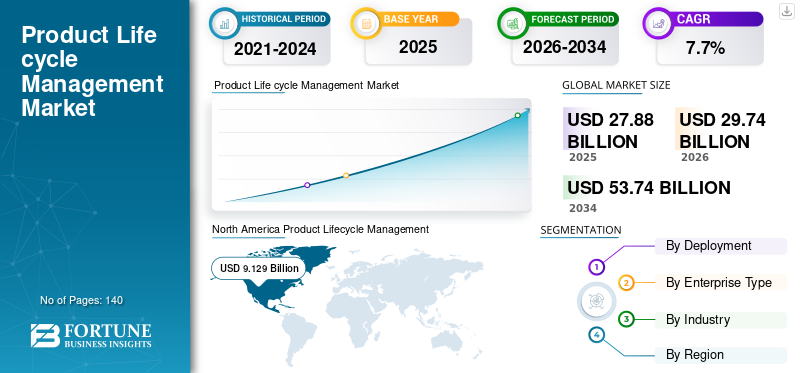
The global Product Lifecycle Management (PLM) market size was valued at USD 27.88 billion in 2025. The market is projected to grow from USD 29.74 billion in 2026 to USD 55.61 billion by 2034, exhibiting a CAGR of 8.10% during the forecast period. North America dominated the Product Lifecycle Management (PLM) market with a market share of 32.74% in 2025.
A Product Lifecycle Management (PLM) solution allows teams from different disciplines and locations to collaborate effectively with partners and customers by using the latest product information. It helps organizations centralize, distribute, automate, and secure product data, thereby regulating the product development process. Additionally, PLM software consolidates business systems, data, personnel, and processes involved in product development.
The implementation of PLM software is being driven by the growth in smart manufacturing, as a result of the adoption of IoT technologies and 3D printing/modeling. Furthermore, the increasing focus on smart products is leading to a rise in demand for cloud-based PLM solutions. Technological trends, such as engineering, Augmented Reality (AR), and additive manufacturing, are expected to fuel the market during the forecast period. These technologies are projected to encourage companies to enhance their PLM solutions with new capabilities, leading to increased demand.
Leading companies such as Dassault Systèmes, Siemens, Autodesk, PTC, and SAP SE are strengthening their market positions through continuous software innovation, cloud platform expansion, AI integration, and industry-specific PLM offerings. These players are focusing on enhancing product design, simulation, lifecycle analytics, collaboration, and compliance capabilities to meet the evolving requirements of global enterprises.
Download Free sample to learn more about this report.
Product Lifecycle Management (PLM) Market Key Takeaways
 Global Market Size & Forecast
- 2025 Market Size: USD 27.88 billion
- 2026 Market Size: USD 29.74 billion
- 2034 Forecast Market Size: USD 55.61 billion
- CAGR: 8.10% from 2026–2034
 Market Share
- North America dominated the Product Lifecycle Management (PLM) market with a 32.74% share in 2025.
- The automotive segment held the largest market share in 2025.
- The cloud deployment segment accounted for the largest market share in 2025.
 Key Regional Highlights
North America
North America dominated the market with a 32.74% share in 2025.
Europe
Europe reached USD 7.63 billion in 2025 and is projected to grow at an 8.0% CAGR.
Asia Pacific
Asia Pacific was valued at USD 6.19 billion in 2025 and is projected to grow at the highest 10.8% CAGR.
U.S
The U.S. PLM market was valued at USD 5.98 billion in 2025.
Japan
The Japan PLM market was valued at USD 1.36 billion in 2025.
Read More

Impact of Generative AI
Deployment of Generative AI across all Product Lifecycle Levels to Address Challenges Boosts Market Growth
The integration of Generative AI is expected to significantly enhance product lifecycle management solutions by improving product design, prototyping, simulation, maintenance, and decision-making. Traditional PLM systems face challenges such as fragmented data, time-consuming processes, limited predictive insights, and inadequate support for innovation. Generative AI helps address these gaps by enabling automated design generation, predictive maintenance, supply chain optimization, customized product variations, and faster virtual prototyping.
Several PLM providers are actively incorporating AI capabilities into their platforms to improve efficiency and innovation. For instance, in February 2026, Dassault Systèmes launched AI-powered virtual companions on its 3DEXPERIENCE platform, while in December 2025, PTC introduced Arena AI Engine and upgraded Onshape with AI-driven features. Such developments indicate that Generative AI is becoming a key growth enabler in the PLM market.
- According to industry experts, Generative AI is expected to contribute to 70% of text and data-driven heavy tasks by 2025, compared to less than 10% in 2023. By 2026, Generative AI competencies are projected to be applied in 50% of PLM solutions, compared to around 5% currently.
Product Lifecycle Management (PLM) Market Trends
Adoption of Digital Twin Technology to Enhance Simulation and Analytics Capabilities Supports Industry Expansion
The integration of digital twin technology is emerging as a key trend in the PLM market, enabling the creation of virtual replicas of physical products using real-time data from connected devices. This allows manufacturers to monitor performance, conduct advanced simulations, and gain deeper insights across the product lifecycle.
Digital twins help optimize product design, predict performance outcomes, and identify potential issues early, reducing development time and costs while accelerating time-to-market. These capabilities also support better decision-making and improved operational efficiency.
- For instance, in January 2026, Siemens launched Digital Twin Composer, a software solution that creates large-scale Industrial Metaverse environments by combining 2D/3D digital twins with real-time physical data using NVIDIA Omniverse. The tool allows companies to simulate, visualize, and optimize products, processes, and factories before physical implementation, improving design cycles, reducing costs, and identifying up to 90% of potential issues.
MARKET DYNAMICS
Market Drivers
Download Free sample to learn more about this report.
Deployment of Industry-Specific PLM Solutions to Boost Market Development
The increasing adoption of industry-specific PLM solutions is driving market growth, as these platforms are tailored to meet the unique requirements of sectors such as automotive, aerospace, healthcare, and consumer goods. These solutions help businesses streamline product development processes, ensure regulatory compliance, and improve operational efficiency. Unlike generic systems, industry-focused PLM platforms offer specialized functionalities that address sector-specific standards, workflows, and sustainability requirements.
The growing emphasis on end-to-end product lifecycle management, from design to disposal, is further accelerating Product Lifecycle Management (PLM) market growth. PLM solutions enable better decision-making by integrating data across functions, supporting innovation, compliance, and sustainability initiatives. Companies are actively adopting advanced PLM platforms to enhance collaboration, improve data accuracy, and optimize workflows. For instance, in February 2026, PTC’s FlexPLM was selected by SPG Company to modernize its licensed product operations with a scalable, cloud-based product lifecycle management platform. The solution replaces SPG’s legacy system, improving data accuracy, workflow efficiency, and cross-functional collaboration, while accelerating product development cycles.
- Moreover, in September 2025, Specright launched a new AI-driven, specification-first PLM solution tailored for the Food & Beverage industry, helping companies manage formulas, ingredients, packaging, and bills of materials. The platform accelerates product development, ensures compliance and sustainability, and improves traceability by centralizing product data and enabling collaboration across teams and suppliers.
Market Restraints
Rising Cybersecurity Concerns to Impede Market Progress
PLM systems store highly sensitive product data, including designs, specifications, and supplier information, making them vulnerable to cyber threats and data breaches. The increasing adoption of cloud-based PLM platforms and integration with enterprise systems further expands the risk of unauthorized access and cyberattacks, especially with growing collaboration across external stakeholders.
Addressing these risks requires robust cybersecurity measures such as encryption, access controls, and continuous monitoring, which increase system complexity and operational costs. This creates adoption challenges, particularly for organizations with limited security capabilities.
- For instance, vulnerabilities identified in platforms such as Oracle Agile PLM highlight the risk of unauthorized access and data compromise, reinforcing cybersecurity concerns as a key barrier to PLM adoption.
Market Opportunities
Rising Applications of PLM Solutions in Medical Devices to Bolster Market Growth
The growing focus on quality control and regulatory compliance is driving the adoption of PLM solutions in the medical devices sector. These solutions help manufacturers improve efficiency, enhance visibility, and accelerate product development timelines. PLM platforms also support critical functions such as risk management, validation, and documentation, enabling smoother transitions from concept to commercialization.
Integration with tools such as CAD further streamlines workflows by reducing data complexity and improving coordination across design, validation, and production stages. This enhances overall productivity and ensures compliance with stringent healthcare regulations.
- For instance, in September 2025, Prodiet Medical Nutrition, a Brazilian clinical nutrition company, implemented Centric PLM from Centric Software to accelerate its product development and innovation processes. The platform replaced manual spreadsheets and improved collaboration, allowing researchers to create new nutritional formulas in minutes instead of days.
Segmentation Analysis
By Industry
Automotive Segment Dominated Owing to Increasing Adoption of Electric Vehicles
Based on industry, the global market is categorized into automotive, aerospace and defense, manufacturing, healthcare, retail, and others.
The automotive segment held the majority share in the PLM market in 2025. It is due to its highly complex product development processes, large-scale production volumes, and strong reliance on continuous innovation. Automakers require advanced PLM solutions to manage intricate design structures, integrate electronics and software, ensure regulatory compliance, and coordinate across global supply chains. The increasing adoption of electric vehicles, autonomous technologies, and connected car systems further intensifies the need for efficient lifecycle management, simulation, and collaboration tools.
To know how our report can help streamline your business, Speak to Analyst
The healthcare segment is projected to showcase the highest CAGR of 11.9% during the forecast period (2026-2034).
By Deployment
Cloud Segment Dominates the Market due to its Flexibility and Scalability
By deployment, the market has been classified into cloud and on-premises.
Cloud deployment holds the majority share in the PLM market due to its flexibility, scalability, and lower upfront costs compared to on-premises solutions. Organizations prefer cloud-based PLM as it enables real-time collaboration across geographically dispersed teams, faster implementation, and easier integration with other enterprise systems. Additionally, reduced IT infrastructure requirements and simplified maintenance make cloud solutions more accessible, especially for companies aiming to streamline operations and improve efficiency.
The cloud segment is projected to showcase the highest CAGR of 9.1% during the forecast period, driven by increasing digital transformation initiatives and the rising demand for remote accessibility and agile workflows. Businesses are shifting toward cloud platforms to support real-time data access, continuous updates, and advanced capabilities such as AI and analytics integration.
By Enterprise Type
Adoption of PLM Software Increased Among Large Enterprises to Enhance Collaboration
By enterprise type, the market is classified into small and mid-sized enterprises (SMEs) and large enterprises.
The large enterprises segment held the major market share in 2025. Large businesses with extensive product offerings benefit from using advanced product lifecycle management solutions to streamline processes, enhance collaboration, and ensure compliance across their global operations. These organizations have the financial means to invest significantly in state-of-the-art PLM solutions, which in turn fosters innovation and helps them maintain a competitive edge.
The SMEs segment is projected to showcase the highest CAGR of 9.3% during the forecast period (2026-2034).
PRODUCT LIFECYCLE MANAGEMENT (PLM) MARKET REGIONAL OUTLOOK
By geography, the market is categorized into Europe, North America, Asia Pacific, South America, and the Middle East & Africa.
North America
North America Product Lifecycle Management (PLM) Market Size, 2025 (USD Billion)
To get more information on the regional analysis of this market, Download Free sample
North America holds the majority share in the PLM market due to the early adoption of advanced digital engineering tools and the strong presence of key PLM vendors such as PTC, Autodesk, and Dassault Systèmes. Industries such as automotive, aerospace & defense, and industrial manufacturing extensively use PLM solutions to manage complex product lifecycles, integrate software and electronics, and enhance cross-functional collaboration. High investment in digital twins, AI integration, and cloud-based PLM platforms further strengthens the region’s leadership.
U.S. Product Lifecycle Management (PLM) Market
Given North America's strong contribution and the U.S.’ dominance in the region, the U.S. market stood at around USD 5.98 billion in 2025, accounting for roughly 21.4% of global sales.
Europe
Europe is projected to grow at a CAGR of 8.0% during the forecast period. The market reached a valuation of USD 7.63 billion in 2025. The growth is driven by its strong automotive and industrial manufacturing base, particularly in Germany, France, and the U.K. Companies in the region focus heavily on engineering precision, sustainability, and regulatory compliance, leading to increased adoption of PLM solutions for product traceability, lifecycle optimization, and environmental compliance. The push toward Industry 4.0 and smart manufacturing is also supporting steady demand for PLM platforms.
U.K. Product Lifecycle Management (PLM) Market
The U.K.’s market in 2025 stood at around USD 1.61 billion, representing roughly 5.7% of global revenues.
Germany Product Lifecycle Management (PLM) Market
Germany's market reached approximately USD 1.74 billion in 2025, equivalent to around 6.2% of global sales.
Asia Pacific
Asia Pacific is projected to grow at a CAGR of 10.8% over the forecast period, the highest among all regions. The market reached a valuation of USD 6.19 billion in 2025, driven by rapid expansion in the automotive, electronics, and heavy manufacturing industries across China, Japan, South Korea, and India. Increasing adoption of smart manufacturing, digital engineering, and cloud-based PLM solutions is enabling companies to improve design efficiency and reduce time-to-market. The presence of large-scale OEMs and growing investments in industrial automation are key factors accelerating PLM adoption in the region.
Japan Product Lifecycle Management (PLM) Market
The Japanese market in 2025 stood at around USD 1.36 billion, accounting for roughly 4.8% of global revenues.
China Product Lifecycle Management (PLM) Market
China's market is projected to be one of the largest worldwide, with 2025 revenues standing at around USD 1.48 billion, representing roughly 5.3% of global sales.
India Product Lifecycle Management (PLM) Market
The Indian market in 2025 stood at around USD 1.09 billion, accounting for roughly 3.9% of the global market.
South America and the Middle East & Africa
The Middle East & Africa reached USD 2.72 billion in 2025, making it the fourth-largest market and emerging as a significant player with the second-highest CAGR. The growth in the region is driven by growing industrialization, infrastructure development, and increasing focus on digital transformation. Adoption is rising in sectors such as energy, construction, and industrial equipment, where organizations are leveraging PLM tools to improve project lifecycle management, collaboration, and operational efficiency.
South America is expected to grow at a notable CAGR in the PLM market, supported by the expansion of manufacturing and industrial sectors in countries such as Brazil and Argentina. Companies are increasingly adopting PLM solutions to improve product design efficiency, enhance lifecycle visibility, and support digital transformation initiatives, although adoption remains at a developing stage compared to other regions.
GCC Product Lifecycle Management (PLM) Market
The GCC market reached approximately USD 0.94 billion in 2025, accounting for roughly 3.3% of global revenues.
COMPETITIVE LANDSCAPE
KEY INDUSTRY PLAYERS
Product Enhancements and Strategic Collaborations to Become Prominent Strategies among Key Market Players to Increase Profitability
The global market is competitive, with the presence of prominent players, such as Autodesk, Siemens, Rockwell Automation, and Aegis Software. These players are focusing on offering modernized solutions with the integration of emerging technologies and other software, such as CAD, PDM (Product Data Management), and ERP, while developing tools and fulfilling the changing needs of customers. They are, therefore, increasing their market share by investing in projects, introducing new products in the market, and forming various partnerships.
- For instance, in May 2024, Siemens announced a partnership with Microsoft to offer AI-driven solutions for resistant PLM with Azure. The continued partnership builds on the introduction of the Teamcenter application on Microsoft Teams, which links service teams and frontline factories to the engineering and design teams through Siemens' Teamcenter software for PLM.
List of Key Product Lifecycle Management (PLM) Companies Profiled
- PTC (U.S.)
- Siemens AG (Germany)
- Dassault Systèmes (France)
- Autodesk Inc. (U.S.)
- SAP SE (Germany)
- Oracle Corporation (U.S.)
- ARAS (U.S.)
- Centric Software Inc. (U.S.)
- HCL Technologies Limited (India)
- Infor Inc. (U.S.)
KEY INDUSTRY DEVELOPMENTS
- April 2026: Blykalla selected Aras and its Aras Innovator to support the development of its next-generation small modular nuclear reactors. The platform would act as a central system to manage engineering data, design processes, and lifecycle complexity in a highly regulated environment. This move aims to improve collaboration, traceability, and risk management.
- March 2026: Capgemini agreed to acquire Piterion to strengthen its Product Lifecycle Management (PLM) and industrial digitalization capabilities. Piterion’s expertise in connecting complex manufacturing systems and cloud-based solutions would enhance Capgemini’s AI-driven offerings. The deal aims to help clients improve efficiency, reduce costs, and speed up product development.
- September 2025: AMC Bridge extended its long-term partnership with Aras to support organizations transitioning from traditional PLM systems to broader digital innovation platforms. With over 15 years of collaboration, AMC Bridge provides development, upgrades, testing, and custom solutions for the Aras Innovator system. The partnership aims to improve operational efficiency, collaboration, and innovation in engineering and manufacturing processes.
- September 2025: Data Patterns selected Siemens Digital Industries Software solutions, including Teamcenter and Polarion ALM, to unify its design, development, and manufacturing processes. The move would create a digital thread across operations, helping improve efficiency, enhance product quality, and compliance with strict aerospace standards.
- July 2025: Siemens expanded its NX software portfolio within the Xcelerator PLM suite by introducing AI-driven Design Copilot, immersive mixed-reality collaboration, CAD-integrated fluid and thermal simulation, and enhanced design-for-manufacturing tools. These updates strengthen Siemens’ PLM capabilities, enabling more efficient product design, simulation, and collaboration across the entire product lifecycle.
- July 2025: Bluestar PLM expanded its collaboration with Microsoft to integrate its PLM system directly into Microsoft Dynamics 365. The partnership combines PLM and ERP capabilities to help manufacturers streamline processes across engineering, production, and supply chain operations. This integrated solution aims to improve collaboration, centralize product data, and accelerate digital transformation in the manufacturing industry.
- April 2025: PTC Inc. acquired IncQuery Group to strengthen its capabilities in application lifecycle management (ALM) and systems engineering. IncQuery helps connect hardware and software engineering systems to improve collaboration and product development efficiency. The acquisition will enhance PTC’s ALM and product lifecycle management (PLM) portfolio and support manufacturers in developing higher-quality products faster.
REPORT COVERAGE
The report provides a detailed analysis of the Product Lifecycle Management (PLM) market size and focuses on key aspects, including leading companies, product types, and the leading applications of the product. Besides, it offers insights into the market trends and highlights key industry developments. In addition to the factors above, the market's growth in recent years was driven by several other factors.
Request for Customization to gain extensive market insights.
REPORT SCOPE & SEGMENTATION
| ATTRIBUTE | DETAILS |
| Study Period | 2021-2034 |
| Base Year | 2025 |
| Estimated Year | 2026 |
| Forecast Period | 2026-2034 |
| Historical Period | 2021-2024 |
| Growth Rate | CAGR of 8.10% from 2026 to 2034 |
| Unit | Value (USD Billion) |
| Segmentation | By Deployment, Enterprise Type, Industry, and Region |
| By Deployment |
|
| By Enterprise Type |
|
| By Industry |
|
| By Geography |
|
Frequently Asked Questions
Fortune Business Insights says that the market was valued at USD 27.88 billion in 2025 and is expected to reach a valuation of USD 55.61 billion by 2034.
The market is projected to record a CAGR of 8.10% during the forecast period.
By industry, the automotive segment dominated the market in terms of share in 2025.
Deployment of industry-specific PLM solutions is a key factor driving market growth.
Dassault Systèmes, Siemens, Autodesk, PTC, and SAP SE are the top players in the market.
Asia Pacific is expected to record the highest CAGR.
The healthcare segment is likely to register the highest CAGR of 11.9% during the forecast period.



- 2021-2034
- 2025
- 2021-2024
- 140
-
(Offer valid till 30th Sep 2026)
Get 30-60 hrs Free Customization
Expand Regional and Country Coverage, Segments Analysis, Company Profiles, Competitive Benchmarking, and End-user Insights.




















Related Reports
-
US +1 833 909 2966 ( Toll Free )
-
Get In Touch With Us