Global & U.S. Sleepwear and Loungewear Market Size, Share & Industry Analysis, By Product Type (Sleepwear and Loungewear), By Fabric Type (Cotton, Polyester, Silk, Satin, Fleece, Modal, Blended Fabrics, and Others), By Gender (Women, Men, Youth/Kids, and Others), By Price Positioning (Economy, Mid-Range, Premium, and Luxury), By Distribution Channel (Hypermarkets, Department Stores, Specialty Apparel Stores, Online/E-commerce, and Others), and Regional Forecast, 2026-2034
 Download Free Sample
(Offer valid till 15th Oct 2026)

Global & U.S. Sleepwear and Loungewear Market and Future Outlook
 Listen to Audio Version
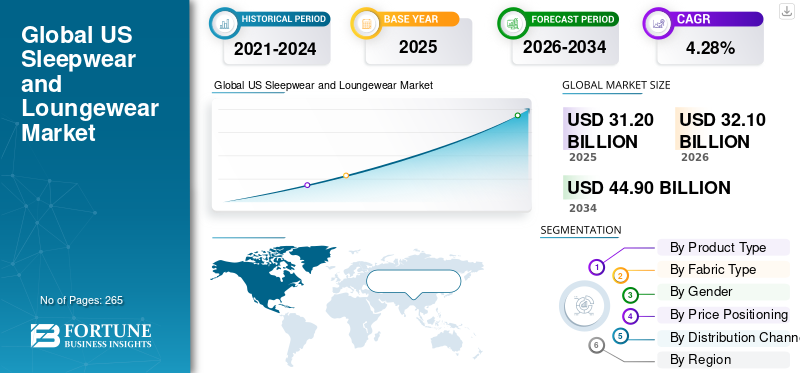
The global & U.S. sleepwear and loungewear market size was valued at USD 31.20 billion in 2025. The market is projected to grow from USD 32.10 billion in 2026 to USD 44.90 billion by 2034, with a CAGR of 4.28% over the forecast period.
The global & U.S. sleepwear and loungewear market is growing steadily, driven by changing consumer behavior centered on comfort, wellness, and hybrid lifestyles. With the continued rise of remote work arrangements, the distinction between homewear and casual wear has become increasingly blurred. The loungewear segment in the U.S. is estimated to expand at mid-single-digit growth rates annually, supported by growing disposable incomes and ongoing premiumization trends. Sustainability is also playing a growing role in shaping consumer demand, with shoppers increasingly preferring organic cotton. In addition, as e-commerce remains a growth driver, contributing to a significant share of total sales, driven by its convenience and availability.
Major players in the market include Ralph Lauren, Victoria’s Secret, Lululemon Athletica, Calvin Klein, and Hanesbrands Inc. These brands compete on product innovation, such as comfort-driven designs and incorporating sustainable, long-lasting fabrics. Market players are also focused on widening their e-commerce platforms and direct-to-consumer channels to fortify their geographic reach. Moreover, limited-edition product launches and strategic collaborations are being increasingly used to attract younger consumer segments and reinforce brand engagement.
Download Free sample to learn more about this report.
Global & U.S. SLEEPWEAR AND LOUNGEWEAR MARKET TRENDS
Rising Demand for Sustainable and Eco-Friendly Sleepwear to Amplify Product Demand
Consumers are increasingly shifting toward eco-friendly, sustainable, and ethical apparel, which is largely driven by increased environmental awareness, changing consumer preferences and behavior, and tightening regulatory forces. This trend is not limited to niche segments and has become mainstream across the global apparel industry, including sleepwear and loungewear. Consumers are showing a preference for clothing made from organic cotton, wool, recycled materials, and bamboo fibers, owing to heightened concerns about climate change and skin sensitivity. In response, companies are also launching certified sustainable product lines and emphasizing their ESG commitments as part of their branding.
MARKET DYNAMICS
MARKET DRIVERS
Download Free sample to learn more about this report.
Increased Demand For Comfortable Clothing to Augment Market Growth
In recent years, there has been a significant rise in hybrid/remote work arrangements, including work-from-home models, leading consumers to spend more time at home. This shift has increased demand for comfortable clothing suitable for extended indoor use. Traditionally, consumers have focused on purchasing sleepwear for nighttime comfort; however, evolving lifestyles have driven demand for multipurpose loungewear suitable for daily activities such as casual outings. The increased demand for comfortable loungewear has prompted brands to develop styles that can be used for various activities. Thus, the loungewear market continues to grow due to shifts in consumer behavior.
MARKET RESTRAINTS
Intense Price Competition and Market Saturation to Hamper Product Adoption
The market in the U.S. faces significant pressure due to intense competition among domestic brands and private-label manufacturers. The widespread availability of similar products has increased price sensitivity among consumers. Thus, established industry players are often required to offer regular promotions to retain their market share. This persistent price competition compresses profit margins, thereby hindering the global & U.S. sleepwear and loungewear market growth.
MARKET OPPORTUNITIES
Increased Demand for Premium Sleepwear to Boost Market Demand
With consumers becoming more wellness-conscious, they are prioritizing various aspects of health, including self-care and sleep quality, leading to an increase in demand for premium sleepwear. As individuals associate sleep with health and wellness, they seek products with features such as moisture-controlling, temperature-regulating, and skin-friendly fabrics to improve sleep cycles and enhance comfort. This transition has led brands to introduce new wellness-based features in sleepwear. Thus, the trend of premium sleepwear has gained traction, helping brands to achieve new revenue streams.
MARKET CHALLENGES
Volatility in Raw Material Costs and Supply Chain Disruptions to Deter Market Growth
Sleepwear and loungewear are made using raw materials such as cotton, silk, polyester, and other synthetic fibers. Fluctuations in the prices of these materials pose a significant challenge for manufacturers, as final product pricing is highly dependent on raw material costs. The ongoing geopolitical war and supply chain disruptions are affecting several industries due to logistics hurdles and labor shortages. Subsequently, manufacturers face challenges maintaining prices and inventory due to disruptions in the global supply chain. This situation is increasing operational complexity but also adversely affecting profit margins for apparel brands.
Segmentation Analysis
By Product Type
Sleepwear Segment Led due to its Essential Everyday Use Across all Consumer Groups
By product type, the market is segmented into sleepwear and loungewear.
The sleepwear segment dominated, accounting for the major market share, owing to its essential everyday use across all consumer groups. Sleepwear represents a daily necessity, ensuring consistent and repetitive demand irrespective of changing fashion trends. As a result, consumers often purchase multiple sets to maintain hygiene and address seasonal needs, thereby increasing overall sales volume. Moreover, the availability of a wide price range, from affordable basics to premium collections, enables brands to cater to diverse consumer segments.
The loungewear segment is anticipated to rise at a CAGR of 4.72% over the forecast period.
To know how our report can help streamline your business, Speak to Analyst
By Fabric Type
Comfort and Breathability Boost the Cotton Fabric Segment Growth
Based on fabric type, the market is divided into cotton, polyester, silk, satin, fleece, modal, blended fabrics, and others.
The cotton fabric segment holds the largest global & U.S. sleepwear and loungewear market share due to its properties, such as breathability, softness, moisture-wicking, superior comfort, and hypoallergenic nature, making it ideal for prolonged wear. Consumers have shifted their preference toward lightweight, skin-friendly fabrics for regular use, and cotton checks all their requirements. In addition, the widespread availability and affordability further uplift high-volume consumption.
The modal fabric segment is anticipated to rise at a CAGR of 5.55% over the forecast period.
By Gender
Product Variety and Higher Purchase Frequency to Boost the Growth of Women's Gender
Based on gender, the market is divided into women, men, youth/kids, and others.
The women segment dominated the market owing to higher engagement in fashion-driven purchases and the availability of a wide product variety. Most brands in the market continuously upgrade and introduce seasonal collections, premium designs, a variety of colors & patterns, and diverse styles. Women also tend to purchase multiple sets for different occasions, such as casual wear, relaxation, and sleep. Moreover, strong brand positioning and the growing influence of social media platforms further strengthen product demand within this segment.
The other segment is anticipated to rise at a CAGR of 5.65% over the forecast period.
By Price Positioning
Mid-Range Segment Led as it Offers Better Fabric Quality and Designs
Based on price positioning, the market is divided into economy, mid-range, premium, and luxury.
The mid-range segment dominated the market, as it offers an optimal balance between quality and affordability. A large share of consumers seeks comfortable yet reasonably priced sleepwear and loungewear, and the mid-range price segment effectively meets this demand. Products in this category typically offer better fabric quality and designs than economy offerings, while remaining accessible to a broad consumer base.
The luxury segment is anticipated to rise at a CAGR of 5.65% over the forecast period.
By Distribution Channel
Extensive Product Choices Boosted Online/E-commerce Segment Growth
Based on distribution channel, the market is segmented into hypermarkets, department stores, specialty apparel stores, online/e-commerce, and others.
The online/e-commerce segment accounted for the largest share of the market, driven by growing preferences for convenient shopping experiences and digital adoption. Online platforms offer extensive product choices, competitive pricing, customer reviews & feedback, multiple payment gateway options, and the benefit of home delivery. Thus, brands are also emphasizing strengthening direct-to-consumer channels, driving higher sales volumes and market share.
The other segment is projected to grow at the second-fastest CAGR of 4.10% during the forecast period.
Global & U.S. Sleepwear and Loungewear Market Regional Outlook
Global
The global market is growing at a CAGR of 4.28% and reached USD 31.20 billion in 2025. The market growth is driven by factors such as the shift toward home-centric, comfort-focused living and evolving consumer lifestyles. Furthermore, growing consumer consciousness around physical and mental well-being and the importance of sleep quality is boosting demand for skin-friendly, functional fabric materials, leading to market expansion. Moreover, rapid urbanization, rising income levels, and consumers' discretionary spending power contribute to market growth.
U.S. Sleepwear and Loungewear Market
The U.S. dominated the North America region, with the U.S. market reaching USD 7.03 billion in 2025, accounting for roughly 22.52% of global sales. The country’s market benefits from a well-established apparel ecosystem, strong distribution network, high consumer spending power, and a consumer base that increasingly prioritizes comfort, wellness, and quality in daily wear. According to data from the U.S. Bureau of Economic Analysis (BEA) and the U.S. Census Bureau, total consumer spending on clothing and footwear in the U.S. reached approximately USD 554 billion in 2024, with per capita spending rising to USD 1,559, reflecting strong purchasing power and a post-pandemic recovery in apparel demand. This high-spending base enables consumers to allocate more of their budget toward non-essential yet comfort-driven categories, including sleepwear and loungewear.
COMPETITIVE LANDSCAPE
Key Industry Players
Key Players Focus on Innovation to Improve Supply Chain Efficiency
The global & U.S. sleepwear and loungewear market is moderately fragmented, with both established apparel brands and new direct-to-consumer brands operating. The leading players in the market are focused on innovating products, particularly in sustainable materials and comfort-based design, to create brand differentiators. Players undertake multiple growth strategies, including mergers, geographic expansion, and partnerships, to improve supply chain efficiency and geographic reach.
LIST OF KEY GLOBAL & U.S. SLEEPWEAR and LOUNGEWEAR COMPANIES PROFILED
- Triumph Intertrade AG. (U.S.)
- PVH Corp (U.S.)
- Jockey International (U.S)
- Adidas AG (U.S.)
- Fruit of the Loom (Canada)
- Urban Outfitters (Japan)
- Hanesbrands (Switzerland)
- American Eagle Outfitters Inc. (Canada)
- L Brands (China)
- Authentic Brands Group LLC (China)
KEY INDUSTRY DEVELOPMENTS
- November 2025: Jockey International launched the “Take It Outside” collection, expanding its loungewear and athleisure portfolio to support multi-functional, all-day comfort. This initiative reflects Jockey’s strategic shift from traditional sleepwear toward versatile loungewear that transitions across indoor and outdoor environments. The collection is designed for modern consumers who move fluidly between home, work, and social settings, emphasizing adaptability in apparel usage.
- September 2025: PVH Corp. introduced the Calvin Klein “Icon Cotton Modal” collection, featuring improved comfort, breathability, and seamless construction. This launch is strategically significant for sleepwear and loungewear since it emphasizes modal-based fabrics, which are widely used in premium sleepwear due to their softness, moisture absorption, and temperature regulation properties. The collection incorporates stitch-free waistbands and bonded construction, improving wearability and reducing irritation, key requirements in nightwear and lounge apparel.
- February 2025: Adidas AG introduced the “A-Type” premium line under Adidas Originals, expanding high-end lifestyle and lounge-oriented apparel offerings. The launch of the A-Type premium line marks Adidas’ strategic move into elevated lifestyle and premium loungewear segments, aligning with increasing consumer demand for high-quality, fashion-forward comfortwear.
- March 2024: Hanesbrands launched an expanded “Hanes Originals” collection featuring new SuperSoft fabric innovations targeted at loungewear and everyday comfort apparel. This initiative reflects Hanesbrands’ strategic focus on comfort-driven apparel, which directly overlaps with sleepwear and loungewear demand.
- January 2024: Triumph International expanded its retail presence in India with a new franchise store in Hyderabad, incorporating an extended range of sleepwear and loungewear products designed for multifunctional use. This initiative reflects the company’s strategic focus on positioning loungewear as a lifestyle category rather than purely homewear.
REPORT COVERAGE
The global & U.S. sleepwear and loungewear market analysis includes a comprehensive study of the market & forecast by all the market segments included in the report. This qualitative and quantitative report includes details on the market dynamics and trends expected to drive the market over the forecast period. It provides information on key aspects, including a technologically advanced product portfolio, the regulatory environment, and new launches. Additionally, it details partnerships, mergers & acquisitions, and key industry developments, and their prevalence by key regions. The global market research report also provides a detailed competitive landscape, including market share and profiles of industry players.
Request for Customization to gain extensive market insights.
Report Scope & Segmentation
| ATTRIBUTE | DETAILS |
| Study Period | 2021-2034 |
| Base Year | 2025 |
| Estimated Year | 2026 |
| Forecast Period | 2026-2034 |
| Historical Period | 2021-2024 |
| Growth Rate | CAGR of 4.28% from 2026 to 2034 |
| Unit | Value (USD Billion) |
| Segmentation | By Product Type, Fabric Type, Gender, Price Positioning, Distribution Channel, and Region |
| By Product Type |
|
| By Fabric Type |
|
| By Gender |
|
| By Price Positioning |
|
| By Distribution Channel |
|
| By Region |
|
Frequently Asked Questions
According to Fortune Business Insights, the global market estimates USD 32.10 billion in 2026 and is projected to reach USD 44.90 billion by 2034.
In 2025, the market value stood at USD 31.20 billion.
The market is expected to grow at a CAGR of 4.28% over the forecast period.
By product type, the sleepwear segment led the market.
Growing disposable income and premiumization are the key factor driving the market.
Ralph Lauren, Victoria’s Secret, Lululemon Athletica, Calvin Klein, and Hanesbrands Inc. are the major players in the global market.



- 2021-2034
- 2025
- 2021-2024
- 265
-
(Offer valid till 15th Oct 2026)
Get 30-60 hrs Free Customization
Expand Regional and Country Coverage, Segments Analysis, Company Profiles, Competitive Benchmarking, and End-user Insights.



















Related Reports
-
US +1 833 909 2966 ( Toll Free )
-
Get In Touch With Us